Understanding Your New Build Home’s Carbon Footprint
New build homes are widely marketed as the green choice for UK homebuyers, and for good reason. Built to modern Building Regulations and EPC standards, they use significantly less energy than the average existing UK property. But how green is a new build home really? The answer depends on understanding two very different types of carbon emissions — and being honest about both.
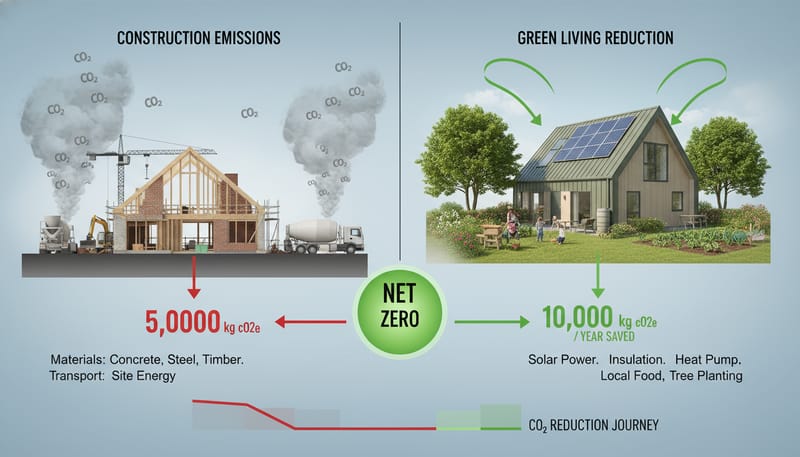
Every home has a carbon footprint: the total greenhouse gas emissions associated with it, measured in tonnes of CO2 equivalent (tCO2e). For a new build, this footprint comes from two distinct sources. Operational carbon is the ongoing emissions from heating, hot water, lighting, and running appliances once you move in. Embodied carbon is the one-off emissions from extracting, manufacturing, transporting, and assembling the building materials used to construct the home.
This guide breaks down the full carbon picture for UK new build homes, comparing them honestly against older housing stock, examining where emissions actually come from, and showing how the Future Homes Standard and renewable energy technologies are driving new builds towards genuine net zero.
These headline figures tell a compelling story, but the full picture is more nuanced. Let us dig into the detail.
Operational Carbon vs Embodied Carbon
The distinction between operational and embodied carbon is fundamental to understanding how green your new build really is. For decades, building regulations focused almost exclusively on operational carbon — reducing the energy needed to heat and run a home. This has been enormously successful: a new build constructed to 2022 Building Regulations produces around 31% less operational CO2 than one built to the 2013 standard, and roughly 75% less than a typical 1970s house.
What Is Operational Carbon?
Operational carbon encompasses all the CO2 emissions produced by running your home on a day-to-day basis. This includes:
- Space heating: The largest component, typically accounting for 55–65% of a home’s operational carbon. Determined by insulation quality, heating system efficiency, and the carbon intensity of the fuel used (gas, electricity, or renewable).
- Hot water: Accounts for 15–25% of operational carbon. Heavily influenced by cylinder insulation, boiler efficiency, and household size.
- Lighting and appliances: Typically 15–20% of operational carbon. New builds with 100% LED lighting and efficient fixed appliances score well here.
- Cooking: A smaller component (3–5%) but increasingly relevant as homes switch from gas hobs to electric induction.
What Is Embodied Carbon?
Embodied carbon is the total CO2 emitted during the construction of the home — before anyone moves in. This includes raw material extraction, manufacturing of products like cement, bricks, and insulation, transportation of materials to site, and the construction process itself. For a typical 3-bedroom new build, embodied carbon ranges from 50 to 80 tonnes of CO2.
Here is the critical insight: as operational carbon decreases thanks to better building standards and renewable energy, embodied carbon becomes a proportionally larger share of a home’s total lifecycle footprint. For homes built to the Future Homes Standard (from 2025), embodied carbon could represent 60–80% of total lifecycle emissions over a 60-year building lifespan.
CO2 Emissions by Home Type: How New Builds Compare
To put new build carbon performance in context, here is a comparison of annual operational CO2 emissions across different property types and ages. These figures are based on SAP calculations and real-world monitoring data from the Energy Saving Trust and the Building Research Establishment.
Based on a 3-bed semi-detached home. Figures represent annual operational CO2 emissions only (excludes embodied carbon). Data sources: BRE, Energy Saving Trust, SAP 10.2 methodology.
The difference is stark. A typical B-rated new build produces 44% less operational CO2 than the average UK home, and a new build with a heat pump and solar panels can reduce that figure by a further 72%, down to just 0.5 tonnes per year.
Annual CO2 Emissions by EPC Rating
| EPC Rating | Annual CO2 (tCO2e) | Annual Energy Cost | Typical Property |
|---|---|---|---|
| A (92–100) | 0.5–1.0 | £400–£600 | Net zero or near-zero carbon new build with renewables |
| B (81–91) | 1.5–2.0 | £650–£800 | Modern new build (post-2021) with gas boiler |
| C (69–80) | 2.0–2.8 | £800–£1,100 | New build (2013–2021) or well-insulated older home |
| D (55–68) | 2.8–3.5 | £1,100–£1,500 | Average UK home — 1980s–2000s construction |
| E (39–54) | 3.5–4.5 | £1,500–£2,000 | Older home with partial insulation |
| F/G (1–38) | 4.5–6.0+ | £2,000–£3,000+ | Unimproved pre-war or listed property |
Where Does the Carbon Come From? A Full Breakdown
Understanding where your home’s carbon emissions originate is the first step towards reducing them. The breakdown differs significantly between a gas-heated new build and one with a heat pump, because the carbon intensity of the fuel source varies dramatically.
Total: 1.80 tCO2e per year. Based on SAP 10.2 carbon factors. Gas: 0.210 kgCO2e per kWh; Electricity: 0.136 kgCO2e per kWh (2024 grid average).
Space heating dominates the carbon footprint of a gas-heated new build, accounting for nearly 60% of total operational emissions. This is precisely why the Future Homes Standard will effectively ban gas boilers in new homes from 2025 — replacing gas with an electric heat pump dramatically reduces the carbon intensity of heating, because the UK electricity grid is rapidly decarbonising.
How the Electricity Grid Is Getting Greener
The carbon intensity of UK electricity has fallen dramatically over the past decade. In 2012, grid electricity produced 0.53 kgCO2e per kWh. By 2024, this had dropped to approximately 0.136 kgCO2e per kWh — a 74% reduction driven by the growth of wind, solar, and nuclear power. The government targets a fully decarbonised grid by 2035.
This means electric heating systems like heat pumps become greener every year automatically, without the homeowner doing anything. A heat pump installed today will produce less carbon next year simply because the electricity powering it is becoming cleaner. By contrast, a gas boiler will always produce the same emissions per unit of heat, regardless of changes to the energy system.
The Carbon Cost of Construction
While operational carbon gets the headlines, the embodied carbon from construction is a substantial — and often overlooked — component of a new build home’s total footprint. Building a typical 3-bedroom semi-detached house generates between 50 and 80 tonnes of CO2, depending on the construction method and materials used.
Embodied Carbon by Building Element
| Building Element | % of Total Embodied Carbon | Typical CO2 (tonnes) | Key Materials |
|---|---|---|---|
| Substructure (foundations) | 15–20% | 8–16 | Concrete, steel reinforcement |
| Superstructure (walls, floors, roof) | 35–45% | 18–36 | Bricks, blocks, timber, steel, concrete |
| Internal finishes | 10–15% | 5–12 | Plasterboard, paints, flooring, tiles |
| Building services (M&E) | 8–12% | 4–10 | Copper pipework, steel radiators, wiring |
| Windows and doors | 5–8% | 3–6 | PVC, aluminium, glass |
| External works | 5–10% | 3–8 | Paving, fencing, drainage |
The superstructure — the main walls, floors, and roof — accounts for the largest share of embodied carbon. This is where material choices make the biggest difference. A timber-frame home can reduce superstructure embodied carbon by 40–60% compared to traditional masonry, while also storing carbon within the timber structure itself.
Construction vs Operation: The Shifting Balance
As building regulations push operational emissions down, the balance between embodied and operational carbon is shifting dramatically:
- Pre-2006 building regulations: Embodied carbon represented approximately 20–30% of a home’s total 60-year lifecycle emissions. Operational carbon dominated.
- 2013 building regulations: Embodied carbon rose to approximately 30–40% of lifecycle emissions as insulation and heating efficiency improved.
- 2022 building regulations: Embodied carbon now accounts for 40–55% of lifecycle emissions for a typical new build.
- Future Homes Standard (2025): With operational emissions cut by 75–80%, embodied carbon could represent 60–80% of total lifecycle emissions.
This shift is driving the industry to address embodied carbon with the same rigour it has applied to operational emissions. Some developers, such as Berkeley Group and Barratt Developments, have begun measuring and targeting embodied carbon reductions in their sustainability strategies.
Lifecycle Carbon Analysis: A 60-Year View
To make a fair comparison between a new build and an older home, we need to look at the full lifecycle carbon — embodied carbon plus 60 years of operational emissions. This gives the complete picture that headline figures often miss.
60-Year Lifecycle Carbon Comparison
| Home Type | Embodied Carbon (tCO2e) | Annual Operational (tCO2e) | 60-Year Operational (tCO2e) | Total Lifecycle (tCO2e) |
|---|---|---|---|---|
| New build (EPC A, heat pump + solar) | 55–70 | 0.5 | 30 | 85–100 |
| New build (EPC B, gas boiler) | 55–75 | 1.8 | 108 | 163–183 |
| Retrofitted older home (EPC C) | 5–15 (retrofit only) | 2.5 | 150 | 155–165 |
| Average UK home (EPC D, no improvements) | 0 (already built) | 3.2 | 192 | 192 |
| Poor efficiency home (EPC E/F) | 0 (already built) | 4.5 | 270 | 270 |
The lifecycle analysis reveals some interesting findings. A new build with a heat pump and solar panels has the lowest total lifecycle carbon (85–100 tonnes over 60 years), even when the substantial embodied carbon from construction is included. A standard B-rated new build with a gas boiler has a higher lifecycle footprint than you might expect, because 60 years of gas heating accumulates significant operational carbon.
Perhaps the most thought-provoking comparison is between a new B-rated gas-heated home (163–183 tCO2e lifecycle) and a retrofitted older home achieving EPC C (155–165 tCO2e). The retrofitted home can actually have a lower lifecycle footprint because the embodied carbon of the original construction is a “sunk cost” — it has already been emitted. This is why some environmental commentators argue that retrofitting existing homes can be more carbon-efficient than building new, depending on the specification.
However, new builds with heat pumps and renewables convincingly win the lifecycle comparison, producing the lowest total emissions of any option. As the Future Homes Standard makes heat pumps standard from 2025, new builds will increasingly offer the lowest lifecycle carbon of any housing option.
How to Reduce Your New Build’s Carbon Footprint
Whether you are buying a new build or have recently moved in, there are practical steps you can take to minimise your home’s carbon footprint. Some are available at the point of purchase through developer upgrade packages, while others can be implemented after you move in.
At the Point of Purchase
- Choose a home with a heat pump: If your developer offers an air source heat pump as the primary heating system, this single choice can reduce operational carbon by 60–75% compared to a gas boiler.
- Add solar PV panels: A 4kW solar panel system can generate 3,400–4,200 kWh of electricity per year, offsetting approximately 0.5 tonnes of CO2 annually from grid electricity consumption.
- Opt for battery storage: A home battery maximises the use of self-generated solar energy, reducing reliance on grid electricity and further lowering your carbon footprint.
- Upgrade to triple glazing: Triple glazing reduces heat loss through windows by 30–50% compared to standard double glazing, lowering heating demand and associated emissions.
- Choose enhanced insulation: Ask about upgraded insulation packages that exceed the minimum building regulations requirement.
After Moving In
- Switch to a green energy tariff: Choosing a 100% renewable electricity tariff effectively reduces your electrical carbon footprint to zero, as the equivalent amount of green energy is fed into the grid on your behalf.
- Install a smart thermostat: Products like Hive, Nest, or Tado can reduce heating energy by 10–15% through intelligent scheduling with smart home energy management.
- Use time-of-use tariffs: Tariffs like Octopus Agile or Octopus Go charge less during off-peak periods when grid electricity is cleaner (more wind and solar in the mix).
- Reduce hot water temperature: Lowering your combi boiler flow temperature to 55°C improves condensing efficiency and reduces gas consumption by 5–8%.
- Choose efficient appliances: A-rated appliances in your kitchen and laundry use 30–50% less energy than lower-rated models.
- Consider an EV: If you have an EV charger, switching from a petrol car to an electric vehicle can save 1.5–2.5 tonnes of CO2 per year — potentially more than your home’s entire operational footprint.
The Future Homes Standard and the Net Zero Pathway
The Future Homes Standard (FHS) represents the most significant change to building regulations in a generation. When it takes full effect in 2025, all new homes in England will be required to produce 75–80% less CO2 than those built to the 2013 standard.
In practice, this means:
- No more gas boilers: The FHS will effectively end the installation of gas boilers in new homes. Heat pumps (primarily air source heat pumps) will become the standard heating system.
- Enhanced fabric standards: Walls, roofs, and floors will need to achieve even lower U-values, meaning better insulation and reduced heat loss.
- Improved airtightness: Homes will need to meet stricter airtightness targets, supported by mechanical ventilation with heat recovery (MVHR).
- Solar PV likely as standard: While not explicitly mandated, meeting the FHS targets will be extremely difficult without on-site renewable generation.
- EPC A ratings: Homes built to the FHS are expected to achieve EPC A ratings as standard, with annual CO2 emissions of around 0.5–1.0 tonnes.
What Does Net Zero Mean for a Home?
A net zero home is one that produces no more CO2 over the course of a year than it generates from on-site renewable energy. In practice, this means a highly insulated, airtight home with a heat pump, solar panels, and potentially battery storage that generates as much clean energy as the home consumes.
True net zero also requires addressing embodied carbon. Some leading developers are now committing to net zero including embodied carbon, through a combination of low-carbon building materials, efficient construction methods, and verified carbon offsetting for any residual emissions.
Carbon Offsetting
Where residual emissions cannot be eliminated through design and technology, some developers and homeowners turn to carbon offsetting — paying to fund projects that reduce or absorb CO2 elsewhere, such as tree planting or renewable energy projects in developing countries. While offsetting has a role to play, it should be considered a last resort after all practical emission reductions have been made. The most credible offsets are verified by schemes such as the Gold Standard or Verified Carbon Standard, and are additional (meaning the CO2 reductions would not have happened without the offset funding).
Frequently Asked Questions
What is the average carbon footprint of a new build home in the UK?
A typical new build home with an EPC B rating produces approximately 1.8 tonnes of CO2 per year in operational emissions. This is 44% lower than the average UK home (3.2 tonnes). Homes built to the upcoming Future Homes Standard will produce just 0.5–1.0 tonnes per year. In addition to operational carbon, the construction of a new build generates 50–80 tonnes of embodied carbon.
Is a new build really greener than an older home?
In operational terms, yes — significantly so. A new build uses 40–55% less energy than the average UK home. However, when embodied carbon from construction is included, the picture is more nuanced. A new build with a heat pump and solar panels has the lowest total lifecycle carbon of any housing option. A standard gas-heated new build has a lifecycle footprint comparable to a well-retrofitted older home. The key factor is the heating system: heat pump homes are substantially greener than gas-heated ones over their full lifecycle.
How much CO2 will the Future Homes Standard save?
The Future Homes Standard targets a 75–80% reduction in CO2 emissions compared to the 2013 building regulations. For a typical 3-bedroom home, this means annual operational emissions of around 0.5–1.0 tCO2e, compared to approximately 2.5 tCO2e under the 2013 standard. Over a 60-year lifecycle, a Future Homes Standard home could save 90–120 tonnes of operational CO2 compared to its 2013 equivalent.
Can I make my new build home carbon neutral?
It is increasingly feasible. A combination of solar panels, a heat pump, battery storage, a green energy tariff, and a smart energy management system can reduce operational carbon close to zero. For any residual emissions (and for embodied carbon), verified carbon offsets can bridge the gap. Some green mortgage products also include carbon offset schemes as part of the deal.
Does the type of heating system really make that much difference?
Yes, it is the single most important factor in a home’s operational carbon footprint. A gas boiler produces approximately 0.210 kgCO2e per kWh of heat. An air source heat pump using grid electricity produces approximately 0.045 kgCO2e per kWh of heat (based on a COP of 3.0 and 2024 grid carbon intensity). That is a 79% reduction in carbon per unit of heat delivered — and the gap widens every year as the grid decarbonises.
The Full Carbon Picture: Making an Informed Choice
New build homes are significantly greener than the average UK property in operational terms, producing 44% less CO2 each year. For buyers who choose homes with heat pumps and solar panels, the annual carbon footprint can drop to just 0.5 tonnes — less than a quarter of a return flight from London to New York.
The embodied carbon from construction is a real and substantial part of the equation, adding 50–80 tonnes of CO2 that operational savings take decades to recoup. However, the industry is actively addressing this through sustainable building materials, modern methods of construction, and whole-life carbon assessment. As the Future Homes Standard drives operational emissions towards near-zero, expect embodied carbon regulation to follow.
When choosing a new build, ask about the EPC rating, heating system, renewable energy options, and the developer’s sustainability commitments. A home with a heat pump, solar panels, and good insulation will not only have the lowest running costs but also the smallest environmental footprint over its full lifecycle. For the most comprehensive approach to reducing your impact, explore our guides to net zero homes and water efficiency to understand the complete sustainability picture.