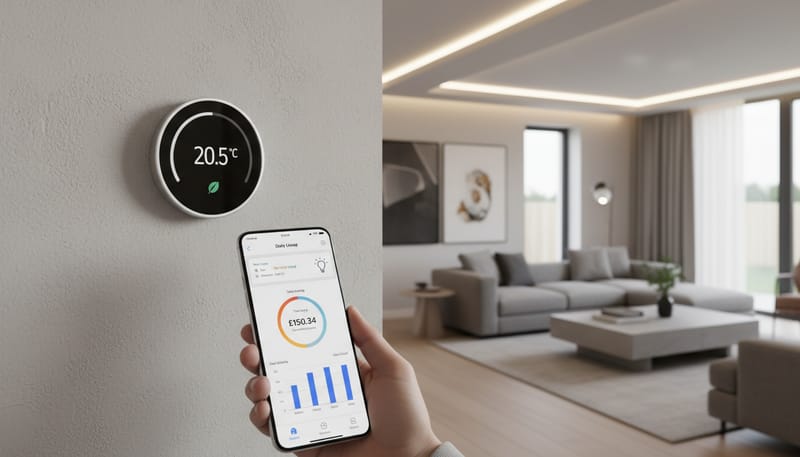
What Is Smart Home Energy Management?
Smart home energy management refers to the use of connected devices, intelligent controls, and automation to optimise how your home uses energy. Instead of relying on manual timer switches and guesswork, a smart energy system monitors your usage patterns, responds to real-time conditions, and makes adjustments automatically to minimise waste and reduce your energy bills.
For new build homes, smart energy management is increasingly relevant. Modern properties already benefit from excellent insulation, efficient heating systems, and high EPC ratings. Smart technology takes this a step further by ensuring that the energy-efficient features built into your home are used to their full potential. Studies consistently show that smart heating controls alone can reduce energy consumption by 10–25%, translating to annual savings of £80–£250 for a typical new build.
Many UK developers now offer smart home packages as standard or as optional upgrades. Understanding what is available and how it works will help you make informed decisions about which technologies to prioritise.
Smart Thermostats: The Foundation of Energy Management
A smart thermostat is the single most impactful smart home device for reducing energy bills. Unlike a basic programmable thermostat, a smart thermostat learns your habits, responds to your location, adjusts to weather conditions, and can be controlled remotely via a smartphone app. The result is a heating system that runs only when needed and never wastes energy heating an empty home.
Smart Thermostat Comparison
| Feature | Hive Thermostat | Google Nest | Tado° | Drayton Wiser | Honeywell Evohome |
|---|---|---|---|---|---|
| Price (thermostat + install) | £180 – £250 | £200 – £280 | £150 – £220 | £130 – £200 | £250 – £400 |
| Smart TRVs available | Yes (£45–£55 each) | No | Yes (£60–£80 each) | Yes (£40–£55 each) | Yes (£50–£70 each) |
| Geofencing | Yes | Yes | Yes (advanced) | No | No |
| Learning capability | Basic scheduling | Yes (learns routine) | Yes (weather-aware) | Basic scheduling | Basic scheduling |
| Multi-zone control | Yes (with TRVs) | Limited | Yes (with TRVs) | Yes (with TRVs) | Yes (up to 12 zones) |
| Voice assistant | Alexa, Google | Google only | Alexa, Google, Siri | Alexa, Google | Alexa, Google |
| Open window detection | No | No | Yes | No | No |
| Energy reports | Monthly | Monthly | Monthly (detailed) | Weekly | Monthly |
| Heat pump compatible | Some models | Yes (Nest E) | Yes | Yes | Yes |
| Estimated annual saving | £80–£130 | £90–£150 | £100–£180 | £80–£120 | £100–£200 |
Key Features Explained
- Geofencing: Uses your phone’s GPS to detect when everyone has left the home, automatically reducing the heating. When you start heading home, it turns the heating back on so the house is warm when you arrive. Tado° offers the most advanced geofencing, tracking multiple household members.
- Learning algorithms: Google Nest learns your daily routine over the first week and creates an optimised schedule automatically. It adjusts as your habits change over time.
- Weather compensation: Tado° integrates with local weather forecasts to pre-heat the home before a cold snap or reduce heating when milder weather is expected.
- Open window detection: Tado° detects sudden temperature drops that indicate an open window and pauses heating in that room to avoid wasting energy.
If your new build has a heat pump, check that the smart thermostat is compatible with heat pump controls. Heat pumps operate most efficiently when they run continuously at lower temperatures rather than cycling on and off, so the thermostat needs to support this “weather compensation” mode.
Zoned Heating and Smart Thermostatic Radiator Valves
Zoned heating means controlling the temperature of different rooms or areas independently, rather than heating the entire house to the same temperature. This is one of the most effective ways to reduce energy waste, as you only heat the rooms you are actually using.
In new build homes, zoned heating can be achieved through:
- Smart thermostatic radiator valves (TRVs): These replace standard manual TRVs on individual radiators and connect wirelessly to a smart thermostat. You can set different temperatures for each room and schedule heating room by room.
- Underfloor heating zone control: Homes with UFH typically have individual room thermostats that control zone valves, allowing different temperatures in different rooms.
- Multi-zone wiring: Some new builds are pre-wired for two or more heating zones (typically upstairs and downstairs), each with its own thermostat and motorised valve.
Smart TRV Cost and Savings
| Brand | Cost Per TRV | Hub Required | Battery Life | Key Feature |
|---|---|---|---|---|
| Tado° Smart TRV | £60 – £80 | Yes (Tado° bridge) | ~2 years | Open window detection; weather-aware |
| Hive Smart TRV | £45 – £55 | Yes (Hive hub) | ~2 years | Integrates with Hive thermostat |
| Drayton Wiser TRV | £40 – £55 | Yes (Wiser hub) | ~2 years | Budget-friendly; good app |
| Honeywell Evohome TRV | £50 – £70 | Yes (Evohome controller) | ~2 years | Up to 12 independent zones |
| Meross Smart TRV | £30 – £45 | Yes (Meross hub) | ~1.5 years | Budget option; Apple HomeKit |
A typical 3-bedroom new build has 6–8 radiators. Fitting smart TRVs to all of them costs £250–£500, with estimated additional savings of £50–£100 per year on top of the smart thermostat savings. The payback period is typically 3–5 years.
Smart Meters, IHDs, and Energy Monitoring Apps
All new build homes in the UK are fitted with smart meters as standard, providing real-time data on your electricity and gas consumption (or just electricity if you have a heat pump). Understanding how to use this data effectively is key to managing your energy costs.
In-Home Displays (IHDs)
Every smart meter comes with an in-home display (IHD), a small screen that shows your current energy usage in real time (measured in kWh and £). While basic, the IHD is a powerful tool for identifying energy-hungry appliances and understanding your consumption patterns. Research from BEIS shows that households with IHDs reduce their energy consumption by an average of 3% simply through greater awareness.
Energy Monitoring Apps and Platforms
Beyond the basic IHD, several apps and devices provide more detailed energy insights:
- Octopus Energy app: If you are on an Octopus tariff, the app shows half-hourly consumption data, cost breakdowns, and tariff comparisons. Essential for time-of-use tariff customers.
- Loop (by Trustpower): Free app that connects to your smart meter and provides personalised energy-saving tips, appliance-level usage estimates, and monthly reports.
- Hildebrand Glow: A device that connects to your smart meter’s Consumer Access Device (CAD) port, providing real-time data to apps like Home Assistant for advanced automation.
- Sense or Emporia Vue: Whole-home energy monitors that clamp onto your consumer unit and provide appliance-level disaggregation, showing exactly what each device costs to run.
- Solar monitoring: If you have solar panels, the inverter app (SolarEdge, GivEnergy, Huawei) shows generation, self-consumption, and export in real time.
Time-of-Use Tariffs: Saving with Smart Timing
Time-of-use (ToU) tariffs charge different rates for electricity depending on when you use it. By shifting your energy-intensive activities to cheaper periods, you can significantly reduce your bills. These tariffs are particularly beneficial for new build homes with heat pumps, batteries, and EV chargers.
Popular Time-of-Use Tariffs
| Tariff | Provider | How It Works | Best For |
|---|---|---|---|
| Octopus Agile | Octopus Energy | Half-hourly variable rates tied to wholesale prices. Rates can go negative (you get paid to use electricity). | Flexible users with battery storage; can shift loads to cheap periods |
| Octopus Go | Octopus Energy | Super-cheap rate (7.5p/kWh) from 00:30–05:30; standard rate rest of day. | EV owners; heat pump pre-heating overnight |
| Intelligent Octopus Go | Octopus Energy | Same as Go but with smart EV charging — extends the cheap period if needed. | EV owners with compatible charger |
| Octopus Cosy | Octopus Energy | Cheap rates during two periods: 04:00–07:00 and 13:00–16:00. | Heat pump homes; charge battery and pre-heat during cheap windows |
| Economy 7 | Various suppliers | Cheaper rate for 7 hours overnight (typically 00:00–07:00). | Homes with storage heaters or hot water cylinders |
Maximising ToU Tariff Savings
The key to saving money on a time-of-use tariff is load shifting — running energy-intensive appliances during cheap periods and minimising consumption during expensive periods. Smart home technology makes this practical:
- Heat pump scheduling: Programme your heat pump to pre-heat the home during cheap rate periods. With good insulation, the home retains this heat for hours.
- Battery charging: If you have battery storage, charge from the grid during cheap overnight rates and discharge during expensive peak periods.
- EV charging: Smart EV chargers automatically charge your car during the cheapest rates, potentially saving £500+ per year versus charging at peak times.
- Washing machines and dishwashers: Use delay-start timers to run these appliances overnight. A smart plug can also automate this.
- Hot water cylinder: If you have a heat pump with a hot water cylinder, schedule the boost cycle during cheap rate periods.
Smart Plugs, Automated Lighting, and Other Savings
Beyond heating controls and energy tariffs, several other smart home technologies contribute to energy savings in new build homes.
Smart Plugs
Smart plugs sit between an appliance and the wall socket, allowing you to control power remotely, set schedules, and monitor energy consumption. Key uses include:
- Eliminating standby power: UK households waste an average of £60–£80 per year on standby power. Smart plugs can turn off entertainment systems, monitors, and chargers when not in use.
- Scheduling: Automate lamps, dehumidifiers, and other devices to run only when needed.
- Energy monitoring: Track how much individual appliances cost to run and identify the biggest energy consumers.
Popular options include TP-Link Tapo (£10–£15), Amazon Smart Plug (£15–£25), and Hive Active Plug (£20–£30).
Automated Lighting
New build homes come with 100% LED lighting as standard, which is already highly efficient. Smart lighting adds further savings through automation:
- Motion sensors: Lights in hallways, bathrooms, and utility rooms turn on when you enter and off when you leave.
- Schedules and scenes: Programme lights to dim in the evening and switch off at bedtime.
- Daylight harvesting: Smart lighting systems can detect ambient light levels and adjust brightness accordingly, reducing electricity use on sunny days.
The energy saving from smart lighting is modest (typically £20–£40 per year in a new build with LEDs already installed) but the convenience and comfort benefits are significant.
Developer Smart Home Packages
Many UK housebuilders now offer pre-installed smart home packages or optional upgrades. These packages typically integrate several smart devices into a single ecosystem, making setup straightforward for buyers.
What Developers Typically Include
| Feature | Typically Included as Standard | Often Available as Upgrade |
|---|---|---|
| Smart meter | Yes (legally required) | N/A |
| Smart thermostat | Many developers (Hive or Nest) | Premium options (Tado°, Evohome) |
| USB sockets | Often in kitchens and bedrooms | Additional locations |
| Cat6 Ethernet wiring | Some developers | Whole-home networking |
| Smart lighting | Rarely as standard | Dimmer switches, smart bulb starter kit |
| Smart speaker | Rarely | Amazon Echo or Google Home starter |
| Security system | Basic alarm often included | Smart cameras, video doorbell |
| EV charger | Cable route provided (legally required) | Full smart charger install |
When evaluating developer upgrades, the smart thermostat and smart TRVs offer the best return on investment for energy saving. Smart lighting and speakers are more about convenience than energy reduction. If you are planning to add smart home technology after moving in, check what wiring and infrastructure the developer has pre-installed — Cat6 Ethernet, speaker cable routes, and smart switch backboxes make future upgrades much easier.
Integration with Solar, Battery, and Heat Pump Systems
The real power of smart energy management emerges when you integrate multiple systems into a coordinated whole. In a new build with solar panels, battery storage, and a heat pump, smart controls can orchestrate these systems to minimise grid electricity consumption and maximise self-sufficiency.
How an Integrated Smart System Works
- Morning (off-peak rates): The heat pump pre-heats the home and hot water cylinder using cheap overnight electricity. The battery charges from the grid at the lowest available rate.
- Daytime (solar generation): Solar panels power the home directly. Excess electricity charges the battery and runs the heat pump if additional heating is needed. Any remaining surplus is exported for Smart Export Guarantee income.
- Evening (peak rates): The battery discharges to power the home, avoiding expensive peak-rate grid electricity. The heat pump uses stored battery power rather than drawing from the grid.
- Night: The system reverts to cheap overnight rates, recharging the battery and pre-heating the hot water cylinder for the next day.
Platforms like GivEnergy, myenergi, and Home Assistant provide the intelligence to coordinate these systems automatically. Some can even predict the next day’s solar generation based on weather forecasts and adjust battery charging schedules accordingly.
For a fully integrated system, typical total savings (combining solar, battery, heat pump, and smart controls on a time-of-use tariff) can reach £1,200–£1,800 per year compared to a standard gas-heated home on a flat-rate tariff. This is the future of home energy management, and new builds are perfectly positioned to benefit.
Frequently Asked Questions
Do I need a smart thermostat if my new build already has a heat pump?
Most heat pumps come with their own controller, but a dedicated smart thermostat (compatible with heat pumps) typically offers better scheduling, geofencing, and app-based control. Check with your developer whether the heat pump controller already includes smart features — some Vaillant and Daikin controllers have built-in Wi-Fi and smart scheduling that may be sufficient.
How much can I realistically save with smart home technology?
Typical savings range from 10–25% of heating costs, depending on which technologies you adopt. For a new build spending £720 per year on energy, a smart thermostat with geofencing could save £80–£150. Adding smart TRVs for zoned heating saves another £50–£100. A time-of-use tariff with smart scheduling can save a further £100–£200. Total potential savings: £230–£450 per year.
Are smart home devices compatible with each other?
The smart home ecosystem has historically been fragmented, but the Matter standard (supported by Apple, Google, Amazon, and Samsung) is bringing greater interoperability. When buying smart devices, look for Matter compatibility to ensure they work together regardless of brand. For now, sticking within one ecosystem (e.g., all Hive, all Tado°) is the simplest approach.
Will a smart thermostat affect my EPC rating?
Yes, but the impact is small. The SAP calculation gives a modest credit for smart heating controls with features like delayed start optimisation and load compensation. The EPC improvement is typically 1–3 points, which may be enough to tip a home from the top of B into the A band. The real benefit is in running cost savings rather than the EPC number.
Can I install smart home devices myself?
Most smart home devices are designed for DIY installation. Smart plugs, smart bulbs, and energy monitors simply plug in. Smart TRVs swap directly with existing manual TRVs. Smart thermostats are slightly more involved — if your new build has a standard combi boiler, many are straightforward to fit, but if you have a heat pump or complex heating system, professional installation (£50–£100) is recommended to ensure compatibility.
Building Your Smart Energy Strategy
Smart home energy management is the final piece in the new build efficiency puzzle. Your home already benefits from excellent insulation, an efficient heating system, and a high EPC rating. Smart technology ensures you extract maximum value from these features by eliminating waste, optimising timing, and giving you visibility and control over every pound you spend on energy.
Start with a smart thermostat — it offers the biggest single saving for the lowest cost. Add smart TRVs if you have radiators, and consider a time-of-use tariff if you have a heat pump, battery, or EV. Together, these technologies can save £200–£450 per year, paying for themselves within 1–3 years.
For more on maximising your new build’s energy efficiency, explore our guides on heat pumps, solar panels, battery storage, and EV charging. Browse available new build homes to find a property ready for smart energy management.