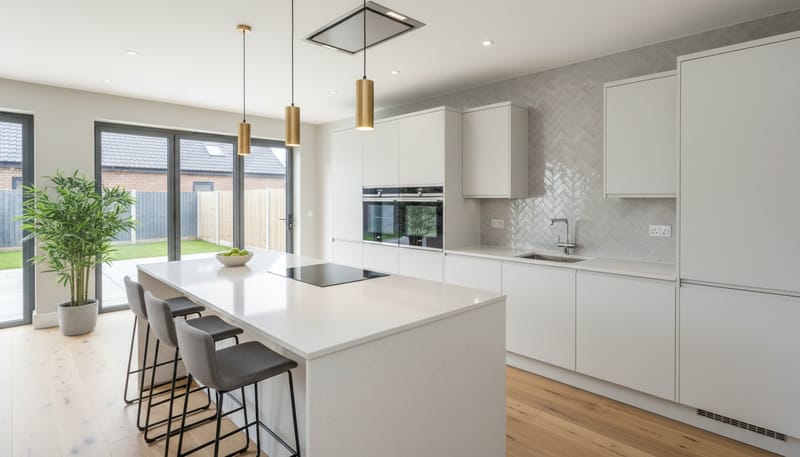
What to Expect from Your Developer's Standard Kitchen
Before making any design decisions, it helps to understand exactly what your developer provides as standard. UK new build kitchen specifications vary by developer, price bracket, and house type, but they fall into three broad tiers. The table below gives you a clear picture of what to expect at each level.
| Feature | Budget Tier (£180k–£280k) | Mid-Range Tier (£280k–£450k) | Premium Tier (£450k+) |
|---|---|---|---|
| Cabinet Doors | Flat-panel slab, white or cream, standard hinges | Shaker or substantial slab, soft-close, 2–3 colour choices | True painted timber or premium laminate, matched interiors |
| Worktops | 30mm laminate (wood or grey effect) | Upgraded laminate or basic quartz composite | Branded quartz (Silestone, Caesarstone) as standard |
| Sink & Tap | Stainless steel 1.5-bowl, basic chrome mixer | Composite granite undermount, designer mixer | Premium composite, designer tap, boiling water tap option |
| Appliances | Single oven, 4-burner hob, fridge-freezer, washing machine space | Oven (sometimes double), induction hob, hood, dishwasher, fridge-freezer | Bosch/Neff/Siemens throughout, pyrolytic oven, induction, wine cooler |
| Splashback | Single row of ceramic tiles behind hob only | Extended tiling behind cooking zone | Full-height tiling or matching worktop material |
| Flooring | Vinyl sheet or basic ceramic | Porcelain tile or premium vinyl | Large-format porcelain or engineered stone |
| Lighting | Single pendant or fluorescent fitting | Recessed downlights, basic pendant | Downlights, under-cabinet LEDs, pendant over island |
| Island | Not included | Available on 4-bed+ house types | Standard on most house types, often with integrated hob |
Even at the budget tier, new build kitchens offer well-planned layouts, modern services, and clean finishes. They are an excellent starting point that many buyers choose to personalise with targeted upgrades rather than wholesale replacements.
Key Observations by Tier
- Budget tier: Functional and clean with sensible layouts. The biggest upgrade opportunities are worktops, handles, and lighting — small changes that make a disproportionate visual impact.
- Mid-range tier: Genuinely attractive kitchens that most buyers are happy with. The main areas for improvement are upgrading to full quartz worktops, extending the splashback, and improving the lighting scheme.
- Premium tier: Often needs little fundamental improvement. Buyers typically personalise with accessories, statement lighting, and finishing touches rather than structural changes.
- Shared ownership: Specifications are usually budget-tier but layouts are thoughtfully designed. Check your lease for any restrictions on modifications before planning upgrades.
Understanding New Build Kitchen Layouts
The layout determines how your kitchen flows for cooking, storage accessibility, and social interaction. Your new build kitchen will follow one of four common configurations, each with distinct strengths. Understanding these helps you decide which upgrades will have the most impact.
| Layout | Best For | Min. Floor Space | Storage Capacity | Social Cooking | Typical House Types |
|---|---|---|---|---|---|
| Galley | Maximum efficiency in compact spaces | 6–8 m² | Moderate | Limited | 1–2 bed apartments, starter homes |
| L-Shaped | Open-plan living and flexible use | 10–14 m² | Good | Good | 2–4 bed houses, open-plan designs |
| U-Shaped | Maximum storage and worktop space | 10–16 m² | Excellent | Moderate | 3–4 bed houses with separate kitchens |
| Island | Entertaining, family life, visual impact | 15–20 m² | Excellent | Excellent | 4–5 bed family homes, premium developments |
Galley Kitchen — Making a Compact Space Work Harder
Two parallel runs of cabinets with a walkway between them. Galley kitchens are common in apartments and starter homes. Despite their compact footprint, they are actually one of the most efficient layouts for cooking because everything is within arm's reach.
- Minimum walkway width: 1,200mm is comfortable; 1,000mm is workable but tight for two people
- Light colour palette: White or pale grey cabinets with a light worktop create an illusion of greater space
- Avoid wall cabinets on both sides: Use open shelving on one side to prevent a tunnel effect
- Under-cabinet LEDs: Essential to eliminate shadows cast by wall cabinets above the worktop
- Window positioning: If your galley has an end window, keep it unobstructed to draw the eye through the space
L-Shaped Kitchen — The Open-Plan Favourite
Two runs of cabinets meeting at a right angle, with the remaining sides open to living or dining space. This is the most common layout in new build houses, particularly in open-plan kitchen-dining-living areas.
- Working triangle: Hob, sink, and fridge at three points with no leg longer than 2,700mm — usually well-implemented by developers
- Portable island option: A freestanding butcher's block or island cart (£200–£600) adds worktop space and storage without permanent modifications
- Corner optimisation: Fit a lazy Susan or pull-out corner unit to maximise the often-wasted deep corner cabinet
- Peninsula conversion: Extending the shorter arm into the room with a breakfast bar overhang creates a natural zone divider
U-Shaped Kitchen — Maximum Storage and Workspace
Cabinets wrapping around three walls deliver the most storage and worktop space of any layout. Found in larger houses with separate kitchens, the U-shape is a highly efficient cooking environment.
- Peninsula conversion: Converting one arm to a peninsula with bar stool seating opens the kitchen to adjacent spaces while retaining storage
- Light finishes essential: Use light cabinet colours and glass-fronted wall cabinets to prevent the room feeling enclosed
- Two-tone approach: Consider darker base cabinets with lighter wall cabinets to add depth without making the space feel heavy
Island Layout — The Social Kitchen
Islands are increasingly standard in mid-range and premium new builds, particularly in four and five-bedroom family homes. They serve as additional worktop space, informal dining with bar stools, and a natural zone divider in open-plan rooms.
- Minimum clearance: 1,000mm on all sides for comfortable movement; 1,200mm on the seating side for pulling out stools
- Developer island upgrades: Almost always worth choosing, as retrofitting plumbing or electrics into an island post-completion requires significant floor work
- Dual-purpose island: Open shelving or wine storage on the dining side, deep pan drawers on the kitchen side
- Lighting over islands: Two or three pendant lights hung 700–800mm above the island surface provide both task light and visual drama
Worktop Options: Materials, Brands, and Costs
The worktop is the single most impactful element in any kitchen design. Upgrading from a developer-standard laminate to a premium surface is the most popular change new build buyers make — and for good reason. The worktop sets the visual tone for the entire room. Here is a detailed comparison of every major option available in the UK for 2026.
| Material | Typical Cost (Fitted) | Heat Resistance | Scratch Resistance | Stain Resistance | Maintenance | Undermount Sink |
|---|---|---|---|---|---|---|
| Laminate | £800–£2,000 | Moderate (use trivets) | Good | Good | Virtually none | No (drop-in only) |
| Quartz | £2,500–£5,000 | Good (use trivets) | Excellent | Excellent | Virtually none | Yes |
| Granite | £2,500–£5,500 | Excellent | Excellent | Good (needs sealing) | Seal every 1–2 years | Yes |
| Dekton | £3,500–£7,000 | Excellent | Excellent | Excellent | Virtually none | Yes |
| Corian | £3,000–£6,000 | Low (heat sensitive) | Moderate (repairable) | Good | Occasional sanding | Yes (seamless) |
Laminate — Better Than Its Reputation
Modern laminate from brands like Duropal, Axiom, and Bushboard has improved dramatically. Textured surfaces convincingly replicate stone, marble, and concrete effects. Laminate is lightweight, affordable, and available in hundreds of colours and patterns.
- Pros: Lowest cost, huge range of finishes, easy to replace, lightweight, stain-resistant
- Cons: Visible seam joints, cannot accept undermount sinks, perception as a budget material
- Best for: Budget-conscious buyers, rental properties, kitchens you plan to fully replace within 5–10 years
Quartz — The Most Popular Premium Choice
Quartz composite (90–95% natural quartz bound with polymer resins) is the UK's most popular premium worktop material and the upgrade most commonly offered by developers. Leading brands include Silestone, Caesarstone, Compac, and Quarella.
- Silestone Calacatta Gold: Stunning marble effect without marble's maintenance — consistently one of the UK's best sellers
- Caesarstone Statuario Maximus: Bold veining for a dramatic statement surface
- Developer upgrade pricing: £1,500–£3,000 at reservation stage versus £2,500–£5,000 retrofitted — always cheaper to choose early
- Edge profiles: Square edge for modern kitchens, pencil round for a softer look, bullnose for traditional styles
Granite — Unique Natural Beauty
Every granite slab is unique, with natural veining and movement that quartz can replicate but never truly match. Granite was the premium default before quartz took over and remains popular with buyers who value natural authenticity.
- Pros: Unique character, excellent heat resistance, extremely hard-wearing, ages beautifully
- Cons: Porous (requires sealing), heavier than quartz, must visit stone yard to select slabs, matching between slabs can be challenging
- Best for: Buyers who value natural materials and do not mind periodic maintenance
Dekton — The Ultra-Performance Surface
Manufactured by Cosentino (makers of Silestone), Dekton is an ultra-compact sintered surface that is virtually indestructible. It resists scratches, stains, heat, and UV light, and can be produced in very large formats with minimal visible joints.
- Pros: Highest durability of any surface, UV-resistant, massive slab sizes, stunning finishes
- Cons: Most expensive option, limited colour range compared to quartz, requires specialist fabrication
- Best for: Premium kitchens where performance and visual impact are the top priorities
Corian — Seamless Elegance
Corian and similar solid surfaces (Hi-Macs, Staron) can be shaped, curved, and joined invisibly. Worktops, splashbacks, sinks, and drainer grooves can all be formed from a single continuous piece with no visible joints.
- Pros: Completely seamless, warm to the touch, repairable (scratches sand out), hygienic
- Cons: Softer than quartz and granite, more susceptible to heat damage, higher maintenance
- Best for: Contemporary kitchens where seamless aesthetics and integrated sinks are a priority
Cabinet Styles and How to Upgrade Them
Cabinet doors define the visual character of your kitchen more than almost any other element. If your developer's standard cabinets are not to your taste, there are three main approaches — from a simple handle swap to a complete door replacement.
Option 1: Handle Swaps — The Simplest Upgrade
Changing handles is the easiest and most cost-effective kitchen upgrade. It can transform a standard kitchen in a single afternoon.
- Measure the centre-to-centre hole spacing on your existing handles (most common: 128mm, 160mm, or 192mm)
- Choose new handles with the same spacing to avoid drilling new holes
- Select a consistent finish across all handles, knobs, and pulls for a cohesive look
- Fit all handles at the same height for a professional, uniform appearance
- Brushed brass knurled T-bars: Warm, contemporary — the standout trend for 2026
- Matt black cup handles: Modern farmhouse aesthetic that pairs well with Shaker doors
- Slim brushed nickel bars: Sleek and minimalist for flat-panel kitchens
- Leather strap handles: Scandinavian-inspired warmth and texture
- Recommended suppliers: Plank Hardware, Dowsing & Reynolds, Do Up — all offer stylish options at fair prices
- Budget: £100–£400 for a full set of handles for a standard kitchen
Option 2: Door Replacement — Transform Without Replacing the Kitchen
Replacing doors and drawer fronts while keeping the existing carcasses is a highly cost-effective way to completely transform your kitchen. This works because virtually all UK new build kitchens use standard carcass sizes.
| Supplier | Material | Typical Cost (Full Kitchen) | Lead Time | Key Feature |
|---|---|---|---|---|
| Plykea | Birch plywood | £2,000–£4,000 | 4–6 weeks | Designed specifically for standard new build carcasses |
| Husk Kitchens | Painted MDF | £1,500–£3,500 | 3–5 weeks | Wide range of paint colours |
| Naked Doors | Various | £1,000–£3,000 | 3–4 weeks | Multiple styles and finishes |
| Superfront | MDF with designer finishes | £1,800–£4,500 | 4–6 weeks | Scandinavian design, textured fronts |
Door replacement typically costs 30–50% of the price of an entirely new kitchen while delivering a dramatic visual transformation.
Option 3: Professional Kitchen Respraying
If your existing doors are solid and well-made but simply the wrong colour, professional respraying produces a factory-smooth finish that is virtually indistinguishable from new.
- Cost: £1,500–£3,000 for a full kitchen respray
- Timeline: 2–3 days — doors removed, sprayed off-site, refitted
- Durability: Professional-grade paint finishes last 8–12 years with normal use
- Popular colours for 2026: Sage green, warm mushroom, soft navy, cashmere, charcoal
Splashback Materials and Costs
The splashback — the wall area between worktop and wall cabinets — protects your walls while providing a prime opportunity for colour, pattern, and texture. Upgrading your splashback is one of the most visually impactful changes you can make.
| Material | Behind Hob Only | Full Wall Coverage | Pros | Cons |
|---|---|---|---|---|
| Metro/Subway Tiles | £200–£500 | £500–£1,200 | Timeless, wide colour range, easy to source | Grout lines need cleaning and resealing |
| Large-Format Porcelain | £300–£700 | £700–£2,000 | Fewer grout lines, marble and concrete effects | Heavier, needs experienced tiler |
| Zellige/Handmade Tiles | £400–£800 | £900–£2,500 | Unique character, artisan feel, warm tones | Irregular surface, higher material cost |
| Toughened Glass | £300–£800 | £800–£2,500 | Seamless, any colour, very easy to clean | Needs professional fitting, no DIY |
| Matching Quartz/Dekton | £500–£1,000 | £800–£1,500 (add-on) | Cohesive look with worktop, premium feel | Expensive, adds to worktop order lead time |
- Best value: White or sage green metro tiles — timeless, affordable, and easy to install as a DIY project
- Most dramatic impact: Full-height matching quartz from worktop to wall cabinet creates a seamless, high-end finish
- Trending for 2026: Zellige tiles in warm terracotta, olive, or cream tones add handmade character
- Easiest to clean: Toughened glass — a single wipe with a cloth keeps it spotless
Kitchen Lighting: Three Essential Layers
Most new build kitchens are handed over with minimal lighting — often just a single pendant or a few basic downlights. A well-lit kitchen requires three layers working together: ambient, task, and accent. This is one of the most cost-effective upgrades you can make.
| Lighting Layer | Purpose | Typical Options | Cost Range | Colour Temperature |
|---|---|---|---|---|
| Ambient | General room illumination | Recessed LED downlights at 1,000–1,200mm intervals | £80–£120 per light (installed) | 2,700K–3,000K (warm white) |
| Task | Illuminating worktops and cooking areas | Under-cabinet LED strips, over-island pendants | £15–£500 depending on type | 3,000K–4,000K (neutral to cool white) |
| Accent | Atmosphere, visual interest, feature highlighting | Cabinet interior LEDs, plinth lights, shelf lights | £20–£100 per zone | 2,700K (warm white) |
Practical Lighting Tips
- Warm white always: Choose 2,700K–3,000K for ambient and accent lighting — cool white makes kitchens feel clinical
- Under-cabinet LEDs: The single best lighting upgrade. Plug-in kits cost £15–£40, while hardwired options run £200–£500 for a full kitchen
- Pendant lights over islands: Hang 700–800mm above the surface. Two or three pendants spaced evenly look more balanced than a single centred fitting
- Dimmer switches: Essential for open-plan kitchen-diners so you can dim the kitchen while the dining area is in use — £15–£30 per switch
- Plinth lighting: LED strips along the base of cabinets create a floating effect and provide soft night-time navigation — £30–£80 for a full kitchen
- Separate circuits: If possible, put kitchen, dining, and living zone lights on separate circuits (£200–£400 for an electrician) for independent control
Kitchen Flooring: What Works Best in New Builds
Kitchen flooring needs to be waterproof (or highly water-resistant), durable, easy to clean, and comfortable underfoot. These are the main options for UK new build kitchens in 2026.
| Flooring Type | Cost (Fitted, per m²) | Waterproof | Warmth Underfoot | Durability | Popular Brands |
|---|---|---|---|---|---|
| Luxury Vinyl Tile (LVT) | £25–£60 | Yes | Warm | Excellent | Karndean, Amtico, Quick-Step Livyn |
| Porcelain Tiles | £40–£100 | Yes | Cold (unless with UFH) | Outstanding | Porcelanosa, Topps Tiles, Mandarin Stone |
| Engineered Wood | £35–£80 | No (water-resistant only) | Warm | Good | Woodpecker, V4, Kahrs |
| Polished Concrete | £80–£150 | Yes (when sealed) | Cold | Outstanding | Specialist applicators |
- Best all-rounder: LVT is the UK's most popular kitchen flooring for good reason — it is waterproof, warm, durable, and available in stunning wood and stone effects
- Premium choice: Large-format porcelain tiles (600x600mm or larger) create a sleek, architectural look
- Engineered wood caution: Choose a lacquered finish for better water resistance, and place mats in front of the sink and dishwasher
- Underfloor heating: If your new build has UFH, porcelain tiles conduct heat most efficiently; LVT is also compatible; check suitability before fitting engineered wood
- Open-plan continuity: Running the same flooring from kitchen through dining and living areas creates a sense of spaciousness — LVT and porcelain are both ideal for this
Maximising Storage in a New Build Kitchen
Even well-designed new build kitchens can benefit from smarter internal organisation. These solutions transform basic cabinets into highly efficient storage systems, often for a very modest outlay.
Internal Cabinet Organisers
- Pull-out wire baskets: £20–£50 each — ideal for base cabinets, making items at the back easily accessible
- Drawer dividers: £10–£30 — keep cutlery, utensils, and small items neatly separated
- Under-shelf baskets: £8–£15 — double the usable space inside wall cabinets
- Lazy Susans for corner cabinets: £30–£80 — transform dead corner space into accessible rotating storage
- Pull-out spice racks: £25–£60 — fit into narrow gaps beside ovens or fridge-freezers
- Pan drawer inserts: £15–£40 — keep pans and lids organised in deep drawers
Additional Storage Solutions
- Freestanding larder cupboard: £200–£600 — significant additional capacity without modifying the fitted kitchen
- Built-in pull-out larder unit: £300–£800 — replaces a standard tall cabinet with fully accessible shelving
- Floating shelves: £30–£100 per shelf — replacing one or two wall cabinets with open shelving creates a more spacious, curated feel
- Island storage: Base cabinets on the kitchen side, open shelving or wine storage on the dining side, deep drawers for pots and pans
- Over-door organisers: £10–£25 — inside cupboard doors for cleaning products, chopping boards, or baking trays
- Magnetic knife strips: £15–£40 — free up worktop space and drawer space while keeping knives safely accessible
Appliance Upgrades Worth Considering
New build kitchens come with a solid set of integrated appliances, but some upgrades can genuinely transform how you use your kitchen. Here are the upgrades that deliver the best return in daily convenience and enjoyment.
| Appliance | Top UK Brands | Cost Range | Key Benefit | Developer Upgrade? |
|---|---|---|---|---|
| Boiling Water Tap | Quooker Fusion, Grohe Blue, Franke Omni | £700–£1,500 | Eliminates the kettle, instant boiling for cooking | Sometimes available |
| Induction Hob | Bosch, Neff, AEG, Bora | £300–£800 | Faster, safer, more energy-efficient than ceramic | Often standard in mid-range+ |
| Induction with Extraction | Bora, Neff Venting Hob, Elica | £1,500–£3,000 | Eliminates overhead hood, clean sight lines | Premium developments only |
| Built-In Coffee Machine | Miele, Siemens, Neff | £1,000–£2,500 | Frees worktop space, barista-quality coffee daily | Rarely |
| Pyrolytic Oven | Bosch, Neff, Siemens | £500–£1,200 | Self-cleaning at 500°C, saves hours of scrubbing | Premium developments |
| Wine Cooler | Caple, CDA, Liebherr | £250–£800 | Dual-zone temperature control, built-in elegance | Sometimes available |
Which Appliance Upgrades Deliver the Best Value?
- Induction hob (if not already standard) — faster cooking, lower energy bills, safer for families with young children
- Boiling water tap — a daily convenience you will use multiple times, eliminates worktop clutter from the kettle
- Pyrolytic oven — the self-cleaning cycle alone justifies the upgrade cost over the life of the appliance
- Built-in coffee machine — best for serious coffee drinkers who currently spend heavily at coffee shops
- Wine cooler — a lifestyle upgrade that adds a touch of luxury and is often available at reasonable cost
The Kitchen-Diner: Zoning an Open-Plan Space
Open-plan kitchen-dining-living areas are the standard layout in most new builds. The challenge is creating distinct zones that feel purposeful without losing the openness. Here are practical techniques for effective zoning.
- Flooring transitions: Different materials for kitchen and living zones create visual boundaries. Use a clean metal threshold strip (£10–£30) for a professional join, or run the same LVT throughout for seamless flow
- Lighting zones: Separate circuits for kitchen, dining, and living allow independent atmosphere control — bright for cooking, dimmed for dining, soft for relaxing
- The island as divider: Different finishes on the kitchen side (matching cabinets) versus dining side (open shelving, timber cladding, or painted finish) create a deliberate transition
- Colour transitions: Cooler tones (white, light grey) for the kitchen zone; warmer tones (cream, taupe, sage) for living and dining. Consistent metalwork (brass, black, or chrome) ties everything together
- Rug placement: A rug under the dining table instantly defines the dining zone within an open-plan space
- Pendant grouping: A cluster of pendants over the dining table and separate pendants over the island establish two distinct focal points
For more ideas on making the most of your new build's living spaces, see our guide to new build interior design ideas.
Kitchen Design Trends for 2026
Kitchen trends evolve steadily rather than changing overnight. These are the movements shaping the most desirable new build kitchens in 2026.
- Warm neutrals replacing cool greys: Mushroom, cashmere, sage green, warm taupe, and soft terracotta are replacing the all-grey kitchens that dominated 2018–2023
- Fluted and reeded textures: Textured cabinet doors and fluted glass inserts add depth and visual interest to flat surfaces
- Concealed appliance stations: Pocket doors and tambour units that reveal a coffee station, toaster, and kettle, then close for a clean worktop
- Natural materials: Real wood shelving, timber-fronted islands, and wooden accessories create a calm Japandi aesthetic
- Statement lighting: Oversized pendants, sculptural fittings, and architectural lighting above islands are becoming bolder and more dramatic
- Sustainability: Recycled glass worktops, bamboo cabinet fronts, reclaimed timber, and energy-efficient LED lighting — for more on this, see our guide to sustainable new build homes
- Two-tone kitchens: Contrasting colours for upper and lower cabinets, or a different-coloured island, adds visual depth
- Curved edges: Rounded island ends, curved cabinet corners, and bullnose worktop profiles soften angular kitchen designs
- Open display: Glass-fronted cabinets and open shelving replacing solid wall units for a lighter, curated look
Realistic Budget Guide for Kitchen Improvements
How much should you expect to spend? Here is a practical breakdown of the three main upgrade levels, with realistic UK costs for 2026.
| Upgrade Level | Total Budget | What Is Included | Impact |
|---|---|---|---|
| Quick Refresh | £500–£1,500 | New handles (£100–£300), under-cabinet LEDs (£30–£100), splashback tiles (£200–£500), new light fitting (£50–£200), accessories (£50–£200), bar stools (£100–£400) | Noticeably refreshed kitchen without structural changes |
| Meaningful Upgrade | £3,000–£8,000 | Quick refresh items plus quartz worktops (£2,500–£5,000), full-height splashback (£500–£1,500), replacement doors or respraying (£1,500–£3,500), boiling water tap (£800–£1,500), internal organisers (£200–£500) | Transformed kitchen that looks and feels premium |
| Complete Transformation | £12,000–£25,000+ | Full kitchen replacement with premium doors, quartz or Dekton worktops, upgraded appliances, new flooring, feature lighting, redesigned layout or island | Bespoke-quality kitchen rivalling high-end show homes |
Where to Prioritise Your Budget
If your budget is limited, focus spending on the changes that deliver the greatest visual and functional impact per pound.
- Worktops — the single biggest visual upgrade, especially moving from laminate to quartz
- Lighting — under-cabinet LEDs and well-chosen pendants transform atmosphere for modest cost
- Handles — disproportionate impact for very low cost
- Splashback — a full-height tiled or glass splashback elevates the entire room
- Flooring — particularly impactful in open-plan spaces where the kitchen floor flows into living areas
Developer Upgrades Checklist
Choosing upgrades at reservation stage is almost always cheaper than retrofitting after completion, because the work is done during the build. But not every upgrade is worth choosing through your developer. Use this decision matrix to guide your choices.
| Upgrade | Developer Cost | Retrofit Cost | Savings via Developer | Recommendation |
|---|---|---|---|---|
| Quartz worktops | £1,500–£3,000 | £2,500–£5,000 | £1,000–£2,000 | Always choose |
| Additional power sockets | £50–£150 per socket | £100–£300 per socket | £50–£150 each | Always choose |
| Under-cabinet lighting | £200–£400 | £200–£500 | £0–£100 | Choose (cleaner install) |
| Full-height tiling | £300–£600 | £500–£1,500 | £200–£900 | Always choose |
| Appliance upgrades | Varies | Similar + removal costs | Moderate | Choose if good brands offered |
| Island with plumbing/electrics | £1,500–£4,000 | £3,000–£8,000+ | £1,500–£4,000 | Always choose |
| Boiling water tap | £800–£1,200 | £700–£1,500 | Minimal | Can retrofit at similar cost |
| Cabinet colour upgrade | £300–£800 | £1,500–£3,000 (respray) | £1,200–£2,200 | Choose only if you love the colour |
| Handle upgrades | £100–£300 | £100–£400 | Minimal | Skip — much cheaper to DIY |
For a comprehensive overview of all types of developer upgrades beyond the kitchen, see our dedicated guide to developer upgrades worth choosing.
Common Kitchen Design Mistakes to Avoid
Even with the best intentions, certain mistakes come up repeatedly in new build kitchen upgrades. Avoiding these will save you time, money, and frustration.
- Prioritising aesthetics over function: A stunning kitchen that lacks adequate worktop space or has poor workflow is a daily frustration. Always ensure the working triangle (hob, sink, fridge) is efficient before focusing on finishes.
- Choosing dark colours in a small kitchen: Dark cabinets throughout a compact kitchen make the room feel smaller and heavier. Instead, use dark colours as accents — a dark island with light perimeter cabinets is far more effective.
- Neglecting the lighting plan: A single ceiling light is never enough. Plan all three layers (ambient, task, accent) from the start to avoid costly retrofit wiring later.
- Forgetting ventilation: Open-plan kitchens need effective extraction. Consider upgrading from a recirculating hood to an externally ducted hood, or choosing an induction hob with integrated downdraft extraction.
- Overspending on niche features: Quartz worktops and quality flooring add genuine resale value. Ultra-niche appliances (steam ovens, teppanyaki grills) appeal to a narrower market and may not recoup their cost if you sell.
- Rushing upgrades before living in the space: Spend at least four to six weeks using your kitchen as delivered. You may find that things you planned to change actually work perfectly, while unexpected issues become clear priorities.
- Ignoring socket placement: Modern kitchens need more sockets than you think. Ensure you have enough for the kettle (or boiling water tap), toaster, coffee machine, food processor, phone charging, and any other daily-use appliances.
- Mismatching finishes: Keep metalwork consistent — if your tap is brushed brass, your handles, light fittings, and socket plates should coordinate. Mixing chrome, brass, and black looks disjointed.
- Golden rule: Function first, aesthetics second — a kitchen that works brilliantly will always feel more satisfying than one that only looks good
- Budget rule: Allocate 60% of your budget to worktops, flooring, and lighting; 25% to cabinets and splashbacks; 15% to accessories and finishing touches
- Timeline rule: Order worktops and replacement doors 4–8 weeks before you want them fitted; appliances and lighting can often be sourced within 1–2 weeks
Making Your New Build Kitchen Truly Yours
Your new build kitchen comes with excellent foundations — a well-planned layout, modern services, and clean finishes. Whether you make a few targeted upgrades (handles, lighting, splashback) or embark on a complete transformation, the key is designing a kitchen that works for your household's daily life while reflecting your personal style.
Start with the practical considerations — layout efficiency, adequate storage, and good lighting — and layer in the aesthetic choices from there. Take time to use your kitchen as the developer delivered it before making major changes; you may find that certain things work better than you expected.
For guidance on other areas of your new build, explore our guides to interior design ideas, bathroom upgrades, and maximising energy efficiency.