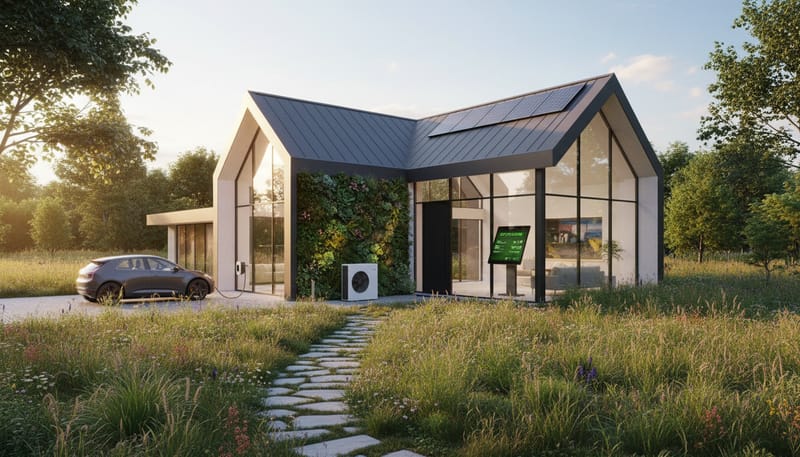
What Does Net Zero Mean for Housing?
The term net zero has become central to UK climate policy, and the housing sector is at the heart of the challenge. Residential buildings account for approximately 17% of the UK’s total carbon emissions, making the transition to net zero housing essential if the country is to meet its legally binding target of achieving net zero greenhouse gas emissions by 2050.
But what does net zero actually mean in the context of a new build home? At its core, a net zero home is one that produces zero or negative net carbon emissions over the course of a year. This means the energy consumed by the home (for heating, hot water, lighting, and appliances) is balanced by energy generated on site, typically through solar panels or other renewable energy systems.
However, the concept has important nuances. There is a distinction between operational net zero (zero emissions from living in the home) and whole-life net zero (which also accounts for the carbon emitted during construction, material production, and eventual demolition). Most current net zero homes focus on operational carbon, though the industry is increasingly looking at whole-life carbon as well.
This guide explores what net zero means for UK new build homes, how the Future Homes Standard is paving the way, what technologies and design principles make a home net zero, which developers are leading the charge, and what buyers should look for when purchasing a net zero or near-net-zero property.
The Pathway to Net Zero: Future Homes Standard and Beyond
The UK government’s roadmap to net zero housing is built around a series of increasingly stringent Building Regulations, culminating in the Future Homes Standard (FHS). Here is how the standards have evolved and where they are heading:
| Building Regulations | Year | CO2 Reduction vs 2013 Standard | Key Requirements |
|---|---|---|---|
| Part L 2013 | 2013 | Baseline | Condensing gas boiler, basic insulation standards, partial low-energy lighting |
| Part L 2021 (Interim Update) | 2022 | 31% reduction | Improved insulation, enhanced ventilation, 100% LED lighting, solar PV encouraged |
| Future Homes Standard | 2025 | 75–80% reduction | No gas boilers, heat pumps standard, high-performance fabric, on-site renewables |
| Operational Net Zero | 2025+ | 100% reduction | FHS compliance + additional solar PV and/or battery storage to reach zero balance |
The Fabric-First Approach
At the heart of net zero design is the fabric-first approach. This principle prioritises the physical performance of the building envelope — walls, roof, floor, windows, and doors — before considering mechanical systems and renewable energy. The logic is simple: reduce the energy demand first, then meet the remaining demand with clean energy.
A fabric-first approach in a net zero home typically includes:
- Enhanced wall insulation: U-values of 0.13–0.15 W/m²K (compared to 0.26 in current Building Regulations), using continuous insulation systems that minimise thermal bridging
- Superior roof insulation: U-values of 0.10–0.12 W/m²K with 300mm+ insulation thickness
- High-performance glazing: Triple-glazed windows with U-values below 0.80 W/m²K, low-emissivity coatings, and warm-edge spacer bars
- Exceptional airtightness: Air permeability of 1–3 m³/hr/m² (compared to the 5–8 typical of current new builds), achieved through careful detailing and testing
- Thermal bridge-free construction: Careful design of junctions between walls, floors, roofs, and windows to eliminate cold spots
The Passivhaus Standard
The Passivhaus (Passive House) standard, developed in Germany, represents the gold standard for ultra-low-energy building design. A Passivhaus home uses up to 90% less heating energy than a conventional building, primarily through exceptional insulation, airtightness, and mechanical ventilation with heat recovery (MVHR).
Key Passivhaus criteria include a space heating demand of no more than 15 kWh/m²/year, airtightness of 0.6 air changes per hour or less, and total primary energy consumption of no more than 120 kWh/m²/year. While not all net zero homes are certified Passivhaus, many adopt Passivhaus principles as the basis for their low-energy design. When combined with on-site renewable energy generation, a Passivhaus home can readily achieve net zero status.
Technologies That Make a Home Net Zero
Achieving net zero requires a combination of technologies that work together to minimise energy consumption and generate clean energy. Here are the key systems found in a net zero new build home:
Energy Generation and Storage
A net zero home must generate enough renewable energy to offset its annual consumption. The primary technologies are:
- Solar PV panels: Typically 4–8 kW of roof-mounted solar panels generating 3,500–7,000 kWh per year. This is the most common and cost-effective on-site generation technology
- Battery storage: A 5–13 kWh home battery system stores excess solar energy for evening and overnight use, increasing self-consumption from 30% to 70–80%
- Solar thermal panels: Supplement hot water heating, particularly effective when combined with a hot water cylinder and heat pump
Heating and Hot Water
- Air source heat pump (ASHP): The standard heating solution for net zero homes, delivering 3–4 kWh of heat for every 1 kWh of electricity consumed. Zero direct emissions
- Ground source heat pump (GSHP): Even more efficient than ASHPs (COP of 4–5), but more expensive to install due to ground loop or borehole requirements
- Underfloor heating: Runs at lower flow temperatures than radiators, maximising heat pump efficiency
- Waste water heat recovery (WWHR): Captures heat from shower drain water to pre-heat incoming cold water, reducing hot water energy demand by 30–40%
Ventilation and Air Quality
Because net zero homes are extremely airtight, controlled ventilation is essential for air quality and moisture control:
- Mechanical Ventilation with Heat Recovery (MVHR): Extracts stale air from kitchens and bathrooms while recovering up to 90–95% of the heat. Fresh, filtered air is supplied to living rooms and bedrooms. This is standard in net zero and Passivhaus homes
- Demand-controlled ventilation: Sensors adjust ventilation rates based on occupancy, CO2 levels, and humidity, minimising energy waste while maintaining excellent indoor air quality
The Net Zero Energy Balance
The following chart illustrates how a net zero home balances its energy consumption with on-site generation:
Typical annual energy balance for a 3-bed net zero home with ASHP and 6kW solar PV. Actual figures vary by orientation, occupancy, and location.
Developer Net Zero Commitments and Exemplar Developments
Several UK developers are leading the transition to net zero housing, often going beyond current Building Regulations to deliver homes that meet or exceed the Future Homes Standard ahead of schedule. Here are some notable examples:
| Developer | Net Zero Commitment | Example Development | Key Features |
|---|---|---|---|
| Hill Group | Net zero operational carbon by 2030 | Marleigh, Cambridge | ASHP, solar PV, MVHR, enhanced fabric, EPC A |
| Countryside Partnerships | Pathway to net zero across all developments | Beaulieu, Chelmsford | Fabric-first design, ASHPs, community energy schemes |
| Barratt Homes | Z House prototype; science-based targets | Z House demonstration home | Triple glazing, ASHP, solar PV, battery storage, MVHR |
| Ilke Homes | Factory-built net zero homes | Multiple sites nationally | Modular construction, ASHP, solar PV, airtight factory build |
| Berkeley Group | Net zero scope 1 & 2 emissions by 2025 | Kidbrooke Village, London | District heat network, communal PV, biodiversity net gain |
| Etopia Homes | Net zero as standard on all homes | Corby and Northampton | Panelised construction, ASHP, solar PV, smart controls |
Developer commitments and specifications evolve. Check directly with the developer for the latest details on specific developments.
What Makes These Developments Stand Out
The exemplar developments above share several common characteristics that distinguish them from standard new builds:
- All-electric heating: No gas connections. Heat pumps provide all space heating and hot water
- On-site generation: Solar PV as standard, often with battery storage
- Exceptional building fabric: Insulation and glazing performance significantly exceeding current Building Regulations
- MVHR ventilation: Mechanical ventilation with heat recovery as standard, ensuring excellent air quality while minimising heat loss
- Smart controls: Smart home energy management systems that optimise energy use, manage battery charging, and maximise solar self-consumption
- Biodiversity and landscaping: Green spaces, wildlife corridors, and sustainable drainage systems (SuDS) integrated into the development design
Costs, Long-Term Savings, and Resale Value
The Net Zero Premium
Net zero homes currently cost more to build than standard new builds, primarily due to the enhanced building fabric, heat pump systems, solar panels, and battery storage. The premium varies depending on the specific technologies used and the starting specification:
| Specification Level | Cost Premium vs Standard New Build | Typical Additional Cost (3-bed) |
|---|---|---|
| FHS compliant (2025 standard) | 5 – 8% | £12,000 – £20,000 |
| Net zero operational carbon | 8 – 12% | £20,000 – £30,000 |
| Passivhaus certified | 10 – 15% | £25,000 – £40,000 |
| Whole-life net zero | 12 – 18% | £30,000 – £50,000 |
These premiums are expected to decrease as technologies mature, supply chains scale up, and net zero becomes the regulatory standard. The industry-wide shift to heat pumps and solar PV driven by the Future Homes Standard will significantly reduce unit costs through economies of scale.
Long-Term Energy Savings
The higher upfront cost of a net zero home is offset by dramatically lower running costs. A net zero home with solar PV and battery storage can achieve near-zero energy bills, particularly if the occupant takes advantage of smart tariffs and EV charging during solar generation hours.
Compared to a standard B-rated new build with annual energy costs of around £720, a net zero home might achieve annual energy costs of just £100–£250 (the small remaining cost covers grid electricity during winter months when solar generation is low). Over a 25-year mortgage term, this represents a cumulative saving of £12,000 – £15,000 on energy bills alone.
Resale Premium
Energy-efficient homes already command a price premium in the UK market. Research from the Department for Energy Security and Net Zero indicates that homes with higher EPC ratings sell for 5–14% more than equivalent lower-rated properties. As awareness of energy costs grows and regulations tighten, this premium is expected to increase — particularly for homes that are already net zero compliant.
A net zero home purchased today is effectively future-proofed against energy price rises, tightening regulations, and shifting buyer expectations. When you come to sell, your home will be among the most desirable on the market, with the lowest running costs and the highest sustainability credentials. This makes the modest upfront premium a sound long-term investment in your home’s resale value.
Certification Schemes and What to Look for When Buying
Net Zero Certification Schemes
Several certification schemes verify the sustainability credentials of new build homes. If a developer claims their homes are “net zero,” look for independent certification:
| Certification | Focus | Key Requirements |
|---|---|---|
| Passivhaus | Ultra-low energy design | Space heating ≤ 15 kWh/m²/yr, airtightness ≤ 0.6 ACH, verified by testing |
| BREEAM | Overall sustainability | Comprehensive assessment of energy, water, materials, ecology, health |
| Home Quality Mark (HQM) | Build quality and sustainability | BRE scheme rating homes on energy, sustainability, and resilience |
| UKGBC Net Zero Framework | Operational/whole-life carbon | UK Green Building Council framework defining net zero for buildings |
| EPC A rating | Energy efficiency | SAP score of 92+ indicating exceptional energy performance |
What to Look for When Buying a Net Zero Home
If you are considering purchasing a net zero or near-net-zero new build home, here is a checklist of features and questions to guide your assessment:
- Check the EPC rating: A genuine net zero home should achieve an EPC A rating (92+ SAP score). Be cautious of marketing claims that do not align with the EPC
- Ask about heating: Is the home heated by a heat pump? Net zero homes should not have gas boilers
- Solar PV capacity: How many kW of solar panels are installed? A net zero 3-bed home typically needs 4–8 kW
- Battery storage: Is battery storage included? This maximises the value of solar generation
- Insulation specification: Ask for wall, roof, and floor U-values. Net zero homes should achieve wall U-values of 0.15 or below
- Ventilation system: Is MVHR installed? This is essential for airtight homes
- Airtightness test results: Ask for the as-built air permeability figure. Net zero homes target 1–3 m³/hr/m²
- Independent certification: Does the home carry Passivhaus, BREEAM, or HQM certification?
- Smart home controls: Is an energy management system included to optimise generation, storage, and consumption?
Government Policy and the Road to 2050
The UK government’s commitment to net zero by 2050 is driving a series of policy changes that will progressively raise standards for new build homes and retrofit requirements for existing properties:
- Future Homes Standard (2025): New homes must produce 75–80% less CO2 than 2013 standards. Gas boilers will effectively be banned in new builds. This is the single biggest step towards net zero housing
- Future Buildings Standard (2025): Parallel standard for non-residential buildings, also driving decarbonisation of commercial and public sector construction
- Minimum EPC C for rentals: The government has proposed requiring all rented homes to achieve a minimum EPC C rating, which will drive improvements to existing housing stock
- Green finance regulation: Green mortgage products are expected to become mainstream, with lenders potentially required to report on the energy efficiency of their mortgage books
- Embodied carbon regulations: Future regulations may address the carbon footprint of building materials and construction processes, moving towards whole-life carbon assessment
- Biodiversity net gain: All new developments must deliver at least 10% biodiversity net gain, integrating ecological enhancement into the development process
For buyers, the implication is clear: homes built to higher standards today will be better protected against future regulatory requirements and energy price increases. A net zero new build purchased now will not need costly retrofitting to meet future standards, giving you confidence in the long-term value and liveability of your home.
Frequently Asked Questions
Are any new build homes truly net zero right now?
Yes, though they remain a small proportion of the market. Developers such as Hill Group, Etopia Homes, and Ilke Homes are building operationally net zero homes on selected developments. These homes use heat pumps, solar PV, battery storage, and exceptional fabric performance to achieve zero or near-zero net carbon emissions from day-to-day living. As the Future Homes Standard takes effect, the proportion of near-net-zero homes will increase dramatically.
How much more does a net zero home cost?
The premium for a net zero home is typically 8–12% above a standard new build, equating to approximately £20,000–£30,000 for a 3-bedroom house. This premium covers the heat pump, enhanced insulation, triple glazing, MVHR, solar panels, and battery storage. However, the premium is offset by energy bill savings of £500–£650 per year and a resale premium of 5–14% for high-EPC homes.
Can I make a standard new build net zero after purchase?
Partially. You can add solar panels and battery storage to a standard new build to significantly reduce energy costs. However, improving the building fabric (insulation, airtightness, glazing) is much more difficult and expensive after construction. This is why buying a home with the best possible specification from the outset is more cost-effective than retrofitting.
What is the difference between net zero and Passivhaus?
Passivhaus is a specific building standard focused on ultra-low energy demand through exceptional insulation, airtightness, and heat recovery ventilation. A Passivhaus home uses very little energy but does not necessarily generate any. Net zero, by contrast, focuses on the balance between energy consumed and energy generated. A home can be net zero without being Passivhaus (by generating enough solar energy to offset higher consumption) and vice versa. The highest-performing homes combine both: Passivhaus-level demand reduction with sufficient renewable generation to achieve net zero.
Will all new builds be net zero after 2025?
Not immediately. The Future Homes Standard (2025) will require a 75–80% reduction in CO2 emissions, which is a major step towards net zero but not quite 100%. Homes built to FHS will need heat pumps and improved fabric but may not include enough solar PV and battery storage to achieve full operational net zero. However, they will be “net zero ready” — meaning that adding solar panels and a battery after purchase could achieve the remaining reduction. Full regulatory net zero is expected to follow in subsequent Building Regulation updates.
Embracing the Net Zero Future
Net zero new build homes represent the future of UK housing. While they are currently the leading edge of the market, the rapid pace of regulatory change — driven by the Future Homes Standard and the 2050 net zero target — means that what is exceptional today will become standard within the next decade.
For buyers, purchasing a net zero or near-net-zero new build offers a compelling combination of benefits: dramatically lower energy bills, access to preferential green mortgage rates, excellent indoor comfort and air quality, a smaller carbon footprint, and strong long-term resale value. The modest cost premium is increasingly justified by these tangible financial and lifestyle benefits.
When evaluating new build homes, look beyond the marketing claims and focus on the specifics: the EPC rating, the heating system, the insulation specification, the solar PV capacity, and whether independent certification has been achieved. These details will tell you more about your future comfort and running costs than any brochure.
To explore available new build homes across the UK, including developments with enhanced sustainability credentials, browse our property listings or read our step-by-step buying guide for comprehensive guidance on the purchase process.