Understanding New Build Running Costs
One of the most common questions from buyers considering a new build home is: how much will it actually cost to live in? Beyond the mortgage payment, your monthly outgoings include energy bills, council tax, water rates, broadband, insurance, and potentially service charges or ground rent. Understanding these costs before you buy is essential for accurate budgeting and avoiding unwelcome surprises.
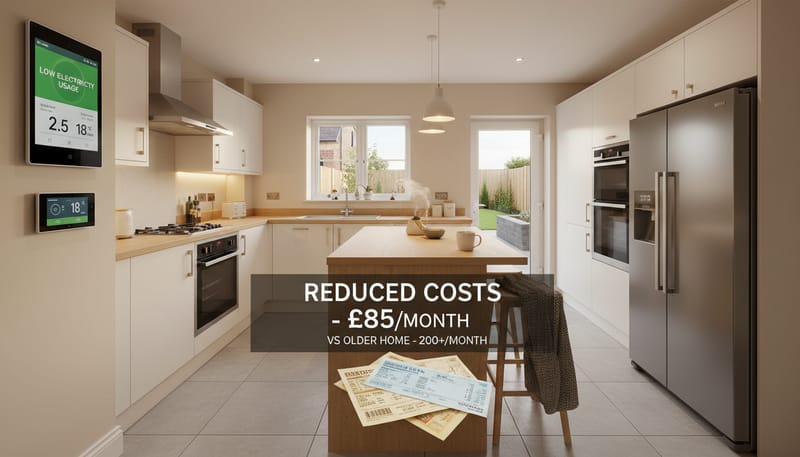
The good news is that new build homes are significantly cheaper to run than older properties. Thanks to modern insulation standards, energy-efficient heating systems, and higher EPC ratings, new build owners typically enjoy substantially lower energy bills. However, energy is just one piece of the puzzle — council tax, water, communications, and other costs all contribute to your total monthly outgoings.
This guide breaks down every running cost you can expect when living in a new build home in the UK, with real figures based on 2024/25 data. We compare these costs against older properties so you can see the full financial picture.
As the figures above show, the three biggest running costs for any homeowner are energy, council tax, and water. For a typical new build home, these alone total approximately £3,341 per year. When you add broadband, insurance, and other essentials, total annual running costs for a new build typically fall between £4,800 and £6,500, depending on location, property size, and whether you live in a house or apartment.
Energy Bills: Gas and Electricity Costs
Energy bills represent the area where new build homes offer the most dramatic savings compared to older properties. Thanks to superior insulation, airtight construction, efficient boilers or heat pumps, and modern ventilation systems, a typical new build uses far less energy to heat and power than a home built even 20 or 30 years ago.
Average Energy Bills by EPC Rating
Your energy bill is directly linked to your home’s EPC rating. Here is what homeowners typically pay for a 3-bedroom semi-detached home under Ofgem’s 2024/25 price cap:
| EPC Rating | Typical Property | Annual Gas | Annual Electric | Total Energy |
|---|---|---|---|---|
| A (92–100) | Heat pump new build with solar PV | £0 | £480 – £560 | £480 – £560 |
| B (81–91) | Modern new build (post-2021) | £380 – £440 | £280 – £340 | £660 – £780 |
| C (69–80) | New build (2013–2021) | £520 – £600 | £340 – £420 | £860 – £1,020 |
| D (55–68) | Average UK home | £780 – £900 | £420 – £520 | £1,200 – £1,420 |
| E (39–54) | Older home, partial insulation | £1,050 – £1,200 | £500 – £620 | £1,550 – £1,820 |
| F/G (1–38) | Pre-war, unimproved property | £1,400+ | £580 – £720 | £1,980 – £2,520 |
Based on Ofgem price cap Q1 2025 rates. Actual costs vary by usage, tariff, and region.
Gas vs Electric: The Shifting Balance
Traditionally, UK homes have relied on mains gas for heating and hot water, with electricity covering lighting, cooking, and appliances. This split typically means around 60% of your energy bill goes on gas and 40% on electricity. However, this balance is changing rapidly as more new build developments move away from gas entirely.
From 2025, the Future Homes Standard will effectively ban gas boilers in new homes, pushing developers towards air source heat pumps and other electric heating solutions. While electricity costs more per unit than gas (approximately 24.5p/kWh versus 6.2p/kWh), heat pumps deliver 3–4 units of heat for every unit of electricity consumed, making them comparable or cheaper overall.
If you are buying a new build with a heat pump, your gas bill will be zero, but your electricity bill will be higher than in a gas-heated home. The total energy cost is typically similar or slightly lower, with the added benefit of zero direct carbon emissions from your home.
Standing Charges
Regardless of how much energy you use, you will pay standing charges for being connected to the gas and electricity networks. These are currently around £0.32/day for electricity and £0.31/day for gas, totalling approximately £230 per year. If your new build is all-electric with no gas connection, you save around £113 per year on the gas standing charge alone.
- Dual fuel (gas + electric): Standing charges total approximately £230/year
- Electricity only (heat pump home): Standing charge approximately £117/year
- Smart meter benefit: Accurate billing, no estimated reads, and access to flexible tariffs that reward off-peak usage
- Fixed vs variable tariff: Consider fixing your energy rate for 12–24 months to protect against price cap increases
Council Tax Bands for New Build Homes
Council tax is often the single largest running cost for homeowners, frequently exceeding energy bills. The amount you pay depends on your property’s council tax band (A to H in England and Scotland, A to I in Wales) and the local authority area where you live.
How New Builds Are Banded
When a new build home is completed, the Valuation Office Agency (VOA) assigns it a council tax band based on what the property would have been worth on 1 April 1991 (or 1 April 2003 in Wales). This means a brand-new £350,000 home is not banded at £350,000 — it is assessed at a much lower 1991 equivalent value. In practice, most new build 3-bedroom semi-detached houses fall into Band C or D in England.
| Band | 1991 Value | Average Charge (England 2024/25) | Typical New Build |
|---|---|---|---|
| A | Up to £40,000 | £1,447 | Studio or 1-bed apartment |
| B | £40,001 – £52,000 | £1,688 | 2-bed apartment or small terrace |
| C | £52,001 – £68,000 | £1,929 | 2–3 bed terrace or semi |
| D | £68,001 – £88,000 | £2,171 | 3-bed semi-detached |
| E | £88,001 – £120,000 | £2,653 | 4-bed detached |
| F | £120,001 – £160,000 | £3,136 | Large detached or executive home |
| G | £160,001 – £320,000 | £3,618 | Premium detached homes |
| H | Over £320,000 | £4,342 | Luxury or mansion-type properties |
Average council tax for England 2024/25. Actual charges vary significantly by local authority.
Regional Variations and Challenging Your Band
Council tax rates vary enormously across the country. A Band D property in Westminster pays around £960 per year, while the same band in Nottingham costs over £2,500. When budgeting for a new build, always check the specific council tax rate for the local authority area where the development is located.
If you believe your new build has been placed in the wrong council tax band, you can appeal to the VOA within six months of receiving your first council tax bill. Successful appeals are uncommon for new builds, but it is worth checking if comparable properties on the same development are in a lower band.
- Single person discount: If you live alone, you receive a 25% discount on your council tax bill
- Student exemption: Properties occupied entirely by full-time students are exempt from council tax
- Payment options: Most councils allow you to spread payments over 12 months rather than the standard 10
Water Rates, Broadband, and Other Essential Bills
Water and Sewerage
All new build homes in England and Wales are required to have a water meter installed. This means you pay for the water you actually use, rather than a flat rate based on your property’s rateable value. For most households, metered billing works out cheaper than unmetered, particularly in newer, water-efficient homes with low-flow taps, dual-flush toilets, and efficient showers.
The average metered water and sewerage bill in England and Wales for 2024/25 is approximately £448 per year (£37 per month). However, this varies by water company:
| Water Company | Average Annual Bill (Metered) | Region |
|---|---|---|
| Thames Water | £492 | London, Thames Valley |
| United Utilities | £434 | North West England |
| Severn Trent | £410 | Midlands |
| Yorkshire Water | £426 | Yorkshire |
| Anglian Water | £496 | East Anglia |
| Southern Water | £520 | South East |
| South West Water | £574 | Devon, Cornwall |
New build homes with water-efficient fittings can reduce water consumption by 20–30% compared to older properties, potentially saving £90–£135 per year. Some developments also incorporate rainwater harvesting systems for garden use, further reducing mains water consumption.
Broadband and Communications
Most new build developments benefit from full-fibre broadband connections (FTTP — Fibre to the Premises), offering speeds of up to 900Mbps or more. This is a significant advantage over many older properties limited to slower FTTC connections. Typical costs:
- Standard fibre (36–80Mbps): £25 – £35 per month
- Ultrafast fibre (100–500Mbps): £30 – £45 per month
- Gigabit fibre (900Mbps+): £40 – £60 per month
- Broadband + TV bundle: £45 – £80 per month depending on package
Budget approximately £400 – £720 per year for broadband and TV packages. If you watch live television or use BBC iPlayer, you will also need a TV licence costing £169.50 per year.
Service Charges, Ground Rent, and Management Fees
If you are buying a new build apartment or a house on a managed estate, you will likely face additional charges that do not apply to traditional freehold houses. These costs can be substantial and should be factored into your budget from the outset.
Leasehold Apartments and Managed Estates
Most new build apartments are sold on a leasehold basis, which means you will pay an annual service charge and potentially ground rent to the freeholder or managing agent. Service charges cover the maintenance of communal areas, building insurance, lifts, cleaning, landscaping, and any shared facilities.
| Charge Type | Typical Annual Cost | What It Covers |
|---|---|---|
| Service charge (apartment) | £1,200 – £3,500 | Building maintenance, communal cleaning, lifts, lighting, landscaping |
| Service charge (house on estate) | £150 – £600 | Estate roads, landscaping, communal play areas, drainage |
| Ground rent (pre-2022 leases) | £150 – £500 | Payment to freeholder for use of land |
| Ground rent (post-June 2022) | £0 (peppercorn) | Leasehold Reform Act 2022 — zero ground rent on new leases |
| Sinking fund / reserve | £200 – £600 | Contributions towards future major works |
An important development for buyers: the Leasehold Reform (Ground Rent) Act 2022 means that all new residential leases granted on or after 30 June 2022 must have a ground rent of zero. This eliminates what was previously an annual cost of £150–£500 and removes the risk of escalating ground rent clauses.
Even freehold new build houses may face estate management charges of £150–£600 per year if the development has communal areas not adopted by the local council. When viewing developments, always ask for a detailed breakdown of charges, and your conveyancing solicitor should review them carefully.
- Ask for service charge accounts to understand how charges have changed over time
- Check what the sinking fund covers and whether major works are planned
- Confirm whether roads and open spaces will be adopted by the council
- Review the management company structure — resident-managed companies give homeowners more control
Home Insurance and Total Annual Running Costs Compared
Buildings and Contents Insurance
Protecting your new build home with adequate insurance is essential. You will need buildings insurance (required by your mortgage lender) and should also consider contents insurance. New builds often benefit from lower premiums due to modern construction standards, compliance with building regulations, and the NHBC warranty covering structural defects for 10 years.
- Buildings insurance: £150 – £350 per year
- Contents insurance: £80 – £200 per year
- Combined buildings & contents: £200 – £500 per year
If you buy a leasehold apartment, buildings insurance is typically included in your service charge. You will only need contents insurance separately.
Total Annual Running Costs: The Full Picture
Now let us bring all these costs together and compare the total annual running costs for a new build home against older property types. The following comparison is based on a typical 3-bedroom semi-detached home:
Based on a 3-bed semi in an average English council tax area. Includes energy, council tax, water, broadband, and insurance. Excludes service charges.
The difference is striking. A new build owner can expect to save approximately £1,600 per year compared to an equivalent 1990s home, and nearly £3,800 per year compared to a Victorian terrace. Over a 25-year mortgage term, that is a cumulative saving of £40,000 to £95,000 — a significant factor when evaluating the new build price premium.
The comparison cards illustrate how savings accumulate. While council tax and broadband are broadly the same regardless of property age, the differences in energy, water, and insurance give new builds a clear advantage. If you are weighing up new build versus older homes, these ongoing savings should be central to your decision.
How to Reduce Your New Build Running Costs Further
Even though new builds already have lower running costs than older homes, there are plenty of ways to trim your outgoings further. Here are the most effective strategies:
Energy Bill Savings
Your energy bills are the most controllable part of your running costs. Small changes in behaviour and some strategic investments can reduce your annual energy bill by 20–40%:
- Install solar panels: A 4kW system generates around 3,500–4,000 kWh per year, cutting your electricity bill by £300–£500 annually
- Add battery storage: Increase solar self-consumption from 30% to 70–80% by storing excess energy for evening use
- Use a smart thermostat: Products like Hive, Nest, or Tado typically reduce heating bills by 10–15%
- Switch energy supplier: Compare tariffs regularly. Fixed-rate deals can protect against price cap increases
- Time your energy usage: With a time-of-use tariff, run appliances and EV chargers during off-peak hours to save up to 50%
- Reduce hot water temperature: Setting your boiler flow temperature to 55°C reduces energy use without affecting comfort
Council Tax Savings
- Check your band is correct: Compare with similar properties on the same development using the VOA website
- Single person discount: Apply for a 25% discount if you are the only adult resident
- Disability reduction: You may qualify if a household member has a disability requiring specific property features
- Spread payments over 12 months: Request monthly payments rather than the standard 10-month plan
Water and Insurance Savings
New build homes with water-efficient fixtures already minimise water usage, but you can go further by fixing dripping taps promptly, using a water butt for garden watering, running only full loads in washing machines and dishwashers, and considering rainwater harvesting systems that can reduce mains water usage by up to 50%.
For insurance, compare quotes annually rather than auto-renewing. Highlight your NHBC warranty to insurers, consider increasing your voluntary excess, install smart security features, and bundle buildings and contents insurance with one provider for a combined discount.
Frequently Asked Questions
How much does it cost to run a new build home per month?
A typical 3-bedroom new build home in England costs approximately £440 – £540 per month in total running costs. This breaks down to roughly £60 for energy, £180 for council tax, £37 for water, £45 for broadband, £14 for TV licence, and £25 for insurance. If you live in a leasehold apartment or on a managed estate, add £100–£290 per month for service charges.
Are new build energy bills really lower than older homes?
Yes, significantly. A new build with an EPC rating of B typically costs around £720 per year to heat and power, compared to approximately £1,380 for the average UK home rated D. That is a saving of around £660 per year. The savings come from better insulation, more efficient heating systems, double or triple glazing, LED lighting, and airtight construction.
Do new build apartments have higher running costs than houses?
New build apartments typically have lower energy bills than houses because they are smaller and benefit from shared walls. However, apartments usually have service charges of £1,200 to £3,500 per year, which can make total costs comparable to or higher than a house. Council tax tends to be lower for apartments (often Band A–C), which partially offsets service charges.
Will my running costs increase over time?
Most running costs increase annually. Council tax typically rises by 3–5% per year, water bills increase with Ofwat price reviews, and energy prices fluctuate with the Ofgem price cap. However, new build homes are well-positioned because baseline costs are lower, and you can further reduce energy costs by investing in solar panels or battery storage.
Can I get help with running costs as a first-time buyer?
Several forms of support may be available. The Warm Home Discount provides £150 off electricity bills for eligible households. Council tax reduction schemes are available for those on low incomes. As a first-time buyer, you may also qualify for green mortgage products that offer lower interest rates for energy-efficient homes, freeing up more of your monthly budget.
Budgeting for Your New Build Home
Understanding the full running costs of a new build home is essential for accurate financial planning. While the mortgage is the biggest expense, energy, council tax, water, broadband, and insurance add up to a significant annual sum that must be accounted for.
The good news is that new build homes offer a clear financial advantage. With total annual running costs of approximately £5,250 for a typical 3-bedroom house — compared to £6,850 for an equivalent 1990s home and £9,050 for a Victorian terrace — the savings are substantial and compound over the years you live in your home.
By taking advantage of smart energy management, renewable energy technologies, and water-efficient features already built into your home, you can reduce these costs even further. Factor in green mortgages offering preferential rates for energy-efficient properties, and the total cost of living in a new build becomes even more competitive.
For a comprehensive guide to everything involved in purchasing a new build, visit our step-by-step buying guide. You can also browse available new build homes across the UK to find developments that match your budget and lifestyle.