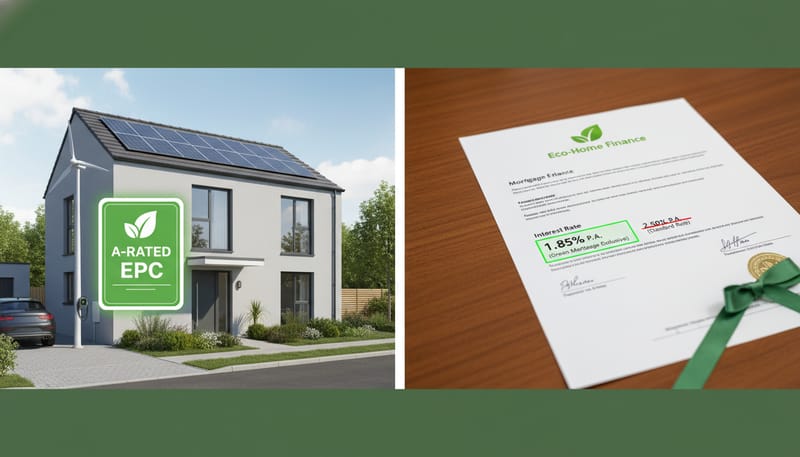
What Are Green Mortgages?
A green mortgage is a mortgage product that offers preferential terms — typically a lower interest rate or cashback incentive — to borrowers purchasing an energy-efficient home. In the UK, green mortgages are generally available to buyers of properties with an EPC rating of A or B, which means most new build homes automatically qualify.
The concept is straightforward: lenders recognise that homeowners with lower energy bills have more disposable income available to service their mortgage repayments. This makes them statistically lower risk, which justifies offering better rates. For buyers, this translates to lower monthly payments on top of the energy bill savings they are already enjoying.
Green mortgages have grown significantly in the UK market since 2020, with most major high street lenders now offering some form of green or energy-efficient product. For new build buyers, this is particularly advantageous — because modern homes are built to current Building Regulations, the vast majority achieve an EPC B rating or above, giving you automatic access to these preferential deals without any additional effort or expense.
This guide covers everything you need to know about green mortgages in the UK: which lenders offer them, what rates and incentives are available, how much you can save over the life of your mortgage, and how to apply. Whether you are a first-time buyer or moving home, understanding green mortgages could save you thousands of pounds.
How Green Mortgages Work
Green mortgages work in the same way as standard mortgage products, with the key difference being the eligibility criteria and the financial incentive offered. Here is how the process typically works:
Eligibility Requirements
To qualify for a green mortgage in the UK, your property must meet certain energy efficiency criteria. The most common requirement is:
- EPC rating of A or B: This is the standard threshold for most green mortgage products from major lenders
- Valid EPC certificate: The certificate must be current (less than 10 years old) and registered on the national EPC register
- Standard lending criteria still apply: You must meet the lender’s usual affordability, credit, and deposit requirements
- Some products accept C ratings: A small number of lenders offer green products for C-rated homes, though the incentives are typically smaller
Types of Green Mortgage Incentives
Lenders offer green mortgage benefits in several forms, and it is worth understanding the differences to choose the product that offers you the best value:
| Incentive Type | How It Works | Typical Value | Best For |
|---|---|---|---|
| Rate discount | Lower interest rate than equivalent standard product | 0.05% – 0.15% reduction | Long-term savings over the full mortgage term |
| Cashback | Lump sum paid after completion | £250 – £500 | Immediate cash for moving costs or furnishing |
| Free valuation | Valuation fee waived | £250 – £400 saving | Reducing upfront purchase costs |
| Reduced fees | Lower or waived arrangement fee | £500 – £1,000 saving | Minimising overall mortgage costs |
| Additional borrowing | Extra lending at preferential rate for green improvements | Up to £25,000 | Funding upgrades like solar panels or heat pumps |
The most valuable incentive is typically the rate discount, because even a small reduction in interest rate compounds significantly over a 25 or 30-year mortgage term. A 0.10% rate reduction on a £250,000 mortgage saves approximately £2,500 – £3,000 over 25 years, making it far more valuable than a one-off cashback payment.
Green Mortgage Lenders: Who Offers What
The green mortgage market in the UK has expanded rapidly, with most major lenders now offering dedicated products. Below is a comprehensive comparison of green mortgage products from leading UK lenders, current as of 2024/25:
| Lender | Product Name | EPC Requirement | Rate Benefit | Cashback | Other Benefits |
|---|---|---|---|---|---|
| Barclays | Green Home Mortgage | A or B | Up to 0.10% discount on selected fixed rates | None | Available for purchase and remortgage; includes flats and houses |
| NatWest | Green Mortgage | A or B | Competitive rates across 2, 3, and 5-year fixes | £250 | Dedicated green mortgage range; includes new builds |
| Halifax | Green Living Reward | A or B | Standard rates apply | £500 | Cashback paid within first year; can be combined with other Halifax offers |
| Nationwide | Green Additional Borrowing | Any (for improvement lending) | Discounted rate on additional borrowing for green improvements | None | Borrow up to £25,000 for energy improvements at reduced rates |
| Virgin Money | Green Mortgage Range | A or B | Reduced rates across their mortgage range | None | Available for purchase, remortgage, and product transfer |
| Ecology Building Society | Energy-Efficient Mortgage | A (or Passivhaus certification) | Up to 1.00% discount for highest efficiency | None | Specialist lender; also offers discounts for self-build eco homes |
Rates and products change frequently. Always check directly with lenders or use a mortgage broker for the latest deals. Information correct as of early 2025.
Specialist and Smaller Lenders
Beyond the high street banks, several specialist and smaller lenders offer green mortgage products that may suit certain buyers:
- Ecology Building Society: The UK’s leading specialist in sustainable property lending. They offer the most generous rate discounts (up to 1.00%) but have stricter requirements — typically needing an A rating or Passivhaus certification
- Saffron Building Society: Offers a green mortgage product with rate discounts for energy-efficient homes
- Kensington Mortgages: Has introduced green options for borrowers with complex income situations
- Perenna: A newer lender offering long-term fixed rates with green incentives
It is worth speaking to a whole-of-market mortgage broker who can compare all available green products and find the deal that offers the best overall value for your circumstances. Sometimes a standard mortgage with a very competitive rate may still beat a green mortgage with a smaller discount.
How Much Can You Save with a Green Mortgage?
The financial benefit of a green mortgage depends on several factors: the size of your loan, the interest rate discount, and the length of your mortgage term. To illustrate the potential savings, let us compare a standard mortgage against a green mortgage over different scenarios:
Savings Example: £250,000 Mortgage over 25 Years
| Scenario | Interest Rate | Monthly Payment | Total Interest Paid | Saving vs Standard |
|---|---|---|---|---|
| Standard mortgage | 4.50% | £1,390 | £166,920 | — |
| Green mortgage (0.05% discount) | 4.45% | £1,383 | £164,840 | £2,080 |
| Green mortgage (0.10% discount) | 4.40% | £1,376 | £162,780 | £4,140 |
| Green mortgage (0.15% discount) | 4.35% | £1,369 | £160,740 | £6,180 |
| Ecology BS (1.00% discount) | 3.50% | £1,252 | £125,520 | £41,400 |
Illustrative figures based on a repayment mortgage. Actual rates depend on your deposit, credit history, and lender criteria. Most borrowers remortgage every 2–5 years, so lifetime savings depend on green products being available at each remortgage point.
Combined Savings: Green Mortgage + Energy Efficiency
The real power of buying an energy-efficient new build with a green mortgage is the combined saving. When you add the mortgage interest reduction to the lower energy bills of a B-rated home, the total financial benefit becomes substantial:
| Saving Category | Annual Saving | 25-Year Total |
|---|---|---|
| Green mortgage rate discount (0.10%) | £166/year | £4,140 |
| Energy bill saving vs D-rated home | £660/year | £16,500 |
| Water bill saving (metered vs unmetered) | £100/year | £2,500 |
| Lower insurance premiums | £80/year | £2,000 |
| Total combined saving | £1,006/year | £25,140 |
Over 25 years, the combined savings of a green mortgage and energy-efficient new build amount to over £25,000 compared to buying an average D-rated home with a standard mortgage. This goes a significant way towards offsetting the new build price premium and demonstrates the long-term financial logic of energy-efficient housing.
The New Build Advantage and Government Schemes
One of the most significant advantages of buying a new build home is that you automatically qualify for green mortgage products without needing to make any additional improvements. Under current Building Regulations Part L (2021 update), all new homes in England must achieve substantially higher energy efficiency standards than previous regulations, and the vast majority achieve an EPC rating of B or above.
Why New Builds Qualify Automatically
Modern new build homes achieve their high EPC ratings through a combination of features that are now standard across the industry:
- High-performance insulation: Full cavity wall insulation, 270mm+ loft insulation, and insulated ground floors
- Efficient heating: High-efficiency condensing boilers (89–94%) or air source heat pumps (300–400% effective efficiency)
- Modern glazing: Double or triple glazed windows with low-emissivity coatings and argon gas fill
- Airtight construction: Tested to ensure minimal air leakage, reducing heat loss
- LED lighting: 100% low-energy lighting throughout the home
- Efficient ventilation: Mechanical extract ventilation or MVHR systems
This means that when you apply for a green mortgage to buy a new build, the energy efficiency requirement is essentially pre-satisfied. You do not need to commission a separate energy assessment or make improvements to qualify — the developer provides the EPC as part of the standard sales process.
Combining Green Mortgages with Government Schemes
Green mortgages can often be combined with government home-buying schemes, providing additional financial benefits for eligible buyers:
| Government Scheme | Compatible with Green Mortgages? | Key Benefits |
|---|---|---|
| Shared Ownership | Yes — some lenders offer green Shared Ownership products | Buy a share (25–75%) with lower deposit; green rates on your mortgage portion |
| First Homes | Yes — where the underlying mortgage qualifies | 30–50% discount on new build homes for first-time buyers |
| Right to Buy | Potentially — depends on the property’s EPC after purchase | Discounted purchase of council homes; green rates if EPC meets threshold |
| Forces Help to Buy | Yes — where the mortgage lender offers green products | Interest-free loan for armed forces personnel |
If you are using Shared Ownership to buy a new build apartment, check whether your lender offers a green version of their Shared Ownership mortgage. This can provide the rate discount or cashback on top of the affordability benefits of shared ownership itself.
Why Lenders Offer Green Mortgages and How to Apply
The Lender’s Perspective
Understanding why lenders offer green mortgages helps explain the trend and why these products are likely to become even more generous over time:
- Lower default risk: Homeowners with lower energy bills have more disposable income to make mortgage payments, reducing the risk of arrears and default. Research by the Energy Efficient Mortgages Action Plan (EeMAP) found that energy-efficient homes have 20–30% lower default rates
- Asset value protection: Energy-efficient homes hold their value better and are less susceptible to future regulatory changes (such as minimum EPC requirements for rentals). This protects the lender’s security
- ESG commitments: Banks and building societies are under increasing pressure to demonstrate their environmental, social, and governance (ESG) credentials. Offering green mortgages helps them meet lending portfolio targets and regulatory expectations
- Regulatory direction: The Bank of England and Financial Conduct Authority are actively encouraging green finance. Lenders who build green product expertise now will be better positioned as regulations tighten
- Customer demand: A growing number of buyers actively seek out sustainable options. Green mortgages help lenders attract and retain these customers
How to Apply for a Green Mortgage
Applying for a green mortgage follows the same process as a standard mortgage application, with one additional step — providing evidence of your property’s energy efficiency. Here is the process:
- Get a Mortgage Agreement in Principle (AIP): Most lenders can issue an AIP for their green products before you have identified a specific property
- Choose your new build home: Reserve your plot and obtain the predicted EPC rating from the developer
- Apply for the green mortgage: Submit your full application, specifying the green product. Your broker or the lender will confirm the property qualifies
- Provide the EPC: The lender will verify the property’s EPC rating. For new builds, this is usually available before or at legal completion
- Completion: Once the mortgage offer is issued and the property is ready, you complete in the normal way. Any cashback is typically paid within the first few months
The key advice is to work with a mortgage broker who understands both the new build market and the green mortgage landscape. They can compare all available products and ensure you are getting the best deal, not just the best green deal.
The Future of Green Mortgages in the UK
Green mortgages are still a relatively young product category in the UK, but the direction of travel is clear — they will become increasingly mainstream and increasingly generous. Several factors are driving this trend:
Regulatory Drivers
The UK government has committed to achieving net zero carbon emissions by 2050, and the housing sector is a critical part of this plan. The Future Homes Standard, due for full implementation by 2025, will require all new homes to produce 75–80% less CO2 than current standards. This means future new builds will achieve even higher EPC ratings, potentially making A ratings standard rather than exceptional.
For the existing housing stock, the government has discussed introducing minimum EPC requirements for mortgage lending. While no firm date has been set, industry expectations are that lenders will eventually need to consider the energy efficiency of their entire mortgage book, creating a strong incentive to attract energy-efficient properties and encourage improvements to less efficient ones.
What to Expect in Coming Years
- More generous incentives: As competition among lenders intensifies, expect larger rate discounts, higher cashback amounts, and additional perks
- Broader availability: Green products will be available across more product types, including Shared Ownership, buy-to-let, and self-build mortgages
- Whole-life carbon assessment: Future green mortgages may consider embodied carbon and sustainable materials alongside operational energy efficiency
- Smart data integration: Lenders may use smart meter data and smart home energy data to verify ongoing energy efficiency, potentially offering ongoing rate benefits
- Green retrofit lending: Expect more products that fund energy improvements to existing homes, such as solar panel installation or heat pump retrofits
Impact on Property Values
The growth of green mortgages is already affecting property values. Research from the Department for Energy Security and Net Zero suggests that homes with higher EPC ratings command a premium of 5–14% compared to equivalent lower-rated properties. As green finance becomes more mainstream, this premium is expected to grow, benefiting owners of energy-efficient new build homes at resale.
Frequently Asked Questions
Do all new build homes qualify for green mortgages?
The vast majority do. Most new build homes achieve an EPC rating of B or above, which meets the standard threshold for green mortgage products. However, the qualification depends on the specific lender’s requirements. Some homes built to older building regulations (pre-2021) may achieve a C rating, which qualifies with fewer lenders. Always check the EPC rating of your chosen property and confirm eligibility with your lender or broker.
Is a green mortgage always cheaper than a standard mortgage?
Not always. While green mortgages offer a discount or incentive relative to the same lender’s standard product, a different lender may offer a lower standard rate that beats the green deal. This is why it is essential to compare all available mortgages, not just green ones. A good mortgage broker will do this comparison for you and recommend the best overall deal.
Can I get a green mortgage as a first-time buyer?
Yes. Green mortgages are available to all buyer types, including first-time buyers. In fact, first-time buyers purchasing a new build home are ideally positioned — you get the green mortgage benefits on top of any first-time buyer incentives such as Stamp Duty relief on properties up to £425,000 and potential developer incentives.
What happens if I remortgage — can I get another green deal?
Yes. When your initial fixed rate period ends and you remortgage, you can apply for another green mortgage product. As long as your property still has a valid EPC of A or B (EPCs last 10 years), you remain eligible. The green mortgage market is growing, so you may find even better deals available when you come to remortgage.
Do green mortgages apply to buy-to-let properties?
Some lenders offer green buy-to-let mortgage products, though the market is less developed than for residential mortgages. As minimum EPC requirements for rental properties continue to tighten (the government has proposed a minimum C rating for all rented homes), expect more green buy-to-let products to emerge. If you are purchasing a new build as a buy-to-let investment, the high EPC rating will be an increasing advantage.
Making the Most of Green Mortgage Opportunities
Green mortgages represent a genuine financial opportunity for anyone buying an energy-efficient new build home. With rate discounts of up to 0.15% from high street lenders — and up to 1.00% from specialist providers like Ecology Building Society — the potential savings over a 25-year mortgage term are significant.
The beauty of buying a new build is that qualification is effectively automatic. Your home’s EPC rating of B or above opens the door to green products without any additional cost or effort on your part. When you combine the mortgage savings with the lower running costs of an energy-efficient home, the total financial benefit over the life of your mortgage can exceed £25,000.
As the UK continues its transition towards net zero housing, green mortgages are likely to become even more attractive. Lenders are competing to offer better green products, the Future Homes Standard will push new builds to even higher efficiency levels, and the resale premium for energy-efficient homes continues to grow.
To find the best green mortgage for your new build purchase, speak to a whole-of-market mortgage broker who can compare all available products. And for more guidance on the complete buying process, explore our step-by-step new build buying guide or browse available new build homes across the UK.