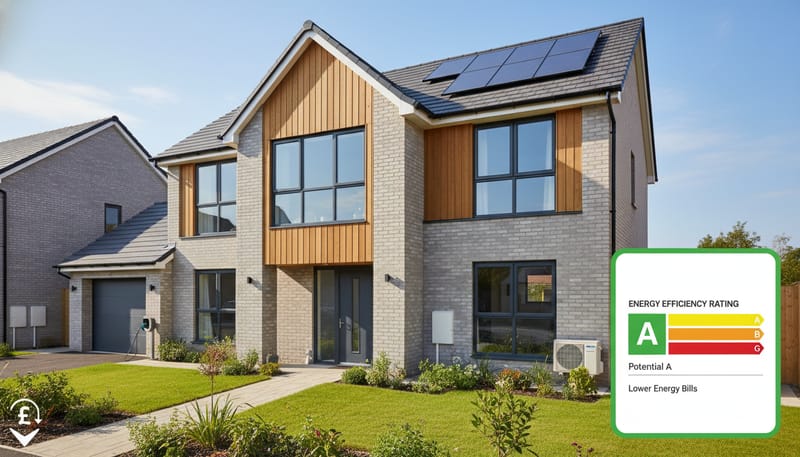
What Is an EPC Rating?
An Energy Performance Certificate (EPC) is a legal requirement for any property being sold or rented in the UK. Introduced under the Energy Performance of Buildings Regulations, an EPC rates a property's energy efficiency on a scale from A (most efficient) to G (least efficient). The certificate is valid for 10 years and provides prospective buyers with a clear indication of how much energy the home uses and what the likely running costs will be.
For anyone buying a new build home, understanding EPC ratings is essential. The rating directly impacts your annual energy bills, your home's environmental footprint, and increasingly, the mortgage rates available to you. New build homes are constructed to modern building regulations, which means they typically achieve significantly better EPC ratings than older properties.
Every EPC includes two key elements: a current energy efficiency rating and a potential rating showing what could be achieved with recommended improvements. For new builds, the gap between current and potential is usually minimal, reflecting the modern construction standards already in place.
The EPC Rating Scale
Below is the official EPC rating scale with colour codes used on certificates across England, Wales, and Scotland:
Most new build homes achieve a B or C rating, highlighted above. The average UK home is rated D.
| Rating | Score Range | Colour | Typical Property |
|---|---|---|---|
| A | 92 – 100 | Dark Green | Passivhaus or near-zero carbon homes with solar panels and heat pumps |
| B | 81 – 91 | Light Green | Modern new builds (post-2021), well-insulated with efficient heating |
| C | 69 – 80 | Yellow-Green | New builds (2013–2021), some older homes with upgrades |
| D | 55 – 68 | Yellow | Average UK home — 1980s–2000s construction |
| E | 39 – 54 | Orange | Older homes with partial insulation, single-glazed windows |
| F | 21 – 38 | Red-Orange | Pre-war properties with little or no insulation |
| G | 1 – 20 | Red | Listed buildings, unimproved period properties |
What EPC Rating Do New Builds Get?
Under current Building Regulations Part L (2021 update), all new homes in England must produce approximately 31% less CO2 than the previous 2013 standard. In practice, this means the vast majority of new build homes now achieve a B rating, with some reaching the lower end of A. Homes built between 2013 and 2021 typically achieve a C rating, which is still significantly above the national average of D.
The upcoming Future Homes Standard, expected to take full effect by 2025, will push new homes to produce 75–80% less CO2 than previous standards, making an A rating the new norm for newly built properties.
Different developers use varying specifications, which means EPC ratings can differ from one housebuilder to another. Below is a summary of typical ratings by major UK developers:
| Developer | Typical EPC Rating | Standard Heating |
|---|---|---|
| Barratt Homes | B (83–88) | Gas boiler with smart thermostat |
| Persimmon Homes | B (81–86) | Gas boiler |
| Taylor Wimpey | B (82–87) | Gas boiler or air source heat pump |
| Bellway | B (81–85) | Gas boiler |
| Berkeley Group | B (84–90) | Communal heating or heat pump |
| Redrow | B (82–86) | Gas boiler with solar PV |
| Countryside Partnerships | A/B (88–93) | Air source heat pump |
| Hill Group | A/B (87–92) | Air source heat pump with solar PV |
Note: Ratings vary by development and house type. Always check the specific EPC for the plot you are considering. Your conveyancing solicitor will review the EPC as part of the buying process.
How EPC Ratings Affect Your Energy Bills
The difference between EPC ratings is not just a letter on a certificate — it translates directly into pounds saved or spent each year. Based on Ofgem's energy price cap and average household consumption data, here is a breakdown of estimated annual energy costs by EPC rating for a typical 3-bedroom home:
Annual Energy Cost by EPC Rating
Based on a 3-bed semi-detached home at 2024/25 energy price cap rates. Actual costs vary by location, usage, and tariff.
As the chart shows, moving from a D-rated older home to a B-rated new build can save you approximately £660 per year on energy bills. Over a typical 25-year mortgage period, that amounts to £16,500 in cumulative savings — a significant factor when comparing the new build pricing premium against long-term running costs.
What Affects Your EPC Rating?
- Insulation levels: Wall, roof, and floor insulation thickness and quality. New builds use full-fill cavity wall insulation or external wall insulation systems.
- Heating system: The type and efficiency of the primary heating system. Gas boilers achieve around 89–94% efficiency; heat pumps deliver 300–400% effective efficiency.
- Windows and doors: Double or triple glazing with low-emissivity coatings. New builds typically have double-glazed windows with a U-value of 1.2 or better.
- Lighting: Low-energy LED lighting throughout. New builds must have 100% low-energy fixed lighting.
- Renewable energy: Solar panels, heat pumps, and other renewable technologies can push ratings from B to A.
- Hot water system: Cylinder insulation, solar thermal panels, and efficient distribution reduce energy waste.
- Air tightness: Modern new builds are tested for air leakage, with rates well below the regulatory maximum of 10 m³/hr/m².
- Thermal bridging: Careful construction detailing at junctions reduces heat loss through the building fabric.
New Build vs Older Home: Energy Comparison
One of the most compelling arguments for buying a new build is the energy efficiency advantage. Here is a side-by-side comparison of a typical new build home versus the average existing UK property:
Insulation Performance Comparison
Insulation is the single biggest factor in energy efficiency. Here is how new build insulation compares to the average existing UK home across key building elements:
The difference is stark. New build wall insulation scores 95 out of 100 compared to just 40 for the average UK property. This translates to dramatically lower heat loss and, consequently, lower heating bills throughout the winter months. If you are comparing new builds against older properties, insulation quality should be a primary consideration alongside purchase price.
Understanding Your EPC Certificate
When you receive the EPC for a new build home, it contains several important sections beyond just the letter rating. Knowing how to read the certificate will help you make informed decisions about your purchase and identify areas where energy efficiency could be improved further.
Key Sections of the EPC
- Current and potential energy ratings: Shows the letter grade and numerical score. For new builds, the current rating is usually very close to the potential rating.
- Estimated energy costs: A breakdown of heating, hot water, and lighting costs per year based on standardised usage assumptions.
- Recommended improvements: A list of upgrades ranked by cost-effectiveness, with estimated savings for each.
- Environmental impact rating: A separate CO2 rating from A to G, indicating the home's carbon footprint.
- Heat demand and generation: Technical data on primary energy use, including space heating demand and hot water generation.
Energy Source Breakdown in a Typical New Build
Understanding where your energy goes is key to managing costs. Below is a typical breakdown for a B-rated new build home with a gas boiler:
Breakdown of energy use in a typical B-rated new build. Space heating accounts for the largest share, making insulation and heating efficiency the most impactful factors.
What to Check on Your EPC
- SAP rating: The numerical score (e.g., 84) calculated using the Standard Assessment Procedure. Higher is better.
- Environmental impact: Look for the CO2 rating, which is separate from the energy cost rating. A home can be efficient in cost terms but still have a high carbon footprint if it relies on gas.
- Heating costs breakdown: Compare the estimated heating, hot water, and lighting costs against your current bills to understand potential savings.
- Recommendations section: Even for new builds, there may be cost-effective improvements listed such as adding solar panels or upgrading the hot water system.
- Primary energy use: Measured in kWh/m²/year, this figure indicates the total energy consumed per square metre. Lower is better — new builds typically achieve 100–150 kWh/m²/year compared to 250+ for older homes.
How to Improve Your EPC Rating
While most new builds already achieve excellent EPC ratings, there are several improvements you can make either at the point of purchase (through developer upgrade options) or after moving in. Each improvement has different costs, energy savings, and payback periods.
Top Improvements Ranked by Impact
| Improvement | Typical Cost | EPC Impact | Payback Period |
|---|---|---|---|
| Solar PV panels (4kW system) | £6,000 – £8,000 | +8 to +15 points | 8–12 years |
| Air source heat pump | £8,000 – £14,000 | +10 to +20 points | 10–15 years |
| Upgrade to triple glazing | £3,000 – £7,000 | +3 to +6 points | 15–25 years |
| Hot water cylinder insulation jacket | £15 – £30 | +1 to +2 points | Under 1 year |
| Smart heating controls | £150 – £300 | +1 to +3 points | 1–3 years |
| LED lighting throughout | £50 – £150 | +1 to +2 points | Under 1 year |
| Loft insulation top-up (to 300mm) | £300 – £500 | +1 to +3 points | 2–4 years |
| Battery storage (with solar) | £4,000 – £7,000 | +2 to +5 points | 8–12 years |
When buying a new build, it is worth discussing upgrade options with your developer. Many offer upgrade packages that include solar panels or heat pump installations at discounted rates. These are often more cost-effective when installed during construction rather than retrofitted later.
Quick Wins After Moving In
- Smart thermostat installation: Products like Hive, Nest, or Tado can reduce heating bills by 10–15% through intelligent scheduling and geofencing.
- Draught-proofing: While new builds are relatively airtight, checking around loft hatches, letterboxes, and pipe penetrations can eliminate minor draughts.
- Efficient appliance choices: When furnishing your new build kitchen, choose A-rated or higher appliances. A high-efficiency washing machine or fridge-freezer uses 30–50% less energy than lower-rated models.
- Curtains and blinds: Thermal-lined window treatments can reduce heat loss through windows by up to 17% in winter.
- Hot water temperature: Setting your cylinder or combi boiler flow temperature to 55–60°C (rather than the typical default of 70°C) reduces energy waste without affecting comfort.
EPC Ratings and Mortgage Rates
An increasingly important benefit of buying an energy-efficient new build is access to green mortgage products. A growing number of UK lenders now offer preferential interest rates for properties with an EPC rating of B or above. This is sometimes referred to as a “green mortgage” or “energy-efficient mortgage.”
The logic is straightforward: homeowners with lower energy bills have more disposable income to service their mortgage, making them lower risk. For buyers, this means a better EPC rating can translate to a lower monthly mortgage payment as well as lower utility costs.
Green Mortgage Deals for Energy-Efficient Homes
| Lender | Product | Rate Benefit | EPC Requirement |
|---|---|---|---|
| Barclays | Green Home Mortgage | Up to 0.10% rate discount | A or B rating |
| NatWest | Green Mortgage | £250 cashback + lower rate | A or B rating |
| Halifax | Green Living Reward | £500 cashback | A or B rating |
| Nationwide | Green Additional Borrowing | Discounted rate for improvements | Any (for improvement lending) |
| Virgin Money | Green Mortgage Range | Reduced rates across range | A or B rating |
| Ecology Building Society | Energy-Efficient Mortgage | Up to 1.00% discount | A rating or Passivhaus |
For a detailed breakdown of mortgage rates for new builds, including current best-buy deals, see our dedicated mortgage comparison guide. It is worth noting that most new build homes automatically qualify for green mortgage products thanks to their B rating, giving buyers an additional financial advantage.
Beyond mortgage rates, EPC ratings may also affect your home's resale value. Research from the Department for Energy Security and Net Zero suggests that homes with higher EPC ratings command a premium of between 5% and 14% compared to equivalent lower-rated properties. As energy costs continue to rise and buyer awareness grows, this premium is expected to increase further.
Frequently Asked Questions
Do all new build homes have an EPC?
Yes. It is a legal requirement for all newly built homes in England, Wales, and Scotland to have a valid EPC before they can be sold. Your developer must provide this before completion. The assessment is carried out by a qualified Domestic Energy Assessor and the certificate is registered on the national EPC register.
Can a new build get an A rating?
Yes, but it is uncommon with standard specifications. Most new builds achieve a B rating. To reach an A rating (92+), a home typically needs renewable energy generation such as solar panels combined with a heat pump heating system and exceptional insulation. Some developments by forward-thinking builders such as Countryside Partnerships and Hill Group do achieve A ratings as standard.
Is a C-rated new build bad?
Not at all. A C rating is well above the national average of D. Homes built between 2013 and 2021 may achieve a C rating, and this still represents excellent energy efficiency by UK housing stock standards. However, a B-rated home will have lower running costs, so it is worth comparing the running costs of different properties.
How long does an EPC last?
An EPC is valid for 10 years from the date of issue. If you make significant improvements to your home (such as installing solar panels or a heat pump), you can choose to get a new assessment to reflect the improved rating, which may benefit you if you plan to sell or remortgage.
Can I see the EPC before buying?
Yes. You can search any property's EPC on the government's Find an Energy Certificate service. For new builds, the developer should provide the predicted EPC rating during the buying process, though the final certificate is issued after construction is complete.
Making the Most of Your New Build's Energy Efficiency
Understanding EPC ratings is essential for any new build buyer in the UK. With most new homes achieving a B rating, you are already benefiting from significantly lower energy bills compared to the average UK home. The annual savings of around £660 per year add up substantially over the life of your mortgage, and green mortgage products can further reduce your costs.
When comparing new build developments, pay close attention to the EPC rating and the specific features that contribute to it. A home with a heat pump and solar panels will not only cost less to run but will also be better positioned for future regulations and energy price increases.
For more guidance on the buying process, explore our comprehensive new build buying guide, or browse available new build homes across the UK. If you are a first-time buyer, our first-time buyer guide covers everything from deposits to government schemes that can help you get on the property ladder.