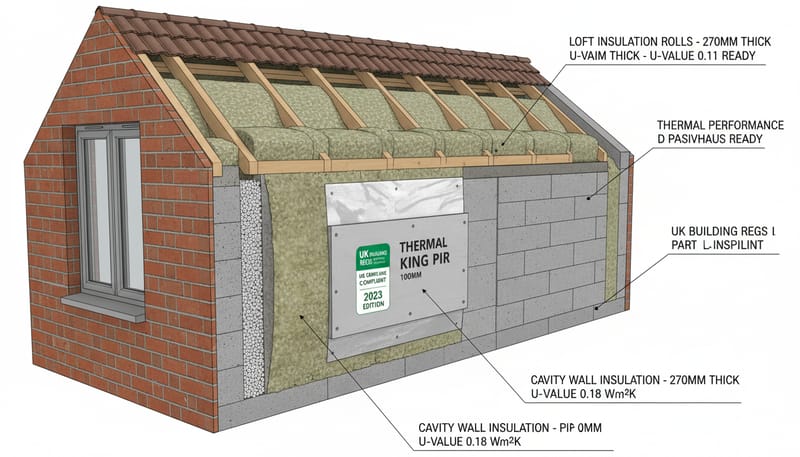
Why Insulation Matters in New Build Homes
Insulation is the single most important factor in determining how much energy your home uses and how comfortable it feels to live in. In a well-insulated new build, heat is retained within the building envelope for far longer, meaning your heating system runs less frequently and your energy bills stay low. Poor insulation, by contrast, is the primary reason why older UK homes are so expensive to heat.
Modern new build homes are built to significantly higher insulation standards than the existing UK housing stock. Under the current Building Regulations Part L (2021), new homes must achieve U-values (a measure of heat loss) that are roughly twice as good as those required just a decade ago. The upcoming Future Homes Standard will push these requirements even further, making insulation performance the cornerstone of energy-efficient house design.
This guide explains the types of insulation used in new build homes, the building regulations that govern them, and how to assess the thermal performance of any new property you are considering purchasing.
U-Values Explained: The Key to Understanding Insulation
A U-value measures the rate at which heat passes through a building element (wall, roof, floor, or window), expressed in watts per square metre per degree Kelvin (W/m²K). The lower the U-value, the better the insulation performance and the less heat escapes through that element.
Understanding U-values is essential when comparing new build homes, as they directly indicate how well-insulated each part of the building is. Here is how U-values translate to real-world performance:
U-Value Comparison Table: New Build vs Older Homes
| Building Element | Victorian Home | 1960s–1980s Home | Part L 2013 New Build | Part L 2021 New Build | Future Homes Standard |
|---|---|---|---|---|---|
| External walls | 1.60–2.10 W/m²K | 0.60–1.00 W/m²K | 0.30 W/m²K | 0.26 W/m²K | 0.15–0.18 W/m²K |
| Roof / loft | 1.50–2.30 W/m²K | 0.40–0.68 W/m²K | 0.20 W/m²K | 0.16 W/m²K | 0.11–0.13 W/m²K |
| Ground floor | 0.80–1.20 W/m²K | 0.45–0.70 W/m²K | 0.25 W/m²K | 0.18 W/m²K | 0.11–0.13 W/m²K |
| Windows | 4.80 W/m²K (single) | 2.80–3.10 W/m²K | 2.00 W/m²K | 1.40 W/m²K | 0.80–1.00 W/m²K |
| External doors | 3.00+ W/m²K | 2.00–3.00 W/m²K | 2.00 W/m²K | 1.40 W/m²K | 1.00 W/m²K |
The improvement is dramatic. A current Part L 2021 new build wall achieves a U-value of 0.26 W/m²K, meaning it loses heat at roughly one-sixth the rate of a typical Victorian solid wall. This single factor explains much of the difference in energy costs between new builds and older properties.
Cavity Wall Insulation in New Builds
The vast majority of new build homes in England use cavity wall construction — two leaves of masonry (typically an outer leaf of brick and an inner leaf of blockwork) separated by a cavity that is fully or partially filled with insulation. The cavity itself is typically 100–150mm wide, with insulation filling most or all of this space.
Types of Cavity Wall Insulation
| Insulation Type | Thermal Conductivity | Typical Thickness | Pros | Cons |
|---|---|---|---|---|
| PIR (Polyisocyanurate) | 0.022–0.025 W/mK | 75–100mm | Best thermal performance per mm; rigid boards; fire resistant; low moisture absorption | More expensive; requires careful fitting to avoid gaps |
| Mineral wool (Rockwool/Knauf) | 0.032–0.038 W/mK | 100–150mm | Excellent fire resistance (non-combustible); good acoustic performance; cost-effective | Lower thermal performance per mm; absorbs moisture if exposed |
| EPS (Expanded Polystyrene) | 0.030–0.034 W/mK | 100–125mm | Lightweight; good moisture resistance; cost-effective | Lower fire resistance than mineral wool; moderate performance |
| Phenolic foam (Kooltherm) | 0.018–0.021 W/mK | 60–90mm | Best available thermal performance; thin profile; fire resistant | Most expensive; can be brittle |
| Glass mineral wool | 0.032–0.040 W/mK | 100–150mm | Cost-effective; recycled content; non-combustible | Lower performance per mm; requires wider cavities |
In current Part L 2021 new builds, PIR boards and full-fill mineral wool are the two most common choices. PIR is preferred where cavity width is limited because its superior thermal conductivity achieves lower U-values in less thickness. Mineral wool is widely used where cavities are wider (125mm+) and where fire safety is a priority, particularly in buildings above 11 metres in height following post-Grenfell regulations.
Some developers use a partial-fill approach, where a rigid insulation board is fixed to the inner leaf with a residual air gap between the insulation and the outer leaf. This air gap provides additional protection against wind-driven rain penetration. Others use full-fill insulation, which maximises thermal performance but requires careful detailing to prevent moisture bridging.
Loft, Roof, and Floor Insulation
While walls represent the largest surface area of heat loss, the roof and ground floor also contribute significantly. New build homes address all three elements to create a complete thermal envelope.
Loft Insulation
In homes with a traditional cold roof (unheated loft space), insulation is laid between and over the ceiling joists at the loft floor level. The current Part L 2021 standard requires at least 270mm of mineral wool or equivalent to achieve a U-value of 0.16 W/m²K or better. This is typically installed as two layers:
- First layer (100mm): Laid between the ceiling joists to fill the joist depth
- Second layer (170mm): Laid perpendicular across the joists to cover the timber, which would otherwise create thermal bridges
Where the loft space is converted to habitable rooms (as in many 4–5 bedroom new builds), insulation is fitted between and below the rafters using rigid PIR boards or mineral wool quilts, with a vapour barrier on the warm side to prevent condensation.
Floor Insulation
New build ground floors are typically constructed as either beam and block or ground-bearing concrete slab systems, with insulation installed below or above the structural floor:
- Below-slab insulation: Rigid EPS or XPS (extruded polystyrene) boards are laid on compacted hardcore before the concrete slab is poured. This is the most common method in new builds. Typical thickness: 100–150mm.
- Above-slab insulation: PIR boards are laid on top of the concrete slab, beneath the screed. This approach is common where underfloor heating is installed, as the insulation directs heat upwards into the room rather than into the ground.
- Between-beam insulation: In beam and block floors, insulation (typically EPS or mineral wool) is fitted between the concrete beams before the screed is applied.
The Part L 2021 requirement for ground floors is a U-value of 0.18 W/m²K, achieved with approximately 100–125mm of high-performance insulation. Under the Future Homes Standard, this will tighten to 0.11–0.13 W/m²K, requiring significantly thicker or higher-performance floor insulation.
Airtightness Testing and the Blower Door Test
Insulation alone is not enough to create an energy-efficient home. If warm air leaks out through gaps and cracks in the building envelope, much of the insulation’s benefit is lost. This is why airtightness is a critical component of modern building regulations and a key differentiator between new builds and older homes.
How Airtightness Is Measured
Airtightness is measured using a blower door test, which is mandatory for all new build homes under Part L. The test involves sealing all intentional openings (trickle vents, extract fans), fitting a large fan into an external doorway, and pressurising the building to 50 Pascals above atmospheric pressure. The rate at which air leaks out is measured in cubic metres per hour per square metre of building envelope (m³/hr/m² at 50Pa).
Airtightness Standards
| Standard | Maximum Air Permeability | Description |
|---|---|---|
| Part L 2013 | ≤10 m³/hr/m² | Regulatory maximum; many homes achieved 5–8 |
| Part L 2021 (current) | ≤8 m³/hr/m² | Typical new build achieves 3–5 |
| Future Homes Standard | ≤5 m³/hr/m² | MVHR ventilation becomes essential at this level |
| Best practice new build | 1–3 m³/hr/m² | High-quality developers already achieve this |
| Passivhaus | ≤0.6 ACH at 50Pa | Ultra-low energy standard; approximately 0.6–1.0 m³/hr/m² |
When a home achieves an airtightness of 3 m³/hr/m² or below, mechanical ventilation becomes essential to maintain indoor air quality. This is why the Future Homes Standard effectively requires MVHR (mechanical ventilation with heat recovery) systems, which provide a controlled supply of fresh air while recovering up to 90% of the heat from outgoing air.
Common Air Leakage Points
Even in new builds, certain junctions and penetrations are more prone to air leakage:
- Service penetrations: Where pipes and cables pass through the building envelope (electrical sockets on external walls, plumbing penetrations, extract fan ducts)
- Loft hatches: The junction between the loft hatch and the ceiling frame is a common leakage point if not properly sealed and insulated
- Window and door frames: Gaps between the frame and the structural opening can allow air infiltration if not correctly sealed with expanding foam and finished with airtightness tape
- Floor-to-wall junctions: The junction between the ground floor slab and the external walls can be a thermal bridge and air leakage path
- Intermediate floors: Where first-floor joists are built into external walls, air can track along the joist ends into the cavity
Thermal Bridging and SAP Calculations
A thermal bridge (sometimes called a cold bridge) occurs at any point where the continuity of the insulation layer is broken, allowing heat to escape more rapidly. Common thermal bridges in new build construction include window reveals, door thresholds, wall-to-floor junctions, wall-to-roof junctions, and around lintels above windows.
Thermal bridging can account for 20–30% of total heat loss in a well-insulated building, making it a critical consideration in modern construction. Developers use several strategies to minimise thermal bridging:
- Insulated cavity closers: Pre-formed insulated closers are fitted around window and door openings to maintain the insulation layer across the cavity.
- Insulated lintels: Steel lintels with built-in insulation replace traditional uninsulated lintels above windows and doors.
- Thermally broken thresholds: Doorway thresholds with insulating breaks prevent heat loss at the floor-to-door junction.
- Enhanced junction details: Accredited construction details (ACDs) or independently calculated psi-values demonstrate that junctions meet thermal performance targets.
SAP Calculations
The Standard Assessment Procedure (SAP) is the UK government’s methodology for assessing the energy performance of dwellings. Every new build home must undergo a SAP calculation to demonstrate compliance with Part L and to generate the property’s EPC rating.
SAP takes into account:
- Building fabric: U-values of walls, roof, floor, windows, and doors, plus thermal bridging (psi-values)
- Airtightness: The design air permeability target
- Heating system: Type and efficiency of the primary heating system (heat pump, gas boiler, etc.)
- Hot water system: Cylinder losses, pipework insulation, and generation method
- Ventilation: Type of ventilation system (natural, MEV, or MVHR) and associated fan energy
- Lighting: Proportion of low-energy (LED) lighting
- Renewable energy: Contribution from solar PV, solar thermal, or other renewables
The SAP calculation produces two key outputs: the Dwelling Emission Rate (DER), which must be below the Target Emission Rate (TER), and the Dwelling Fabric Energy Efficiency (DFEE), which must be below the Target Fabric Energy Efficiency (TFEE). Both must pass for the home to receive building regulations approval.
Current Building Regulations Requirements
Here is a summary of the key Part L 2021 insulation and energy requirements that all new build homes in England must meet:
| Requirement | Part L 2021 Specification | Notes |
|---|---|---|
| Wall U-value | ≤0.26 W/m²K | Many developers achieve 0.20–0.24 |
| Roof U-value | ≤0.16 W/m²K | Requires 270mm+ mineral wool or equivalent |
| Floor U-value | ≤0.18 W/m²K | 100–125mm rigid insulation typical |
| Window U-value | ≤1.40 W/m²K | High-performance double glazing standard |
| Door U-value | ≤1.40 W/m²K | Insulated composite doors standard |
| Air permeability | ≤8 m³/hr/m² at 50Pa | Blower door test mandatory |
| CO2 target | 31% below Part L 2013 | DER must be ≤ TER |
| Fabric energy efficiency | DFEE ≤ TFEE | Prevents over-reliance on technology to compensate for poor fabric |
| Lighting | 100% low-energy (LED) | All fixed lighting must be low energy |
| Heating system | High-efficiency boiler or heat pump | Gas boilers must be ≥92% efficient; heat pumps preferred |
It is important to note that these are minimum standards. Many quality developers exceed these requirements, particularly on insulation U-values and airtightness. When comparing developments, ask for the specific SAP data or design specifications to see how each developer performs against the minimum.
Frequently Asked Questions
Can I add more insulation to a new build?
New builds are already well-insulated, but there are some options for improvement. You can top up loft insulation above the standard 270mm (adding an extra 100mm is cheap and effective). Internal wall insulation or external wall insulation is possible but rarely cost-effective on a new build. The best time to upgrade insulation is during construction through developer upgrade options.
What is thermal mass and does it matter in new builds?
Thermal mass refers to a material’s ability to absorb and slowly release heat. Dense materials like concrete blocks and brick have high thermal mass, which helps regulate indoor temperatures by absorbing excess heat during the day and releasing it at night. New build masonry homes benefit from this effect. Timber-frame homes have lower thermal mass but can compensate with phase-change materials or exposed concrete elements.
How can I check the insulation in my new build?
Request the SAP calculation from your developer, which will list the U-values for every building element. You can also check the construction details in the building control documentation. For a physical check, a thermal imaging survey (best done in winter) can reveal any insulation gaps, thermal bridges, or areas of poor installation. Some new build snagging companies offer thermal imaging as part of their inspection service.
Is timber frame or masonry better insulated?
Both construction methods can achieve identical U-values. Timber frame homes place insulation within the structural frame (between the studs), while masonry homes use cavity insulation between the brick and block leaves. Timber frame can sometimes achieve slightly better airtightness due to fewer wet trades and joints. The choice between the two often comes down to developer preference, regional tradition, and acoustic performance rather than thermal performance.
Will insulation standards continue to improve?
Yes. The Future Homes Standard will require U-values approximately 30–40% better than current Part L 2021 standards. Beyond the FHS, there is growing interest in Passivhaus and net zero energy standards, which require even higher insulation levels. Homes built to higher standards today will remain competitive in the future housing market.
Understanding Your New Build’s Thermal Performance
Insulation is the foundation of an energy-efficient home. The U-values, airtightness, and thermal bridging performance of your new build directly determine your heating bills, comfort levels, and the home’s environmental impact. Modern new builds achieve insulation standards that are dramatically better than the existing UK housing stock, and this gap will widen further under the Future Homes Standard.
When comparing new build developments, do not just look at the EPC rating — ask for the specific U-values, airtightness targets, and SAP data. These figures give you a precise picture of how the home will perform and what your running costs will be. A home with better-than-minimum insulation may cost slightly more upfront but will save you money every year for decades to come.
For more on the energy features that affect new build performance, explore our guides on heat pumps, triple glazing, ventilation systems, and solar panels. Browse available new build homes to find your next energy-efficient property.