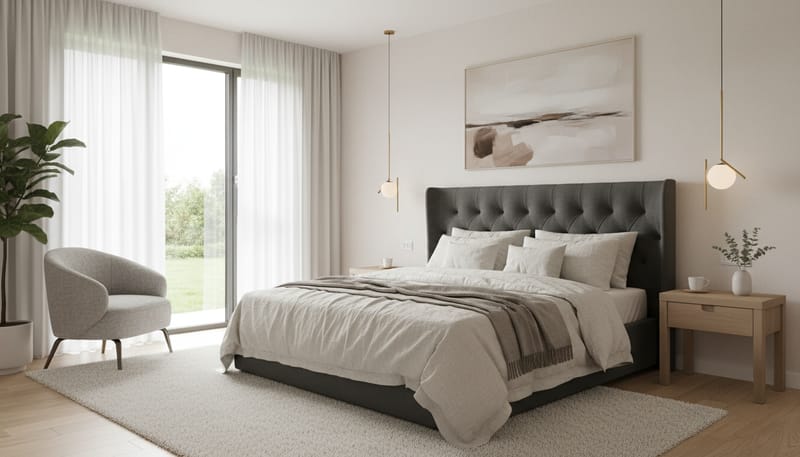
What Your Developer Provides as Standard
Before you start planning purchases, it helps to understand what arrives with your new build bedroom on handover day. Developers invest heavily in specification, and the starting point is better than many buyers expect.
- Walls: Smooth plastered finish in white or magnolia emulsion, ready for repainting or wallpapering after settlement drying
- Flooring: Mid-range twist-pile carpet in neutral grey, beige, or oatmeal, typically with basic underlay
- Windows: Double-glazed uPVC units meeting Part L energy efficiency requirements, often larger than in older properties
- Heating: Radiator with thermostatic valve, or underfloor heating in premium developments
- Electrics: Central ceiling pendant point, double sockets on at least two walls, TV aerial point in master bedroom
- Lighting: Single pendant bulb holder; some premium developments include recessed downlights
- Wardrobe space: Alcove or designated wardrobe area; some developers include fitted sliding-door wardrobes
- Door: Internal door with chrome or brushed nickel handle, typically hollow-core in standard specification
- Smoke alarm: Ceiling-mounted, interlinked with the whole house as per Building Regulations
This is a solid foundation. Your job is to layer comfort, personality, and practical storage on top of it. For a full overview of what to expect at handover, see our decorating a new build home guide.
Typical New Build Bedroom Dimensions
Understanding your room sizes is the essential first step. New build bedrooms follow fairly consistent patterns depending on the property type, and knowing your dimensions prevents expensive furniture mistakes. The table below shows what to expect across common UK new build property types.
| Bedroom | Typical Width | Typical Length | Approx. Area | Best Bed Size |
|---|---|---|---|---|
| Master (3-bed house) | 3.2 m | 3.5 m | 11.2 sq m | King (150 x 200 cm) |
| Master (4/5-bed house) | 3.5 m | 4.0 m | 14.0 sq m | Super King (180 x 200 cm) |
| Master (2-bed apartment) | 3.0 m | 3.5 m | 10.5 sq m | King (150 x 200 cm) |
| Second bedroom (house) | 2.8 m | 3.2 m | 9.0 sq m | Double (135 x 190 cm) |
| Third bedroom (house) | 2.2 m | 2.7 m | 5.9 sq m | Single (90 x 190 cm) |
| Box room / study | 2.0 m | 2.4 m | 4.8 sq m | Single or day bed |
These figures are averages. Always measure your specific rooms before ordering furniture. Use masking tape on the floor to mark out bed and wardrobe footprints so you can physically walk around the layout before committing to purchases.
Bed Size Guide: Matching Bed to Room
Selecting the right bed size is about more than personal comfort. You need enough clearance for bedside tables, wardrobe doors, and comfortable movement around the room. The UK standard bed sizes and the minimum room dimensions required for each are set out below.
| Bed Size | Mattress Dimensions | Min. Room Width | Min. Room Length | Best Suited To | Frame Cost Range |
|---|---|---|---|---|---|
| Single | 90 x 190 cm | 2.1 m | 2.7 m | Children, box rooms, guest singles | £100 – £400 |
| Small Double (4ft) | 120 x 190 cm | 2.5 m | 2.7 m | Teens, guest rooms, compact second bedrooms | £150 – £500 |
| Double | 135 x 190 cm | 2.7 m | 3.0 m | Second bedrooms, couples in compact rooms | £200 – £800 |
| King | 150 x 200 cm | 3.0 m | 3.3 m | Master bedrooms in 3-bed houses and apartments | £300 – £1,200 |
| Super King | 180 x 200 cm | 3.4 m | 3.5 m | Large master bedrooms in 4/5-bed houses | £400 – £2,500 |
A practical rule of thumb: you need at least 60 cm of clearance on each accessible side of the bed for comfortable movement, and 75 cm if wardrobe doors or drawers open into that space. If the bed pushes against one wall, ensure the accessible side and the foot of the bed still have adequate room.
Master Bedroom Design: Getting It Right
The master bedroom deserves the most attention. It is where you spend the most time, and a well-designed master bedroom genuinely improves daily life. Here are the principles that make the biggest difference.
- Anchor with the bed: Position the bed as the focal point, ideally centred on the longest wall opposite the door so it is the first thing you see when entering
- Symmetry calms: Matching bedside tables and lamps on both sides of the bed create visual balance that the brain reads as restful and ordered
- Layer your lighting: Combine overhead, bedside, and accent lighting on separate switches so you can adjust the mood from bright to softly lit
- Invest in the mattress first: A £700 mattress on a £250 frame will always outperform a £700 frame with a £250 mattress
- Prioritise storage: Clutter is the enemy of rest; fitted wardrobes, ottoman beds, and drawer organisers keep surfaces clear
- Control light ruthlessly: New builds often have larger windows than older homes; blackout solutions are essential for quality sleep
- Limit electronics: Keep televisions, laptops, and exercise equipment out of the master bedroom if possible; the room should signal sleep, not activity
- Choose carpet carefully: The master bedroom is where you walk barefoot most; a wool-blend twist pile or plush Saxony makes a noticeable comfort difference
For master bedrooms with an en-suite, consider the visual flow between the two spaces. Coordinating colour palettes and finishes creates a cohesive feel. Our new build bathroom design guide covers en-suite considerations in detail.
Mattress Types Compared
The mattress is your most important bedroom investment. You spend roughly a third of your life on it, and the difference between a poorly chosen mattress and the right one is measurable in sleep quality, back health, and daily energy. The UK market in 2026 offers four main types.
| Mattress Type | How It Works | Best For | Lifespan | King-Size Cost | Top UK Brands |
|---|---|---|---|---|---|
| Pocket Sprung | Individually wrapped springs move independently for targeted support | Couples (minimal motion transfer), back sleepers, those who sleep hot | 8 – 10 years | £400 – £3,500 | Hypnos, Harrison Spinks, Vispring, Sleepeezee |
| Memory Foam | Viscoelastic foam contours to body shape, distributing weight evenly | Side sleepers, joint pain sufferers, pressure point relief | 7 – 10 years | £300 – £1,200 | Emma, Nectar, Tempur, Dormeo |
| Hybrid | Pocket spring core with foam or latex comfort layers on top | All sleeping positions, couples with different preferences | 8 – 10 years | £500 – £1,800 | Simba, Emma Hybrid, Brook + Wilde, Eve |
| Natural Latex | Responsive latex provides bounce and breathability; hypoallergenic | Allergy sufferers, eco-conscious buyers, warm sleepers | 12 – 20 years | £800 – £2,500 | Dunlopillo, Natural Sleep Co., Naturalmat |
- Side sleepers: Choose medium to medium-soft; the mattress must cushion shoulders and hips
- Back sleepers: Choose medium to medium-firm; you need spinal curve support without sinking
- Stomach sleepers: Choose firm; prevents hip sinking and lower back strain
- Couples with different needs: Consider zip-and-link mattresses from Hypnos or Harrison Spinks, where two singles zip together as a king
Most bed-in-a-box brands offer generous trial periods: Emma offers 200 nights, Simba offers 200 nights, and Nectar offers 365 nights. Take advantage of these. A mattress that feels perfect in a showroom may not suit your sleeping position over several weeks at home.
Bedding and Layers
Quality bedding transforms a functional bed into one you genuinely look forward to climbing into. The layers work together to regulate temperature, provide comfort, and create the visual appeal of a well-dressed bed.
- Mattress protector: Essential. Waterproof or moisture-wicking; protects your mattress investment. Budget £20 – £60 from John Lewis or The White Company
- Fitted sheet: Egyptian cotton percale for a cool, crisp feel or sateen for silky smoothness. £25 – £80 for king-size
- Duvet: All-seasons (4.5 tog + 9 tog that button together for 13.5 tog) suits new builds perfectly, as consistent insulation means fewer temperature extremes. £60 – £280
- Duvet cover set: White or neutral creates a hotel feel; patterned adds personality. £30 – £170 depending on fabric and brand
- Pillows: One firm support pillow plus one softer pillow per person. Replace every 2 – 3 years. £15 – £90 each
- Throw: A textured throw across the foot of the bed in a contrasting fabric. Chunky knit on smooth cotton, or velvet on linen. £30 – £100
- Scatter cushions: Two or three maximum. More than that becomes a nightly annoyance. £10 – £40 each
The best UK sources for quality bedding include The White Company (benchmark quality, Egyptian cotton from £50 per set), John Lewis (excellent own-brand range), Bedfolk (direct-to-consumer linen and cotton), and Dunelm (the Dorma range offers 300-thread-count cotton from £30). For maximum longevity, wash bedding at 60 degrees every one to two weeks and replace duvets every five to eight years.
Fitted vs Freestanding Wardrobes
Wardrobe choice has a bigger impact on bedroom functionality than almost any other decision. It determines how much you can store, how tidy the room feels, and how the space flows. Here is a direct comparison of the three main approaches available to UK buyers.
| Feature | Fitted Wardrobes (Sharps, Hammonds) | Freestanding Wardrobes | IKEA PAX System |
|---|---|---|---|
| Cost (2.4 – 3.0 m wall) | £2,500 – £8,000 | £200 – £1,500 | £600 – £1,800 |
| Storage efficiency | Excellent – floor to ceiling, wall to wall, no dead space | Moderate – gaps above and beside units waste space | Good – configurable internals, slight top gap unless trimmed |
| Customisation | Fully bespoke: internal layout, door style, finish, lighting | Limited to available sizes and styles from the manufacturer | Highly configurable from standard components; 50+ door finishes |
| Installation | Professional survey, manufacture, and installation (4 – 8 weeks lead) | Self-assembly or flat-pack delivery; immediate | Self-assembly or IKEA assembly service (£100 – £250) |
| Moves with you? | No – built into the room; becomes a fixture | Yes – take it to your next property | Partially – can be disassembled but prone to damage |
| Adds property value? | Yes – quality fitted wardrobes are a selling point | No – personal furniture, not a property feature | Minimal – perceived as semi-permanent |
| Best new build fit | Straight, plumb new build walls make installation seamless | Good for renters or those planning to move within 3 – 5 years | Excellent mid-ground for budget-conscious owners staying 5+ years |
A well-designed wardrobe interior matters as much as the exterior. Regardless of which option you choose, aim for this internal mix:
- Full-length hanging section (at least 60 cm wide) for dresses, coats, and long items
- Double-height hanging (two shorter rails stacked) for shirts, jackets, and folded trousers
- Shelving section for jumpers, bags, and folded items
- Internal drawers for underwear, socks, and accessories
- Shoe storage: pull-out racks or angled shelves at the base
- Optional extras: pull-out trouser rack, tie/belt hooks, LED interior lighting with door sensor
Sharps, Hammonds, and Sliderobes all offer free design consultations where a designer visits your home, measures the space, and creates a 3D visualisation. This is worth doing even if you ultimately choose a different supplier, because it helps you understand what is possible. For more on making smart storage decisions, see our guide to new build storage solutions.
Bedroom Lighting: A Layered Plan
Lighting is the single most underestimated element in bedroom design. The right lighting scheme transforms a flat, shadowless room into a warm, atmospheric retreat. New build bedrooms typically arrive with a single ceiling pendant point, which is adequate but uninspiring. The goal is three distinct layers that work together.
| Lighting Layer | Purpose | Best Fixtures | Cost Per Unit | Installation |
|---|---|---|---|---|
| Overhead / ambient | General room illumination for dressing, cleaning | Flush/semi-flush ceiling light or recessed downlights on dimmer | £30 – £200 | Swap existing pendant; downlights need electrician (£50 – £80 per point) |
| Bedside / task | Reading without disturbing a partner; pre-sleep wind-down | Table lamps, wall-mounted reading lights, or low-hung pendants | £30 – £200 | Table lamps: plug in. Wall lights: electrician (£80 – £150 per light) |
| Accent / mood | Warm glow for evening relaxation; architectural interest | LED strip behind headboard, under-bed LED strip, wardrobe interior lights | £10 – £50 | Peel-and-stick LED strips; no electrician needed |
| Dressing table | Even, shadow-free illumination for grooming and makeup | Hollywood mirror, LED-framed mirror, or flanking table lamps | £40 – £150 | Plug-in or battery; no wiring required |
| Night light | Safe navigation to bathroom without fully waking | Motion-sensor plug-in night light or under-bed strip on sensor | £8 – £25 | Plug-in; no installation |
The most important single upgrade is a dimmer switch for the overhead light. Being able to dial the ceiling light from full brightness to a soft glow makes an enormous difference to evening atmosphere. A dimmer switch replacement costs £20 – £50 for a DIY installation or £50 – £100 with an electrician. For a deep dive into lighting schemes, see our dedicated new build lighting design guide.
Always choose warm white LEDs (2,700K) for bedrooms. Cool white (4,000K+) suppresses melatonin production and makes the room feel clinical rather than restful. Smart bulbs from Philips Hue or IKEA TRADFRI allow you to adjust colour temperature throughout the day, shifting from energising cool-white in the morning to relaxing warm-white in the evening.
Colour Psychology for Sleep
Colour has a measurable impact on mood, heart rate, and sleep quality. Research consistently shows that cool, muted, and nature-inspired tones promote relaxation, while bright or saturated colours stimulate the brain. The developer-standard white or magnolia provides a neutral starting point that you can take in any direction once settlement drying is complete (typically three to six months).
- Soft blue (duck egg, powder blue, blue-grey): The most restful bedroom colour. Lowers heart rate and blood pressure. Try Farrow & Ball Borrowed Light or Dulux Mineral Mist. Ideal for master bedrooms
- Warm neutrals (greige, putty, warm white): Creates a cocooning, calming environment without feeling cold. Farrow & Ball Skimming Stone or Dulux Pebble Shore
- Muted sage green: Connects the room to nature and promotes tranquillity. Farrow & Ball Mizzle or Little Greene Aquamarine
- Dusky blush pink: Soft and nurturing without being saccharine. Farrow & Ball Setting Plaster. Works beautifully in guest bedrooms
- Deep navy or charcoal (feature wall): Creates a dramatic, enveloping cocoon effect in larger rooms. Balance with lighter bedding and warm metallics. Farrow & Ball Hague Blue
- Warm earth tones (clay, terracotta, olive): The 2026 shift away from cool greys toward grounded, organic colours. Little Greene Tuscan Red or Dulux Salted Caramel
A tin of premium paint costs £25 – £55 (Farrow & Ball, Little Greene) or £15 – £28 (Dulux, Crown). A standard master bedroom requires approximately 5 – 7 litres for two coats on all walls. For extensive colour guidance, see our colour schemes for new build homes article.
Flooring Choices for Bedrooms
Most new build bedrooms come with carpet as standard, and for good reason: carpet is warm, soft underfoot, absorbs sound, and creates a cosy bedroom atmosphere. However, you may want to upgrade the developer-standard carpet or consider alternatives.
- Wool-blend twist pile: The gold standard for bedroom carpet. An 80/20 wool-nylon blend is naturally soft, flame-resistant, and soil-resistant. £30 – £50 per sq m supplied and fitted
- Saxony (plush) carpet: Dense, velvety pile that feels luxurious underfoot. Shows footprints more than twist, so best for master bedrooms rather than children's rooms. £40 – £70 per sq m
- Synthetic twist pile: Polypropylene or polyester. Stain-resistant and affordable but less soft than wool. Good for children's bedrooms. £15 – £25 per sq m
- Engineered wood: Warm, durable, and easy to clean. Pair with a large bedroom rug for underfoot warmth. £30 – £60 per sq m
- Luxury vinyl tile (LVT): Waterproof and scratch-resistant. Increasingly popular for bedrooms with en-suites where a continuous floor is desired. £25 – £50 per sq m
Do not overlook underlay quality. Premium underlay (£5 – £12 per sq m) makes a noticeable difference to both comfort and carpet longevity. For a complete overview of options, see our flooring options for new build homes guide.
Window Treatments for Bedrooms
Light control in the bedroom directly affects sleep quality. New build properties often have generously sized windows for Part L energy compliance, which is wonderful for natural daylight but means you need effective treatments for nighttime darkness.
- Blackout roller blind inside the recess as the functional light-blocking layer (£40 – £150 made-to-measure per window)
- Dress curtains framing the window for softness and visual warmth (£50 – £200 per pair ready-made; £150 – £600 made-to-measure)
- Extend curtain poles 15 – 20 cm beyond each side of the window so open curtains stack against the wall, not the glass
- Ceiling-mounted curtain tracks create a clean, modern look and make 2.4 m ceilings feel taller
For shift workers or light-sensitive sleepers, the double-layer approach (blackout roller inside recess plus blackout-lined curtains) creates near-total darkness. Magnetic blackout blinds from Bloc Blinds (£40 – £80) attach directly to the window frame for edge-to-edge coverage with no light gaps. Plantation shutters (£300 – £600 per window) offer a premium, architectural alternative with excellent light control. Our window treatments guide covers all options in detail.
Storage Solutions Beyond the Wardrobe
A calm, clutter-free bedroom requires storage that goes beyond the wardrobe. Every item needs a home. These solutions keep surfaces clear and the room feeling restful.
- Ottoman bed base: The single most storage-efficient option. The gas-lift mechanism reveals the entire bed footprint as a storage compartment. Ideal for seasonal bedding, suitcases, and bulky items. £400 – £1,200 for a king-size frame
- Bedside tables with drawers: Conceal phone chargers, books, medication, and personal items behind a closed drawer rather than on an open surface. £50 – £300 per pair
- Chest of drawers: Six drawers handle underwear, pyjamas, gym kit, and knitwear more accessibly than wardrobe shelving. £150 – £600
- Under-bed rolling drawers: For standard bed frames without built-in storage. Clear or labelled for easy identification. £15 – £40 each
- Vacuum storage bags: Compress duvets and seasonal bedding to a fraction of their size. £10 – £25 per set
- Over-door organisers: Hooks and pocket organisers on the back of the bedroom door for dressing gowns, bags, and accessories. £5 – £25
- Wall-mounted peg rail: Shaker-style peg rails add both storage and character. Perfect for the back wall or beside the door. £15 – £40
- Floating shelves: Display books, photos, and decorative items without consuming floor space. £15 – £50 each
The goal is to keep every horizontal surface in the bedroom clear except for a bedside lamp, a water glass, and perhaps one decorative item. If every surface is covered, you need more concealed storage, not fewer possessions.
Creating a Dressing Area
A dressing table provides a dedicated space for grooming, skincare, and jewellery. In new build bedrooms, the best position is near a window for natural light during daytime use.
The IKEA Malm dressing table (approximately £99) remains a best-seller for good reason: it is compact, has a pull-out drawer with built-in compartments, and tucks neatly into smaller bedrooms. Mid-range options from John Lewis and Habitat cost £250 – £600. If floor space is tight, a wall-mounted floating shelf (£20 – £60) with a wall mirror above creates a minimalist dressing area that uses zero floor space.
Lighting at the dressing table is critical. Overhead lighting casts shadows that make makeup application unreliable. A mirror with integrated LED lighting (£40 – £150) or two small lamps flanking a freestanding mirror provides even, shadow-free illumination. A small upholstered stool that tucks under the table when not in use completes the setup.
Guest Bedroom Ideas
A spare bedroom used ten to twenty nights a year as a guest room should work as a functional daily-use space the rest of the time. Multi-purpose furniture is the key.
- Sofa bed: The IKEA Friheten (£400 – £500) is the UK's most popular, with built-in storage and a genuinely comfortable mattress. John Lewis and Made.com offer design-led options from £600 – £1,500
- Day bed with trundle: A single bed styled as a sofa by day; pull out the trundle for a second guest or push both halves together for a double. IKEA Hemnes day bed from £300
- Fold-down wall bed (Murphy bed): Folds flat against the wall when not in use, freeing the entire floor for a home office or exercise space. From £1,500 – £4,000 installed
- Hotel-standard touches: Crisp white bedding, extra pillows (one firm, one soft), a folded throw, bedside lamp, carafe of water, empty drawer or shelf space for guests to unpack into, spare hangers, a power strip with USB ports near the bed
- Practical extras: Full-length mirror, blackout blinds, spare toothbrush and toiletries in a small basket, clear WiFi password on a card
A complete guest bedroom setup in a new build can be achieved from £500 – £1,000 (budget), £1,000 – £2,500 (mid-range), or £2,500 – £5,000 (premium with quality bed frame, pocket sprung mattress, and fitted wardrobe).
Making Small Bedrooms Feel Bigger
Third bedrooms and box rooms in new builds can feel cramped, but smart design choices make a significant difference to both perceived and usable space.
- Light colours on all walls: White, soft cream, or pale grey reflect light and make walls recede. Save dark feature walls for larger rooms
- Mirrors: A large mirror opposite or adjacent to the window doubles the perceived depth of the room. A full-length mirror on the wardrobe door is both practical and space-enhancing
- Furniture with legs: Beds and bedside tables with visible legs create a sense of floor space beneath, making the room feel less crowded than solid-based furniture
- Vertical storage: Floor-to-ceiling shelving, tall narrow wardrobes, and wall-mounted shelves draw the eye upward and use height rather than floor space
- Multi-function furniture: Ottoman beds, bedside tables with drawers, and desks that double as dressing tables reduce the total number of pieces needed
- Ceiling-mounted curtain track: Hanging curtains from ceiling height rather than window height makes the room feel taller
- Minimal furniture: Bed, one bedside table, and one storage piece. Resist the temptation to fill every wall
- Under-bed and wall-mounted solutions: Keep the floor as clear as possible; use walls and under-bed space for everything that does not need to be at hand
For children's small bedrooms, consider a mid-sleeper or cabin bed with desk and storage beneath. These cost £200 – £600 and effectively double the usable floor space. Our children's room design guide covers age-specific layouts in detail.
Developer Bedroom Upgrades Worth Choosing
Many developers offer optional upgrades at the point of purchase. Some represent excellent value because the developer can install them during construction far more efficiently than you can retrofit them. Others are overpriced relative to the aftermarket. Here is an honest assessment of common bedroom-related upgrades.
- Upgraded carpet and underlay (typically £500 – £1,500): Often good value. The carpet is installed before you move in, there is no disruption, and developer carpet suppliers source at trade prices. Compare the specification offered with equivalent aftermarket options
- Additional double sockets (typically £80 – £150 per socket): Strongly recommended. Adding sockets after handover means chasing walls and redecorating. Extra sockets beside the bed (for lamps and charging) and at dressing table height are particularly useful
- Recessed downlights (typically £150 – £400 per room): Worth considering. Retrofitting downlights is possible but more disruptive than having them installed during construction. Ask for warm white (2,700K) on a dimmer circuit
- Fitted wardrobes (developer specification varies widely): Assess the quality and internal configuration carefully. Some developer-supplied fitted wardrobes are excellent; others are basic. Compare with aftermarket options from Sharps, Hammonds, or IKEA PAX before deciding
- USB sockets (typically £30 – £60 per double socket): Convenient but not essential. USB-C charging standards change quickly, and aftermarket USB sockets are easy to swap in later
For a comprehensive guide to which upgrades deliver the best return, see our dedicated developer upgrades worth choosing article.
Headboard Walls and Feature Walls
A feature wall behind the bed anchors the room's design and creates a focal point that draws the eye. New build walls are smooth and true, making feature wall installation straightforward.
- Statement wallpaper: A single wall of botanical, geometric, or textured paper behind the bed, with remaining walls in a coordinating paint colour. Graham & Brown from £15 – £60 per roll, Designers Guild from £50 – £120
- Shaker-style panelling: Timber battens applied to the wall and painted, creating rectangular panels. DIY cost £50 – £150 in materials; professional fitting £300 – £800
- Vertical slat panelling: Narrow timber strips with even gaps for a contemporary, textural look. MDF slat kits from The Wall Panelling Company make this an achievable weekend project
- Colour-blocked paint: Paint the wall behind the bed in a deeper shade and extend the colour 30 – 50 cm onto the ceiling for an architectural, modern effect. Cost: one tin of paint, £15 – £55
- Upholstered headboard panel: A full-width padded fabric panel mounted behind the bed. Creates a luxurious, boutique-hotel feel. £200 – £800 from specialists
For more inspiration and step-by-step guidance, see our feature walls and statement pieces guide.
Bedroom Design Trends for 2026
Bedroom trends in 2026 are shifting firmly toward warmth, texture, and considered simplicity. The cool grey minimalism that dominated the last decade is giving way to richer, more organic aesthetics.
- Warm minimalism: Pared-back interiors using natural materials: light oak, linen, boucle, cream, and warm whites. Less furniture, but higher quality in every piece
- Curved furniture: Rounded headboards, arched mirrors, and curved bedside tables soften the angular lines typical of new build rooms
- Earth tones replacing cool greys: Terracotta, clay, rust, warm brown, and olive are the dominant palette, creating bedrooms that feel grounded and connected to nature
- Textural layering: Mixing materials within the same colour family: linen bedding with a velvet throw, a wool rug on carpet, rattan accessories against smooth walls
- Japandi influence: The fusion of Japanese simplicity with Scandinavian warmth continues to grow, characterised by low-profile beds, natural timber, muted tones, and intentional emptiness
- Biophilic elements: Plants, botanical prints, natural wood, and stone textures that connect the bedroom to the natural world
- Statement lighting: Sculptural pendant lights and oversized bedside lamps as decorative focal points, not just functional fittings
- Sustainable materials: Organic cotton bedding, FSC-certified timber furniture, and natural latex mattresses reflecting growing environmental awareness
For the full picture of what is shaping interiors this year, see our 2026 interior design trends roundup.
Bedroom Makeover Budget Breakdown
Here is a realistic breakdown of what it costs to furnish and design a new build master bedroom in 2026, across three budget tiers. All costs are for a king-size bedroom setup.
| Item | Budget Tier | Mid-Range Tier | Premium Tier |
|---|---|---|---|
| Bed frame | £200 – £400 | £500 – £1,200 | £1,500 – £3,000 |
| Mattress | £300 – £500 | £600 – £1,200 | £1,200 – £3,500 |
| Bedding (full set) | £60 – £120 | £150 – £300 | £300 – £600 |
| Pillows and duvet | £50 – £100 | £120 – £300 | £300 – £700 |
| Wardrobes | £200 – £500 | £1,500 – £4,000 | £4,000 – £10,000 |
| Bedside tables (pair) | £40 – £100 | £150 – £400 | £400 – £1,000 |
| Lighting (all layers) | £50 – £120 | £150 – £400 | £300 – £800 |
| Curtains / blinds | £30 – £100 | £150 – £500 | £400 – £1,200 |
| Carpet upgrade | £0 (keep developer) | £360 – £600 | £600 – £1,200 |
| Feature wall | £15 – £55 (paint) | £100 – £400 | £300 – £800 |
| Chest of drawers | £80 – £200 | £250 – £600 | £500 – £1,200 |
| Mirror and accessories | £30 – £80 | £80 – £250 | £200 – £600 |
| TOTAL | £1,055 – £2,280 | £4,115 – £10,150 | £10,000 – £24,600 |
The budget tier delivers a comfortable, well-functioning bedroom. The mid-range tier adds quality fitted wardrobes, a premium mattress, and considered design details. The premium tier creates a genuinely luxurious retreat with bespoke storage, high-end furniture, and professional-grade finishes. Most new build homeowners settle in the £3,000 – £7,000 range for their master bedroom.
Common Bedroom Design Mistakes to Avoid
Even with the best intentions, certain mistakes appear repeatedly in new build bedrooms. Avoiding these saves money, time, and frustration.
- Buying furniture before measuring: New build rooms look larger when empty. Always measure and mark furniture footprints with masking tape on the floor before purchasing. Check that wardrobe doors and drawers can open fully without hitting the bed
- Spending more on the frame than the mattress: The mattress determines your sleep quality; the frame is primarily aesthetic. Allocate at least 60% of your bed budget to the mattress
- Ignoring light control: Fitting decorative curtains without blackout lining and then wondering why you sleep poorly. Always include a functional blackout layer
- Painting too soon: New build walls need three to six months to dry and settle. Painting immediately risks peeling, cracking, and wasted effort. Use the developer finish initially and plan redecoration for month six onwards
- Overcrowding the room: A bed, two bedside tables, a wardrobe, a chest of drawers, a dressing table, an armchair, and a blanket box in a 12-square-metre room. Edit ruthlessly. A bedroom with breathing space feels more restful than one packed with furniture
- Neglecting the ceiling: The ceiling is the largest uninterrupted surface you see from bed. A flush light fitting, a slightly different shade of white, or a colour extension from the feature wall all improve the view overhead
- Using only overhead lighting: A single ceiling light creates flat, unflattering illumination with no atmosphere. Layer with bedside lamps and accent lighting
- Forgetting about temperature: The ideal sleep temperature is 16 – 18 degrees Celsius. New builds with efficient insulation can overheat in summer. Consider a bedroom fan, and ensure the radiator TRV is set lower than in living spaces
- Mismatching everything intentionally: Deliberately mismatched bedside tables and lamps can work, but it requires a confident eye. Symmetry is the safer route to a restful, balanced bedroom
- Skipping the mattress trial period: If your mattress brand offers a 200-night trial, use it. Do not persevere with a mattress that is not right for your sleeping position
Final Thoughts
Your new build bedroom arrives as a well-built, well-insulated space with clean walls, quality carpet, modern wiring, and double-glazed windows. It is a strong foundation. The journey from developer handover to a beautiful, deeply restful retreat is one of the most rewarding parts of making a new house feel like home.
The principles are consistent regardless of budget: invest in sleep comfort first (mattress, pillows, blackout solutions), create adequate storage (fitted wardrobes or well-planned freestanding pieces), layer your lighting (overhead, bedside, accent), and build a colour palette that promotes calm. Take your time with decisions, live in the space before committing to major purchases, and remember that the best bedroom is not the one that looks most like a magazine spread. It is the one where you sleep deeply, wake refreshed, and feel genuinely glad to be home.
For more inspiration on making every room in your new build work beautifully, explore our guides to kitchen design, open-plan living, and achieving show home style on a budget.