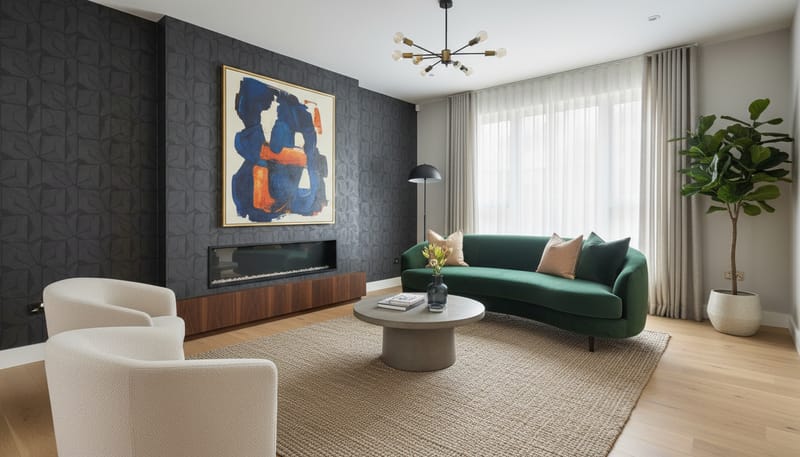
Choosing the Right Wall
Before you pick a colour, a wallpaper, or a panelling style, the single most important decision is which wall to treat. The wrong wall wastes effort and can actually make a room feel smaller or more cluttered. The right wall transforms the entire space. In new build homes with their typically open, clean layouts, this decision matters even more because there are fewer existing architectural cues to guide you.
- The chimney breast (if present): This projects slightly from the wall plane, naturally drawing the eye. It is the obvious first choice in any room that has one — paint it, panel it, or build a fireplace feature around it.
- Behind the sofa: In an open-plan living area where no chimney breast exists, the wall behind the main sofa creates a strong backdrop and is visible from the kitchen and dining zones.
- Behind the bed: The headboard wall is the natural focal point in any bedroom. You see it as you enter, and it frames the most important piece of furniture in the room.
- The staircase wall: Spanning two storeys, this wall offers dramatic height that no other room can match. It is ideal for gallery arrangements and oversized artwork.
- The wall facing the entrance: In hallways and reception rooms, the wall you see first when walking in has the greatest visual impact.
- Alcove walls: Recessed areas beside chimney breasts or built-in cupboards provide natural frames for a contrasting colour or texture.
Walls to avoid: Do not choose the window wall — daylight washes out colour during the day and the wall appears as a dark void at night. Avoid walls broken up by multiple doors, as the frequent interruptions prevent the feature from reading as a cohesive statement. One feature wall per room is almost always sufficient; two competing treatments cancel each other out.
Feature Wall Types at a Glance
The table below compares the five main categories of feature wall treatment across the factors that matter most to new build homeowners: cost, DIY difficulty, visual impact, and how easily the treatment can be removed or changed if your tastes evolve.
| Feature Wall Type | Typical Cost (Single Wall) | DIY Difficulty | Visual Impact | Removability |
|---|---|---|---|---|
| Paint (bold colour / colour block / limewash) | £20 – £120 | Easy | Medium | Very easy — just repaint |
| Wallpaper (paste-the-wall / peel-and-stick / mural) | £50 – £400 | Easy to moderate | High | Moderate — strippable grades peel off cleanly |
| Wall panelling (shaker / slat / Jacobean / fluted) | £50 – £350 | Moderate | Very high | Moderate — adhesive strips may damage plaster on removal |
| Stone or brick cladding (natural / faux / brick slips) | £150 – £800 | Moderate to hard | Very high | Difficult — adhesive-fixed cladding is semi-permanent |
| Living wall (real plants / artificial / moss) | £100 – £600 | Moderate | Very high | Easy (modular systems) to moderate (fixed frames) |
For most new build homeowners starting their first project, paint or wallpaper offers the best balance of impact, affordability, and reversibility. Panelling is the next step for those comfortable with basic DIY tools. Stone cladding and living walls are best reserved for homeowners who are confident in their long-term vision for the room.
Paint Feature Walls: Colour Blocking, Two-Tone, and Limewash
A painted feature wall remains the simplest and most affordable way to transform a room. One wall in a bold colour while the remaining three stay neutral creates an instant focal point. In new build homes, where walls are already beautifully smooth and primed, the finish you achieve is professional-quality from the start. The key is choosing the right colour, technique, and paint type — especially during the first twelve months of ownership.
Colour Blocking and Two-Tone Techniques
Colour blocking goes beyond a single bold wall by using two or more colours in geometric arrangements. These techniques add architectural interest to the flat, featureless walls of a new build and can visually alter a room's proportions.
- Horizontal split (dado effect): Paint the lower third in a deeper colour and the upper portion in white or a pale neutral. Use Frog Tape (£7 – £10 per roll) for a crisp dividing line. This grounds the room and works especially well in hallways and bedrooms.
- Painted arch: Mark the centre point at the top of your arch, attach string and pencil to draw a perfect curve, and paint inside the arch in a bold tone. Two tester pots (£8 – £15 each) are usually sufficient. Stunning behind beds and console tables.
- Wrap-around: Continue the feature wall colour across a section of the ceiling for a cocooning, immersive effect. This works brilliantly in bedrooms, creating an intimate sleeping zone within a larger room.
- Geometric shapes: Use painter's tape to create triangles, diamonds, or diagonal stripes across the wall. This suits children's bedrooms and playrooms particularly well.
Limewash Finish
Limewash paint creates a chalky, mottled finish with subtle colour variations that shift as light moves across the surface. Unlike conventional paint, limewash penetrates the wall rather than sitting as a uniform film. Apply in cross-hatching strokes and embrace the natural variation. Bauwerk Colour (approximately £65 – £80 per 4-litre tin) is the leading UK brand. Lick also offers limewash-effect finishes at £38 – £48 per 2.5 litres. Two to three thin coats build the characteristic layered, cloudy appearance that looks superb in living rooms and bedrooms.
- Best for: Living rooms, bedrooms, and dining areas where natural light shifts throughout the day
- Not ideal for: High-traffic hallways or children's rooms — the soft finish marks more easily than standard emulsion
- Drying-out note: Limewash is breathable and can be applied during the drying-out period, making it one of the few decorative finishes safe for freshly plastered new build walls
- Application tools: Use a wide, flat brush rather than a roller for the authentic textured finish
For a complete guide to choosing paint colours that work with your new build's natural light and fixed finishes, see our article on colour schemes for new build homes.
Wallpaper Accent Walls
Wallpaper delivers pattern, texture, and richness that paint alone cannot achieve. Modern technology — paste-the-wall papers, peel-and-stick options, and full-wall murals — has made wallpapering dramatically easier than in previous decades. A single wallpapered wall in a new build living room typically requires two to three rolls depending on pattern repeat and wall dimensions.
Wallpaper Types
- Paste-the-wall: Apply adhesive directly to the wall and press dry paper onto it. No soaking or booking time required. Significantly easier for DIY hangers and the standard for most modern UK wallpaper brands.
- Peel-and-stick: Self-adhesive wallpaper that applies like a giant sticker. Repositionable and removable without damaging walls — perfect for renters or commitment-phobes. Typically £25 – £60 per roll from brands like NuWallpaper and Tempaper.
- Traditional paste-the-back: The classic method. Still used for some premium and specialist wallpapers. Requires more skill but produces excellent results.
- Mural wallpaper: Numbered panels that join together to create a single enormous image across the full wall. Misty forests, abstract watercolours, and mountain landscapes are all popular. Expect £80 – £250 per full-wall mural set.
UK Wallpaper Brands and Price Ranges
| Brand | Price per Roll | Style Focus | Paste Type | Best For |
|---|---|---|---|---|
| Graham & Brown | £18 – £70 | Contemporary, tropical, geometric | Paste-the-wall | Best all-round value |
| Farrow & Ball | £95 – £130 | Subtle, sophisticated, heritage | Paste-the-wall | Premium understated elegance |
| Cole & Son | £85 – £150 | Botanical, geometric, maximalist | Paste-the-back | Museum-quality statement walls |
| Little Greene | £72 – £110 | Archive patterns, heritage colours | Paste-the-wall | Period-inspired character |
| Harlequin | £52 – £95 | Bold pattern, bright colour | Paste-the-wall | Vibrant, confident interiors |
| Superfresco Easy | £12 – £22 | Textured, simple patterns | Paste-the-wall | Budget-friendly feature walls |
| NuWallpaper | £25 – £45 | Modern, minimalist | Peel-and-stick | Renters and easy removal |
Wallpaper Hanging Tips for New Build Walls
- Wait for walls to dry: Wallpaper should not be applied during the drying-out period. Moisture behind the paper causes mould and peeling. Wait at least 9 – 12 months after completion.
- Size the walls first: Apply wallpaper size or a diluted PVA solution to the wall before hanging. This seals the plaster and makes repositioning easier.
- Start from a true vertical: Use a plumb line or spirit level to mark a perfectly vertical starting line. New build walls are usually true, but check anyway.
- Account for pattern repeat: Large pattern repeats (over 30cm) generate more waste. Order an extra roll to be safe — most retailers accept sealed returns.
- Use a seam roller gently: Roll the seams firmly but not aggressively. Excessive pressure squeezes out adhesive and creates shiny patches on matt papers.
- Trim with a sharp blade: Change your trimming blade after every three or four cuts. A dull blade tears wet paper rather than cutting it cleanly.
- Temperature matters: Hang wallpaper at room temperature (18 – 22°C). Avoid hanging when heating is on full blast, as rapid drying causes edges to lift.
- Feature wall shortcut: For a single feature wall, you only need to worry about matching at the corners where the feature wall meets the plain walls — this means less precision is needed than papering an entire room.
Wall Panelling DIY
Wall panelling has become one of the most sought-after feature wall treatments in UK new build homes, adding texture, architectural interest, and a sense of craftsmanship. The beauty of panelling is that most styles are achievable as weekend DIY projects, and when painted the same colour as the wall behind, the shadow lines add depth and elegance without overwhelming the space.
Panelling Styles and Costs
| Panelling Style | Materials Cost (Single Wall) | DIY Difficulty | Best Rooms | Visual Character |
|---|---|---|---|---|
| Shaker (grid of flat rectangles) | £50 – £100 | Easy – moderate | Hallways, living rooms, bedrooms | Classic, elegant, understated |
| Jacobean (ornate raised mouldings) | £120 – £250 | Moderate – hard | Living rooms, dining rooms | Grand, traditional, heritage |
| Board and batten (vertical strips) | £40 – £80 | Easy | Hallways, bedrooms, bathrooms | Farmhouse, Hamptons, coastal |
| Tongue and groove (interlocking boards) | £80 – £150 | Easy – moderate | Bathrooms, kitchens, bedrooms | Cottage, coastal, Scandi |
| Ribbed / fluted (rounded vertical ridges) | £120 – £350 | Easy (pre-made panels) | Living rooms, bedrooms, media walls | Contemporary, refined, tactile |
| Vertical slat (evenly spaced battens) | £100 – £180 | Moderate | Living rooms, dining rooms, offices | Architectural, modern, Japandi |
Tools Needed for Panelling DIY
- Mitre saw or mitre box: Essential for cutting MDF strips and battens to length. A powered mitre saw (£60 – £150) is ideal; a manual mitre box and tenon saw (£10 – £20) works for smaller projects.
- Spirit level (1200mm): Ensures every strip is perfectly horizontal or vertical. Non-negotiable for professional-looking results.
- Tape measure and pencil: Measure twice, cut once. Mark all your fixing positions on the wall before applying any adhesive.
- Grab adhesive: No More Nails or similar (£5 – £7 per tube). Apply in a zigzag pattern to the back of each strip for maximum hold.
- Panel pins and pin gun: Provides extra security while the adhesive sets. A battery-powered pin nailer (£40 – £80) speeds up the process enormously.
- Decorators' caulk: Fill all gaps between strips and wall, and between strips at joints. This is what creates the seamless, built-in finish when painted.
- Sandpaper (120 grit): Smooth all cut edges of MDF before fixing. MDF absorbs paint unevenly at rough-cut edges.
- Paint and primer: Prime bare MDF with a shellac-based primer (Zinsser BIN, £18 – £22 per 1L) before your topcoat. MDF is porous and drinks standard paint.
Professional installation of any panelling style typically adds £200 – £500 in labour costs. Many new build homeowners choose to DIY the simpler styles (shaker, board and batten) and hire a joiner for more complex Jacobean or full-height slat wall installations.
Stone and Brick Cladding
For a feature wall with serious visual weight, stone and brick cladding brings raw texture and natural warmth that no other treatment can replicate. Modern cladding options are thinner and lighter than you might expect, making them suitable for standard new build plasterboard walls without structural reinforcement.
- Natural stone cladding (split-face): Thin strips of real stone (slate, quartzite, or sandstone) fixed to the wall with flexible tile adhesive. Creates an extraordinary textured surface that catches light and shadow beautifully. Expect to pay £40 – £80 per square metre for materials, plus £30 – £50 per sqm for professional fitting. Total feature wall cost: £350 – £800.
- Brick slips: Thin slices of real brick (typically 15 – 20mm thick) applied to the wall with adhesive and pointed with mortar. Creates an authentic exposed-brick effect. Priced at approximately £30 – £60 per square metre for the slips, plus adhesive and pointing mortar. Suppliers like Higgins Wall Decor and The Brick Tile Company offer a wide range of colours and finishes.
- Faux stone panels: Lightweight polyurethane or fibreglass panels moulded from real stone. Much lighter and easier to install than real stone, at £25 – £50 per square metre. The best modern panels are remarkably convincing, particularly from several feet away.
- 3D gypsum panels: Plaster panels with geometric, wave, or organic 3D textures. Paint them the same colour as surrounding walls for subtle, sculptural depth. Priced at £20 – £45 per square metre.
Stone and brick cladding works best around fireplaces, behind media walls, and in dining areas. It is semi-permanent — removal will likely damage the plasterboard behind — so commit to this treatment only when you are confident in the long-term design direction of the room. For more on enhancing your new build's interior, see our guide to decorating a new build home.
Living Walls and Moss Walls
A living wall — a vertical arrangement of real or artificial plants — brings nature indoors and creates a feature wall that is genuinely alive. In the well-insulated, temperature-stable environment of a new build home, indoor plants thrive, and a dedicated plant wall takes this to a dramatic level. Preserved moss walls offer a stunning maintenance-free alternative.
- Real living walls: Modular pocket planters (£15 – £40 per module) allow you to build gradually. Suitable plants include pothos, ferns, spider plants, and philodendrons. Total DIY cost for a feature section: £100 – £300. Professional installation runs £200 – £500 per square metre.
- Preserved moss walls: Real moss that has been preserved with glycerin — it looks and feels natural but requires zero watering, zero light, and zero maintenance. Panels cost £80 – £180 per square metre from specialists like Nordgröna and Benetti Moss. They last 5 – 10 years indoors without degradation.
- Artificial plant walls: Pre-made panels of realistic artificial foliage at £20 – £50 per square metre. Simply fix to the wall with screws or adhesive. A full feature wall costs £100 – £300. Retailers like Blooming Artificial and Evergreen Direct offer excellent UK-made panels.
- Plant shelving walls: A grid of wall-mounted shelves displaying potted plants at varying heights. Uses IKEA Lack shelves (£5 – £15 each) or a tall ladder shelf (£40 – £150). Allows easy rearrangement and replacement.
Living walls make particularly striking features in hallways, above staircases, in home offices, and as backdrops in open-plan living areas. A preserved moss wall behind a dining table is one of the most impactful feature walls you can create in a new build home.
Gallery Walls
A gallery wall — a curated arrangement of framed prints, photographs, and artwork — is one of the most personal feature wall treatments you can create. It tells a story about who you are, and it can be built gradually over time as you discover pieces that speak to you. The key to a successful gallery wall is planning the arrangement before making a single hole in the wall.
Gallery Wall Arrangement Rules
- Lay out on the floor first: Arrange all frames on the floor and photograph the layout from above before transferring to the wall. This avoids unnecessary holes.
- Paper template method: Cut newspaper or brown paper to the size of each frame, tape them to the wall with painter's tape, and live with the arrangement for a day before committing.
- Consistent spacing: Maintain 5 – 8cm gaps between frames throughout the arrangement. Inconsistent spacing is the most common gallery wall mistake.
- Start from the centre: Hang the central piece first and build outward. This ensures the arrangement is balanced around a focal point.
- Mix sizes, not too many: Use three to four different frame sizes maximum. Too many sizes creates visual chaos.
- Limit frame colours: Stick to no more than two frame colours (black and natural oak, or white and gold, for example) for cohesion.
- Staircase galleries: Follow the angle of the stairs with the bottom edges of frames. Use a string line taped at the stair angle as a guide.
- Plasterboard fixings: New build walls are plasterboard. Use Command Strips (£5 – £8 per pack) for frames under 2kg, or hollow wall anchors for heavier pieces.
Popular print sources include Desenio (£7 – £20 per print), King & McGaw (£20 – £200 for framed art prints), and Etsy for independent artist prints. IKEA Ribba frames (£5 – £15) are the go-to affordable option. A complete gallery wall of 8 – 12 frames costs £80 – £400 depending on print and frame quality.
Statement Lighting
A statement light fitting defines a room's character as powerfully as any feature wall. New build homes are typically fitted with basic, functional pendants as standard — replacing these with something more dramatic is one of the quickest and most impactful upgrades you can make. Most new builds come with pre-wired ceiling roses and sometimes wall light points, so installation is usually straightforward.
Statement Lighting Comparison
| Lighting Type | Price Range | Best Rooms | Installation | Impact Level |
|---|---|---|---|---|
| Oversized rattan pendant | £40 – £120 | Living rooms, bedrooms | Simple swap — DIY | High |
| Cluster pendant (3 – 5 drops) | £80 – £250 | Dining tables, hallways | Single ceiling rose — DIY | Very high |
| Contemporary chandelier | £100 – £800 | Dining rooms, double-height halls | May need electrician for weight | Very high |
| Arc floor lamp | £50 – £200 | Living rooms, reading corners | Plug in — no installation | Medium – high |
| Decorative wall sconces (pair) | £30 – £100 | Bedrooms, either side of mirrors | Needs wiring point or plug-in type | Medium |
| LED strip / neon sign | £15 – £80 | Media walls, shelving, bedrooms | Adhesive backed — DIY | Medium |
| Sputnik / starburst pendant | £60 – £350 | Living rooms, dining rooms | Simple swap — DIY | High |
Replacing a ceiling pendant is a simple job for a competent DIYer — isolate the circuit at the consumer unit, remove the existing fitting, connect the new fitting to the existing wires, and restore power. If you are not confident with electrical work, a qualified electrician charges approximately £50 – £100 per fitting. For guidance on making the most of your new build's electrical layout, see our guide to smart home features in new builds.
Mirrors as Statement Pieces
A large, striking mirror amplifies natural light, creates an illusion of space, and serves as a sculptural focal point. In the often compact rooms of a new build, these qualities are especially valuable. Mirrors are also one of the easiest statement pieces to install — most can be hung with standard plasterboard fixings or simply leaned against a wall.
- Large round mirrors (80 – 120cm): Position above a fireplace, console table, or sofa. Circular shapes soften angular new build lines. £50 – £200 from Dunelm, Habitat, or Wayfair; £150 – £400 from John Lewis or The White Company.
- Full-length arched mirrors: Wall-mounted or freestanding, leaned against the wall. Add height and architectural elegance. £80 – £300 from high-street retailers; £300 – £600 for large, solid-framed premium versions.
- Sunburst and decorative mirrors: Ornamental frames in metal, rattan, or carved wood serve as wall art and mirror simultaneously. £30 – £200 depending on size and material.
- Multi-panel mirror arrangements: Several smaller mirrors arranged as a group create a gallery-wall effect with light-reflecting benefits. £40 – £120 for a set.
For mirrors over 10kg, locate the timber studs behind the plasterboard using a stud finder (£15 – £30) and screw directly into the studs for maximum security.
Shelving Displays
A carefully styled shelving arrangement transforms a blank wall into a curated display that reflects your personality. Floating shelves, picture ledges, and open bookcases all create feature-wall effects while providing practical storage.
- Floating shelves: Fix three to five shelves at staggered heights. Display a mix of books (stacked vertically and horizontally), small plants, candles, framed photos, and decorative objects. IKEA Lack shelves (£10 – £25 each) or Habitat oak shelves (£25 – £50 each) are excellent starting points.
- Picture ledges: Narrow shelves designed for leaning framed prints rather than hanging them. Allows you to swap and rearrange artwork without making new holes. IKEA Mosslanda (£9 – £15 each) is the go-to affordable option.
- Floor-to-ceiling bookcases: A full-wall bookcase creates an instant library feature. The IKEA Billy system (£50 – £90 per unit) can be configured wall-to-wall and fitted with trim to look built-in.
- Box shelving: Cube or hexagonal wall-mounted shelves create geometric interest. Arrange in clusters of three to five for maximum impact. Priced at £10 – £30 per unit from most homeware retailers.
Styling rule of three: Group objects on shelves in odd numbers (three or five). Vary heights within each group. Include at least one organic element (plant or natural material) per shelf to prevent the display from feeling too sterile.
Fireplace Installations: Electric and Bioethanol
A fireplace has been the natural focal point of a British living room for centuries. Modern new build homes — many built without traditional chimneys — can still enjoy this timeless feature through electric and bioethanol fire options. Neither requires a flue, chimney, or gas supply, making them perfectly suited to sealed, energy-efficient new build construction.
Electric Fires
Today's best electric fires use LED flame technology with realistic flickering effects in customisable colours. Wall-mounted units protrude just 10 – 15cm from the wall and can be recessed into a false chimney breast for a fully flush, built-in appearance. Top picks include the Gazco eReflex (£800 – £2,000) for premium realism, the Be Modern Amari (£300 – £500) for mid-range value, and the Endeavour Fires Lexington (£150 – £250) for budget-friendly wall-mounting. Building a false chimney breast from timber studwork and plasterboard costs approximately £100 – £200 in materials.
Bioethanol Fires
Bioethanol fires burn clean, plant-derived fuel that produces real flames without smoke, soot, or a flue. Freestanding models start at £100 – £200, while built-in burner inserts cost £300 – £1,500. Running costs are approximately £2 – £3 per hour. Always ensure adequate ventilation when burning — crack a window slightly, as combustion consumes oxygen even though it produces no visible smoke.
A complete fireplace feature wall with a recessed electric fire, purpose-built surround, and decorative cladding or panelling ranges from £400 – £2,500 depending on the fire and surround complexity. This single project can become the centrepiece of your entire ground floor.
TV Feature Walls and Media Walls
The media wall transforms a television from an intrusive black rectangle into an integrated design element. Rather than simply mounting a TV on a blank wall, a media wall creates a cohesive architectural feature around it. This is one of the most requested feature wall treatments in new build living rooms across the UK.
- Plan cable management first: Chase cables into the wall behind (ideal during early ownership when redecorating anyway), use surface-mounted trunking concealed behind panelling, or fit a recessed power and HDMI socket behind the TV position. Cable management is the difference between a professional and an amateur result.
- Choose your backdrop: Vertical slat panelling, fluted panels, or a contrasting paint colour behind the TV. Extend the treatment across the full wall for maximum impact.
- Add a floating shelf or low media unit: Position below the TV for soundbars, consoles, and accessories. A floating shelf at £20 – £50 is the simplest option.
- Consider an integrated electric fire: Mount below the TV for a dual focal point. Ensure the fire's heat output vents away from the screen (most modern wall-mounted electrics vent from the top or bottom rather than upward).
- Add ambient LED strip lighting: Fix behind the TV or along shelf undersides for a soft backlight effect that reduces eye strain and adds atmosphere. LED strip kits cost £15 – £40.
A DIY panelled media wall including slat or fluted panels, floating shelf, cable management, and paint costs £200 – £500. Flat-pack modular media walls (IKEA Besta system) cost £300 – £800 for a full-wall configuration. Custom-built media walls from a local joiner typically run £1,500 – £4,000.
Bedroom Headboard Walls
The wall behind the bed is the single most impactful feature wall opportunity in any bedroom. A thoughtfully designed headboard wall creates a focal point that anchors the room, frames the bed, and sets the tone for the entire space. New build bedrooms particularly benefit from this treatment because they tend to be clean and symmetrical — a strong headboard wall adds the character and warmth that makes the difference between a bedroom and a retreat.
- Upholstered headboard wall: Floor-to-ceiling padded panels in velvet, linen, or boucle fabric behind the bed. Custom from a local upholsterer: £500 – £1,500. Standard oversized headboard from Loaf or John Lewis: £200 – £800.
- Panelled headboard wall: Shaker or slat panelling painted in a deep contrasting tone — sage green, navy, or charcoal. Materials: £50 – £180.
- Wallpapered headboard wall: Bold botanical or mural wallpaper behind the bed with complementary neutral on remaining walls. Cost: £40 – £250 for two to three rolls.
- Painted arch headboard: A large arch painted directly on the wall behind the bed acts as a decorative headboard for virtually nothing — one tester pot and an hour of work.
- Reclaimed wood headboard: Pallet wood or reclaimed timber planks arranged horizontally behind the bed. Authentic, rustic, and often free if you source pallets locally (sand and treat them thoroughly first).
For more bedroom design inspiration, see our guide to decorating a new build home.
Bathroom Statement Tiles
New build bathrooms are typically finished with neutral, practical tiling. A statement tile feature wall — behind the bath, inside the shower enclosure, or behind the basin — elevates the space from functional to spa-like. Because most new builds tile only the wet areas as standard, adding decorative tiles to a dry wall creates a feature that is both beautiful and practical.
- Zellige tiles: Handmade Moroccan tiles with a distinctive uneven, glossy surface that catches light beautifully. Available in a range of jewel-tone colours. £80 – £150 per square metre from specialists like Bert & May and Ca' Pietra.
- Large-format marble-effect porcelain: Single large slabs (up to 120 x 60cm) in marble-look porcelain create a luxurious, virtually grout-free feature wall. £40 – £80 per square metre from Topps Tiles, Porcelain Superstore, or Tile Mountain.
- Patterned encaustic tiles: Geometric or floral cement tiles that bring Mediterranean character. £60 – £120 per square metre. Popular for shower niches and basin splashbacks.
- Hexagonal tiles: Six-sided tiles in contrasting colours, arranged to create ombre or scattered patterns. £30 – £70 per square metre.
- Terrazzo tiles: Flecked, speckled surfaces in soft pastels or bold colours. On trend for 2026 and available as both real terrazzo and porcelain reproductions. £35 – £90 per square metre.
Professional tiling costs approximately £35 – £60 per square metre for labour. A single feature wall in a standard new build bathroom typically covers 2 – 4 square metres, putting the total cost (tiles plus fitting) at £150 – £600. For more bathroom ideas, see our guide to new build bathroom upgrades.
Staircase Walls
The staircase wall spans two full storeys, offering dramatic height that no other wall in the house can match. It is one of the most underutilised spaces in a new build home and one of the most rewarding to transform.
- Ascending gallery wall: Frames arranged to follow the angle of the stairs, mixing family photographs with art prints. A staircase gallery of 8 – 12 frames costs £100 – £300. Use consistent frame styles for cohesion.
- Oversized single artwork: One large canvas (100 x 150cm or larger) hung at the midpoint of the staircase. The scale that would overwhelm any other room works perfectly here. Large canvases from Desenio, King & McGaw, or Artfinder cost £60 – £300.
- Full-height wallpaper: A mural wallpaper spanning the full two storeys creates a jaw-dropping feature. Working at height requires scaffolding — most homeowners hire a decorator at £150 – £350 for labour plus the cost of the wallpaper.
- Bold paint: A deep colour (Farrow & Ball Railings, Inchyra Blue, or Hague Blue) on the staircase wall contrasting with pale hallway walls. The changing light on the tall wall creates subtle tonal shifts throughout the day.
- Vertical slat panelling: Full-height slat panelling up the staircase wall is dramatic and architectural. More complex to install at height but the result is spectacular.
The Drying-Out Period and Feature Walls
Every new build home contains thousands of litres of water trapped in plaster, concrete, and screed. This moisture must escape gradually over the first 9 – 12 months after completion. The drying-out period is the single most important factor for new build homeowners to understand before committing to any feature wall treatment. Ignoring it leads to blistering paint, peeling wallpaper, and mould growth behind non-breathable finishes.
Drying-Out Period Considerations
- Breathable paint only during Year 1: Use matt emulsion (not vinyl silk or wipeable finishes) during the drying-out period. Apply a mist coat first (paint diluted 70:30 with water) to seal fresh plaster.
- Limewash is safe: Limewash paint is breathable by nature and can be applied to drying walls without trapping moisture. One of the few decorative paint finishes suitable during Year 1.
- No wallpaper until walls are dry: Wallpaper traps moisture and causes mould behind the paper. Wait 9 – 12 months minimum. Test with a moisture meter if unsure — readings below 1% are safe for wallpapering.
- Panelling with caution: MDF panelling fixed with adhesive is acceptable during the drying-out period if you leave small gaps at top and bottom to allow airflow behind the panels. Solid panelling with no ventilation traps moisture.
- No stone or brick cladding during Year 1: Adhesive-fixed cladding is non-breathable and should wait until walls are fully dry.
- Gallery walls and mirrors are fine: Hanging frames and mirrors does not affect wall breathability. These are safe feature wall treatments from day one.
- Ventilate consistently: During the drying-out period, keep trickle vents open on windows, run extractor fans in kitchens and bathrooms, and open windows daily even in winter. This accelerates drying and reduces condensation.
- Monitor humidity: A digital hygrometer (£8 – £15) helps track indoor humidity levels. Aim for 40 – 60% relative humidity. Readings consistently above 70% suggest the drying-out process is still active.
The drying-out period is a natural part of owning a new build, not a defect. Plan your feature wall projects in two phases: quick wins during Year 1 (paint, gallery walls, lighting, mirrors, shelving), and more permanent treatments (wallpaper, stone cladding, sealed panelling) from Year 2 onward.
Room-by-Room Feature Wall Suitability Matrix
Not every feature wall treatment works in every room. The matrix below rates each treatment's suitability for the main rooms in a typical new build home, helping you choose the right approach for each space.
| Treatment | Living Room | Bedroom | Hallway | Bathroom | Dining Area | Home Office | Staircase |
|---|---|---|---|---|---|---|---|
| Bold paint / colour block | Excellent | Excellent | Excellent | Good | Excellent | Excellent | Excellent |
| Wallpaper | Excellent | Excellent | Good | Limited (moisture) | Excellent | Good | Excellent |
| Wall panelling | Excellent | Excellent | Excellent | Good (moisture-rated) | Excellent | Good | Good |
| Stone / brick cladding | Excellent | Limited | Good | Limited | Excellent | Limited | Limited |
| Living / moss wall | Excellent | Good | Excellent | Limited (humidity) | Excellent | Good | Good |
| Gallery wall | Excellent | Good | Excellent | Limited | Good | Excellent | Excellent |
| Statement mirror | Excellent | Good | Excellent | Excellent | Excellent | Good | Limited |
| Statement lighting | Excellent | Excellent | Excellent | Good | Excellent | Good | Excellent |
| Statement tiles | Limited | Limited | Limited | Excellent | Limited | Limited | Limited |
Key: "Excellent" means the treatment is ideally suited and commonly used. "Good" means it works well with some considerations. "Limited" means it is possible but not the most natural fit for that room — proceed with care or consider alternatives.
Complete Cost Guide
The table below summarises typical UK costs for every feature wall and statement piece treatment covered in this guide, from the most affordable to the most premium options.
| Feature Wall Treatment | Budget DIY | Mid-Range | Premium / Professional |
|---|---|---|---|
| Bold paint / colour block | £15 – £30 | £30 – £55 | £55 – £120 |
| Limewash paint | £38 – £48 | £65 – £80 | £80 – £120 |
| Wallpaper (single wall) | £35 – £70 | £70 – £200 | £200 – £450 |
| Wall panelling (DIY) | £40 – £100 | £100 – £200 | £200 – £500 (inc. labour) |
| Stone / brick cladding | £100 – £200 (faux panels) | £250 – £500 (brick slips) | £400 – £800 (natural stone) |
| Living / moss wall | £100 – £200 (artificial) | £200 – £400 (preserved moss) | £400 – £600+ (real, pro-installed) |
| Gallery wall | £80 – £150 | £150 – £400 | £400 – £1,500+ |
| Statement lighting | £30 – £80 | £80 – £250 | £250 – £800 |
| Statement mirror | £30 – £80 | £80 – £200 | £200 – £600 |
| Electric fireplace feature wall | £250 – £500 | £500 – £1,200 | £1,200 – £2,500 |
| Bioethanol fire | £100 – £300 | £300 – £800 | £800 – £1,500 |
| Media wall (TV feature) | £200 – £400 (DIY panel) | £400 – £800 (flat-pack) | £1,500 – £4,000 (bespoke) |
| Bathroom statement tiles | £80 – £200 | £200 – £400 | £400 – £700 |
| Headboard wall | £15 – £50 (painted arch) | £50 – £250 (panel/wallpaper) | £500 – £1,500 (upholstered) |
All prices include materials for a single standard-sized feature wall in a typical new build home. Professional installation labour is included in the "Premium" column where noted. Prices are based on UK retail costs as of early 2026 and may vary by region.
Mistakes to Avoid
Feature walls are forgiving — most mistakes are fixable with a repaint or a redesign. However, the following common errors are worth avoiding from the start.
- Decorating too soon: Applying wallpaper, non-breathable paint, or sealed cladding during the drying-out period is the single most costly mistake new build owners make. Wait, or use breathable finishes only.
- Choosing the window wall: Daylight washes out colour and the wall reads as a dark void after sunset. Choose the wall opposite or adjacent to the window instead.
- Two competing feature walls: One feature wall per room is the rule. Two bold walls in the same space create visual competition and neither reads as a focal point.
- Ignoring the room's fixed finishes: Your feature wall must work with the floor colour, kitchen units, bathroom tiles, and any other permanent elements. Bring samples home and view them in situ before committing.
- Skipping the mist coat: Painting directly onto fresh plaster without a diluted mist coat causes peeling and poor adhesion. Always mist coat new plaster first.
- Poor cable management on media walls: A beautifully panelled media wall with visible cables hanging beneath the TV ruins the entire effect. Plan cable routing before you start building.
- Hanging heavy items without proper fixings: New build plasterboard walls need appropriate fixings. Standard nails and screws pull straight out. Use hollow wall anchors, spring toggles, or screw into studs for anything over 5kg.
- Rushing gallery wall placement: Hanging frames without planning the layout first results in too many holes and an unbalanced arrangement. Always use the paper template method or floor layout first.
Trending Feature Wall Styles for 2026
Interior trends evolve constantly, but the following feature wall styles are dominating UK homes heading into 2026 and show no signs of fading.
- Warm minimalism: Limewash paint in earthy tones (terracotta, clay, warm sand) combined with natural materials. Less is more, but what is there has texture and depth.
- Japandi slat walls: Vertical slat panelling in light oak or natural timber tones. Clean lines with organic warmth. Inspired by the fusion of Japanese and Scandinavian aesthetics.
- Preserved moss art: Framed panels of preserved moss in varying shades of green, arranged as living artwork. Zero maintenance with maximum visual impact.
- Curved panelling: Arched and curved MDF panels replacing the straight lines of traditional shaker panelling. Softer, more organic, and distinctly contemporary.
- Dark and moody bedrooms: Full-wall deep colour (forest green, midnight blue, rich plum) combined with warm brass lighting and textured fabrics. The "cocooning" trend continues to grow.
- Integrated media walls: TV surrounded by slat or fluted panelling with integrated electric fire below and floating shelves alongside. The all-in-one living room feature wall.
- Textured plaster: Venetian plaster and microcement finishes in stone and putty tones. The imperfect, handmade look contrasts beautifully with crisp new build architecture.
- Bold wallpaper maximalism: Large-scale botanical and abstract wallpapers in rich, saturated colours. After years of restraint, bold pattern is back in a big way.
Bringing It All Together
Feature walls and statement pieces are the tools that transform a new build house into a home with character, personality, and soul. The clean, smooth, well-finished walls of a new build provide the perfect foundation for any of these treatments — there is no stripping of old wallpaper, no filling of cracks, no working around existing features. You have complete creative freedom.
The approaches in this guide range from a £15 pot of bold paint and a free afternoon to professionally installed stone cladding and bespoke media walls that make a genuine architectural statement. Start with one room, one wall, one idea that excites you. A sage green panelled wall in the living room. A botanical mural behind the bed. A gallery wall ascending your staircase. A preserved moss panel above the dining table. Whatever you choose, that first feature wall will be the moment your new build truly starts to feel like home.
For more ideas on personalising your new build property, explore our guides to new build kitchen design, colour schemes for new builds, and smart home features.