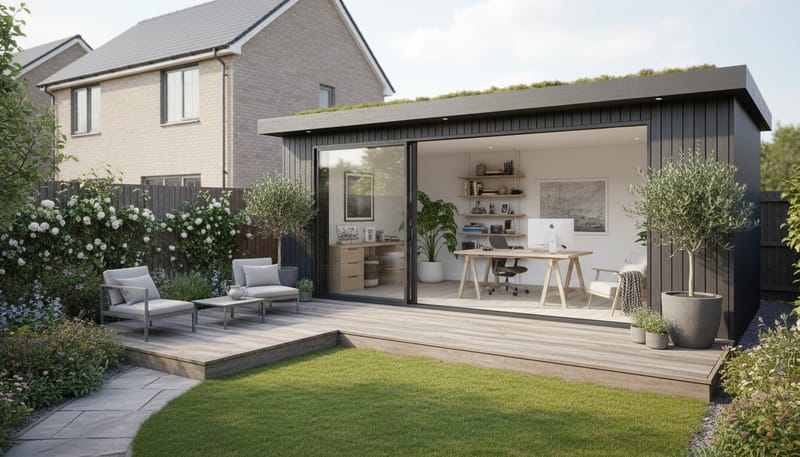
Why Garden Rooms Suit New Build Properties
New build homes are modern, energy-efficient, and well-designed inside, but garden space is often more compact than older properties. A garden room transforms that outdoor area into genuinely usable living space without the disruption, cost, or planning complexity of a house extension. The shift to hybrid working means millions of UK households now need a dedicated workspace at home, and for families where both partners work remotely or children are home during school holidays, a separate building in the garden provides essential separation between work and domestic life.
New builds are particularly well-suited to garden room installations for several practical reasons. Your garden is typically level and well-prepared by the developer, free from mature tree roots and old foundations. Your consumer unit is modern and usually has spare capacity for an additional circuit. The ground has already been cleared and graded, and your property boundaries are clearly defined.
- Smaller plots, bigger demand: Average new build garden sizes have decreased by 30% since the 1990s, making every square metre count. A garden room adds 10 to 25 sqm of usable space without reducing your indoor footprint.
- Work from home is permanent: ONS data shows 44% of UK workers now work from home at least part of the week. A dedicated garden office eliminates the dining-table-as-desk compromise.
- Cost vs extension: A quality garden room costs £800 to £1,500 per sqm. A traditional house extension costs £1,800 to £3,000 per sqm and takes three to six months.
- No structural impact: A garden room leaves your main house untouched. No knocking through walls, no dust, no temporary kitchen in the living room.
- Property value boost: Estate agents report that a well-specified garden office adds £10,000 to £25,000 to a property's asking price, often exceeding its installation cost.
- Speed of installation: Most garden rooms are installed in one to five days, compared to three to six months for a conventional extension.
- Flexible use: A garden room can serve as an office today, a gym next year, and a teenage retreat in five years. Its purpose evolves with your household.
For more on maximising your new build space, see our guide to open plan living in new build homes.
Planning Permission Rules
Most garden rooms fall within permitted development rights, meaning you can build them without formal planning permission. However, the rules are strict, and breaching them can result in enforcement action from your local authority. Understanding every condition is essential before you order.
Permitted Development Requirements for England
| Requirement | Rule | Key Detail |
|---|---|---|
| Maximum eaves height | 2.5 metres | Measured from natural ground level to the underside of the eaves |
| Maximum overall height (apex roof) | 4.0 metres | For a dual-pitched (gable) roof only |
| Maximum overall height (flat/mono roof) | 3.0 metres | Pent and flat roofs have a lower limit |
| Height within 2m of boundary | 2.5 metres max overall | Applies to the total height, not just eaves |
| Garden coverage | 50% maximum | Total of all outbuildings, extensions, and structures must not exceed 50% of the curtilage |
| Position | Not forward of the principal elevation | Must be to the side or rear of the house |
| Use | Incidental to the dwelling | Offices, gyms, studios are fine. Self-contained accommodation is not. |
| Designated land | Additional restrictions apply | National Parks, AONBs, Conservation Areas, World Heritage Sites |
| Single storey only | No upper floors or balconies | Mezzanines may be challenged by planning officers |
Scotland, Wales, and Northern Ireland each have separate permitted development rules that differ in detail. Always check with your local planning authority before proceeding. Note also that some new build planning consents include conditions that remove or restrict permitted development rights. Check your property's planning history on your local authority's portal or review the documentation from your developer.
Planning Permission Checklist
- Check your transfer deed (TR1): Look for restrictive covenants that require consent for outbuildings.
- Review estate management rules: Many new build estates require management company approval before erecting any structure.
- Confirm permitted development rights: Check the original planning consent for your development to ensure PD rights have not been removed or restricted.
- Measure your garden accurately: Calculate the 50% coverage rule including all existing outbuildings, sheds, and extensions.
- Check boundary distances: Measure from the proposed building to every boundary, especially if you are within 2 metres.
- Contact your local planning authority: For a Certificate of Lawful Development (CLD) costing £103 (England, 2026), you get written confirmation that your building is lawful.
- Notify neighbours: Not legally required for PD, but good practice to maintain neighbourly relations.
- Document everything: Keep measurements, photos, supplier plans, and any written approvals in a file for future reference or resale.
When Full Planning Permission Is Required
- The building exceeds the height limits shown in the table above.
- Combined outbuildings cover more than 50% of the garden area.
- The building is forward of the principal elevation of your house.
- You intend to use it as a self-contained dwelling, holiday let, or Airbnb with sleeping, cooking, and bathroom facilities.
- Your property is on designated land with additional restrictions.
- Your permitted development rights have been removed by a planning condition.
- You want to add a raised veranda, balcony, or mezzanine.
Building Regulations
Planning permission and building regulations are separate legal requirements. Even if your garden room does not need planning permission, it may still need to comply with building regulations depending on its size and specification.
- Under 15 sqm floor area: Building regulations approval is generally not required, provided the building is more than 1 metre from any boundary or is built from substantially non-combustible materials.
- 15 to 30 sqm floor area: Building regulations apply if the building contains sleeping accommodation. If it is a simple office, gym, or studio with no sleeping provision, regulations may not apply, but check with your local building control.
- Over 30 sqm floor area: Building regulations approval is required regardless of use. This includes structural integrity, fire safety, ventilation, electrical safety, and energy efficiency.
- Electrical work: All electrical installations must comply with Part P of the Building Regulations and be carried out or certified by a registered electrician who can issue an Electrical Installation Certificate.
- Plumbing and drainage: If you add a WC, shower, or kitchenette with drainage, the work must comply with Part H (drainage) and Part G (sanitation).
- Fire safety: Buildings within 1 metre of a boundary must have fire-resistant external walls. SIPs and timber frame buildings can achieve this with appropriate fire-rated board or cladding.
Types of Garden Rooms Compared
The term "garden room" covers everything from a basic timber summerhouse to a fully insulated, architect-designed studio with underfloor heating. Understanding the main categories helps you match the right type to your needs, your garden, and your budget. For guidance on garden layout and landscaping, see our article on new build garden design.
Construction Type Comparison
| Construction Type | Typical Cost per sqm | Insulation (U-value) | Build Time | Lifespan | Maintenance |
|---|---|---|---|---|---|
| Log Cabin (28-44mm) | £200 - £500 | 1.0 - 1.5 W/m2K (poor) | 1 - 3 days (self-build kit) | 10 - 20 years | Annual treatment required |
| Log Cabin (70mm+ insulated) | £400 - £800 | 0.4 - 0.6 W/m2K (moderate) | 2 - 5 days | 20 - 30 years | Biennial treatment |
| Timber Frame (insulated) | £600 - £1,200 | 0.2 - 0.3 W/m2K (good) | 2 - 5 days | 25 - 40 years | Low to moderate |
| SIPs Panel | £800 - £1,500 | 0.15 - 0.22 W/m2K (excellent) | 1 - 3 days | 30 - 50+ years | Very low |
| Composite/Modern | £900 - £1,800 | 0.15 - 0.25 W/m2K (excellent) | 2 - 5 days | 30 - 50+ years | Minimal |
| Modular (factory-built) | £700 - £1,400 | 0.18 - 0.28 W/m2K (very good) | 1 day (delivered complete) | 25 - 40 years | Low |
SIPs (Structural Insulated Panels) are widely regarded as the gold standard for year-round garden rooms. Each panel is a rigid insulation core, typically expanded polystyrene or polyurethane, sandwiched between two structural boards. The result is a building that is exceptionally well-insulated, airtight, and remarkably quick to assemble. Composite and modern material builds use combinations of timber, steel, aluminium, and engineered panels for a contemporary architectural aesthetic with slim profiles, large glazed areas, and virtually zero maintenance. Modular units arrive factory-finished and can be craned into position in a single day, making them ideal where garden access is tight or disruption must be minimised.
Log cabins offer a rustic charm but standard 28-44mm wall logs provide poor insulation for UK winters. If you want year-round use, insist on at least 70mm walls with additional internal insulation, or choose a different construction method entirely. Timber frame is the most widely available and versatile option, covering every price point from budget to premium and offering excellent design flexibility.
Use Case Deep Dives
Different uses demand different specifications. The table below provides a quick comparison, followed by detailed guidance for each use case.
Use Case Comparison
| Use Case | Recommended Size | Typical Cost (installed) | Planning Required? | Key Requirements |
|---|---|---|---|---|
| Home Office | 8 - 15 sqm | £10,000 - £25,000 | Usually PD | Full insulation, power, broadband, good lighting |
| Home Gym | 12 - 20 sqm | £12,000 - £22,000 | Usually PD | Reinforced floor, ventilation, rubber matting |
| Art/Music Studio | 10 - 18 sqm | £12,000 - £25,000 | Usually PD | Sound insulation, north-facing light (art), utility sink |
| Garden Annexe | 20 - 35 sqm | £25,000 - £60,000+ | Full planning required | Plumbing, kitchen, bathroom, fire safety, building regs |
| Hot Tub Room | 10 - 16 sqm | £8,000 - £18,000 (excl. tub) | Usually PD | Waterproofing, ventilation, reinforced floor, drainage |
| Children's Playroom | 10 - 16 sqm | £8,000 - £18,000 | Usually PD | Safety glass, soft flooring, heating, line of sight from house |
Garden Office Setup
The garden office is the most popular garden room in the UK. A well-designed one provides a professional, distraction-free workspace just steps from the back door. For design inspiration, see our guide to home office design in new build homes.
- Minimum size: A single-person office needs at least 3m x 2.5m (7.5 sqm). For two people or a meeting area, aim for 4m x 3.5m (14 sqm) or larger.
- Power sockets: Plan for 8 to 12 double sockets at desk and floor level. You will always need more than you think.
- Broadband: A direct Cat6 ethernet cable run underground with the power supply is the gold standard. Mesh Wi-Fi is the backup.
- Lighting: Combine LED downlights for ambient light with adjustable task lamps. Avoid positioning your desk with a window directly behind the screen to prevent glare on video calls. Read our full guide to new build lighting design.
- Ergonomics: Budget £400 to £900 for a quality desk and ergonomic chair. This is not the place to economise.
- Heating: A single 1kW to 1.5kW electric panel heater is sufficient for a well-insulated 10 sqm office, costing £1 to £3 per day in winter.
Home Gym Conversion
A garden gym eliminates monthly gym memberships and the commute. The critical factor is the floor structure: it must support heavy equipment and absorb impact from dropped weights.
- Floor specification: Specify a reinforced floor rated to at least 250 kg/sqm. Add 20mm rubber gym matting (£15 to £30 per sqm) on top.
- Ventilation: Essential for managing heat and moisture. Include opening windows on two sides for cross-ventilation, or fit a mechanical extract fan.
- Ceiling height: If you plan overhead presses or pull-ups, you need at least 2.4m internal height. Discuss this with your supplier.
- Power: A dedicated 32A circuit may be needed for a treadmill or rowing machine with a motor. Standard 13A sockets are fine for lighter equipment.
- Mirrors: Full-length mirrors on one wall improve form-checking and make the space feel larger. Use safety-backed mirrors.
- Sound: Rubber matting and good insulation reduce noise transfer to neighbours. Add acoustic underlay beneath the rubber if you plan to drop weights.
Art and Music Studio
For artists, north-facing windows or rooflights provide consistent, diffused natural light without harsh direct sun. For musicians, sound insulation is the priority: SIPs construction with acoustic plasterboard, double or triple glazing, and a solid-core door can reduce sound transmission by 35 to 45 dB, enough for amplified instruments without disturbing neighbours. Budget £12,000 to £25,000 depending on size and acoustic specification. A utility sink (approximately £200 to £400 installed) is invaluable for artists working with paints, inks, or clay.
Garden Annexe for Family or Airbnb
A self-contained garden annexe with sleeping, cooking, and bathroom facilities is a different proposition entirely. Because it constitutes a separate dwelling, it requires full planning permission, compliance with all relevant building regulations (including Part B fire safety, Part M accessibility, Part L energy efficiency), and potentially a Council Tax assessment. Costs range from £25,000 for a basic studio annexe to £60,000 or more for a one-bedroom annexe with kitchen and wet room. If you intend to let it on Airbnb, check your local authority's rules on short-term lets and your estate's covenants, which may prohibit commercial use.
Hot Tub Housing
A dedicated garden building to house a hot tub provides shelter, privacy, and year-round use. Key requirements include a reinforced floor (a filled hot tub weighs 1,500 to 2,500 kg), waterproof flooring (vinyl, tile, or sealed concrete), excellent ventilation to manage steam and humidity, and a dedicated electrical supply (most hot tubs require a 32A or 40A dedicated circuit). Budget £8,000 to £18,000 for the building, plus the cost of the hot tub itself (£3,000 to £12,000).
Children's Playroom
A garden playroom gives children dedicated space for play, crafts, and homework while keeping the main house tidier. Specify toughened safety glass in all windows and doors, soft and durable flooring (vinyl or carpet tiles that can be replaced individually), heating for year-round use, and ensure there is a clear line of sight from the house so you can supervise younger children. Budget £8,000 to £18,000 for a well-insulated 10 to 16 sqm playroom.
Construction Methods and Materials
Your choice of construction method determines thermal performance, durability, build speed, and long-term maintenance. The comparison table in the Types section provides the numbers; here we examine each method in more detail.
External Cladding Options
- Western Red Cedar: The most popular premium timber cladding. Naturally durable, weather-resistant, and ages to a beautiful silver-grey patina. £30 to £50 per sqm. Treat with oil every 2 to 3 years to maintain colour, or leave to weather naturally.
- Thermowood (thermally modified timber): Enhanced durability without chemical treatment. Stable and attractive. £25 to £45 per sqm.
- Treated Softwood (spruce/pine): Budget-friendly and available in any colour. Requires painting or staining every 3 to 5 years. £12 to £25 per sqm.
- Composite Cladding: Wood fibres and recycled plastic. Does not rot, warp, or need painting. £35 to £60 per sqm.
- Cedral Fibre Cement Board: Smooth modern finish with exceptional durability and fire resistance. Virtually maintenance-free. £40 to £65 per sqm.
- Aluminium Composite Panels: Ultra-modern, lightweight, weather-proof. £50 to £80 per sqm. Used by premium suppliers for a sleek architectural look.
Choose cladding that complements your new build's external finishes. Many homeowners select colours that echo the brick, render, or timber details of their main house. For ideas on coordinating your home's aesthetic, see our article on colour schemes for new build homes.
Insulation and Heating Options
If your garden room will be used year-round, particularly as a home office, insulation and heating are non-negotiable. A poorly insulated building is uncomfortable in winter, prone to condensation, and expensive to heat. A well-insulated one requires surprisingly little energy to stay warm.
Insulation Must-Haves
- Walls: Target a U-value of 0.3 W/m2K or better (equivalent to 75-100mm rigid foam or 100-150mm mineral wool).
- Floor: Must be insulated to the same standard as walls. An uninsulated floor is the fastest way to make a garden room feel cold and damp.
- Roof: Insulate to at least 0.25 W/m2K. Heat rises, so the roof is the biggest source of heat loss in most buildings.
- Windows and doors: Double glazing minimum, triple glazing preferred. Low-emissivity glass and thermally broken frames are essential.
- Airtightness: SIPs construction naturally achieves excellent airtightness. Timber frame buildings need a vapour barrier and taped joints to prevent draughts.
- Ventilation: Airtight buildings need controlled ventilation. Trickle vents, opening windows, or a mechanical ventilation with heat recovery (MVHR) unit (£300 to £600) prevent condensation.
Heating Options Compared
| Heating Type | Purchase Cost | Running Cost (10 sqm office, winter) | Pros | Cons |
|---|---|---|---|---|
| Electric Panel Heater | £80 - £200 | £1 - £3 per day | Cheap to buy, easy to install, responsive | Higher running costs than heat pumps |
| Electric Underfloor Heating | £40 - £80 per sqm | £1.50 - £3 per day | Even warmth, no wall space used, luxury feel | Must be installed during build, slow to warm up |
| Infrared Panel Heater | £150 - £400 | £0.50 - £2 per day | Heats people directly, very efficient, silent | Does not warm the air, unfamiliar feel for some |
| Split-System Air Con / Heat Pump | £800 - £1,500 installed | £0.40 - £1.50 per day | Heating and cooling, lowest running cost, quiet | Higher upfront cost, external unit needed |
| Oil-Filled Radiator (portable) | £40 - £100 | £1.50 - £4 per day | No installation needed, portable | Slow to warm, takes floor space, less efficient |
For year-round garden offices, a split-system air conditioning unit is the best long-term investment. It provides heating in winter and cooling in summer, with running costs 60% to 70% lower than direct electric heating because the heat pump extracts energy from outside air. For more on heat pump technology, see our guide to heat pumps in new build homes.
Electrical Supply and Broadband
A dedicated electrical supply and reliable internet connection are fundamental for any garden room used as a workspace. Both should be planned before installation begins, not retrofitted afterwards.
Electrical and Plumbing Considerations
- Dedicated circuit: Run a dedicated circuit from your main consumer unit. Do not tee off an existing ring main. Cost: £500 to £1,500 depending on distance.
- Armoured cable: Use SWA (steel wire armoured) cable buried at minimum 450mm under lawn or 600mm under hard surfaces, in protective ducting with warning tape above.
- Sub-board: Install a small consumer unit in the garden room with an RCD (residual current device) and individual MCBs (miniature circuit breakers) for lighting, sockets, and heating circuits.
- Socket count: Specify 8 to 12 double sockets for a garden office, positioned at desk height and floor level. Include a dedicated circuit for any high-draw appliance (heater, air con, hot tub).
- Exterior lighting: Include an external light above the door and consider PIR-activated path lighting for dark winter mornings.
- Part P compliance: All electrical work must comply with Part P of the Building Regulations. Use a NICEIC, NAPIT, or ELECSA registered electrician who can self-certify and issue an Electrical Installation Certificate.
- Plumbing (if needed): Adding a sink requires a water supply and waste drain run from the house. Cost: £500 to £2,000 depending on distance and connection complexity. A WC or shower adds further cost and building regulations requirements.
- Document cable routes: Record the exact position and depth of all underground cables and pipes. You and future owners need to know where they are before digging.
Broadband Options
- Wired Ethernet (best): Run a Cat6 or Cat6a cable through the same conduit as the power supply. Cost: £50 to £200 additional. Provides speeds up to 10 Gbps, zero interference, and rock-solid reliability for video calls.
- Mesh Wi-Fi (good): Place one node in the house near the garden-facing wall and another in the garden room. Brands like Google Nest, TP-Link Deco, or BT Whole Home cost £100 to £250 for a multi-node kit.
- Powerline Adapters (acceptable): Use your electrical wiring to carry a network signal. Performance varies depending on wiring quality. Cost: £30 to £70 for a pair.
- 4G/5G Router (backup): A dedicated mobile broadband router provides an independent connection. Cost: £100 to £300 for the router, plus £15 to £30/month for data.
For a complete guide to home networking, see our article on smart home features in new builds.
Foundations and Base Options
New build gardens present specific foundation challenges. The ground may have been recently disturbed, backfilled, or compacted during construction. Topsoil is typically shallow (100-200mm), and beneath it conditions vary from stable clay to made ground with construction rubble. Always check for underground services (drainage, water, gas, electrical, telecoms) before breaking ground. Your developer should have provided service plans.
- Concrete Pad Foundations: Individual pads at key structural points. Suitable for most conditions. Cost: £500 to £1,500. The most common choice for medium-sized garden rooms.
- Full Concrete Slab: A continuous reinforced slab covering the entire footprint. The most robust option, recommended for larger buildings, soft ground, and heavy loads (gym, hot tub). Cost: £1,000 to £3,000.
- Ground Screws: Large helical screws driven into the ground. Quick to install (often in one day), minimal disruption, removable if needed. Cost: £800 to £2,000. Increasingly popular for garden rooms on new build sites.
- Adjustable Support Feet on Paving Slabs: Suitable only for smaller, lighter buildings on stable ground. Cost: £200 to £600. The simplest and cheapest option but not appropriate for year-round occupied spaces.
Important: Check whether your garden includes soakaways, attenuation tanks, or SuDS features (sustainable drainage systems) installed by the developer. Building on or blocking these could cause flooding and breach your estate management terms.
Interior Finishing and Lighting
Treat your garden room's interior with the same care as a room in your main house. The finishing transforms a functional box into a space you genuinely enjoy spending time in. For flooring inspiration, read our guide to flooring options for new build homes.
Furniture and Layout Tips
- Invest in your chair: If you are working eight hours a day, spend £300 to £800 on an ergonomic office chair. Your back, neck, and productivity will thank you.
- Position your desk facing the door: This feels psychologically more comfortable and places the window light to the side rather than behind your screen, reducing glare on video calls.
- Use wall-mounted shelving: Maximise floor space by going vertical. Floating shelves keep books, files, and supplies accessible without cluttering the room.
- Add soft furnishings: A rug, blinds, cushions, and a throw soften the acoustics and make the space feel warm and inviting.
- Include plants: Indoor plants thrive in the natural light of a garden room and improve air quality, mood, and productivity.
- Layer your lighting: Combine LED downlights (ambient), a desk lamp (task), and optionally LED strips (accent) for a versatile and comfortable lighting scheme.
- Plan cable management: Use cable trays, under-desk cable baskets, and conduit to keep power and data cables tidy. Nothing ruins a stylish garden office faster than a tangle of cables.
- Consider a small kitchenette area: A compact shelf with a kettle, mini fridge, and a few mugs saves trips to the main house. A simple setup costs £100 to £300.
Security
A garden room containing laptops, monitors, gym equipment, or musical instruments is a valuable target. Protect your investment from day one.
- Multi-point locking: Ensure doors and windows have multi-point locking mechanisms as standard. Most reputable suppliers include this.
- Laminated or toughened glass: Harder to break than standard glass and provides an additional layer of security.
- Motion-activated exterior lighting: Deters opportunistic theft and illuminates the path on dark evenings.
- Smart cameras or alarm: A wireless system linked to your phone provides real-time alerts. Budget £100 to £400 for a quality camera and alarm setup.
- Visible deterrents: An alarm bell box (even a dummy one) and security stickers discourage attempts.
- Security marking: Register valuable equipment on Immobilise (the UK national property register) and mark items with a UV pen or forensic marking solution.
- Lock it up: Simple but vital: always lock the garden room when you leave, even if you are just going back into the house for lunch.
For a broader guide to protecting your home, see our article on home security for new builds.
Insurance Implications
Adding a garden room affects your home insurance. Failing to notify your insurer could invalidate your cover for both the building and its contents.
- Notify your home insurer as soon as the garden room is installed. Most standard home insurance policies cover outbuildings, but there may be a lower contents limit (often £3,000 to £5,000) for outbuildings compared to the main house.
- Increase your contents cover to reflect the value of equipment stored in the garden room. A garden office with a laptop, monitor, desk, and chair can easily contain £2,000 to £5,000 of equipment.
- Check the buildings sum insured and increase it to include the rebuild cost of the garden room itself, typically £10,000 to £30,000 depending on specification.
- Confirm security requirements. Some insurers require specific security measures such as multi-point locks, an alarm, or security lighting. Install these before you need to make a claim.
- Business use declaration: If you use the garden room for work, confirm with your insurer. Working from home for an employer is usually covered, but running a business with visiting clients may require additional business use cover.
Adding Value to Your Property
A quality garden room is one of the few home improvements that consistently returns more than its cost when you sell. Estate agents across the UK report that a well-specified garden office is now one of the top five features buyers look for in family homes.
Research from Savills and Knight Frank suggests a garden office adds between 5% and 15% of its cost to the overall property value, and in some markets considerably more. On a £350,000 new build, a £15,000 garden office could add £17,000 to £25,000 to the asking price. The key factors that maximise value are: professional installation from a reputable supplier, full insulation for year-round use, an electrical supply with lighting and power, an attractive design that complements the house, and clear evidence that the building complies with planning and building regulations. A cheap, poorly insulated shed with an extension lead will not add value and may even deter buyers.
For more ways to increase your home's worth, see our guide to developer upgrades worth choosing.
UK Supplier Comparison
The UK garden room market ranges from budget flat-pack suppliers to luxury bespoke manufacturers. Here are five of the most established names, compared side by side.
| Supplier | Construction Method | Price Range (installed) | Lead Time | Strengths | Coverage |
|---|---|---|---|---|---|
| Rubicon Garden Rooms | SIPs panels | £15,000 - £40,000 | 6 - 10 weeks | Outstanding insulation, contemporary design, excellent build quality | UK-wide |
| Green Retreats | SIPs panels | £18,000 - £50,000 | 8 - 12 weeks | Premium specification, transparent pricing, full project management | UK-wide |
| Cabin Master | Timber frame | £12,000 - £35,000 | 6 - 10 weeks | Bespoke designs, strong customer service, competitive mid-range pricing | England & Wales |
| Garden Spaces | SIPs panels | £14,000 - £35,000 | 6 - 8 weeks | Smart contemporary designs, good value SIPs construction | UK-wide |
| Smart Garden Offices | Modular / timber frame | £8,000 - £22,000 | 4 - 6 weeks | Fast turnaround, competitive pricing, modular efficiency | England & Wales |
Other reputable suppliers worth considering include Crown Pavilions (luxury traditional pavilions from £20,000 to £50,000+), Pod Space (distinctive curved-roof designs), Rooms Outdoor (Scandinavian aesthetic), and budget options like Tiger Sheds, Dunster House, and Forest Garden (basic insulated buildings from £2,000 to £8,000). Always visit a supplier's show site if possible before committing. The difference between a well-built garden room and a cheap one is immediately obvious when you step inside.
Cost Guide by Size and Specification
The table below shows realistic 2026 UK costs for garden rooms at different sizes and specification levels. All prices include the building, delivery, and installation, but exclude foundations, electrical connection, and landscaping unless noted.
| Size | Budget (basic insulation, softwood) | Mid-Range (full insulation, cedar/composite) | Premium (SIPs, aluminium glazing, full spec) |
|---|---|---|---|
| 6 sqm (3m x 2m) | £3,000 - £5,000 | £7,000 - £10,000 | £12,000 - £16,000 |
| 9 sqm (3m x 3m) | £4,000 - £7,000 | £9,000 - £14,000 | £15,000 - £22,000 |
| 12 sqm (4m x 3m) | £5,500 - £9,000 | £12,000 - £18,000 | £18,000 - £28,000 |
| 16 sqm (4m x 4m) | £7,000 - £11,000 | £15,000 - £22,000 | £22,000 - £35,000 |
| 20 sqm (5m x 4m) | £9,000 - £14,000 | £18,000 - £28,000 | £28,000 - £45,000 |
| 30 sqm (6m x 5m) | £12,000 - £18,000 | £25,000 - £38,000 | £38,000 - £60,000+ |
Additional Costs to Budget For
- Foundations: £500 to £3,000 depending on type and ground conditions.
- Electrical connection: £500 to £1,500 for underground armoured cable from house to garden room.
- Internet (ethernet cable): £50 to £200 if run with the electrical supply.
- Landscaping and paths: £200 to £2,000 for a paved or gravelled path and planting around the building.
- Furniture and equipment: £300 to £2,000 for desk, chair, shelving, and accessories.
- Heating installation: £80 to £1,500 depending on type (panel heater vs split-system air con).
- Ongoing maintenance: Natural timber cladding needs treatment every 2 to 5 years at approximately £100 to £250 per treatment. Composite and fibre cement require almost nothing.
Total project budget: Add £2,000 to £6,000 on top of the building price for foundations, electrics, internet, paths, and furnishing. This means a quality mid-range garden office realistically costs £14,000 to £24,000 all-in.
What to Ask Suppliers
Before committing to a supplier, ask these critical questions to avoid surprises and ensure you are comparing like with like.
- What U-values do the walls, floor, and roof achieve? Anything above 0.4 W/m2K for walls is poor for year-round use. Insist on seeing the specification in writing.
- Is the price fully installed, including delivery and crane hire if needed? Some quotes exclude delivery and installation, which can add £1,000 to £3,000.
- What is the warranty period and what does it cover? Look for at least 10 years structural warranty. Check what is excluded, particularly weathering of timber cladding.
- Do you include the electrical package? Some suppliers include internal electrics (consumer unit, sockets, lights) in the price. Others leave this entirely to the customer.
- What foundation do you recommend for my site? A good supplier will want to see your garden before quoting and will recommend the right foundation type for your ground conditions.
- Can I visit a show model or recently completed installation? Seeing the build quality in person is the single best way to assess a supplier. Be wary of any company that cannot show you a finished building.
- What is the lead time from order to installation? Budget suppliers may deliver in 4 weeks; bespoke manufacturers may take 12 to 16 weeks. Plan accordingly.
- What access do you need to my garden? Large panel buildings need crane access or wide side-gate access. Modular buildings delivered whole need a crane. Discuss access constraints early to avoid costly surprises on installation day.
Common Mistakes to Avoid
Having guided thousands of homeowners through garden room projects, here are the mistakes we see most often. Avoid these and your project will run smoothly.
- Skimping on insulation: A garden room you cannot use in January is a waste of money. If you want year-round use, specify full insulation with U-values of 0.3 or better for walls, floor, and roof.
- Forgetting to check covenants: Many new build homeowners discover estate restrictions after ordering their garden room. Check your transfer deed and management company rules first.
- Underestimating socket needs: You will always need more power sockets than you think. Specify at least 8 double sockets for an office.
- Ignoring internet planning: Running an ethernet cable costs £50 to £200 if done at the same time as the electrical supply. Retrofitting it later costs three times as much and involves digging up your garden again.
- Choosing the cheapest quote: A cheap garden room with thin insulation, single glazing, and flimsy construction will cost more in heating, repairs, and early replacement than a quality build that lasts 30+ years.
- Not budgeting for extras: Foundations, electrics, paths, and furniture can add £2,000 to £6,000 to the headline building price. Budget for the total project, not just the building.
- Placing the building without thinking about aspect: Consider where the sun falls at different times of day. A garden office with west-facing full-height glazing will overheat every summer afternoon. North or east-facing glazing provides comfortable, even light.
- Forgetting drainage: If your garden slopes toward the proposed building location, you may need to install drainage or a French drain to prevent water pooling at the base. Address this during the foundation stage.
- Not securing the building: Garden rooms are targets for thieves. Install multi-point locks, security lighting, and a camera from day one, and update your home insurance.
Final Thoughts
A garden room is one of the most rewarding improvements you can make to a new build property. It extends your usable living space, provides the dedicated workspace or retreat that modern life demands, and adds genuine value to your home, all without the disruption of a house extension. New build homeowners are especially well-positioned: your gardens are level and well-prepared, your electrics are modern, and your homes complement a high-quality garden building beautifully.
Whether you want a compact £10,000 garden office for hybrid working, a £15,000 personal gym to replace monthly memberships, a £20,000 creative studio for art or music, or a £40,000+ bespoke annexe for family or guests, the UK market offers excellent options at every level. Take the time to understand planning rules, check your estate covenants, choose a reputable supplier, invest in proper insulation and electrics, and budget realistically for the full project. Get these fundamentals right, and your garden room will serve you brilliantly for decades to come.
For more ideas on making the most of your new build home, explore our guides to new build kitchen design, storage solutions, and garden design.