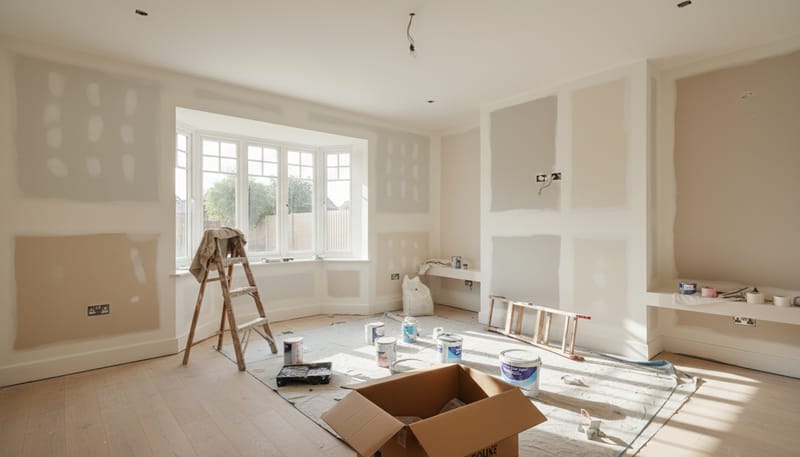
The Drying-Out Period and Why It Matters
Every new build home goes through a drying-out period during the first nine to eighteen months after completion. A typical three-bedroom house contains approximately 3,000 to 5,000 litres of residual moisture at the point of handover. This moisture is locked inside concrete foundations, mortar joints, plaster skim coats, floor screeds, and timber frames. As the heating system runs and the house is ventilated, this water slowly evaporates through wall surfaces, window openings, and the ventilation system.
During this period you will notice condensation on windows, particularly on cooler mornings. Small hairline cracks may appear where plaster meets door frames or at ceiling junctions. The air may feel noticeably damper than in an older property. These are all entirely normal signs of a new building settling and drying, not defects or causes for concern.
| Drying-Out Stage | Timeframe | What Happens | Decorating Action |
|---|---|---|---|
| Initial moisture release | Months 1 to 3 | Heaviest condensation, highest humidity, walls feel slightly cool to touch | Apply mist coat only; use breathable emulsion if painting |
| Active drying | Months 3 to 6 | Condensation reduces, hairline settlement cracks appear, humidity drops | Safe to apply breathable matt emulsion in chosen colours |
| Settlement phase | Months 6 to 9 | Cracks stabilise, moisture levels fall further, house feels noticeably drier | Fill cracks with flexible filler; touch up paintwork |
| Approaching dry | Months 9 to 12 | Morning condensation stops, no new cracks, walls feel warm and dry | Safe to begin using non-breathable paints and wallpaper |
| Fully dried out | Months 12 to 18 | Building fully stabilised; moisture content at equilibrium | Final decoration: premium paints, wallpaper, silk finishes, panelling |
The critical point for decorating is that fresh plaster walls must be allowed to breathe. If you apply a standard vinyl emulsion or any non-breathable coating to walls that are still releasing moisture, you create a barrier that traps water vapour behind the paint film. Over weeks and months, this moisture builds up until the paint blisters, peels away from the wall, or worse, creates hidden damp patches that encourage mould growth behind the surface. Rectifying this requires stripping the paint back to bare plaster and starting again, an expensive and deeply frustrating outcome that is entirely avoidable with the right product choices.
Mist Coats: The Essential First Step
Before applying any colour to fresh plaster, you must apply a mist coat. This is a heavily diluted emulsion, typically mixed at a ratio of one part paint to three or four parts clean water. The diluted paint soaks into the porous plaster surface rather than sitting on top of it, creating a bonding layer that gives subsequent coats something to grip. Without a mist coat, even the best paint will not adhere properly to new plaster and is likely to flake off within months.
- What to use: A basic white or magnolia matt emulsion. Trade products are ideal; there is no need for anything expensive at this stage
- Dilution ratio: One part paint to three or four parts water for very fresh plaster; one part paint to two parts water for plaster that has been drying for several weeks
- Application method: Use a medium-pile roller for large wall areas and a 2-inch brush for cutting in at edges and around fittings
- Drying time: Allow a full 24 hours before applying your first coloured coat
- Coverage: A single 10-litre tin of basic emulsion, diluted, will cover an entire three-bedroom house
- Dark colour tip: If your chosen wall colour is dark (navy, forest green, charcoal), tint the mist coat by adding a small amount of your finish colour. This reduces the number of top coats needed from three or four down to two
- What NOT to use: Never use PVA as a sealer on new plaster. This persistent myth causes more decorating failures than almost anything else. PVA creates a non-porous, plasticky seal that prevents the wall from breathing and causes paint to slide off in sheets
| Mist Coat Product | Price (10L) | Coverage (Diluted) | Drying Time | Best For |
|---|---|---|---|---|
| Dulux Trade Supermatt White | £55 to £65 | Up to 180 sq m | 2 to 4 hours | Professional-grade base; excellent absorption |
| Dulux Vinyl Matt White | £30 to £40 | Up to 160 sq m | 2 to 4 hours | Good mid-range option; widely available |
| Crown Trade Vinyl Matt White | £28 to £38 | Up to 170 sq m | 2 to 4 hours | Budget-friendly; solid performance |
| Johnstone's Trade Vinyl Matt | £25 to £35 | Up to 160 sq m | 2 to 4 hours | Best value; excellent for large areas |
| Leyland Trade Contract Matt | £18 to £25 | Up to 150 sq m | 2 to 4 hours | Lowest cost option; perfectly adequate for mist coats |
The mist coat is purely functional. It does not need to look beautiful, cover perfectly, or provide a final finish. Its only job is to soak into the plaster and provide a key for your chosen colour. A patchy, slightly uneven mist coat is entirely normal and will be invisible once your top coats are applied.
Breathable vs Non-Breathable Paints
Understanding the difference between breathable and non-breathable paints is the single most important piece of knowledge for decorating a new build home. The distinction determines whether your walls can continue to release moisture safely or whether that moisture becomes trapped, causing damage that is expensive and time-consuming to repair.
- Breathable paints (microporous): Trade matt emulsions, clay-based paints, and limewash-style formulations that use natural binders allowing water vapour to pass through the dried paint film. These are safe for fresh plaster at any stage
- Non-breathable paints (vinyl film): Standard retail vinyl emulsions, vinyl silk, gloss, and most off-the-shelf paints that form a plastic-like film when dry. These seal the wall surface and must only be used after the drying-out period is complete
- Semi-breathable paints: Some modern formulations like Dulux Trade Diamond Matt offer partial breathability with enhanced durability. Suitable from around month three onwards in rooms where walls are touched frequently
The key chemical difference is in the binder. Breathable paints use chalk, clay, or casein-based binders that remain microporous when dry, allowing water vapour molecules to pass through while still providing a decorative finish. Non-breathable paints use vinyl or acrylic polymers that form a continuous, impermeable film. Both produce attractive finishes; the difference is invisible to the eye but critical to the health of your walls.
- Signs you have used non-breathable paint too early: Paint bubbling or blistering within weeks of application; damp patches appearing behind paint; musty smell near painted walls; paint peeling in sheets rather than flaking
- How to fix it: Strip affected areas back to bare plaster using a scraper or steam stripper. Allow the plaster to dry fully. Apply a fresh mist coat and repaint with breathable emulsion. In severe cases, replastering may be necessary
- Prevention: Always check the product label for "breathable" or "microporous" before purchasing. Trade matt emulsions are almost always breathable; retail "easy-wipe" and silk products are almost never breathable
Paint Brand Comparison and Costs
Choosing the right paint brand is a balance between budget, colour range, finish quality, and durability. The UK market offers everything from budget trade emulsions that do a perfectly serviceable job through to premium heritage brands that deliver extraordinary depth of colour. The table below compares the most popular brands used in new build homes, with real UK prices as of early 2026.
| Brand | Price (2.5L) | Price (5L) | Coverage per Litre | Finish Quality | Colour Range | Breathable Options |
|---|---|---|---|---|---|---|
| Farrow & Ball | £52 to £58 | £95 to £108 | 10 to 12 sq m | Exceptional; chalky depth | 150+ curated colours | Estate Emulsion (breathable) |
| Little Greene | £48 to £55 | £88 to £100 | 12 to 14 sq m | Excellent; washable matt | 190+ colours | Intelligent Matt Emulsion |
| Dulux Heritage | £35 to £42 | £60 to £72 | 12 to 14 sq m | Very good; rich pigment | 120+ heritage shades | Flat matt formula |
| Lick | £30 to £38 | £55 to £68 | 12 to 14 sq m | Good; modern matt | 100+ contemporary colours | Low-VOC matt |
| Dulux Trade Supermatt | £18 to £24 | £30 to £42 | 14 to 16 sq m | Good; dead flat | Full mixing range | Fully breathable |
| Crown Trade Matt | £18 to £24 | £32 to £45 | 14 to 16 sq m | Good; scrubbable | Full mixing range | Clean Extreme (breathable) |
| Johnstone's Trade | £14 to £20 | £25 to £35 | 14 to 16 sq m | Decent; good coverage | Full mixing range | Covaplus Vinyl Matt |
- Best for the drying-out period: Dulux Trade Supermatt or Johnstone's Trade Covaplus. Both are fully breathable, affordable, and available in a full colour range via the in-store mixing service at Brewers, Dulux Decorator Centres, and independent merchants
- Best for final decoration: Farrow & Ball Estate Emulsion or Little Greene Intelligent Matt. Both deliver unmatched depth of colour and a sophisticated flat finish that transforms a room. Worth the investment for key living spaces
- Best value premium: Dulux Heritage or Lick. Both offer rich, flat-matt finishes with genuine depth at roughly half the cost of Farrow & Ball. Excellent for whole-house decoration without a premium-brand budget
- Best for high-traffic areas: Crown Trade Clean Extreme or Dulux Trade Diamond Matt. Both offer enhanced scrubbability without sacrificing breathability, making them ideal for hallways, kitchens, and children's rooms
- Best for samples: Lick offers peel-and-stick swatches at £2 each (refundable against purchase). Farrow & Ball offers A5 painted swatches at £4. Both are far more useful than tiny tester pots for comparing multiple colours
A practical approach used by many new build owners is to use affordable breathable emulsion throughout the house during the drying-out period, then upgrade to premium paint in the living room, main bedroom, and hallway once the building has fully dried. This limits premium expenditure to the rooms where visitors spend the most time and where the difference in finish quality is most noticeable. For guidance on budgeting your wider home improvements, see our guide to new build snagging checklists.
Paint Finish Types Explained
The finish, or sheen level, of a paint affects both its appearance and its practical performance. Choosing the right finish for each surface in your home is just as important as choosing the right colour. New build walls, with their flat plaster surfaces and potential for settlement cracks, respond differently to each finish type.
| Finish Type | Sheen Level | Best For | Hides Imperfections? | Wipeable? | Breathable? | Typical Cost (2.5L) |
|---|---|---|---|---|---|---|
| Dead matt / flat matt | 0 to 5% | Walls, ceilings, feature walls | Excellent | Limited | Yes (trade products) | £15 to £55 |
| Matt emulsion | 5 to 15% | All walls, most rooms | Very good | Moderate | Usually yes | £15 to £55 |
| Eggshell | 15 to 25% | Woodwork, skirting, doors | Moderate | Good | No | £35 to £58 |
| Satin | 25 to 40% | Woodwork, bathroom walls | Limited | Very good | No | £30 to £55 |
| Silk / soft sheen | 40 to 60% | Feature walls (after drying-out) | Poor | Excellent | No | £20 to £45 |
| Gloss | 70 to 90% | Woodwork only (traditional look) | Very poor | Excellent | No | £25 to £50 |
| Kitchen & bathroom matt | 5 to 15% | Kitchens, bathrooms, utility | Very good | Very good (moisture-resistant) | Partially | £22 to £55 |
- Walls: Always choose matt or flat matt. The zero-sheen finish absorbs light evenly, hides minor imperfections and settlement cracks, and creates a calm, sophisticated atmosphere. Matt is the default choice for every room
- Woodwork (skirting, architraves, door frames): Eggshell is the modern standard. Water-based eggshell from Farrow & Ball (£40 for 750ml) or Little Greene (£38 for 1L) is tough, easy to clean, and complements matt walls beautifully without the yellowing associated with old-fashioned oil-based gloss
- Doors: Eggshell or satin for a subtle sheen that handles daily contact. Semi-gloss is an option for front doors where durability and weather resistance are priorities
- Ceilings: Dead flat matt white, always. A flat ceiling draws zero attention, allowing wall colours and furnishings to take centre stage. Budget £20 to £30 for a 5-litre tin of ceiling-specific matt
- Bathrooms: Use a dedicated kitchen and bathroom matt (Dulux Easycare Bathroom at £28 for 2.5L, or Crown Breatheasy Bathroom at £22). These formulations resist moisture and inhibit mould without the sheen that reveals every imperfection on bathroom walls
- Kitchens: Dulux Trade Diamond Matt or Crown Trade Clean Extreme. Both are scrubbable, grease-resistant, and flat enough to look elegant while standing up to cooking splashes and sticky fingerprints
Room-by-Room Colour Schemes
The following recommendations are designed specifically for new build homes, taking into account the typically neutral flooring, white sanitaryware, and contemporary kitchen cabinetry that most developers specify. Each suggestion includes specific paint names and numbers so you can order samples immediately.
| Room | Recommended Wall Colours | Feature Wall Option | Woodwork Colour | Mood / Effect |
|---|---|---|---|---|
| Living room | Farrow & Ball Elephant's Breath (No. 229); Little Greene Joanna (No. 130); Dulux Heritage DH Linen | F&B Down Pipe (No. 26) on chimney breast | F&B Wimborne White or Pointing | Warm, sophisticated, inviting |
| Kitchen-diner | Little Greene Sage Green (No. 80); F&B Treron (No. 292); Dulux Gentle Fawn | F&B Card Room Green (No. 79) behind open shelving | Little Greene Flint or Loft White | Fresh, natural, airy |
| Main bedroom | F&B Hague Blue (No. 30); Dulux Heritage Potters Pink; Little Greene Juniper Ash (No. 115) | F&B Stiffkey Blue (No. 281) behind headboard | F&B All White or Wevet | Cocooning, restful, luxurious |
| Guest bedroom | F&B Jitney (No. 293); Dulux Warm Pewter; Lick Beige 02 | Little Greene Light Peachblossom (No. 3) | F&B Pointing or Wimborne White | Welcoming, hotel-like, neutral |
| Children's room | F&B Cook's Blue (No. 237); Lick Green 02; Dulux Heritage Maritime Teal | Lick Blue 07 or F&B Babouche (No. 223) | F&B Wimborne White | Playful yet sophisticated |
| Teenager's room | F&B Stiffkey Blue (No. 281); Little Greene Basalt (No. 221); Dulux Sapphire Salute | Little Greene Lamp Black (No. 228) | Little Greene Loft White | Dramatic, grown-up, personal |
| Bathroom | F&B Pavilion Blue (No. 252); Little Greene Aquamarine (No. 138); Dulux Easycare Mint Macaroon | F&B Inchyra Blue (No. 289) all walls | F&B All White | Spa-like, clean, calming |
| Hallway & landing | F&B Skimming Stone (No. 241); Little Greene Slaked Lime (No. 105); Dulux Natural Hessian | Darker shade of same colour on end wall | F&B Pointing or Strong White | Welcoming, spacious, flowing |
| Home office | Little Greene French Grey (No. 113); F&B Mizzle (No. 266); Dulux Heritage Olive Colour | F&B Green Smoke (No. 47) behind desk | Little Greene Flint | Focused, calming, productive |
Living Room Tips
- Open-plan spaces: Use warm whites like F&B James White (No. 2010) or Lick White 03 to let kitchen cabinetry and furniture become the focal points rather than the walls
- South-facing living rooms: Can handle cooler colours like blues and grey-greens that are beautifully enhanced by warm natural light throughout the day
- North-facing living rooms: Stick to warm neutrals with yellow or pink undertones. Avoid anything with blue undertones, which will look cold and unwelcoming
- Small living rooms: Do not automatically default to white. A medium-depth warm neutral creates intimacy without feeling cramped, while pure white can feel clinical in compact spaces
Kitchen-Diner Tips
- White or cream cabinets: The most flexible specification, working beautifully with sage greens, warm greys, soft blues, and earthy neutrals
- Grey cabinets: Pair with warm wall colours like F&B Setting Plaster (No. 231) or Dulux Gentle Fawn to prevent coldness
- Dark cabinets: Keep walls light and clean. F&B Wevet or Little Greene Loft White provides contrast without competing
- Open-plan zoning: Keep the kitchen zone lighter for functionality and the dining area slightly warmer for atmosphere. The transition should be subtle, not jarring
Bedroom Tips
- Four-wall colour: Bedrooms are the best place to go bold with colour on every wall. F&B Hague Blue on all four walls creates a stunningly restful hotel-suite atmosphere
- Pair dark walls with light bedlinen: White or pale grey sheets and duvet covers against dark walls creates a luxurious contrast that photographs beautifully and feels deeply relaxing
- Blackout considerations: Darker colours absorb more light, enhancing the effect of blackout blinds for better sleep quality
- Children's rooms: Avoid primary colours and character themes that date within two years. Choose sophisticated base colours and add personality through removable accessories
For more detailed guidance on kitchen layouts and finishes, see our comprehensive guide to new build kitchen design. For broader decorating advice that covers flooring, lighting, and furnishings alongside paint, see our guide to decorating a new build home.
Creating Colour Flow Through Your Home
The most common mistake in new build decorating is choosing colours room by room in isolation, creating jarring transitions at every doorway. Professional interior designers always work with a whole-house palette that creates visual continuity as you move through the home. This does not mean painting every room the same colour; it means choosing colours from the same tonal family that complement each other when viewed from connecting spaces.
- Start with the hallway: Choose a warm neutral as your connecting colour. This sets the tone for the entire house and should complement colours visible through open doorways
- Map your sightlines: Stand in the hallway and note which rooms are visible. Walk through the house identifying every point where two or more rooms are visible simultaneously. These transitions must work harmoniously
- Choose a tonal family: If your hallway is a warm greige (grey-beige), stay in the warm family throughout. Your living room might be a deeper warm grey, kitchen a soft sage green, and bedroom a dusky pink. All share warm undertones and will flow together naturally
- Limit your palette: Three to five wall colours plus white for the entire house. Use variations in depth rather than entirely different hues to create interest without chaos
- Use the 60-30-10 rule in each room: 60 percent of colour from walls and large surfaces, 30 percent from soft furnishings and curtains, 10 percent from accessories and artwork
- Keep woodwork consistent: Use the same white or off-white on all skirting boards, architraves, and door frames throughout the house. This provides a unifying thread that ties different wall colours together
- Test transitions: Before committing, paint sample patches in connecting rooms and check the transition from every angle, at different times of day, and under both natural and artificial light
- Warm palette example: Hallway in F&B Skimming Stone, living room in F&B Elephant's Breath, kitchen in Little Greene Sage Green, main bedroom in Dulux Heritage Potters Pink, guest room in F&B Jitney. All share warm undertones
- Cool palette example: Hallway in F&B Ammonite, living room in Little Greene French Grey, kitchen in F&B Mizzle, main bedroom in F&B Hague Blue, guest room in F&B Pavilion Blue. All share cool blue-grey undertones
- Avoid mixing families: A warm terracotta bedroom next to a cool blue-grey living room creates a discordant transition. If you want both warm and cool rooms, place them on different floors or separate them with a neutral connecting space
Trending Palettes for 2026
The year 2026 continues the decisive shift away from the cool greys and stark whites that dominated UK interiors throughout the 2010s. The direction is firmly towards warmth, nature, personality, and colour confidence. The following trends are drawn from the major paint brands' colour forecasts, design shows, and the patterns emerging across UK interior design.
- Warm earth tones: Terracotta, clay, ochre, warm sand, and sun-baked red are the dominant palette for 2026. These colours connect homes to the natural world and pair beautifully with timber, rattan, linen, and stone. Key shades include F&B Jitney (No. 293), Little Greene Light Peachblossom (No. 3), F&B Red Earth (No. 64), and Dulux Heritage Red Ochre
- Heritage greens: Green in all its forms is the colour story of the decade, and 2026 sees it broadening from sage and olive into forest, emerald, and bottle green. F&B Card Room Green (No. 79), Little Greene Sage Green (No. 80), Dulux Heritage DH Grass Green, and Lick Green 05 cover the spectrum. Green pairs effortlessly with warm timber, brass hardware, and natural stone
- Japandi neutrals: The Japanese-Scandinavian fusion aesthetic continues with deliberately restrained palettes of soft off-whites, warm greys, muted greens, and natural wood tones. F&B Ammonite (No. 274), Little Greene Linen Wash (No. 33), and Dulux White Cotton are ideal bases
- Deep blues and navy: Navy is the new neutral for 2026, used increasingly on all four walls rather than just as a feature. F&B Hague Blue (No. 30) and Stiffkey Blue (No. 281) remain immensely popular, joined by Little Greene Basalt (No. 221) and Dulux Sapphire Salute
- Blush and dusty pink: Pink has matured from a trend colour into an established neutral, particularly in bedrooms and living rooms. F&B Sulking Room Pink (No. 295), Dulux Heritage Potters Pink, and Lick Pink 03 create warm, flattering light that works with virtually any furnishing style
- Bold accent colours: Rich mustard yellow (Little Greene Yellow-Pink, No. 46), deep plum (F&B Brinjal, No. 222), burnt orange (Dulux Heritage Copper Beech), and saturated teal (F&B Vardo, No. 288) are used as punctuation marks on single walls, inside alcoves, or on architectural details
- Warm whites: Stark brilliant white is out. Warm whites with yellow, pink, or green undertones are in. F&B Pointing, James White, and Wevet, Little Greene Loft White and Flint, and Lick White 03 dominate. These feel lived-in and welcoming rather than sterile and clinical
For more on how modern new build homes integrate smart technology with interior design, see our guide to smart home features in new builds.
Colour Palette Combinations
The following table presents complete colour palette combinations that work beautifully together across a whole house. Each palette has been designed to create a cohesive flow from hallway through living areas to bedrooms, with every colour sharing compatible undertones.
| Palette Name | Hallway | Living Room | Kitchen | Main Bedroom | Bathroom | Woodwork |
|---|---|---|---|---|---|---|
| Warm Heritage | F&B Skimming Stone | F&B Elephant's Breath | F&B Treron | F&B Sulking Room Pink | F&B Setting Plaster | F&B Wimborne White |
| Contemporary Cool | Little Greene French Grey Pale | Little Greene French Grey | Little Greene Sage Green | F&B Hague Blue | F&B Pavilion Blue | Little Greene Flint |
| Earth & Nature | Dulux Natural Hessian | F&B Jitney | Little Greene Sage Green | F&B Red Earth | Dulux Heritage Olive Colour | F&B Pointing |
| Modern Minimal | Lick White 03 | Lick Beige 02 | Lick Green 02 | Lick Blue 07 | Lick White 01 | Lick White 05 |
| Bold Statement | F&B Ammonite | F&B Card Room Green | F&B Mizzle | F&B Stiffkey Blue | F&B Inchyra Blue | F&B All White |
| Scandi Warmth | F&B Wevet | Little Greene Linen Wash | Dulux White Cotton | Little Greene Light Peachblossom | F&B Cabbage White | F&B Strong White |
- Budget tip: Recreate premium palette looks using Dulux Trade colour-matched equivalents. Take a Farrow & Ball colour card to any Dulux mixing centre and they will match it in trade matt for a fraction of the cost. The finish differs slightly from the original, but the colour is nearly identical
- Sample strategy: Order samples from each brand before committing. Paint large test patches on white card and move them between rooms. View them at dawn, midday, dusk, and under lamplight before making a decision
- Cohesion test: Lay all your sample swatches side by side. If they look like a family, your palette works. If one jumps out as an outlier, replace it with something closer in tone
Feature Walls and Accent Techniques
Feature walls remain one of the most effective ways to add personality and architectural interest to the flat, uniform surfaces of a new build home. The key to a successful feature wall is that it must have a reason to exist. The eye needs a focal point, whether that is a fireplace, a bed headboard, a run of shelving, or an alcove. A random wall painted in a different colour with no visual anchor looks arbitrary.
- Painted feature walls: The simplest and most affordable approach. Choose a colour two to three shades deeper than your other walls for a tonal effect, or use a contrasting colour from your palette for drama. Budget £15 to £55 for a single wall depending on brand and room size
- Wallpaper feature walls: Do not apply during the drying-out period as moisture prevents adhesion and causes bubbling. Wait at least nine to twelve months. Budget £30 to £80 per roll for quality wallpaper plus £200 to £400 for professional hanging of a single wall
- Wall panelling: Shaker-style or wainscot panelling adds architectural depth to flat new build walls. MDF panel kits cost £50 to £150 per panel and can be installed as a DIY project in a weekend. Paint in the same colour as the wall above for sophisticated tonal interest, or in a contrasting colour for a bolder look. Panelling can be installed during the drying-out period as it is fixed mechanically and allows airflow behind
- Timber slat walls: Vertical timber slat panels (£40 to £90 per square metre) add warmth, texture, and height. Fixed to battens, they create a natural focal point behind TVs and bed headboards. Like panelling, they allow airflow and are safe during the drying-out period
- Colour blocking: Painting the lower third or two-thirds of a wall in a darker colour with a clean horizontal line creates a modern dado effect without any physical moulding. Use painter's tape for a crisp line. This technique adds visual interest and makes rooms feel taller
- Painted alcoves: If your new build has recesses on either side of a chimney breast or TV wall, painting the inside of the alcoves in a deeper colour creates instant depth and makes shelving stand out beautifully
Trim, Woodwork, and Ceiling Colours
Skirting boards, architraves, door frames, window frames, and doors make up a surprisingly large proportion of the visible surfaces in any room. Getting the trim colour right is essential to a polished, professional-looking finish. Equally, ceiling colour is often overlooked, yet the wrong choice can undermine even the most beautiful wall colour.
Woodwork Colour Guidelines
- Match warm walls with warm whites: F&B Wimborne White, Pointing, or Slipper Satin complement warm-toned wall colours beautifully. These whites have soft yellow or pink undertones that feel harmonious
- Match cool walls with cool whites: F&B All White, Strong White, or Wevet work with cool blue and green wall colours. These whites have subtle blue or green undertones
- Avoid brilliant white: Standard brilliant white from any brand looks harsh and cheap against sophisticated wall colours. It creates a stark contrast that draws the eye to every skirting board and architrave rather than letting them recede into the background
- Same-colour woodwork: For a contemporary, seamless look, paint skirting boards and architraves in the same colour as the walls. This works particularly well in hallways and small rooms where it makes the space feel larger and less broken up
- Dark woodwork: Painting skirting boards and door frames in a darker colour (charcoal grey, dark green, or navy) is a bold 2026 trend that frames rooms beautifully. F&B Railings (No. 31) or Little Greene Lamp Black (No. 228) in eggshell are popular choices
- Consistency is key: Whatever woodwork colour you choose, use it throughout the entire house. Switching white tones from room to room creates subtle but noticeable inconsistency
Ceiling Colour Guidelines
- Default choice: A flat matt white ceiling works in most situations. Use a dedicated ceiling paint or the same white as your woodwork for a cohesive look
- Avoid harsh contrast: Bright white against warm or dark walls looks stark. Paint ceilings in a very pale tint of the wall colour or use a warm-toned ceiling white like F&B Wevet or Little Greene Loft White
- Dark rooms, pale ceiling: In rooms with dark walls, keep the ceiling light to maintain a sense of height and prevent the room feeling cave-like
- Bold ceiling colour: Painting the ceiling the same colour as the walls (including dark colours) is an increasingly popular choice that creates an immersive, cocoon-like effect. This works best in bedrooms and small rooms where intimacy is desirable
- Standard new build ceiling height: Most new builds have 2.4m ceilings, lower than older properties. Dark ceilings can make this feel lower; light ceilings maintain the sense of space
How Light Direction Affects Colour
The compass direction your room faces has a profound effect on how paint colours appear throughout the day. A colour that looks perfect in a sunny south-facing show home can look entirely different in your north-facing living room. Understanding this relationship is one of the most important aspects of choosing colour for your new build.
- North-facing rooms: Receive cool, blue-tinted light that makes cool colours feel cold and unwelcoming. Choose warm tones with yellow, pink, or red undertones. Best colours: F&B White Tie (No. 2002), Setting Plaster (No. 231), Yeabridge Green (No. 287), Little Greene Stock (No. 173). Avoid anything with blue or grey undertones
- South-facing rooms: Bathed in warm golden light throughout the day, making them the most forgiving for colour choices. Cool tones like blues, greens, and grey-blues are beautifully enhanced. Best colours: F&B Hague Blue, Little Greene Juniper Ash, Dulux Sapphire Salute. Even dark colours work well because they are constantly softened by natural light
- East-facing rooms: Warm morning light shifts to cooler light in the afternoon. Ideal for bedrooms, which benefit from the warm sunrise glow. Choose warm neutrals and soft pinks that glow at dawn: F&B Sulking Room Pink, Little Greene Light Peachblossom, Dulux Heritage Potters Pink
- West-facing rooms: Cooler morning light transforms to rich golden light in the afternoon and evening. Dramatic colours like deep blues, rich greens, and sophisticated greys come alive in the golden hour. This is the perfect orientation for bold living room colours
- Artificial lighting matters: LED colour temperature dramatically affects how wall colours appear in the evening. Warm white bulbs (2,700K to 3,000K) flatter paint colours; cool white (4,000K and above) makes everything look clinical and washed out. Replace any cool white GU10 spotlights with warm white alternatives at £3 to £6 each
For more on energy-efficient lighting and how it interacts with your home's performance, see our guide to EPC ratings in new build homes.
Testing Colours Properly
Never commit to a colour based on a tiny swatch in a shop, a photograph on a screen, or a recommendation from a friend whose house has completely different light conditions. Colour is subjective, contextual, and transformed by its surroundings. Testing properly is the only way to avoid expensive mistakes.
- Order peel-and-stick swatches: Lick (£2 each, refundable against purchase) and F&B (£4 each) offer A5-sized painted swatches on adhesive card. Order your top three to five choices for each room
- Stick swatches on two walls in each room: One wall that receives direct light from the window and one in relative shadow. This shows the colour's full range in your specific space
- Observe at four times of day: Morning natural light, midday, afternoon, and under artificial light in the evening. Colours shift dramatically; a colour you love at noon may look entirely different at 8pm under LED downlights
- Buy sample pots for your shortlist: Sample pots (£3 to £8 each) allow you to paint a patch of at least 300mm by 300mm. Apply two full coats to see the true colour
- Use the white card method: Paint two coats onto A3 white card and move the card from room to room. This isolates the colour from its surroundings and reveals how it responds to different light conditions throughout the house
- Test your white: White has undertones. F&B alone offers seven distinct whites, from warm (Pointing, Wimborne White) to cool (All White, Wevet). Put your chosen white next to your wall colour; if the undertones clash, the scheme falls apart
- Live with your shortlist for a week: Leave swatches and painted cards in position for at least five to seven days. First impressions can be misleading; the colours that grow on you are usually the right ones
- Common testing mistake: Painting a tiny patch in a corner. Too small to judge; always paint a large area in the middle of a wall where you can see it from across the room
- Screen colours are unreliable: Every monitor, phone, and tablet displays colour differently. Never choose a paint colour from a photograph or website alone
- Adjacent colours affect perception: A grey swatch next to magnolia looks blue. The same grey next to navy looks light. Always test against the actual surrounding colours in your room, including flooring, furnishings, and curtains
Budget Guide: DIY vs Professional Costs
Understanding the true cost of decorating your new build helps you plan effectively and avoid unpleasant surprises. The following figures are based on real UK costs in early 2026 for a typical three-bedroom new build house with two reception rooms, a kitchen-diner, three bedrooms, a bathroom, an ensuite, and a hallway with landing.
DIY Materials Cost
- Mist coat (whole house): £15 to £25 for 10L basic white emulsion
- Wall paint, mid-range (two coats throughout): £250 to £450
- Wall paint, premium brand (two coats throughout): £700 to £1,400
- Ceiling emulsion (all rooms): £40 to £60
- Eggshell for all woodwork: £80 to £150
- Brushes, rollers, trays, dust sheets, tape: £60 to £100
- Filler, sandpaper, sugar soap: £20 to £40
- Total DIY materials (mid-range): £450 to £800
- Total DIY materials (premium): £900 to £1,800
- Time required: Five to eight days for experienced painters; ten to fourteen days for beginners
Professional Decorator Costs
- Daily rate, London and South East: £220 to £300 per day
- Daily rate, Midlands, North, Wales: £150 to £220 per day
- Full house repaint (labour only): £1,800 to £3,500
- Full house repaint (labour plus mid-range paint): £2,500 to £4,500
- Full house repaint (labour plus premium paint): £3,000 to £5,500
- Single room (walls and ceiling): £200 to £400
- Single room (walls, ceiling, and woodwork): £300 to £500
- Hallway, stairs, and landing: £400 to £800
- Completion time: Four to six working days for a full house
Common Colour Mistakes to Avoid
Thousands of new build homeowners make preventable mistakes when choosing paint colours. The following table lists the most common errors, why they happen, and how to avoid them.
| Mistake | Why It Happens | The Fix |
|---|---|---|
| Using non-breathable paint on fresh plaster | Retail staff recommend vinyl emulsion without asking about wall condition | Always specify "breathable" or "microporous" paint for walls less than 12 months old |
| Choosing colour under shop lighting | Retail fluorescent lighting bears no resemblance to home lighting conditions | Always test with samples in your own rooms at four times of day |
| Ignoring undertones | "Grey" can have blue, green, purple, or warm undertones invisible at first glance | Hold the swatch against pure white card to reveal hidden undertones |
| Too many different colours | Choosing each room independently without a whole-house plan | Limit to three to five colours plus white, all from the same tonal family |
| Dark colour in tiny rooms | Following trends without considering room proportions | Use dark colour on one or two walls only in compact ensuites and box rooms |
| Brilliant white ceilings against warm walls | Using cheap white ceiling paint without considering the contrast | Use a warm-toned white like F&B Wevet or tint ceiling paint to a pale version of the wall colour |
| Brilliant white woodwork | Defaulting to the cheapest white for skirting and architraves | Use a sympathetic off-white like F&B Wimborne White or Little Greene Flint in eggshell |
| Ignoring existing fixtures | Choosing wall colour without considering flooring, kitchen cabinets, or bathroom tiles | Bring fabric swatches and flooring samples when choosing paint colours |
| Applying wallpaper during drying-out | Impatience to achieve a finished look immediately after moving in | Wait at least nine to twelve months; use painted feature walls as a temporary alternative |
| Skipping the mist coat | Assuming new plaster is ready to paint straight away | Always apply a diluted emulsion mist coat as the first layer on fresh plaster |
- Additional tip: Do not paint over existing developer-applied magnolia without first checking if it was a breathable product. If unsure, apply a mist coat over it before adding your chosen colour, as this provides a bonding layer regardless of what was applied originally
- Fixing peeling paint: If paint has peeled due to moisture, scrape off all loose material, allow the plaster to dry fully, apply a mist coat, and repaint with breathable emulsion. In severe cases where plaster has been damaged, a skim coat may be needed before repainting
- When to call a professional: If you find extensive mould behind peeling paint, consult a damp specialist before repainting. Surface mould is treatable with a fungicidal wash; structural damp requires professional diagnosis
Paint Preparation Steps for New Build Walls
Proper preparation is the difference between a paint job that lasts years and one that fails within months. Follow these steps in order for the best possible result on new build plaster.
- Inspect the plaster: Check all walls for cracks, dents, screw pops, and uneven patches. Mark any issues with pencil or painter's tape so you can address them systematically
- Fill any defects: Use flexible filler (Toupret or Polycell, £6 to £10 per tube) for hairline cracks and holes. For larger patches, use ready-mixed finishing plaster. Allow to dry completely
- Sand the filled areas: Use 120-grit sandpaper to smooth filler patches flush with the surrounding plaster. Wipe away dust with a damp cloth
- Clean the walls: Wipe all surfaces with a barely damp cloth to remove construction dust and debris. Do not use sugar soap on new plaster as it is unnecessary and can leave residue
- Protect surfaces: Cover floors with cotton dust sheets (not plastic, which is slippery). Mask skirting boards, window frames, and light switches with low-tack painter's tape
- Apply the mist coat: Dilute white matt emulsion one part paint to three parts water. Apply with a roller for large areas and a brush for cutting in. Allow 24 hours to dry
- Apply the first colour coat: Using breathable matt emulsion in your chosen colour, apply the first coat with a medium-pile roller. Start with cutting in around all edges using a 2-inch angled brush
- Apply the second coat: Allow the first coat to dry fully (check the tin for recommended recoat time, usually 2 to 4 hours). Apply the second coat in the same manner. Two coats is the minimum for full coverage; very dark colours may need three
- Remove tape and inspect: Carefully remove painter's tape while the final coat is still slightly tacky for the cleanest lines. Inspect all areas under good light and touch up any missed spots
- Temperature matters: Paint in rooms above 10 degrees Celsius. Cold rooms slow drying and can cause uneven coverage. If your new build's heating is not yet commissioned, use portable heaters to warm rooms before painting
- Ventilation: Open windows while painting to help paint dry evenly and to remove fumes, even with low-VOC products. Good airflow also helps the ongoing drying-out process
- Roller technique: Load the roller evenly, apply in a large W pattern to spread paint, then roll vertically to even out. Avoid overloading which causes drips, or underloading which leaves a patchy, streaky finish
- Cutting in: Paint all edges, corners, and around fittings first with a brush, then roll up to the brushed edge while it is still wet. This eliminates visible joins between brushed and rolled areas
Final Thoughts
Choosing colour schemes for a new build home is one of the most personal and transformative decisions you will make as a homeowner. The blank canvas of fresh plaster walls is both an opportunity and a responsibility. By understanding the technical requirements of the drying-out period, choosing breathable paints for the first year, and planning a cohesive whole-house palette before you pick up a brush, you set yourself up for a result that looks and feels professional.
Take your time testing colours in your specific light conditions. Invest in samples and swatches rather than guessing. Be brave enough to move beyond magnolia, but disciplined enough to work within a considered palette of three to five colours rather than painting every room a different shade. Remember that the most successful interiors feel effortless precisely because they have been carefully planned.
Whether you are painting this weekend with breathable trade matt or waiting until the drying-out period is complete to invest in Farrow & Ball, the principles are the same: respect the plaster, plan the palette, test before you commit, and choose colours that make you feel at home. The best colour scheme is not the most fashionable one or the most expensive one; it is the one that makes you smile every time you walk through your front door.
For more guidance on making the most of your new build home, explore our guides to decorating a new build home, new build kitchen design, and smart home features in new builds.