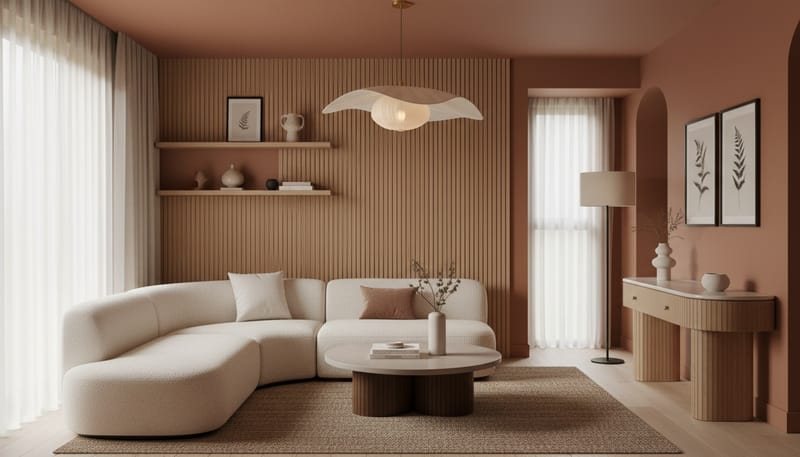
The Top Trends at a Glance
Before diving into each trend in detail, here is a high-level view of the movements shaping new build interiors this year. Each is explored fully in the sections that follow.
- Warm Neutrals Replacing Grey: Mushroom, cashmere, sage, and terracotta tones are the new foundation palette, pushing aside the decade-long dominance of cool grey.
- Curved Furniture and Arched Details: Rounded sofas, arched mirrors, and kidney-shaped tables soften the angular architecture of new builds.
- Japandi Evolution: The Japanese-Scandinavian fusion matures with deeper textures, darker timbers, and more confident craft elements.
- Fluted and Reeded Textures: Vertical ridges on cabinetry, furniture, and accessories add depth and architectural interest to flat surfaces.
- Bold Stone: Dramatic marble, travertine, and even onyx move beyond bathrooms into kitchens, living areas, and hallways.
- Warm Metals: Brushed brass, aged copper, and antique bronze replace chrome and brushed nickel across every room.
- Sustainable and Natural Materials: Reclaimed timber, organic textiles, and responsibly sourced stone reflect a permanent shift in consumer values.
- Maximalism Pockets Within Minimalist Schemes: Bold, expressive moments inside otherwise calm, restrained interiors.
- Statement Lighting: Sculptural pendants, oversized floor lamps, and architectural wall lights treated as art.
- Coloured Sanitaryware: Sage green, soft pink, and matt black basins and WCs bring personality to bathrooms.
- Smart Home Integration as Design: Technology becomes invisible, embedded seamlessly into the aesthetic rather than bolted on top.
- Indoor-Outdoor Connection: Bi-fold doors, garden rooms, and planted thresholds blur the boundary between inside and out.
- Vintage and Antique Mixing: Characterful old pieces layered into new build settings for instant personality and depth.
- Wallpaper Comeback: Bold patterns, botanical prints, and textured wallcoverings reclaim feature walls with confidence.
- Textured Paint Finishes: Limewash, microcement, and Roman clay replace flat emulsion with movement and tactility.
- Boucle and Textured Fabrics: Looped, nubby, and richly woven fabrics add sensory depth to every room.
Trend Longevity Assessment
Not every trend deserves the same level of commitment. Some are generational shifts that will define UK interiors for a decade or more. Others are best enjoyed through small, easily swapped touches. The table below rates each major trend so you can invest your budget wisely.
| Trend | Current Popularity | Staying Power Rating | Investment Level |
|---|---|---|---|
| Warm neutrals replacing grey | Very high | 10/10 — generational shift | High — safe for kitchens, bathrooms, walls |
| Curved furniture & arched details | High | 7/10 — strong medium-term | Medium — invest in one signature piece |
| Japandi evolution | High | 9/10 — rooted in timeless philosophy | High — safe for furniture and layout decisions |
| Fluted and reeded textures | High, nearing peak | 6/10 — risk of over-saturation | Low to medium — use selectively |
| Bold stone (marble, onyx) | Growing fast | 8/10 — natural stone is timeless | High — choose classic veining over extreme patterns |
| Warm metals (brass, copper) | Very high | 9/10 — replacing chrome long-term | High — safe for taps, handles, lighting |
| Sustainable & natural materials | Very high | 10/10 — permanent cultural shift | High — invest without hesitation |
| Maximalism pockets | Medium-high | 5/10 — personal preference driven | Low — express through accessories and art |
| Statement lighting | Very high | 8/10 — lighting as design is established | Medium — pendants are easy to swap later |
| Coloured sanitaryware | Medium, growing | 5/10 — exciting but risky for permanence | Low — try in a cloakroom, not a main bathroom |
| Smart home as design | High | 10/10 — technology only advances | High — plan infrastructure early |
| Indoor-outdoor connection | Very high | 10/10 — fundamental lifestyle shift | High — bi-folds, garden rooms add lasting value |
| Vintage and antique mixing | High | 9/10 — individuality never dates | Medium — one or two pieces per room |
| Wallpaper comeback | High | 7/10 — cyclical but currently strong | Low to medium — one feature wall is ideal |
| Textured paint (limewash, microcement) | Medium-high, growing | 7/10 — adds artisan quality | Medium — perfect for a feature wall or two |
| Boucle and textured fabrics | High, nearing peak | 6/10 — beautiful but at saturation | Low to medium — one or two pieces, not all seating |
Warm Neutrals Replacing Grey
If there is a single defining movement in UK interior design for 2026, it is the decisive and permanent shift from cool greys to warm, nature-inspired neutrals. From roughly 2015 to 2023, grey dominated every element of the typical new build interior — grey kitchen cabinets, grey engineered flooring, grey sofas, grey tiles. It was clean and contemporary, but it created a uniformity that left many homes feeling interchangeable.
The neutrals of 2026 are layered, complex, and grounded in the natural world. Mushroom, cashmere, warm taupe, oatmeal, and soft sand tones wrap rooms in quiet comfort while working beautifully with the generous natural light new build homes provide. For homeowners who inherited a grey palette, the transition is surprisingly easy: warm taupe walls, honey-toned timber accessories, and cream textured soft furnishings transform a grey-based room without a complete overhaul. For guidance on choosing paint colours for new plaster, see our guide to colour schemes for new build homes.
Several developers now offer warmer colour choices as standard or as part of upgrade packages. If you are at the reservation stage, ask about kitchen cabinets in cashmere, sage, or warm stone rather than defaulting to grey. The shift is not just cosmetic — warm neutrals are proven to make rooms feel more spacious, more restful, and more welcoming across different lighting conditions.
| Colour | Where to Use | Pairs With |
|---|---|---|
| Mushroom (warm grey-brown-mauve) | Open-plan living areas, hallways, master bedrooms | Sage green, brass, cream linen, walnut timber |
| Cashmere (soft warm cream) | Kitchen cabinets, bedroom walls, bathroom vanities | Oak, terracotta accents, brushed copper, natural stone |
| Sage green (muted grey-green) | Kitchen cabinets, feature walls, bedrooms, bathrooms | Warm white, brass hardware, timber, blush pink |
| Terracotta (earthy burnt orange) | Accent walls, cushions, ceramics, statement chairs | Cream, mushroom, olive green, dark timber |
| Warm taupe (golden-brown neutral) | All-over wall colour, large sofas, curtains | Leather, aged brass, ivory, charcoal accents |
| Oatmeal (soft warm beige) | Sofas, rugs, bedding, curtain panels | Practically everything — the ultimate mixer |
| Olive green (deeper grey-green) | Feature walls, front doors, dining room accents | Warm white, natural timber, caramel leather, brass |
| Soft sand (warm pale beige) | Ceilings, trim, full-room colour, bathrooms | Every warm neutral, natural stone, warm metals |
Key paint colours leading this movement include Farrow and Ball Jitney (No. 293), a gorgeous warm putty shade; Little Greene Rolling Fog (No. 143), a sophisticated mushroom tone; and Dulux Warm Pewter, which bridges grey and warm palettes beautifully. A full room repaint costs approximately £150 to £350 for a standard new build living room including professional labour, or £40 to £80 in paint alone if you tackle it yourself.
Curved Furniture and Arched Details
Straight lines and sharp angles defined minimalist interiors for the past decade, but 2026 is emphatically about curves. Rounded sofas, arched mirrors, oval dining tables, kidney-shaped coffee tables, and gently curved shelving are softening the naturally angular architecture of new build homes across the UK.
The appeal goes beyond aesthetics. Research in environmental psychology suggests that people perceive curved forms as more relaxing and approachable than angular ones. In an open-plan new build where the architecture tends towards clean right angles, introducing organic shapes through furniture creates a pleasing contrast that makes spaces feel warmer and more human. A curved sofa, for example, creates a sociable, enveloping seating area without the hard visual barrier of an L-shaped sectional — particularly valuable in the kitchen-dining-living layouts that define modern new builds. For layout advice, see our guide to open-plan living in new build homes.
- Curved sofas: MADE Kendal range from approximately £999 to £1,499; Soho Home Odette range from £2,000 to £4,000; Habitat curved armchairs from £350 to £700.
- Arched mirrors: Oliver Bonas from £150 to £350; H&M Home from £60 to £130; West Elm from £200 to £500.
- Oval dining tables: Replace a rectangular table with an oval to improve flow around the room — from £400 to £1,200 at mid-range retailers.
- Kidney-shaped coffee tables: A signature 2026 piece, available in marble, timber, and glass from £150 to £600.
- Budget approach: Add a single arched mirror or round cushions for under £80 to bring curves into any room affordably.
Japandi Evolution
The Japandi aesthetic — a fusion of Japanese minimalism and Scandinavian warmth — has matured from a niche design movement into a defining influence on mainstream UK interiors. In 2026, it evolves further with deeper textures, darker timbers like smoked oak and walnut, and more confident handcraft elements that give spaces genuine soul.
Japandi interiors in a new build context translate through choices such as a simple, beautifully made oak dining table rather than a feature-heavy extendable design; a handwoven jute or wool rug rather than a machine-printed synthetic one; open shelving with carefully curated objects; and low-profile furniture that creates a sense of groundedness and calm. The related philosophy of wabi-sabi — finding beauty in imperfection — adds depth through natural grain variations in timber, irregular glazes on handmade ceramics, and the gentle patina of aged brass.
- Muji: Simple, functional homewares from approximately £5 to £200 — the purest Japandi source.
- Habitat: Current direction leans strongly Japandi with timber and ceramic pieces from £10 to £500.
- Nkuku: Handcrafted ceramics, glassware, and furniture with wabi-sabi sensibility from £8 to £800.
- Applying in a new build: Start with the bedroom — a low platform bed, linen bedding, a single handmade ceramic on the windowsill. See our guide to new build bedroom design.
- Budget tip: A handmade ceramic vase (£15 to £40) and a jute rug (£50 to £120) instantly set the Japandi tone.
Fluted and Reeded Textures
Fluting — those elegant vertical ridges that add rhythm and shadow to flat surfaces — has become one of the most distinctive design details of the mid-2020s. Originally associated with Art Deco architecture, fluted and reeded detailing now appears on kitchen cabinet doors, bathroom vanities, bedside tables, console tables, and TV units. Light catches the ridges differently throughout the day, creating subtle shadow play that brings surfaces alive.
In a new build where standard finishes tend to be smooth and flat, fluted details add an architectural quality that elevates entire rooms. Fluted glass cabinet inserts for kitchens cost approximately £30 to £80 per panel. Fluted kitchen island panels — applied to the front or end of a standard island — cost approximately £200 to £500 for a carpenter to fabricate and install. Free-standing fluted furniture is widely available from Oliver Bonas (sideboards from £350), West Elm (bedside tables from £250), and even IKEA, which has incorporated reeded details into several recent ranges.
- Best application: A single fluted piece per room — a vanity unit, a sideboard, or an island panel — for maximum impact without over-saturation.
- Risk warning: Fluting is approaching peak popularity. Use it as an accent detail rather than a whole-room treatment to ensure longevity.
- Budget entry point: A fluted plant pot or candle holder from £10 to £25 at H&M Home introduces the texture with zero commitment.
Bold Stone: Dramatic Marble, Travertine, and Onyx
Natural stone is having its most dramatic moment in decades. Where bathrooms previously defaulted to safe, uniform porcelain tiles, 2026 embraces the drama of heavily veined marble, warm honey-toned travertine, and even semi-translucent onyx as genuine design statements. The trend is moving stone out of bathrooms and into kitchens, living areas, hallways, and even bedrooms as feature walls and hearth surrounds.
Travertine has surged in popularity, its organic texture and honeyed warmth creating spa-like quality that porcelain struggles to replicate. Genuine travertine tiles cost approximately £40 to £100 per square metre, while convincing porcelain alternatives run £25 to £60 per square metre. Dramatic veined marble — think Calacatta with bold gold and grey veining, or Nero Marquina with striking white veins against black — is being used for kitchen splashbacks, bathroom feature walls, and even dining table tops. Onyx, with its translucent, layered beauty, appears most often as a backlit feature — a bar front, a powder room basin surround, or a dramatic hallway panel — where light can pass through and illuminate the natural patterning.
- New build application: A marble-effect porcelain splashback is the easiest and most affordable way to introduce bold stone — from £30 to £70 per square metre.
- Resale value: Natural stone in bathrooms and kitchens consistently adds perceived value. Estate agents report that stone features are among the first things buyers notice.
- Budget alternative: Marble-effect vinyl wrap for existing worktops or shelving from £15 to £40 per metre of film — removable and renter-friendly.
- Maintenance note: Natural marble and travertine require sealing. Porcelain lookalikes offer the aesthetic with far less upkeep.
Warm Metals: Brushed Brass, Aged Copper, and Antique Bronze
The metalwork of 2026 glows. Brushed brass, aged copper, and antique bronze are replacing chrome and brushed nickel as the default metal finish across kitchens, bathrooms, lighting, and furniture hardware. The shift mirrors the broader warm-neutral movement — warm metals complement mushroom, sage, and terracotta palettes in a way that cool chrome simply cannot.
For new build homeowners, swapping metal finishes is one of the highest-impact, lowest-cost upgrades available. Replacing developer-supplied chrome cabinet handles with brushed brass alternatives transforms a kitchen or bathroom for £80 to £250 for a full set. A brushed brass kitchen tap costs approximately £150 to £400 from brands like Bristan, Abode, and Perrin and Rowe. Aged copper pendant lights add warmth and character above a dining table or kitchen island for £60 to £250 from retailers like Original BTC and Industville.
- Start by choosing one metal finish for the whole room — mixing metals is possible but requires a confident eye.
- Replace cabinet handles first — the most affordable and highest-impact change.
- Swap the tap if your budget allows — this is the most visible single fixture in a kitchen or bathroom.
- Add coordinating light fittings, towel rails, and accessories to complete the warm-metal transition.
- If mixing metals, use a 70/30 rule — 70 percent dominant metal, 30 percent accent metal.
Material Trends Comparison
Choosing the right materials is where trend meets practicality. The table below compares the materials defining 2026 interiors, with honest assessments of cost, durability, and where each works best.
| Material | Look and Feel | Typical Cost Range | Durability | Best Rooms |
|---|---|---|---|---|
| Natural oak (solid or engineered) | Warm, golden, organic grain patterns | £40–£120 per sq m (flooring) | Excellent — can be refinished | All rooms, especially living and bedrooms |
| Travertine | Honeyed warmth, organic texture, spa-like | £40–£100 per sq m (tiles) | Good — requires sealing | Bathrooms, hallways, kitchen splashbacks |
| Calacatta marble | Dramatic white with bold gold-grey veining | £80–£200 per sq m | Moderate — porous, needs care | Splashbacks, vanity tops, feature panels |
| Boucle fabric | Nubby, looped texture, deeply tactile | £800–£3,000 (sofa); £15–£50 (cushion) | Good on quality pieces — can pill on cheap ones | Living rooms, bedrooms, dining chairs |
| Limewash paint | Chalky, mottled, artisan movement | £40–£65 per 2.5L | Good — touch-ups blend naturally | Feature walls, bedrooms, living rooms |
| Microcement | Smooth, industrial-meets-luxe, seamless | £80–£150 per sq m (applied) | Excellent — waterproof when sealed | Bathrooms, kitchens, feature walls |
| Brushed brass | Warm golden glow, sophisticated, tactile | £5–£25 per handle; £150–£400 (tap) | Excellent — develops beautiful patina | Kitchens, bathrooms, lighting, furniture |
| Linen (curtains, upholstery) | Relaxed, naturally textured, breathable | £20–£80 per panel (curtain) | Good — softens and improves with washing | Bedrooms, living rooms, dining rooms |
| Jute and sisal | Earthy, woven, casual warmth | £50–£200 (standard rug) | Moderate — best in low-traffic areas | Living rooms, bedrooms, hallways |
Sustainable and Natural Materials
Sustainability has moved permanently from niche concern to mainstream design driver. In 2026, the most admired interiors are those that prioritise natural, responsibly sourced, and long-lasting materials over disposable fast-furniture alternatives. This aligns perfectly with the broader warm-neutral palette — natural timber, stone, wool, linen, cotton, jute, and rattan all sit beautifully within earthy colour schemes.
For new build homeowners, sustainability often means buying fewer but better things. One excellent solid oak dining table that lasts thirty years is both more sustainable and more beautiful than three cheap replacements over the same period. The shift also encourages repair, reupholstery, and upcycling — extending the life of existing pieces rather than replacing them.
- Reclaimed timber: Shelving, table tops, and decorative beams sourced from architectural salvage yards add character and reduce waste.
- Organic cotton and linen: Bedding and curtains in organic fabrics from The White Company, Piglet in Bed, and IKEA's sustainable ranges.
- FSC-certified furniture: Look for the Forest Stewardship Council mark when buying timber furniture — West Elm and Habitat both carry extensive certified ranges.
- Recycled glass and metal: Decorative accessories, light fittings, and tiles made from recycled materials are increasingly available at mainstream price points.
- Cork: Flooring, pinboards, coasters, and even wall tiles — cork is harvested without cutting trees and has excellent thermal and acoustic properties.
- New build advantage: Modern construction standards mean your home already has excellent insulation and energy efficiency — extend that sustainable thinking into your interior choices.
Maximalism Pockets Within Minimalist Schemes
After years of pared-back minimalism, a confident strain of expressive maximalism is returning — but with a sophisticated twist. Rather than going maximalist throughout, 2026 favours bold, curated moments within otherwise calm, restrained interiors. Think of it as a conversation piece within a quiet room: a vibrant gallery wall in an otherwise neutral hallway, a jewel-toned velvet armchair against a mushroom-painted wall, or a wildly patterned wallpaper inside built-in shelving.
This approach works exceptionally well in new build homes, where the clean, neutral base provides the perfect backdrop for expressive moments. The key is intentional contrast — one bold element per room, supported by calm, warm surroundings that let it breathe. A full maximalist living room risks overwhelming a new build's typically open-plan layout, but a maximalist corner, bookshelf, or powder room can be stunning.
- Gallery wall: Cluster 8 to 12 frames in mixed sizes with a unified colour palette for approximately £100 to £400.
- Patterned wallpaper niche: Paper the back of a shelving unit or a single alcove for approximately £30 to £80 per roll.
- Statement armchair: A bold velvet or patterned accent chair from £250 to £700 anchors a maximalist moment.
- Powder room drama: Small spaces can handle bold choices — dramatic wallpaper, dark paint, or patterned tile in a cloakroom makes an impact without the commitment of a larger room.
Statement Lighting
Lighting in 2026 is sculptural — chosen as much for its visual presence when switched off as for its illumination when switched on. Organic pendants in mouth-blown glass, handmade paper, woven rattan, and raw ceramic; oversized globe and dome shapes above dining tables and kitchen islands; warm-toned metalwork in brass and bronze; and clustered arrangements at staggered heights are all defining the year's lighting aesthetic.
For new build homeowners, lighting upgrades offer exceptional impact relative to cost and effort. Replacing a single developer-supplied ceiling fitting with a statement pendant transforms a room instantly. For detailed guidance on lighting layers and installation, see our comprehensive article on new build lighting design.
- Audit every room and identify the single most important fitting to replace first — usually the dining pendant or the living room ceiling light.
- Choose a pendant that is approximately one-third to two-thirds the width of the table below it, hanging 700 to 800 millimetres above the surface.
- Layer lighting with table lamps and floor lamps in warm-toned finishes to create pools of light and atmosphere in the evening.
- Install dimmer switches — approximately £15 to £30 per switch plus electrician cost — to control mood across every room.
- Consider LED strip lighting under kitchen cabinets or floating shelves for subtle architectural glow — from £15 to £40 per metre.
- Budget range (£50 to £150): Habitat, Oliver Bonas, H&M Home — excellent rattan, paper, and glass pendants.
- Mid-range (£150 to £500): West Elm, MADE, Pooky — designer shapes in quality materials.
- Premium (£500 to £2,000+): Soho Home, Tom Dixon, Original BTC — investment pieces with sculptural presence.
Coloured Sanitaryware
One of the bolder bathroom trends for 2026 is the return of coloured sanitaryware. After decades of all-white suites, manufacturers are introducing basins, WCs, and baths in sage green, soft pink, matt black, warm grey, and even deep navy. Brands like Burlington, BC Designs, and Lusso Stone are leading the charge in the UK market, with pieces that feel modern and refined rather than retro.
This trend works best when treated with restraint. A single coloured basin in a cloakroom or en-suite makes a beautiful design statement. Committing an entire family bathroom to coloured sanitaryware carries more risk — if tastes shift, replacing a basin and WC is a significant expense. The safest approach for resale-conscious homeowners is to introduce colour through one statement piece, supported by neutral tiles and warm metalwork. For comprehensive bathroom design advice, see our guide to new build bathroom design.
- Sage green basin: From approximately £250 to £600 — stunning against warm white or timber.
- Matt black WC and basin suite: From approximately £400 to £900 — dramatic in a monochrome scheme.
- Soft pink freestanding bath: From approximately £800 to £2,000 — a showstopper in a master bathroom.
- Budget alternative: A coloured countertop basin (from £80 to £200) delivers the trend at a fraction of the cost and is easy to swap later.
Smart Home Integration as Design
Smart technology in 2026 is no longer about visible gadgets and trailing cables — it is about seamlessly embedded systems that enhance both function and aesthetics. New build homes are particularly well-suited to smart integration because they arrive with modern wiring, structured cabling, and often pre-installed smart-ready features. For a full overview, see our guide to smart home features in new builds.
- Invisible speakers: Built into walls or ceilings for whole-home audio without visible hardware — from £300 to £800 per room.
- Smart lighting scenes: Colour temperature shifts throughout the day, controlled via elegant wall panels rather than phone apps — Philips Hue or Lutron Caseta from £150 to £400 per room.
- Motorised blinds: Silent operation on timer or voice command, eliminating visible cords — from £200 to £500 per window (Eve MotionBlinds, IKEA Fyrtur).
- Samsung Frame TV: Displays curated artwork when not in use, hanging flush like a framed print — from £800 to £2,000 depending on size.
- Pop-up power sockets: Sit flush with worktops when not in use — from £40 to £100 per socket.
- Design principle: Technology should serve design, never compete with it. The best smart home is one where you cannot see the technology at all.
Indoor-Outdoor Connection
The boundary between inside and outside continues to dissolve in 2026. Bi-fold and sliding doors, garden rooms, planted thresholds, and materials that flow seamlessly from interior to exterior are creating homes that feel larger, lighter, and more connected to nature. New build homes often come with generous glazing and rear door openings that make this trend particularly achievable.
Bi-fold doors opening onto a patio or garden create an entire wall of glass that merges the kitchen-diner with the outdoor space. Continuing the same or similar flooring material from inside to outside — for example, a porcelain patio tile that matches the kitchen floor — reinforces the seamless connection. Garden rooms have surged in popularity, offering year-round usable space for home offices, studios, and entertaining from approximately £8,000 to £25,000 depending on size and specification.
- Matching thresholds: Use the same tile or a close visual match inside and outside the bi-fold line for seamless flow.
- Planted borders: Position pots and planters along the door threshold to green the transition zone — from £50 to £200 for a planted arrangement.
- Outdoor kitchen elements: A built-in barbecue or outdoor prep area extends the kitchen into the garden — from £500 to £3,000.
- For more ideas: See our guide to new build garden setup.
Vintage and Antique Mixing
The most characterful interiors of 2026 blend new pieces with vintage, antique, and second-hand finds. A brand-new home can feel soulless if every piece of furniture arrived in flat-pack boxes on moving day. Introducing a few carefully chosen older pieces — a mid-century teak sideboard, a pair of reclaimed school chairs, a vintage Persian rug, an antique mirror — immediately adds the personality and patina that new builds can sometimes lack.
The contrast between crisp new build architecture and the warmth of aged, characterful pieces creates an interior that feels both modern and storied. Facebook Marketplace, Vinterior, Etsy Vintage, and local antique fairs are excellent hunting grounds, with prices often comparable to or lower than equivalent new pieces.
- One vintage statement per room: A sideboard in the living room, a dressing table in the bedroom, a console table in the hallway.
- Budget range: Expect £100 to £500 for a good-quality vintage sideboard or chest depending on condition.
- Mixing rule: Pair vintage furniture with contemporary accessories, or contemporary furniture with vintage art and ceramics — the contrast is what creates magic.
- Sustainability bonus: Every vintage purchase is inherently sustainable — no new materials, no manufacturing energy, no packaging waste.
Wallpaper Comeback: Bold Patterns Return
Wallpaper is back with confidence. After years of plain painted walls, bold botanical prints, oversized florals, geometric patterns, and richly textured wallcoverings are reclaiming feature walls, hallways, powder rooms, and bedrooms. The quality and variety available in 2026 is extraordinary, with UK brands like Cole and Son, Morris and Co, and Farrow and Ball producing designs that range from subtle texture to unapologetic drama.
In a new build home, wallpaper is one of the fastest routes to personality. A single papered feature wall in a living room or bedroom costs approximately £60 to £200 for the paper (one to two rolls depending on the pattern repeat and wall size) plus £100 to £200 for professional hanging. Peel-and-stick options from brands like Lick and Bobbi Beck allow commitment-free experimentation from approximately £30 to £60 per roll.
- Best rooms for wallpaper in new builds: Hallways (first impression), powder rooms (small space, big impact), bedrooms (behind the headboard), and dining areas.
- Current favourites: Oversized tropical leaves, Art Deco geometric patterns, William Morris-inspired botanicals, and grasscloth texture.
- New build tip: Wait until your walls have fully dried out before papering — typically three to six months after handover. See our guide to decorating a new build home.
Textured Paint Finishes: Limewash, Microcement, and Roman Clay
Flat matt emulsion is losing ground to artisan paint finishes that bring movement, depth, and tactility to walls. Limewash creates a beautiful chalky, mottled effect where no two patches look identical — the light plays across the surface differently throughout the day, creating a living, breathing wall that flat paint simply cannot match. Microcement delivers a smooth, seamless, industrial-meets-luxe finish that works brilliantly in bathrooms, kitchens, and feature walls. Roman clay offers a rich, velvety plaster effect with subtle colour variation.
These finishes are particularly effective in new build homes because they instantly counteract the uniform, factory-fresh quality of new plaster and paint. A limewash feature wall gives a room the kind of depth and character that usually takes decades to develop naturally.
- Limewash paint: Bauwerk Colour and Lick both offer UK-available limewash paints from £40 to £65 per 2.5 litres. Application is forgiving — the uneven look is the point.
- Microcement: Best applied by a professional — approximately £80 to £150 per square metre including labour. Ideal for bathroom walls and floors as a seamless, grout-free alternative to tiles.
- Roman clay: Available from specialist suppliers, applied in thin layers to build depth — approximately £50 to £80 per 2.5 litres.
- DIY suitability: Limewash is the most DIY-friendly of the three. Microcement and Roman clay benefit from professional application for best results.
- Budget hack: Apply limewash to a single feature wall (approximately £30 to £50 in materials) for maximum impact with minimum spend.
Boucle and Textured Fabrics
Texture is the quiet hero of 2026 interiors. Boucle — that distinctive looped, nubby fabric — remains hugely popular, though the colour palette has shifted from ubiquitous cream towards warmer oatmeal, caramel, and mushroom tones. Beyond boucle, the broader texture movement encompasses chunky knit throws, linen curtains, raw-edge ceramics, woven rattan, ribbed glass, and teddy-bear fleece, all layered together to create rooms that invite touch as much as they please the eye.
In a new build with smooth plaster walls and uniform finishes, these textural layers are essential for creating warmth and character. A boucle sofa is a significant investment at £800 to £3,000 from mid-range retailers, but boucle cushions from £15 to £50 at H&M Home and Oliver Bonas bring the texture into a room with far less commitment.
- Boucle sofa: Invest if you love it, but choose oatmeal or mushroom over pure white — more forgiving and more aligned with the warm-neutral direction.
- Linen curtains: Celebrate the natural crease of the fabric — from £20 to £80 per panel at H&M Home.
- Chunky knit throws: From £30 to £120, these add instant warmth to any sofa or bed.
- Mixing rule: Aim for three to five different textures in every room — smooth, nubby, woven, knitted, and natural — to create professional-level depth.
- Longevity note: Boucle is at or near peak saturation. One or two pieces will age gracefully; an entirely boucle interior may feel dated by 2028.
What Is Fading from 2024 and 2025
Every new trend displaces an older one. Here are the movements that are losing momentum heading into 2026 — though none of these become instant eyesores overnight, and anything you genuinely love is always worth keeping.
- All-grey interiors: Cool grey as a dominant palette is firmly fading. Warm grey (greige) survives, but the blue-undertone greys of 2015 to 2022 feel increasingly dated.
- Chrome everything: Cool chrome finishes are being replaced by warm brass, copper, and bronze. Chrome still works in very specific contemporary schemes, but it is no longer the default.
- Matchy-matchy furniture sets: Buying an entire room suite from one range looks less sophisticated now. Mixing brands, eras, and materials is the current direction.
- Live-laugh-love signage: Word art and motivational quote prints are declining in favour of genuine artwork, photography, and illustration.
- Stark minimalism: The ultra-spare, nothing-on-the-surfaces approach is being replaced by warm minimalism with more texture, colour, and personality.
- High-gloss finishes: High-gloss kitchen cabinets, tiles, and furniture are giving way to matt, brushed, and textured surfaces.
- Industrial exposed-metal looks: Raw steel and Edison bulbs are fading. The industrial aesthetic persists but is softening with warm metals and organic materials.
- Synthetic fast furniture: Cheap, disposable furniture is losing cultural acceptance as sustainability and quality-over-quantity thinking grows.
Timeless Choices That Always Work
Regardless of what trends come and go, certain design choices have proven their staying power across decades. If you want to future-proof your new build interior, anchor it with these enduring elements.
- White or warm-white walls: The ultimate versatile backdrop — every accent colour, every furniture style, and every artwork looks good against warm white.
- Natural timber flooring: Oak, walnut, or ash engineered flooring in a natural or lightly toned finish never dates. It is the foundation of virtually every design style.
- Quality upholstered sofa in a neutral fabric: A well-made sofa in oatmeal, mushroom, or warm grey will serve you for fifteen years or more.
- Simple, well-proportioned furniture shapes: Clean lines without extreme curves or overly ornate detailing transcend trend cycles.
- Natural stone in wet rooms: Marble, travertine, or limestone in bathrooms has looked elegant for centuries and will continue to do so.
- Layered lighting: Combining overhead, task, and ambient lighting works in every design era.
- Real plants: Greenery has been part of interior design for as long as interiors have existed. Plants will never go out of style.
- Quality bedding: Crisp white cotton or linen sheets at 300+ thread count are a permanent luxury that every trend supports.
Trend vs Timeless Decision Matrix
When planning your new build interior, some elements should follow trends and others should stay timeless. This decision matrix helps you invest wisely by matching the permanence of the element with the appropriate level of trend commitment.
| Element | Go Trendy? | Go Timeless? | Why |
|---|---|---|---|
| Kitchen cabinets | Moderately — sage, cashmere are safe current choices | Yes — white, cream, or navy never date | Kitchens cost £5,000+ to replace — choose colours with proven longevity |
| Bathroom tiles | On a feature wall only | Yes — neutral stone-effect or white metro tiles last decades | Re-tiling is expensive and disruptive — keep the base neutral |
| Sofa | Shape can be trendy (curves); fabric should be neutral | Neutral fabric, quality construction | A sofa lasts 8–15 years — invest in comfort and quality over fashion |
| Wall colour | Yes — paint is cheap and easy to change | For whole-house base, yes | Repainting a room costs £40–£80 in paint — low risk to experiment |
| Cushions and throws | Absolutely — this is where trends belong | No need — swap seasonally | Costs £10–£50 each — refresh every year or two guilt-free |
| Lighting pendants | Yes — easy to swap, high impact | Useful for recessed downlights | A new pendant for £50–£200 transforms a room instantly |
| Flooring | No — flooring should outlast multiple trend cycles | Absolutely — natural oak or stone-effect | Flooring costs £2,000–£8,000 per floor and disrupts the whole house to replace |
| Hardware (handles, taps) | Yes — affordable and easy to swap | Useful as a starting point | Full handle swap costs £80–£250 — low risk, high reward |
| Wallpaper | Yes — on one feature wall or in a small room | For whole rooms, plain paint is safer | Peel-and-stick options make experimentation risk-free |
| Sanitaryware colour | In a cloakroom or en-suite only | Yes — white in main bathrooms | Coloured WCs and basins cost £400–£900+ to replace if tastes change |
Room-by-Room Trend Application
Different rooms suit different trends. The table below maps the most impactful trends to each room in your new build, with realistic budget ranges and expected impact level.
| Room | Top Trends to Apply | Budget Range | Impact Level |
|---|---|---|---|
| Open-plan living area | Warm neutrals, curved sofa, statement pendant, textured fabrics, vintage accent piece | £500–£5,000 | Very high — this is the heart of your home |
| Kitchen | Warm metals (handles, tap), bold stone splashback, fluted island panel, smart lighting | £200–£3,000 | High — kitchens are the most-used room |
| Master bedroom | Limewash feature wall, linen bedding, Japandi simplicity, wall-mounted reading lights | £300–£1,500 | High — daily retreat and private sanctuary |
| Main bathroom | Travertine or stone-effect tiles, warm brass fittings, microcement, spa minimalism | £500–£4,000 | High — transforms daily routine |
| En-suite or cloakroom | Bold wallpaper, coloured sanitaryware, dramatic tile, statement mirror | £200–£1,500 | High — small space absorbs bold choices well |
| Hallway | Gallery wall, warm neutral paint, vintage console table, statement pendant | £100–£600 | Medium-high — sets the tone for the whole home |
| Dining area | Curved or oval table, clustered pendant lighting, linen table runner, warm metals | £300–£2,000 | Medium-high — social and entertaining space |
| Home office | Japandi desk setup, biophilic plants, smart tech integration, textured paint wall | £200–£1,000 | Medium — affects productivity and wellbeing |
| Garden or patio | Indoor-outdoor flow, matching threshold tiles, garden room, planted borders | £500–£25,000 | Very high — adds usable square footage |
Budget-Friendly Ways to Try Every Trend
You do not need a large budget to bring 2026 trends into your new build. Every single trend covered in this guide has an affordable entry point. Here is how to try each one without breaking the bank.
- Warm neutrals: Repaint one room in mushroom or warm taupe — £40 to £80 in paint for a complete transformation.
- Curved furniture: Add a round cushion or an arched mirror rather than replacing your sofa — £20 to £80.
- Japandi: A single handmade ceramic vase and a jute rug set the tone for £65 to £160.
- Fluted texture: A fluted plant pot or candle holder from H&M Home — £10 to £25.
- Bold stone: A marble-effect chopping board styled as decor, or a small marble tray — £15 to £40.
- Warm metals: Replace cabinet handles in one room with brushed brass — £30 to £80 for a set.
- Sustainability: Buy one vintage piece from Facebook Marketplace — £20 to £100.
- Maximalism pocket: Create a gallery wall with charity shop frames and printed artwork — £30 to £80.
- Statement lighting: Swap one ceiling pendant for a rattan or paper design — £25 to £60.
- Coloured sanitaryware: A coloured soap dispenser and matching accessories — £10 to £30.
- Smart home: Start with smart bulbs in two or three rooms — £30 to £60.
- Indoor-outdoor: Position plants along the door threshold and add outdoor cushions — £30 to £70.
- Vintage mixing: One antique mirror or reclaimed shelf — £20 to £80.
- Wallpaper: Peel-and-stick paper behind shelving or in an alcove — £15 to £40.
- Textured paint: Limewash one feature wall — £30 to £50 in materials.
- Boucle texture: A pair of boucle cushion covers — £15 to £30.
Which Trends Add Resale Value
If you plan to sell your new build within five to ten years, some trends actively increase buyer appeal while others are neutral or even counterproductive. Estate agents and property stylists consistently highlight the following as value-adding design choices.
- Warm neutral palette: Strongly positive. Warm, neutral interiors photograph well and appeal to the widest range of buyers. Grey is losing favour with buyers as well as residents.
- Kitchen upgrades (handles, tap, splashback): Strongly positive. Kitchens sell houses. Even modest upgrades like brass handles and a stone-effect splashback increase perceived value far beyond their cost.
- Natural stone in bathrooms: Positive. Travertine, marble, and quality stone-effect tiles signal quality and permanence to buyers.
- Smart home infrastructure: Positive and growing. Buyers increasingly expect smart thermostats, video doorbells, and smart lighting as standard.
- Indoor-outdoor improvements: Strongly positive. Bi-fold doors, good patio design, and garden rooms consistently add more value than they cost.
- Statement lighting: Mildly positive. Attractive lighting makes rooms photograph well for listings, creating better first impressions online.
- Bold wallpaper or coloured sanitaryware: Neutral to mildly negative for resale — highly personal choices that some buyers love and others would immediately change. Use in easily reversible ways.
- Vintage pieces: Neutral — these move with you, so they do not affect the property itself, but they help stage the home beautifully for viewings.
Where to Find Inspiration
Knowing where to look is half the battle. These sources consistently provide the best quality design inspiration for UK new build homeowners in 2026.
- Pinterest: Create boards for each room and pin freely for the first few weeks. Then step back and look for recurring themes — the colours, materials, and shapes you are drawn to repeatedly reveal your authentic taste.
- Instagram accounts: Follow @mad_about_the_house, @lisa_dawson_stylist, @the_house_acc, and @kloentrup for realistic, beautifully styled UK interiors that translate to real homes.
- Design magazines: Livingetc, Elle Decoration, and Homes and Gardens consistently feature achievable, trend-forward UK interiors. Monthly issues provide more considered, editorial content than the rapid scroll of social media.
- Showroom visits: Spend an afternoon in West Elm, Habitat, and Soho Home showrooms to see furniture, fabrics, and colours in real life — screens never represent materials accurately.
- Developer show homes: Visit the show homes at your development and others nearby. Developers invest significant sums in professional styling, and the layouts and colour choices provide excellent practical inspiration for your specific home type.
- Design exhibitions: The Ideal Home Show, Grand Designs Live, and Decorex all take place annually in the UK and showcase the very latest products and trends in person.
- This blog: Browse our full range of new build home guides covering every aspect of designing, decorating, and maintaining your new build property.
Practical Steps: Implementing Trends in Your New Build
Translating inspiration into real design decisions works best with a phased approach, particularly when you are managing the drying-out period, building savings after a house purchase, and getting to know your new home.
- Month 1 to 3 — Observe and plan: Live in your new build before making major decisions. Notice how light moves through each room, which spaces feel cold or warm, and how you actually use each area. Create mood boards for every room. This costs nothing and prevents expensive mistakes. For guidance on this period, see our guide to decorating a new build home.
- Month 3 to 6 — Quick wins (budget £200 to £800): Replace developer light fittings with statement pendants. Add textured cushions and throws. Introduce houseplants. Hang artwork or set up picture ledges. Swap cabinet handles to warm metals.
- Month 6 to 12 — Feature changes (budget £500 to £2,000): Paint feature walls in warm neutrals or apply limewash. Hang wallpaper in one room. Add a vintage statement piece per room. Upgrade kitchen splashback if desired.
- Month 12 to 18 — Considered investments (budget £1,000 to £5,000): Invest in a quality sofa, a dining table, or an upholstered bed. Refresh a bathroom with new taps and accessories. Add smart home layers. Consider a garden room.
- Year 2 and beyond — Ongoing evolution: Continue layering in pieces — a vintage find, a new artwork, a seasonal change of cushions, a plant that has grown into a specimen. The most beautiful interiors are never truly finished.
Final Thoughts
The interior design trends of 2026 share a unifying thread: a return to warmth, nature, texture, and authenticity. After years of cool greys and clinical minimalism, UK homes are embracing richer colour palettes, handcrafted materials, bold artistic expression, and a design philosophy that values quality, sustainability, and personal meaning over fleeting fashion.
For new build homeowners, these trends are particularly exciting because they address the very qualities a brand-new home sometimes needs most — warmth, character, individuality, and a sense of being truly lived in. Your new build provides the perfect clean, contemporary foundation. The trends of 2026 provide exactly the right ingredients to transform that foundation into a home with genuine soul.
The most important principle remains constant: design for yourself, not for a trend forecast. Use this guide as a toolkit of ideas and inspiration, but filter everything through your own taste, lifestyle, and budget. The best new build interior is not the most fashionable one — it is the one that makes you feel completely, deeply at home every time you walk through the door.
Social Media vs Reality
Instagram, TikTok, and Pinterest are extraordinary sources of design inspiration, but the gap between a styled photoshoot and a lived-in home is real. Here is what to keep in mind when translating social media trends into your actual new build.