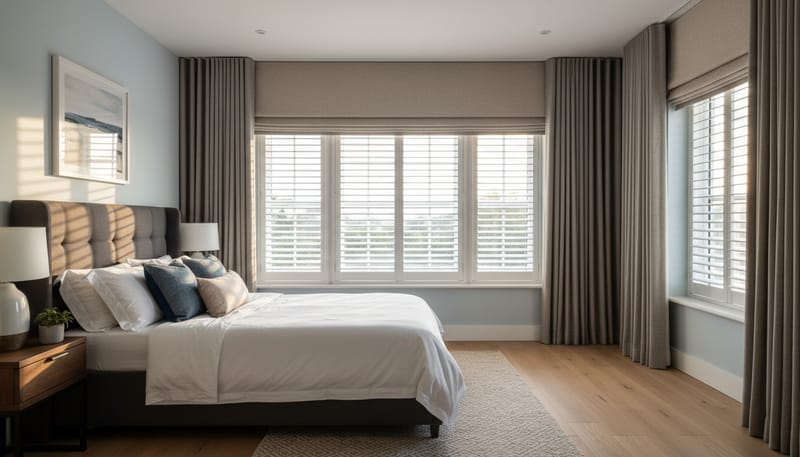
Why Window Treatments Matter in New Builds
Walking into your brand-new home for the first time is thrilling, but the reality of bare windows hits fast. On a new build estate where houses sit close together and front windows face directly onto pavements and shared driveways, privacy becomes an immediate concern. Without any window coverings, every room is on display from the moment you move in — and that includes bedrooms where summer daylight lasts past 9pm.
Beyond privacy, window treatments serve several critical functions: controlling natural light, insulating against heat loss in winter and solar gain in summer, reducing noise transfer, and — perhaps most importantly — turning a generic builder-finish interior into a space that feels genuinely like home. The right blinds, curtains, or shutters add texture, colour, and personality to rooms that can otherwise feel quite uniform across a new development.
What Your Developer Typically Provides
- Windows and frames: Double or triple-glazed UPVC units installed to current Building Regulations, usually with trickle vents
- Obscured glass: Frosted or patterned glass in bathroom and WC windows only — all other windows are clear
- Window sills: Internal MDF or UPVC sills, external stone or concrete sills
- Curtain poles or blinds: Not included — your windows are completely bare
- Fixing points: No pre-drilled holes, brackets, or battens for curtain poles or tracks
- Window reveals: Plastered and painted reveals, typically 70mm to 120mm deep depending on the build method
- Covenants: Some developments require white or neutral coverings visible from the street — check your homeowner pack
None of this is a criticism of developers — it is simply the standard across the UK new build industry. Window treatments are a personal choice, and developers rightly leave this decision to the homeowner. What it does mean is that budgeting for window treatments should be part of your moving-in costs, not an afterthought. For more on planning your move-in budget, see our guide to new build snagging checklists.
Window Treatment Types: Master Comparison
Before diving into the details of each type, this master comparison table gives you a side-by-side overview of the six main window treatment categories. Costs shown are per standard window (approximately 1,200mm x 1,200mm) in made-to-measure form, as this is the most common size in UK new builds.
| Treatment Type | Cost Per Window | Light Control | Privacy | Insulation | Maintenance |
|---|---|---|---|---|---|
| Roller Blinds | £30 – £150 | Good (blackout available) | Full when lowered | Low to moderate | Wipe clean; very low |
| Venetian Blinds | £40 – £250 | Excellent (adjustable slats) | Adjustable; good | Low | Dust slats regularly |
| Roman Blinds | £60 – £300 | Good (blackout available) | Full when lowered | Moderate | Dry clean or spot clean |
| Curtains (lined) | £80 – £400 | Very good (blackout lining) | Full when drawn | High (thermal lining) | Dry clean annually |
| Plantation Shutters | £200 – £600 | Excellent (tiltable louvres) | Excellent | Moderate to good | Dust or wipe; very low |
| Voiles and Sheers | £15 – £80 | Minimal (light filtering only) | Daytime only | Negligible | Machine washable; easy |
Prices reflect the UK made-to-measure market in 2026. Ready-made options start significantly lower. Costs exclude fitting unless stated.
Blinds in Detail
Blinds are the most popular first choice for new build homeowners because they are quick to fit, relatively affordable, and suit the modern aesthetic of new build interiors. They sit close to the glass, take up minimal space, and come in styles to suit every room. Here is what you need to know about each type.
Roller Blinds
The simplest and most affordable blind type. A single piece of fabric wraps around a tube at the top of the window and pulls down via a chain, spring mechanism, or motor. Roller blinds are available in an enormous range of colours, patterns, and specialist fabrics including blackout, thermal-backed, moisture-resistant, and sunscreen (which filters UV while preserving your view). They are the workhorse of new build window treatments — functional, discreet, and effective.
- Best for: Kitchens, bathrooms, children's bedrooms, home offices, and any room where a clean, minimal look is desired
- Blackout option: Yes — highly effective when combined with side channels or Perfect Fit frames
- Moisture-resistant: Yes — PVC and polyester fabrics available specifically for wet rooms
- Perfect Fit compatible: Yes — clips into UPVC frames with no drilling
- Motorised option: Yes — including IKEA FYRTUR from around £85 per blind
- Typical lifespan: 5 to 10 years depending on fabric quality and usage
Venetian Blinds
Horizontal slats — available in aluminium, faux wood, or real wood — that tilt to give you precise control over light direction and privacy. Aluminium Venetians are the cheapest option and ideal for kitchens and bathrooms. Faux wood provides the warmth and appearance of timber without the susceptibility to moisture. Real wood Venetians are the premium choice, offering a natural, luxurious feel that works beautifully in living rooms and bedrooms.
- Best for: Living rooms, bedrooms (faux wood/wood), kitchens and bathrooms (aluminium)
- Light control: The best of any blind type — tilt slats to redirect light onto ceilings or walls
- Slat widths: 15mm, 25mm, 35mm, or 50mm — wider slats suit larger windows and give a more contemporary look
- Cleaning: Requires regular dusting with a microfibre cloth or specialist blind duster
- Perfect Fit compatible: Yes — available in 25mm aluminium and faux wood
- Consideration: Slats can clatter in draughts near open windows or trickle vents
Vertical Blinds
Individual fabric louvres hang from a headrail and rotate to control light and privacy. Vertical blinds are the go-to solution for patio doors, bifold doors, and very wide windows because they draw neatly to one or both sides, allowing full access to the opening. Modern verticals have moved far beyond the dated office look — today's ranges include textured weaves, natural-look fabrics, and printed designs.
Roman Blinds
When raised, Roman blinds fold into soft, elegant horizontal pleats. When lowered, they lie flat against the window like a roller blind. Romans bridge the gap between blinds and curtains — offering the fabric warmth and decorative appeal of curtains with the neat, compact profile of a blind. They are available in hundreds of fabrics, from simple linens to bold geometric prints and rich velvets. Roman blinds are particularly popular in new build living rooms and bedrooms where space around the window is limited.
Pleated and Honeycomb Blinds
Pleated blinds concertina into crisp, neat folds when raised. Honeycomb (cellular) blinds are the energy-efficiency champions — their double-layered honeycomb structure traps insulating air between the glass and your room. Day-and-night versions feature two fabrics (translucent and opaque) that slide independently, giving you flexible light control throughout the day. Pleated blinds are lightweight, take up very little space when stacked, and are ideal for conservatories, skylights, and shaped windows.
- Single-cell honeycomb: Good insulation, slimmer profile — from £40 per window at English Blinds
- Double-cell honeycomb: Superior insulation, slightly thicker — from £55 per window
- Day-and-night pleated: Dual fabric for flexible light control — from £50 per window
- Top-down/bottom-up: Opens from either end for light at the top and privacy at the bottom
- Skylight compatible: Yes — tensioned versions specifically designed for VELUX and roof windows
Curtains: Ready-Made, Made-to-Measure, and Heading Styles
Curtains are the single most transformative window treatment you can add to a new build home. They introduce softness, texture, colour, and acoustic warmth to rooms that — with their hard flooring, plasterboard walls, and minimal soft furnishings — can feel quite bare and echoey. For living rooms and bedrooms especially, curtains make a new build feel like home in a way that blinds alone often cannot.
The first decision is whether to buy ready-made or made-to-measure. The second is your hanging system — pole or track. The third is the heading style, which determines how the fabric folds and drapes. Each choice affects both the look and the cost.
Ready-Made vs Made-to-Measure
Ready-made curtains from Dunelm (from £20 per pair), IKEA (from £15 per pair), and John Lewis (from £40 per pair) are the fastest and most affordable route. New build homes use standardised window sizes, so you are more likely to find an exact-fit ready-made curtain than in an older property. The trade-off is a narrower fabric selection and less precise sizing.
Made-to-measure curtains are manufactured to your exact dimensions in a vastly wider range of fabrics, headings, and linings. Hillarys offers a full in-home service from around £200 per window. John Lewis made-to-measure starts from approximately £150 per window. Online specialists like Blinds2Go and Curtains2Go offer made-to-measure from around £80 per window.
Poles vs Tracks
A curtain pole is the visible, decorative option — a rod with finials at each end, mounted above the window on wall brackets. Poles suit eyelet and ring-top curtains. Standard metal poles from Dunelm start at £15; premium poles from John Lewis and Bradley Collection range from £50 to £200.
A curtain track is a discreet rail, often ceiling-mounted, that hides behind the heading. Tracks are better for bay windows, heavy curtains, wave headings, and very wide windows. Ceiling-mounted tracks create a dramatic floor-to-ceiling effect. Silent Gliss and Swish are the leading UK track brands, from £30 to £150 per window.
Heading Styles Explained
- Eyelet (grommet): Metal-ringed holes thread directly onto a pole, creating bold, evenly spaced folds. Contemporary and unfussy — the most popular heading in new builds. Requires 1.5x to 2x the track width in fabric.
- Pencil pleat: Tightly gathered folds drawn by cords in the heading tape. The most common ready-made heading. Versatile and affordable. Requires 2x to 2.5x fabric width.
- Triple pinch pleat: Groups of three pressed folds at regular intervals. Tailored, elegant, and structured. Usually made-to-measure. Requires 2x to 2.5x fabric width.
- Goblet pleat: Similar to pinch pleat but the top of each group forms an open cup shape. Formal and decorative — suited to living rooms and dining rooms.
- Wave heading: Uniform, gentle S-curves that hang from a specialist track. The sleekest, most minimalist option. Increasingly popular for large new build windows and patio doors. Requires 1.8x to 2x fabric width.
- Tab top: Fabric loops thread onto a pole. Casual and relaxed. Less popular in new builds but works well in children's rooms and spare bedrooms.
Lining Options
- Standard cotton lining: Provides a uniform white appearance from outside, adds weight for a better drape, and offers moderate light reduction. Included in most ready-made curtains.
- Blackout lining: Blocks virtually all light. Essential for bedrooms. Also significantly improves thermal performance. Adds £10 to £30 per pair for ready-made; usually a selectable upgrade for made-to-measure.
- Thermal lining: Coated fabric designed specifically to reduce heat loss. The Energy Saving Trust notes that lined curtains drawn at dusk can reduce window heat loss by up to 14%.
- Interlining: A padded layer between face fabric and lining that creates the most luxurious drape and best insulation. Professional making required. Adds £30 to £60 per curtain.
Plantation Shutters
Plantation shutters are the premium window treatment option — and they have become the aspirational choice for UK new build homeowners. Shutters add genuine architectural character to a room, offer outstanding light control and privacy, require virtually zero maintenance, and last the lifetime of your home. Estate agents consistently report that shutters add measurable value to a property, making them a genuine investment as well as a design statement.
Shutter Styles
- Full height: Covers the entire window, top to bottom. The most popular style. Louvres tilt for light control; panels hinge open for full window access. Suits living rooms, bedrooms, and dining rooms.
- Café style: Covers only the lower half of the window, leaving the upper portion open. Ideal for ground-floor street-facing windows — privacy at eye level with maximum light above. Costs 30% to 40% less than full height.
- Tier-on-tier: Two independent sets of panels — top and bottom operate separately. Maximum flexibility: open the top for light and views while keeping the bottom closed for privacy. Ideal for bedrooms and period-style new builds.
- Solid panel: No louvres — each panel is a single solid piece. Complete blackout when closed. Minimalist aesthetic. Growing in popularity for contemporary new build bedrooms.
- Tracked shutters: Slide on a track rather than hinging, making them ideal for patio doors and bifold door openings. Available from specialists like California Shutters.
Shutter Materials and Costs
Hardwood (basswood, poplar, or paulownia) is the premium choice — lightweight, strong, and beautifully finished. MDF is more affordable and suited to dry rooms. Waterproof ABS or PVC is essential for bathrooms. Composite materials offer a balance of affordability and durability. Leading UK suppliers include California Shutters (from £200 per window for Woodlite composite), Shutterly Fabulous (from £300 per window), and Hillarys (from £250 per window). All include free home surveys and professional fitting.
Voiles and Sheers
Voile panels and sheer curtains are lightweight, translucent fabrics that filter light and provide daytime privacy while maintaining views. They do not offer blackout or significant insulation, but they soften harsh light beautifully and add an elegant, airy quality to rooms. In new builds where windows face directly onto neighbouring properties or shared paths, voiles provide just enough daytime screening to make a room feel private without blocking precious natural light.
Voiles are most effective as a layered treatment — hung behind heavier curtains or in front of a roller blind. A white voile on a slim track close to the glass, combined with full-length curtains on a pole further out, is a classic and highly effective living room arrangement. Ready-made voile panels from Dunelm start at around £8 per panel. John Lewis voiles range from £15 to £60. Made-to-measure voile curtains from Hillarys start from approximately £100 per window.
UK Brand and Price Comparison
The UK market for window treatments is well-served by high-street retailers, online specialists, and in-home made-to-measure services. This table compares starting prices across the main categories from the most popular UK suppliers in 2026.
| Retailer | Roller Blinds | Venetian Blinds | Roman Blinds | Curtains (pair) | Shutters | Service |
|---|---|---|---|---|---|---|
| Dunelm | From £8 | From £15 | From £25 | From £20 | N/A | In-store & online |
| IKEA | From £7 | From £10 | N/A | From £15 | N/A | In-store & online |
| John Lewis | From £40 (MTM) | From £50 (MTM) | From £120 (MTM) | From £40 (RM) / £150 (MTM) | N/A | In-store, online & in-home |
| Hillarys | From £80 (MTM) | From £120 (MTM) | From £150 (MTM) | From £200 (MTM) | From £250 | In-home measure & fit |
| 247 Blinds | From £20 (MTM) | From £25 (MTM) | From £50 (MTM) | N/A | N/A | Online MTM |
| English Blinds | From £30 (MTM) | From £35 (MTM) | From £60 (MTM) | N/A | N/A | Online MTM |
| California Shutters | N/A | N/A | N/A | N/A | From £200 | In-home survey & fit |
| Shutterly Fabulous | N/A | N/A | N/A | N/A | From £300 | In-home design & fit |
RM = ready-made. MTM = made-to-measure. All prices are per window or per pair (curtains) and reflect 2026 pricing. Prices vary by window size, fabric, and specification.
Room-by-Room Recommendation Matrix
Every room in your new build has different priorities — light control, privacy, moisture resistance, style, and budget. This matrix gives you a quick-reference recommendation for every room, along with the key requirement that should drive your decision. For broader room styling advice, see our guides to decorating your new build living room and new build kitchen design.
| Room | Top Recommendation | Runner-Up | Avoid | Key Requirement |
|---|---|---|---|---|
| Living Room | Curtains (eyelet/wave) or shutters | Roman blinds; layered voile + curtains | Plain vertical blinds | Style and warmth |
| Master Bedroom | Blackout roller + curtains (layered) | Blackout Roman blind; shutters with blackout insert | Voiles alone; unlined curtains | Complete blackout |
| Children's Bedroom | Perfect Fit blackout blind | Blackout roller with side channels | Any blind with looped cords | Blackout + child safety |
| Nursery | Honeycomb blackout blind (cordless) | Perfect Fit blackout roller | Corded blinds; long curtains | Total blackout + safety |
| Kitchen | Moisture-resistant roller blind | Aluminium Venetian; faux wood Venetian | Fabric curtains near hob/sink | Wipe-clean + moisture-proof |
| Bathroom / En-Suite | Waterproof roller blind or PVC shutters | Aluminium Venetian; waterproof pleated | Fabric blinds; wooden shutters; curtains | 100% moisture resistance |
| Home Office | Sunscreen roller blind | Venetian (adjustable glare control) | Heavy curtains blocking light | Glare reduction on screens |
| Dining Room | Roman blind or curtains | Full-height shutters | Basic roller blinds | Ambience and elegance |
| Hallway / Landing | Pleated or roller blind | Faux wood Venetian; motorised for high windows | Heavy curtains in narrow spaces | Neat appearance; easy access |
| Patio / Bifold Doors | Vertical blinds or wave curtains on ceiling track | Panel blinds; tracked shutters | Standard curtains on short pole | Full access to door opening |
Blackout Solutions for Bedrooms
Achieving genuine blackout in a new build bedroom is one of the most common challenges — particularly during British summer evenings when it stays light until well past 9pm. Light leaking around the edges of blinds and curtains is the main culprit. Here are the most effective blackout strategies, ranked from good to best.
- Blackout roller blind (standard): Blocks light across the glass area but allows light to seep around the sides and bottom. Effective for moderate darkening. From £30 made-to-measure at 247 Blinds.
- Blackout roller blind with side channels: Slim guide tracks hold the fabric flush against the frame on both sides, eliminating side light gaps. A significant upgrade. Available from English Blinds and Hillarys.
- Perfect Fit blackout blind: Clips directly into the UPVC frame, sitting as close to the glass as physically possible. Minimal edge gaps. The best single-treatment blackout solution for new builds. From £45 at English Blinds.
- Blackout curtains with generous overlap: Extend the pole or track 150mm beyond each side and 100mm above the frame. Add a pelmet or curtain box (from £30 in MDF) to seal the top gap. Floor-length blackout-lined curtains from Dunelm start at £35 per pair.
- Layered blackout (best results): Combine a Perfect Fit blackout blind with blackout-lined curtains. The blind seals the glass; the curtains seal the edges. Near-total darkness even in midsummer, plus excellent thermal and acoustic insulation.
For an immediate temporary solution while choosing permanent treatments, portable suction-cup blackout blinds such as the Gro Anywhere Blind (approximately £22 to £35) stick directly to the glass with no fixings and can be moved between rooms.
Bathroom and Moisture-Prone Windows
Bathrooms, en-suites, and utility rooms present unique challenges: high humidity, steam, condensation, and occasional water splashes. Standard fabric blinds and wooden shutters absorb moisture, develop mould, warp, and deteriorate. You need treatments specifically designed or rated for wet environments.
- Waterproof roller blinds: Made from PVC or moisture-resistant polyester. Wipe clean, mould-resistant, available in blackout. The most practical bathroom option. From £25 at Dunelm.
- Aluminium Venetian blinds: Completely impervious to moisture. Easy to wipe clean. Available in a range of colours. From £10 at IKEA.
- Waterproof ABS/PVC shutters: Look identical to painted wood shutters but are completely waterproof. The premium bathroom option. From £250 per window at Hillarys and California Shutters.
- Waterproof pleated blinds: Moisture-resistant fabric in a compact, neat profile. Good for small bathroom windows. From £30 at English Blinds.
- Faux wood Venetian blinds: Resist moisture far better than real wood. A good mid-range bathroom option. From £20 at Dunelm.
- Privacy window film: A zero-cost-to-maintain option if your bathroom window already has obscured glass or if you want a permanent frosted effect. From £8 per roll on Amazon.
Avoid in bathrooms: fabric roller blinds, Roman blinds, curtains, real wood Venetians, and timber plantation shutters. These will all deteriorate in a humid environment.
Bay Windows, Bifold Doors, and Skylights
New build homes frequently feature non-standard window configurations that need special treatment solutions.
Bay Windows
Bay windows require either a flexible curtain track that bends to follow the bay shape (Silent Gliss and Swish both offer bendable tracks from around £50) or individual blinds or shutters fitted to each section of the bay. Made-to-measure shutters fitted to the individual flat sections of a bay window create a stunning, seamless look. For curtains, a ceiling-mounted bay track with wave-heading curtains is the most elegant solution.
Bifold and Sliding Patio Doors
The challenge with bifold and patio doors is providing coverage when closed while allowing full, unobstructed access to the opening. The best options are vertical blinds (draw completely to one side), wave curtains on a ceiling track (stack neatly to the sides), panel blinds (slide on tracks like a sliding door), and tracked shutters (slide rather than hinge). Avoid standard curtains on a short pole — they bunch up and obstruct the door opening.
Skylight and Roof Windows
VELUX-compatible blinds are purpose-designed for roof windows. VELUX's own range includes blackout roller blinds (from approximately £50), pleated blinds, and solar-powered motorised options (from approximately £150). Third-party VELUX-compatible blinds from 247 Blinds and English Blinds start from around £30. Motorised skylight blinds are strongly recommended — reaching a manual skylight blind in a stairwell or high-ceilinged bathroom is impractical daily.
Child Safety Regulations
Child safety is a critical legal and practical consideration for any home with young children or where children visit. Looped blind cords and chains have been linked to serious accidents, and UK law has responded with mandatory safety standards.
- BS EN 13120 (October 2014): All blinds sold in the UK must comply with this safety standard, which requires internal window blinds to be safe by design — either cordless or fitted with a safety device that breaks the cord loop under pressure
- Make It Safe campaign: The Royal Society for the Prevention of Accidents (RoSPA) and the British Blind and Shutter Association (BBSA) run an ongoing campaign urging parents to move to cordless blinds
- Cordless blinds: Spring-loaded or wand-operated blinds with no exposed cords or chains. The safest option.
- Perfect Fit blinds: Sit within the UPVC frame with no cords whatsoever. Excellent child safety rating.
- Motorised blinds: Operated by remote control or smartphone app. No cords at all. The premium child-safe solution.
- Chain safety devices: If your blind has a chain, it must be fitted with a breakaway connector or a chain tidy that keeps the chain out of children's reach. Most UK retailers include these as standard.
- Curtains: Inherently cord-free. A naturally safe option for children's rooms, particularly when combined with a cordless Perfect Fit blind behind.
If you have children under five, cordless or motorised blinds are strongly recommended for every room. The cost premium is modest and the peace of mind is invaluable.
Electric and Motorised Options
Motorised window treatments have moved from luxury to mainstream — driven by affordable smart home integration and the practical needs of modern homes. In a new build, motorised blinds and curtains are a natural fit alongside smart lighting, heating controls, and voice assistants.
IKEA FYRTUR and KADRILJ: The most affordable motorised blinds on the market. FYRTUR (blackout) starts at around £85; KADRILJ (light filtering) from around £75. Both integrate with IKEA Home Smart, Apple HomeKit, Google Home, and Amazon Alexa. Battery-powered with a rechargeable battery lasting approximately six months between charges.
Hillarys PowerView: Motorised rollers, Romans, and Venetians with smartphone control and daily scheduling. From approximately £200 per window including fitting. Integrates with major smart home platforms.
Silent Gliss motorised curtain tracks: Whisper-quiet electric tracks that open and close curtains automatically. Ideal for bedrooms — program them to open with your morning alarm. From approximately £300 per window.
VELUX solar-powered skylight blinds: No wiring required — a built-in solar panel charges the battery. From approximately £150. Essential for high or hard-to-reach roof windows.
For hard-to-reach windows such as stairwell fanlights and high-level hallway windows, motorised operation is not just convenient but practically essential. A tubular motor retrofit for an existing roller blind costs from approximately £80 for the motor alone. For ideas on smart home technology in new builds, see our guide to smart home technology for new builds.
Energy Efficiency and Thermal Performance
New build homes meet high thermal standards with double or triple glazing and insulated frames, but windows remain the weakest point in any building's thermal envelope. The right window treatments can meaningfully reduce heat loss in winter and solar gain in summer — lowering energy bills and improving comfort year-round.
- Honeycomb (cellular) blinds: The most thermally efficient blind. Trapped air in the honeycomb cells reduces heat loss through windows by up to 40%. Double-cell construction offers the best performance.
- Thermal-lined curtains: Heavy curtains with thermal or interlined backing create a significant heat barrier. The Energy Saving Trust recommends drawing curtains at dusk to reduce heat loss by up to 14%.
- Plantation shutters: Solid-panel shutters provide a physical barrier that reduces draughts and heat transfer. Moderate insulation benefit but highly durable.
- Roller blinds with reflective backing: A thermal-reflective coating on the reverse of the fabric bounces heat back into the room in winter and reflects solar heat in summer.
- Layered treatments: Combining a close-fitting blind with curtains creates two insulating layers and a pocket of still air — the most thermally effective approach.
- Curtain length matters: Floor-length curtains insulate significantly better than sill-length. Tuck curtains behind radiators where possible to direct heat into the room rather than trapping it behind the curtain.
- Close at dusk, open at dawn: The simplest energy-saving habit. Opening south-facing treatments during the day lets solar gain warm the room for free; closing everything at dusk retains that warmth.
For a comprehensive look at reducing energy costs in your new build, see our guide to maximising your new build's energy efficiency.
How to Measure Your Windows
Accurate measurements are the single most important factor in achieving well-fitting window treatments. Ill-fitting blinds look untidy and compromise light control. Incorrect curtain measurements result in skimpy drapes that do not close properly. Use a steel tape measure (not a fabric one) and measure every window individually — never assume two windows of the same apparent size are identical.
| Treatment Type | What to Measure | Width Allowance | Drop Allowance | Minimum Recess Depth |
|---|---|---|---|---|
| Roller blind (recess fit) | Inside recess: width at top, middle, bottom (use narrowest) | Deduct 5–10mm from narrowest width | Use longest of three drop measurements | 40mm |
| Roller blind (face fit) | Overall window width + overlap | Add 50mm each side (100mm total) | Add 70mm above frame; extend below sill | N/A (wall mounted) |
| Venetian blind (recess) | Inside recess: width and drop at three points | Deduct 10mm from narrowest width | Use longest drop measurement | 50mm (25mm slats) to 75mm (50mm slats) |
| Roman blind (recess) | Inside recess: width at three points, drop at three points | Deduct 5–10mm from narrowest width | Use longest drop measurement | 60mm |
| Perfect Fit blind | Glass pane width and height (inside the rubber gasket) | Exact measurement (no deduction) | Exact measurement | N/A (clips into frame) |
| Curtains | Pole/track width (or window width + 300–400mm overlap) | Multiply by 1.5x to 2.5x for fullness (heading dependent) | Pole to floor minus 10–15mm (floor length) | N/A (wall or ceiling mounted) |
| Plantation shutters | Professional measurement included in service | Manufacturer tolerances applied at factory | Manufacturer tolerances applied | 65mm for recess fit |
Essential Measuring Tips
- Measure in millimetres: For blinds and shutters, always measure in millimetres. For curtains, centimetres are acceptable.
- Measure each window individually: Even windows that look identical can vary by 5–10mm in a new build — plaster thickness and frame fitting tolerances cause subtle differences.
- Check the recess depth: Measure from the front edge of the plaster reveal to the window frame at all four corners. Use the shallowest measurement to determine whether a recess fit is viable.
- Photograph every window: Take a photo of each window alongside your measurements. Note any obstructions — handles, trickle vents, alarm sensors — that could interfere with the treatment.
- Account for window handles: Standard UPVC espagnolette handles project approximately 30–40mm from the frame. A recess-fitted blind must clear this when raised.
- Use the supplier's measuring guide: Every made-to-measure company specifies whether you should provide exact recess measurements or deducted measurements. Read their guide before ordering.
- Double-check before ordering: Measure twice, order once. Made-to-measure products are manufactured to your dimensions and generally cannot be returned if you provide incorrect measurements.
DIY Fitting vs Professional Installation
Many window treatments can be fitted as a straightforward DIY project, but some are better left to professionals. Here is a practical guide to help you decide.
Suitable for DIY
- Perfect Fit blinds: Simply clip into the UPVC frame gasket — no tools required. The easiest of all installations.
- Roller blinds (face fit): Two brackets, four screws, and a spirit level. Allow 15 minutes per window.
- Venetian blinds: Similar to roller blinds — bracket, screws, clip in the headrail. 15 to 20 minutes per window.
- Curtain poles (standard): Mark, drill, plug, screw, hang. Allow 30 minutes per window. Use a stud finder to locate solid fixing points behind plasterboard.
- Ready-made curtains: Thread onto pole or hook onto track. Minutes per window once the pole or track is up.
Better with Professional Fitting
- Plantation shutters: Require precise fitting to tight tolerances. Professional fitting is included in the price from all reputable suppliers and is strongly recommended.
- Bay window curtain tracks: Bending and fitting a track to a bay requires specialist tools and experience. Silent Gliss and Hillarys both offer fitting services.
- Motorised tracks and blinds: Wiring, pairing with smart home systems, and correct tensioning benefit from expert installation. Budget £30 to £60 per window for fitting.
- Ceiling-mounted curtain tracks: Require confident plasterboard or joist fixing. A mis-fixed ceiling track can pull out under the weight of heavy curtains.
Whole-House Budget Breakdown
This is the question every new build buyer asks: how much should I budget for window treatments across the entire house? The table below provides realistic total costs for a typical three-bedroom new build home with approximately 10 windows (including one patio door) at four budget levels.
| Budget Level | Treatment Mix | Avg. Cost Per Window | Total House Cost | Best For |
|---|---|---|---|---|
| Starter | Ready-made rollers & Venetians (Dunelm/IKEA) | £15 – £40 | £150 – £400 | Tight budget; immediate coverage |
| Smart Budget | Made-to-measure blinds throughout (247 Blinds/English Blinds) | £40 – £100 | £400 – £1,000 | Neat, well-fitted finish on a sensible budget |
| Mid-Range | MTM curtains (living/bedrooms) + MTM blinds (kitchen/bath) + blackout layers | £100 – £250 | £1,000 – £2,500 | Polished look; the sweet spot for most buyers |
| Premium | MTM curtains + shutters for feature windows + motorised blinds + layered bedrooms | £200 – £500 | £2,500 – £5,000 | Design-led finish with smart features |
| Full Shutter | Plantation shutters throughout (waterproof in bathrooms) | £250 – £600 | £3,000 – £8,000 | Long-term investment; adds property value |
Costs include supply only unless stated. Add £30 to £60 per window for professional fitting where applicable. Shutter prices typically include fitting. Whole-house discounts of 10–20% are common when ordering everything from one supplier.
Trending Window Treatment Styles for 2026
Window treatment trends evolve with interior design fashions. Here are the styles and technologies gaining the most ground in UK new builds this year.
- Warm neutrals and earth tones: Oatmeal, clay, terracotta, and warm greige fabrics are replacing the cool greys that dominated the past decade. They pair beautifully with the warm oak-effect flooring common in new builds.
- Velvet curtains in jewel tones: Deep emerald, navy, plum, and burnt orange velvets make a bold statement in living rooms and bedrooms. Excellent for blackout and insulation too.
- Wave-heading curtains: The sleek, uniform S-curve wave heading has become the go-to for contemporary interiors. Requires a specialist track but the result is unmatched for clean, modern elegance.
- Linen and linen-look fabrics: Relaxed, textured, and effortlessly stylish. Linen curtains in natural tones create a Scandi-inspired calm that suits modern open-plan new builds.
- Smart motorised blinds: Driven by IKEA's affordable FYRTUR range and growing smart home adoption, motorised blinds are moving from luxury to expectation. Voice-controlled blackout for bedrooms is increasingly standard.
- Honeycomb energy blinds: With energy costs still a concern, thermally efficient honeycomb blinds are gaining popularity. Their dual function — energy saving and light control — appeals to cost-conscious homeowners.
- Café style shutters: Lower-half-only shutters for street-facing windows offer privacy without sacrificing light. A more affordable entry point into shutters, increasingly popular on new build estates.
- Layered treatments: Combining a functional blind close to the glass with decorative curtains further out. The layered look is more polished and versatile than either treatment alone.
- Matte black hardware: Curtain poles, finials, and brackets in matte black have overtaken chrome and brushed nickel as the most requested finish. Pairs well with contemporary door handles and light fittings.
- Sustainable and recycled fabrics: Curtains and blinds made from recycled polyester, organic cotton, and responsibly sourced linen are increasingly available from mainstream retailers including John Lewis and Dunelm.
Common Mistakes to Avoid
Having covered the full range of options, here are the most common errors new build homeowners make with window treatments — and how to avoid them.
- Rushing the decision: Living with temporary paper blinds or IKEA's cheapest rollers for a few weeks lets you understand how light moves through each room before committing to permanent, made-to-measure treatments.
- Choosing sill-length curtains when floor-length looks better: In almost every room, floor-length curtains create a more elegant, proportionate look than sill-length. Avoid mid-wall lengths entirely — they look unfinished.
- Fitting a curtain pole that is too narrow: A pole that is only as wide as the window traps the curtain stack over the glass, blocking light even when curtains are open. Extend the pole 150–200mm beyond each side so curtains stack on the wall.
- Ignoring the view from outside: Mismatched blinds, coloured curtain linings, and different treatments at the same level create an untidy streetscape. Aim for a consistent white or neutral appearance from the exterior.
- Drilling into UPVC frames: Screwing into the window frame can damage the sealed unit and void your window warranty. Use Perfect Fit (no drill) or face-fix to the wall above the frame instead.
- Buying blackout without checking edge gaps: A blackout fabric means nothing if light leaks around all four sides. Side channels, Perfect Fit frames, or generous curtain overlap are essential for genuine darkness.
- Forgetting about the snagging period: During the first two years, your developer's warranty covers defects and you may need window access for inspections or repairs. Choose treatments that are easy to remove and refit — Perfect Fit blinds clip out in seconds.
- Ordering without free samples: Colours look dramatically different in a showroom versus your home. Every made-to-measure company sends free fabric samples — order them and hold them against your walls in natural and artificial light before committing.
- Skipping the measuring stage: Never assume windows are the same size, and never round measurements. A 5mm error on a shutter or blind is the difference between a perfect fit and a visible gap. Measure twice, order once.
- Treating every room the same: A kitchen needs moisture-resistant wipe-clean blinds; a living room deserves the warmth and style of curtains or shutters; a nursery demands cordless blackout. Tailor the treatment to the room's specific requirements.
Final Thoughts
Dressing the windows of your new build home is one of the most satisfying parts of turning a builder-finish house into a space that feels genuinely and completely yours. The bare windows you encounter on completion day are not a problem — they are a blank canvas. Whether you start with affordable roller blinds for immediate privacy, invest in statement curtains for your living room, or commit to plantation shutters throughout, the right window treatments add warmth, personality, privacy, and energy efficiency to every room.
The practical advice in this guide — from measuring and child safety to room-by-room recommendations and realistic budgets — should give you the confidence to make informed choices. Start with the rooms that matter most (bedrooms for sleep, street-facing rooms for privacy), take your time with samples and measurements, and remember that whole-house orders from a single supplier often attract 10–20% discounts. With the excellent range of options available from UK retailers in 2026, there is a perfect window treatment for every room, every window, and every budget in your new build home.
For more advice on finishing and furnishing your new build, explore our guides to decorating your new build living room, new build kitchen design, and setting up a home office in your new build.