Why Glasgow Is Attracting New Build Buyers
New build homes in Glasgow have moved from a niche city-centre product to the dominant way most buyers purchase in the city. Decades of riverside regeneration, a large student and graduate population, and some of the lowest average new build prices of any major UK city have combined to put Glasgow firmly on the radar for first-time buyers, upsizers and investors alike.
Scotland’s largest city offers something that is increasingly rare elsewhere: a genuine choice of new build stock — from Clyde-side apartments to suburban family estates — at prices that remain well below Edinburgh, London and the South East, while still sitting on solid employment, transport and rental fundamentals.
This guide works through where new build activity is concentrated across Glasgow, how the main districts compare on price and character, and the practical differences buyers need to understand when purchasing in Scotland — because the process, the taxes and even the way offers are made differ meaningfully from England and Wales.
If you’re weighing Glasgow against other Scottish towns and cities, it’s worth reading our New Build Homes in Scotland: Regional Guide alongside this one, and our general piece on How to Research a Location Before Buying a New Build for a methodical way to shortlist areas.
- Major regeneration corridors along the River Clyde, in the Southside and in the East End
- A wide price spread between premium West End/City Centre schemes and more affordable Southside and commuter-town developments
- A distinct Scottish legal process (missives, Home Reports, LBTT) that differs from the rest of the UK
- Strong rental demand driven by the University of Glasgow, Strathclyde University, and major employers in finance, tech and renewables
The Clyde Waterfront: Glasgow's Biggest Regeneration Story
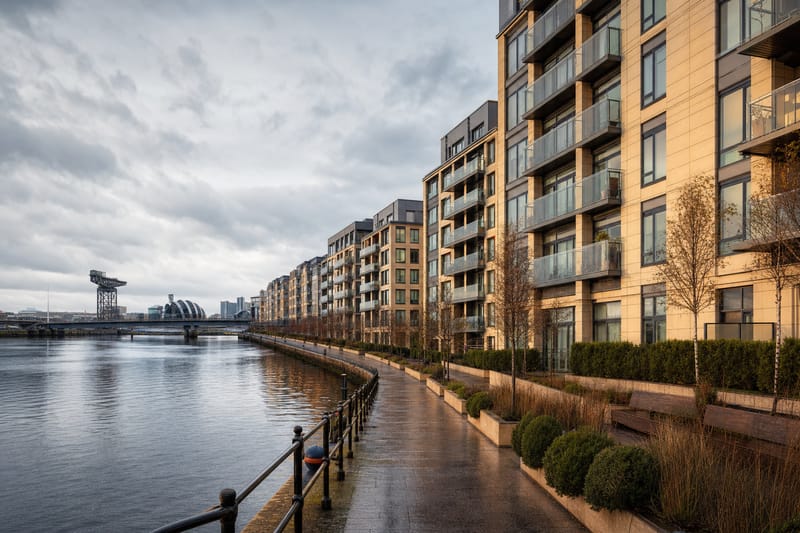
If one theme defines Glasgow’s new build market, it’s the ongoing transformation of the River Clyde. What was once heavy industrial and shipyard land has, over two decades, become the city’s most concentrated pipeline of new apartments, mixed-use quarters and waterside amenity space.
Key riverside zones
- Glasgow Harbour (Partick/Yorkhill): One of the longest-running waterfront schemes, now largely built out, with apartment blocks overlooking the Clyde and good access to the West End and Partick subway/rail interchange.
- Pacific Quay and Govan riverside: Home to BBC Scotland and STV, with newer residential phases adding to the mix as the Southside riverside continues to develop.
- Clyde Gateway (Dalmarnock, Rutherglen, Shawfield): One of the largest urban regeneration programmes in Scotland, spanning the East End and parts of South Lanarkshire, built on the legacy of the 2014 Commonwealth Games athletes’ village and continuing with phased new build housing.
- Tradeston and the Laurieston area: Close to the city centre on the south bank, with ongoing residential-led regeneration linked by the Tradeston pedestrian bridge.
Riverside regeneration areas tend to offer the newest building standards and the most generous shared amenity space, but buyers should check how close individual plots are to the river itself — flood risk and factoring (service charge) costs can vary significantly within the same masterplan.
These zones typically deliver a mix of one- and two-bedroom apartments aimed at young professionals and investors, alongside a smaller number of townhouses in the later phases. Many schemes are delivered by housing associations and private developers working jointly, which is worth noting if you’re comparing tenure types — some riverside plots are outright sale, others include shared equity or mid-market rent blocks within the same masterplan.
For a wider UK view of how regeneration-led new build pricing tends to behave over time, see New Build Homes in Regeneration Areas: Where to Look.
Glasgow's New Build Districts Compared
Glasgow is best understood as a collection of distinct districts rather than a single housing market. New build activity and pricing vary considerably depending on proximity to the river, the city centre, the universities and the motorway network.
| Area | New build character | Typical buyer | Relative price level |
|---|---|---|---|
| West End (Partick, Finnieston, Kelvinbridge) | Apartments in converted and purpose-built schemes, Glasgow Harbour phases | Professionals, academics, investors | Above city average |
| City Centre & Merchant City | High-rise and mid-rise apartments, some build-to-rent | Young professionals, investors, downsizers | Above city average |
| Southside (Shawlands, Pollokshields, Govanhill fringe) | Mix of infill apartments and townhouses | Families, first-time buyers | Mid-range |
| East End & Clyde Gateway (Dalmarnock, Rutherglen) | Houses and apartments in large regeneration masterplans | First-time buyers, young families | Below city average |
| North Glasgow (Maryhill, Possilpark fringe, Lambhill) | Smaller infill developments and housing association-led schemes | First-time buyers | Below city average |
| South Lanarkshire/Renfrewshire commuter fringe (Cambuslang, Newton Mearns, Bishopton) | Suburban estates, 3–5 bed houses | Families, upsizers | Mid to above average (houses) |
West End and City Centre
These remain Glasgow’s premium new build zones, trading on proximity to the universities, Kelvingrove Park, the SEC/Hydro, and strong transport links. Expect a flat-dominated market with limited family-sized stock.
Southside
The Southside has become one of the most talked-about areas for new build buyers wanting more space without a full commuter-town move. Shawlands and Pollokshields in particular combine period tenement character with pockets of new infill development, good schools and the Southside’s well-regarded independent food and retail scene.
East End and the commuter fringe
The East End, through Clyde Gateway, and the wider South Lanarkshire/Renfrewshire commuter belt offer the most affordable entry points, often with larger house types (3–4 bed) that are harder to find close to the centre. The trade-off is a longer commute and, in some pockets, a more gradual pace of wider area regeneration.
Glasgow New Build House Prices: What to Expect
Glasgow’s new build pricing is consistently one of the most discussed advantages of buying in the city, particularly when compared with Edinburgh or the South East of England. Prices are also very area-dependent, so treat city-wide averages as a starting point rather than a guide to any specific plot.
| Property type / area | Indicative new build price range (2026) | Notes |
|---|---|---|
| 1-bed apartment, City Centre/West End | £160,000–£240,000 | Wide range depending on riverside/park views and scheme specification |
| 2-bed apartment, Southside | £180,000–£260,000 | Growing demand from families wanting more space than City Centre stock |
| 2-bed apartment, East End/Clyde Gateway | £140,000–£190,000 | Among the most affordable new build apartment prices in the city |
| 3-bed house, commuter fringe (Cambuslang, Bishopton) | £230,000–£320,000 | Family house types with gardens and parking, further from centre |
| 4-bed detached, Newton Mearns/Bearsden fringe | £380,000–£550,000+ | Premium suburban new build, strong school catchments |
These figures are indicative only — developer pricing moves with each phase release, incentives (such as deposit contributions or stamp duty/LBTT-equivalent assistance) change frequently, and individual plot premiums for views, floor level or aspect can move a price by tens of thousands of pounds. Always check a development’s current price list and compare it against recent Registers of Scotland sold price data where available.
Compare this against other UK regional markets in our New Build Homes in the North West: Regional Guide and New Build Homes in Yorkshire: Regional Guide if you’re weighing Glasgow against other value-led UK cities.
Buying a New Build in Scotland: How the Process Differs
England, Wales and Scotland have separate property law systems, and the differences are significant enough that buyers moving north for the first time should not assume the process will mirror what they’ve experienced elsewhere in the UK.
Offers, Home Reports and missives
For resale property in Scotland, sellers commission a Home Report (including a single survey) before marketing. New build properties are usually exempt from this requirement because the home has never been occupied, but it’s still worth asking the developer what documentation is available, particularly on larger regeneration schemes with mixed older and new stock.
Once you reserve a new build plot, your solicitor negotiates and exchanges “missives” — a formal exchange of letters between your solicitor and the developer’s solicitor that, once concluded, creates a legally binding contract. This is broadly equivalent to exchange of contracts in England, but the terminology, sequencing and some of the legal mechanics differ, so use a solicitor experienced specifically in Scottish new build conveyancing.
Deposits and completion
New build reservation and deposit structures in Scotland tend to follow similar patterns to the rest of the UK — a reservation fee, followed by an exchange deposit once missives conclude, with the balance due on entry (completion) day. Build timelines and longstop dates should be clearly set out in your missives, and it’s worth asking how the developer handles delays relative to the agreed entry date.
If you’re new to new build purchases generally, our guides on Do New Build Buyers Need a Survey? and Do You Need Indemnity Insurance When Buying a New Build? cover ground that applies UK-wide, alongside the Scotland-specific points above.
Land and Buildings Transaction Tax (LBTT) Instead of Stamp Duty
One of the clearest practical differences for Glasgow buyers coming from England is that Stamp Duty Land Tax does not apply in Scotland. Instead, purchases are subject to Land and Buildings Transaction Tax (LBTT), administered by Revenue Scotland, with its own bands and thresholds that are set independently of the rest of the UK.
| Purchase price band | LBTT rate (standard residential, indicative 2026) |
|---|---|
| Up to £145,000 | 0% |
| £145,001–£250,000 | 2% |
| £250,001–£325,000 | 5% |
| £325,001–£750,000 | 10% |
| Above £750,000 | 12% |
First-time buyers in Scotland benefit from a relief that raises the nil-rate threshold, typically to around £175,000 as of 2026 — check the current figure on the Revenue Scotland website, as thresholds are reviewed periodically. Given Glasgow’s relatively low new build entry prices in areas like the East End and North Glasgow, a meaningful share of first-time buyer purchases in the city can fall partly or wholly within the relief band.
Additional Dwelling Supplement (ADS)
Buyers purchasing a second home or a buy-to-let property in Scotland pay an Additional Dwelling Supplement on top of standard LBTT — broadly equivalent to the higher rates for additional properties in England and Wales, but set and reviewed separately. This matters for investors eyeing Glasgow’s riverside apartment market, as it can add a significant percentage to the total purchase cost and should be factored into any yield calculation from the outset.
For the equivalent cost breakdown south of the border, see our related guides in the costs and finance category, and compare total purchase costs carefully if you’re weighing a Glasgow purchase against a city in England or Wales.
Affordable Routes to Buying: Scotland's Own Schemes
Scotland runs its own set of affordability schemes, separate from those available in England, Wales and Northern Ireland. If you’re planning to buy a new build in Glasgow with a limited deposit, it’s worth checking eligibility for these before assuming your only option is a standard mortgage.
New Supply Shared Equity (NSSE)
Delivered through local authorities and housing associations, NSSE helps first-time buyers (and some priority groups) purchase a share of a new build home, typically 60–80%, with the Scottish Government or a housing association retaining the remainder as an equity stake. It’s specifically targeted at new supply, which makes it directly relevant to many Glasgow regeneration-area developments.
Open Market Shared Equity (OMSE)
This scheme works similarly but applies to the open market rather than specific new build developments, and is generally aimed at buyers on lower incomes who would otherwise struggle to purchase outright.
LIFT and local housing association routes
The Low-cost Initiative for First Time Buyers (LIFT) umbrella has historically covered both NSSE and OMSE in various forms; details and availability change, so always check current guidance via myGov.scot or your local authority rather than relying on scheme names alone, as these are periodically restructured.
| Scheme | Who it's for | How it works |
|---|---|---|
| New Supply Shared Equity | First-time buyers, priority groups, on new build stock | Buy a share (typically 60–80%), pay no rent on the retained share |
| Open Market Shared Equity | Lower-income buyers, open market homes | Similar shared equity structure, not tied to specific developments |
| Help to Buy (Scotland) | N/A — scheme closed | Closed to new applicants; do not budget around it |
| Lifetime ISA | UK-wide, first-time buyers under 40 | Government bonus of 25% on savings up to the annual limit, usable toward a first home |
Several Glasgow developers also work with housing associations to deliver Mid-Market Rent and Shared Ownership-style tenures within larger regeneration masterplans, particularly in Clyde Gateway. These can be a useful stepping stone if outright purchase isn’t yet affordable.
Transport and Connectivity Across Glasgow's New Build Areas
Glasgow’s transport network is a major factor in why certain new build areas command a price premium, and why others remain comparatively affordable despite being only a short distance from the centre.
Subway, rail and bus
The Glasgow Subway (the UK’s third-oldest underground system) serves the West End and City Centre well, which partly explains why Partick, Kelvinbridge and Hillhead command stronger pricing. The wider rail network, including Low Level stations, connects the Southside, East End and many commuter towns directly into Glasgow Central and Queen Street, with onward links to Edinburgh in under an hour from the central belt.
Roads
The M8 cuts directly through the city and remains the main artery for commuter-fringe developments in Renfrewshire and South Lanarkshire, though peak-time congestion around the city centre sections is a realistic consideration for daily drivers.
Glasgow Airport
Glasgow Airport sits to the west of the city, making new build developments in Renfrewshire and parts of the West End comparatively well placed for frequent flyers, though airport proximity should also be weighed against potential noise considerations for some sites.
| Area | Nearest transport | Approx. journey to City Centre |
|---|---|---|
| Partick/Glasgow Harbour | Subway, rail | 10–15 minutes |
| Shawlands (Southside) | Rail (Cathcart circle) | 10–15 minutes |
| Dalmarnock/Clyde Gateway | Rail | 10–15 minutes |
| Cambuslang | Rail | 15–20 minutes |
| Bishopton/Renfrewshire fringe | Rail, M8 | 25–35 minutes |
| Newton Mearns | Bus, car (M77) | 25–35 minutes |
If commuting flexibility matters to your decision, it’s worth cross-referencing our UK-wide piece on New Build Homes Near Major Commuter Rail Links for general principles on how rail access tends to hold value over time.
Who's Building in Glasgow: Developers and Delivery Partners
Glasgow’s new build pipeline is delivered through a mix of national housebuilders, Scotland-focused developers and housing associations, often working in partnership on larger regeneration masterplans. Rather than naming specific live developments (which change phase by phase), it’s more useful to understand the types of organisation you’ll encounter and what that typically means for you as a buyer.
National housebuilders
Several UK-wide housebuilders operate across the Glasgow commuter belt, particularly in Renfrewshire and South Lanarkshire, typically delivering traditional house-type estates with standard NHBC, LABC or Premier Guarantee warranties. These tend to be the most straightforward purchases from a process perspective, with well-established sales offices and show homes.
Scotland-focused developers
A number of developers operate primarily or exclusively in Scotland and have a strong track record specifically in Glasgow’s riverside and Southside markets. Their local knowledge of planning, factoring arrangements and Scottish building standards can be an advantage, though it’s still worth checking their warranty provider and completed scheme history in the same way you would any housebuilder.
Housing associations and regeneration partnerships
In areas like Clyde Gateway and parts of the East End, housing associations play a central delivery role, often blending outright sale, shared equity and mid-market rent within the same masterplan. This can mean a longer-term, phased build-out, but it also typically brings more consistent placemaking — parks, community facilities and infrastructure delivered alongside the homes rather than left until later phases.
Use our builders directory and developments search to check who is currently active on specific sites, cross-referenced against our interactive map to see exactly where each scheme sits relative to transport links and amenities.
Build Quality, Warranties and Scottish Building Standards
New build homes in Scotland are regulated under Scottish Building Standards, which are set separately from the Building Regulations that apply in England and Wales. In practice, the end result for buyers is broadly similar — a certified, inspected new home — but the specific regulatory framework, energy performance requirements and completion certification process differ.
Warranty providers
You’ll still typically encounter the same major warranty providers operating in Glasgow as elsewhere in the UK, including NHBC, LABC Warranty and Premier Guarantee, each offering broadly similar structures: a builder’s responsibility period (commonly around the first two years) followed by a longer structural warranty period, usually to ten years. Confirm which provider applies to your specific plot and read the documentation rather than assuming terms are identical across providers.
Completion certificates
In Scotland, a completion certificate issued by the local authority building standards department confirms the home has been built in accordance with the approved plans and building standards. Your solicitor should confirm this is in place (or due imminently) before you complete — it’s a different document from an EPC and from the warranty paperwork, and all three matter for different reasons.
Snagging in Scotland
The practical process of identifying and reporting snags — minor defects found after moving in — works much the same in Glasgow as elsewhere: inspect thoroughly before and shortly after completion, log issues in writing, and use your warranty provider’s escalation route if the developer doesn’t resolve them within a reasonable period. The New Homes Quality Board and its Code apply across Great Britain, including Scotland, for developers registered with it, giving buyers a formal complaints route beyond the builder itself.
For general snagging practice that applies equally to Glasgow buyers, see Smart Home Tech Snagging: When New Build Gadgets Don't Work and What to Check on a Site Visit Before Reserving a New Build Plot.
Investment Fundamentals: Rental Demand and Yields
Glasgow is routinely cited among the UK’s stronger buy-to-let markets, and new build apartments in the City Centre, West End and parts of the Southside are a common target for investors specifically because entry prices remain low relative to achievable rents.
What's driving demand
- Universities: The University of Glasgow, University of Strathclyde and Glasgow Caledonian University together bring a substantial student population, much of which converts into graduate rental demand in the City Centre and West End.
- Employment base: Glasgow has a significant financial and business services sector, a growing tech and digital cluster, and is positioning itself within the UK’s renewables and green energy supply chain — all of which support professional rental demand.
- Population and household growth: Ongoing city-centre living trends and the maturing of regeneration areas like Clyde Gateway continue to add rental stock and tenant demand in tandem.
| Factor | Glasgow | Edinburgh |
|---|---|---|
| Typical new build entry price | Lower | Higher |
| Gross rental yields (indicative) | Often higher on a percentage basis | Often lower due to higher capital values |
| Capital growth history | More volatile, regeneration-dependent | Generally steadier, capacity-constrained |
| Short-term let regulation | Licensing scheme in place | Licensing scheme in place, tighter control zones |
Remember that gross yield figures ignore factoring charges (the Scottish equivalent of service charges, covering common area maintenance in flatted developments), landlord registration costs, and letting agent fees — all of which reduce net returns and should be modelled explicitly rather than assumed away.
Factoring, Schools and Everyday Living Costs
Beyond the headline purchase price, a few everyday cost and lifestyle factors are worth understanding before committing to a specific Glasgow new build area.
Factoring (service charges)
Most new build flats in Scotland, and many estates with shared landscaping, are managed by a property factor — the Scottish equivalent of a managing agent. Factoring fees cover common area cleaning, buildings insurance on shared structures, grounds maintenance and reserve fund contributions. These charges vary widely between developments: a riverside apartment block with a concierge, gym and extensive communal gardens will carry noticeably higher factoring costs than a simple suburban house estate with a basic grounds maintenance arrangement.
Schools and catchment areas
Family buyers weighing Southside and commuter-fringe new build locations should check school catchment boundaries directly with Glasgow City Council, East Renfrewshire Council or South Lanarkshire Council depending on the development, as catchments for new build sites are not always finalised at the point of first sale and can be subject to review as an area grows.
Council tax banding
New build council tax bands in Scotland are assessed by the local assessor and are not necessarily confirmed at the point you move in — a pattern similar to the rest of the UK. For more on how this process works and why your initial estimate may change, see New Build Council Tax Banding: Why It Isn't Set at Move-In.
Council tax bands in Scotland run from A to H, and the specific multiplier and local authority rate both affect your final bill — always check the current rates for the specific council area (Glasgow City, East Renfrewshire, South Lanarkshire or Renfrewshire) rather than assuming a flat city-wide rate.
Frequently Asked Questions
Is Glasgow cheaper than Edinburgh for new build homes?
Generally, yes. New build prices in Glasgow typically sit well below Edinburgh across comparable property types, though premium West End and riverside schemes can narrow that gap considerably. Always compare like-for-like property types and specific areas rather than relying on city-wide averages.
Which area of Glasgow has the most new build activity right now?
Riverside regeneration zones — particularly the Clyde Gateway corridor through the East End and parts of the Southside riverside — have been among the most active in recent years, alongside ongoing phases at established West End schemes. Activity shifts over time, so check live developments on a search tool rather than relying solely on historic reputation.
Do I need a Scottish solicitor to buy a new build in Glasgow?
You need a solicitor qualified to practise Scots law and experienced in Scottish conveyancing, specifically with new build purchases and missives. A solicitor based only in England or Wales cannot usually act for a Scottish property transaction, so arrange this early in your search.
Is Help to Buy still available in Glasgow?
No. Help to Buy (Scotland) has closed to new applicants. If a development is still marketed with reference to it, ask the developer directly what current affordability schemes — such as New Supply Shared Equity — are actually available.
How does LBTT compare to Stamp Duty for a Glasgow new build?
LBTT uses its own bands and rates, set separately from Stamp Duty Land Tax in England and Northern Ireland or Land Transaction Tax in Wales. Lower-priced Glasgow new builds, particularly for first-time buyers using the Scottish first-time buyer relief, can fall partly or wholly within the 0% band — check current thresholds with Revenue Scotland.
Are Glasgow new build flats a good buy-to-let investment?
Many investors have found Glasgow attractive on a yield basis due to lower capital values relative to achievable rents, supported by strong student and graduate demand. Factor in the Additional Dwelling Supplement, factoring charges, landlord registration and letting costs before relying on a headline yield figure.
What's the difference between factoring and a service charge?
They describe essentially the same function — management of shared building and grounds maintenance — but "factoring" is the Scottish term and the factor is regulated under separate Scottish legislation (the Property Factors (Scotland) Act), with its own registration and complaints process distinct from English and Welsh managing agent regulation.
Should I worry about flood risk on Clyde-side new builds?
It’s worth checking, particularly for plots very close to the river. Developers building on former industrial riverside land are required to address flood risk and drainage as part of planning, but ask specifically what mitigation measures apply to your plot and request any relevant flood risk assessment documentation via your solicitor.
Next Steps: Researching Glasgow New Builds Properly
Glasgow’s spread of new build areas — from premium riverside apartments to affordable regeneration-area houses — means the right choice depends heavily on your budget, your commute tolerance and whether you’re buying to live in or to let. The practical next step is to move from this overview into specific, current listings and compare them directly.
- Browse live schemes across Glasgow and the surrounding commuter belt on Developments.
- Check who is building in each area and their track record via Builders.
- Search individual plots and house types currently for sale on Properties.
- Use Map to see exactly how a development sits relative to the subway, rail stations, the M8/M77 and the river.
- Run the numbers on affordability, LBTT and running costs with our Tools.
- Shortlist two or three developments and use Compare to put price, specification and location side by side before booking any site visits.
Before reserving a plot, revisit our practical guides on What to Check on a Site Visit Before Reserving a New Build Plot and Do New Build Buyers Need a Survey? so you go into any reservation with a clear checklist, regardless of which part of Glasgow you end up choosing.
Glasgow rewards buyers who compare areas carefully rather than assuming any single district is automatically the "best" new build location — the right choice is the one that matches your commute, budget and tenure needs, not just the area with the most press coverage.