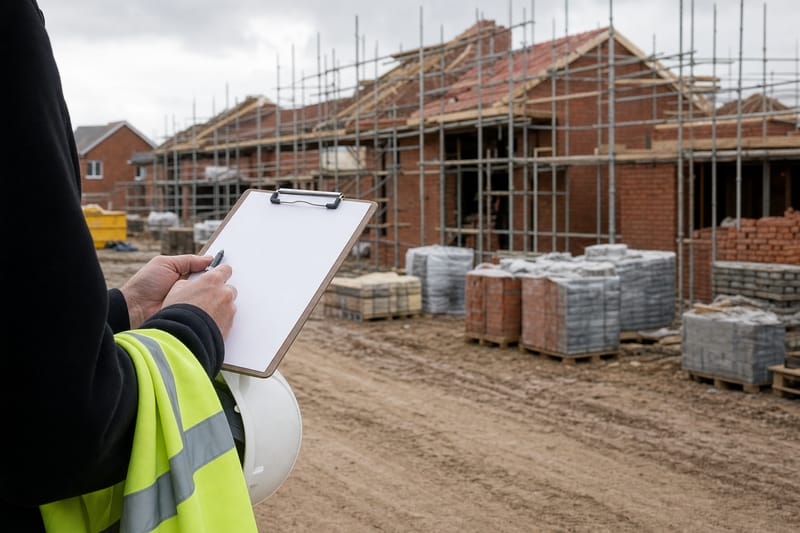
A brochure will tell you about a development’s "landscaped boulevards" and "contemporary kitchens". It will never tell you whether the site manager knows every trade on site by name, whether the drains were laid properly before the brick skin went up, or whether the plot next to yours has been sitting half-finished for six months. That is what a new build site visit checklist is for — and it is the single most useful piece of due diligence you can do before you pay a reservation fee.
Most buyers walk around a show home, admire the staging, and sign up on the strength of a floorplan and a sales advisor’s pitch. Far fewer walk the actual site — the scaffolding, the mud, the skips, the half-built plots — and look at what it tells them about assessing developer quality on a site visit. Yet build quality, programme reliability and how a developer handles snags after completion are all things you can read, imperfectly but usefully, from how organised a working site looks on an ordinary Tuesday.
This guide sets out what to actually look for when visiting construction site plots, the questions worth putting to a site manager, how to compare what you see against the promised build programme, and the signs that separate a well-run site from one that should make you pause before reserving. None of this replaces a proper snagging inspection once you own the keys, or your solicitor’s conveyancing checks — but it adds a layer of first-hand evidence that no star rating or review site can give you.
Treat this as a working checklist. Bring a notebook or your phone, take photos where you’re permitted to, and don’t be afraid to ask the same question twice in different ways if the first answer feels rehearsed. You're not being difficult — you're about to commit a deposit and years of mortgage payments to this organisation's work.
Before You Go: Getting the Most Out of the Visit
A site visit is only useful if you arrive prepared. Sales advisors are trained to walk you through a set route — usually the show home, the sales office, and maybe a view of the "next phase" from a safe distance. To see more than that, you need to ask in advance and come with a plan.
Book it properly
- Ask for a supervised walk of the live site, not just the show home, and ask whether the site manager (not just the sales negotiator) can join you for part of it. Most developers will accommodate this with notice because it's standard practice ahead of a reservation on larger schemes.
- Visit on a weekday during working hours if you can, when the site is actually operating. A Saturday visit shows you a quiet, tidied-up site; a Wednesday afternoon shows you the real working rhythm.
- Go twice if possible — once early in your decision process, and again closer to reservation, so you can see whether progress matches what you were told last time.
What to bring
- Sturdy shoes and, if offered, hard hat and hi-vis — you will not be allowed past the hoarding without proper PPE on an active construction site, and a developer that doesn't offer you any should be a small warning sign in itself.
- A phone for photos (ask first if photography is restricted near other people's homes or neighbouring plots).
- A written list of questions — it's easy to forget half of them once you're standing in a muddy field looking at a timber frame.
- The development's brochure and reservation pack, so you can cross-check what you see against what's promised on paper.
If a sales team is reluctant to let you anywhere near the live build, or insists the show home is "representative enough", treat that reluctance itself as information. Reputable developers operating under the New Homes Quality Board code are generally used to buyers wanting to see more than the dressed show home, and most will arrange it with reasonable notice.
If you can't get a supervised look at the working site before you reserve, ask why — and factor that answer into your decision as much as the floorplan.
First Impressions: Reading the Site Before You Reach the Show Home
Long before you set foot in a staged kitchen, the approach to a development tells you a great deal. Developers know that first impressions sell plots, so the route to the sales office is usually immaculate — but the areas either side of that route are harder to dress up, and that's where you should look.
What a tidy site looks like
- Hoardings and fencing are intact, clearly signed, and free of graffiti or damage.
- Roads and footpaths around completed and part-built plots are swept, not thick with mud and standing water.
- Materials — bricks, blocks, insulation, timber — are stacked under cover, on pallets, off the ground, and roughly where you'd expect them to be used soon, not scattered and weathering.
- Skips are labelled, not overflowing, and segregated for different waste where the site operates that system.
- Site vehicles park in designated bays, not blocking pavements or access for existing residents.
- Plots under construction have visible, current signage: plot numbers, scaffold inspection tags with recent dates, and site safety notices.
Warning signs worth noting
- Standing water, exposed trenches, or unsecured excavations near where people walk.
- Materials left exposed to weather for long periods — particularly insulation boards, plasterboard, or timber, which degrade if rained on repeatedly.
- Scaffold tags that are missing or clearly out of date (by law, scaffolding should be inspected at least every seven days).
- Litter, abandoned equipment, or plots that look to have been untouched for weeks despite being mid-build.
- A general sense of disorganisation — vehicles blocking routes, no clear logic to where things are stored.
None of these are definitive on their own — sites have off days, and weather can make even a well-run operation look muddy. But a pattern of several of these signs together, especially on a repeat visit, tells you something real about how the site is managed day to day.
The Show Home vs Your Actual Plot
Show homes are, by design, the best version of a house type — often with upgraded fittings, bespoke lighting, and furniture chosen to make rooms look larger. It's reasonable to use the show home to understand layout and finish quality, but it's a mistake to assume your finished home will look identical.
Questions to separate show home polish from standard spec
- Which fittings, worktops, flooring, and appliances in the show home are standard specification, and which are upgrades or optional extras?
- Is the show home's furniture scaled down (smaller sofas, narrower beds) to make rooms feel bigger than they will with your own furniture?
- Has the show home's layout been "handed" or altered from the plot you're considering — mirrored room arrangements are common and can shift where windows, doors, and sockets actually fall.
- What is the standard specification for sockets, downlights, and switches per room, since show homes are often fitted with more than the base spec?
Ask for the standard specification sheet in writing, not just verbally, and check it against what you see in the show home room by room. Developers vary considerably in how clearly they separate "as shown" from "as standard" in their marketing, and this is one of the most common sources of buyer disappointment at handover.
Walking your actual plot (or its nearest equivalent)
If your specific plot isn't built yet, ask to see:
- A plot of the same house type at a similar stage elsewhere on site, so you can see real workmanship rather than staged finish.
- The groundworks or foundation stage of your actual plot if it has started, so you can see the orientation, boundary lines, and how it sits relative to neighbouring plots and any roads.
- The plot's position relative to shared bin stores, parking, substations, or pumping stations — these rarely feature in brochure images but affect daily life.
A show home sells you a lifestyle. The actual plot, at whatever stage it's reached, sells you the truth of what you're buying.
Signs of a Well-Run Building Site
Construction professionals talk about "good housekeeping" on site, and it's a genuinely useful lens for a buyer with no building background. Organisation on the ground correlates, loosely but usefully, with organisation in quality control, scheduling, and snagging response after you move in.
| Area | What a well-run site looks like |
|---|---|
| Access & safety | Clear signage, controlled visitor access, PPE enforced consistently, no unsecured hazards near public routes |
| Materials | Stored under cover, off the ground, in a logical sequence close to where they'll be used |
| Site traffic | Deliveries scheduled and managed, vehicles in designated areas, mud not tracked widely onto roads |
| Workforce | Trades visibly busy and coordinated rather than standing idle; site manager recognisable and approachable |
| Documentation | Scaffold tags current, site noticeboard up to date, health & safety information displayed and legible |
| Finished plots | Completed or near-complete homes look protected — window protection film still on, doors covered, no visible damage from other trades still working nearby |
| Communal areas | Roads, drainage, and landscaping progressing roughly in step with the housing, not left until last |
Pay particular attention to that last row. A common pattern on larger developments is for housebuilding to race ahead of the roads, landscaping, and amenity promises in the brochure, leaving early buyers living on a part-finished estate for a year or more longer than expected. Asking specifically about the sequencing of infrastructure versus housing is one of the more valuable questions you can put to a site manager.
You won't find all of these signs present everywhere — even good developers have sites mid-transition between phases that look messier than usual. The point of the checklist is pattern recognition across the whole visit, not a single factor.
Red Flags: Warning Signs Worth Taking Seriously
Some issues are minor and quickly explained; others point to deeper problems with cash flow, subcontractor management, or quality control that are likely to resurface as snagging issues or delays after you've exchanged. Knowing which is which matters.
| What you see | Possible explanation | What to do |
|---|---|---|
| Several plots stalled at the same stage for weeks | Subcontractor or supply issue, cash flow problem, or planning/building control hold-up | Ask the site manager directly and compare the answer with the build programme you were given |
| Materials left exposed to weather long-term | Poor site management or delivery scheduling problems | Ask whether affected materials (especially insulation and timber) will be replaced, not just dried out and used |
| High visible staff turnover or unfamiliar faces each visit | Subcontractor churn, which can affect consistency of workmanship between plots | Ask how long the current site manager has been in post and how the trades are managed |
| Finished homes nearby showing visible defects (cracked render, misaligned doors, staining) | Workmanship issues that may repeat on your plot | Ask existing residents (where you can, politely) about their own snagging experience |
| Sales team discourages or delays a site walk | May simply be scheduling, but can also indicate something they'd rather you didn't see | Push for a specific date and time, and note how it's handled |
| Infrastructure (roads, drainage, landscaping) clearly behind the housing programme | Common sequencing choice by developers, but can leave early movers in a building site for a long period | Ask for the infrastructure completion date in writing, not an estimate |
If your development has previously changed hands, see what happens if your new build developer is taken over mid-build for how that can affect warranty continuity and build quality — it's worth asking directly whether the current developer took over the site from another builder, and if so, at what stage.
One red flag rarely sinks a reservation. Several, repeated across a visit and ignored or brushed off when you raise them, usually do.
Reading Progress Against the Build Programme
Every reservation pack should come with some form of build programme or estimated completion window for your plot. The site visit is your chance to sanity-check that timeline against reality, rather than taking the sales office's word for it months later when the date starts slipping.
What to compare
- Stage of your plot against the stated timeline. If you're told completion is four months away, is the plot at foundation stage, wall-plate height, or roofed and being fitted out? Ask the site manager, not the sales advisor, what stage this corresponds to in their programme.
- Rate of progress across the site generally. Compare plots at similar stages to how long ago groundworks started for them, if you can find out. A development that has taken eighteen months to complete its first phase of twenty homes gives you a realistic benchmark for how long your own phase might take.
- Weather and supply dependency. Ask what's currently holding up progress, if anything, and how the site manager builds contingency into the programme for weather, material delays, or labour shortages.
Typical build stage milestones
| Stage | What it involves | Rough proportion of total build time |
|---|---|---|
| Groundworks & foundations | Site clearance, drainage, foundations laid | 10–15% |
| Superstructure | Walls, floors, and roof structure up to wall-plate and roofed | 25–30% |
| First fix | Plumbing, electrics, and plasterboard before plastering | 15–20% |
| Second fix & finishes | Kitchens, bathrooms, flooring, decoration, external render/brickwork finishing | 25–30% |
| Pre-handover checks | NHBC/warranty inspection, developer quality check, snag rectification before legal completion | 5–10% |
These proportions are indicative only — actual timings vary by house type, site conditions, and developer. But if the site manager's description of your plot's current stage doesn't roughly fit the completion date you've been quoted, that's worth querying before you commit a reservation fee, particularly if you have a chain or a mortgage offer with a fixed expiry date to manage.
Questions to Ask the Site Manager
The site manager runs the build day to day and typically knows far more about real progress, subcontractor quality, and likely snagging issues than the sales team. If you only get a few minutes with them, make the questions count.
On progress and programme
- "What stage is my plot at today, and what's the realistic completion window from here?"
- "What's currently the biggest risk to that date — weather, materials, labour, or something else?"
- "How many plots are you currently managing at once, and how many trades are on site today?"
On quality and process
- "What warranty provider covers this site — NHBC, LABC, or Premier Guarantee — and at what stages do their inspectors visit?"
- "What's your own internal quality check process before a home is handed to the sales team for completion?"
- "How do you handle a snag that's raised in the first few weeks after move-in — what's the typical turnaround?"
On the wider site
- "When are the roads, landscaping, and any shared amenities due to be adopted or finished?"
- "Will there still be active construction near my plot after I move in, and for roughly how long?"
- "Has there been any change of contractor or subcontractor team partway through this site?"
Listen not just to the answers but to how confidently and specifically they're given. A good site manager will usually give you a plot number, a stage name, and a rough date without needing to check with someone else. Vague, general reassurance ("it'll all be fine, don't worry") is worth probing further.
A site manager who can tell you exactly which plots are behind schedule and why is usually more trustworthy than one who insists everything is perfectly on track.
If you've already had a survey arranged or are weighing one up, it's worth reading do new build buyers need a survey? alongside this checklist — a site visit and an independent survey answer different but complementary questions about the same home.
Checking Materials and Workmanship on a Specific Plot
You don't need to be a surveyor to spot some meaningful clues about workmanship quality on a part-built or recently finished plot. These checks work best on a plot at a similar stage to the one you're considering, or on an early-phase home nearing completion.
External checks
- Brickwork and pointing: look for consistent mortar lines, no excessive staining or efflorescence (white salt deposits, often from damp bricks), and bricks laid in a straight, even bond.
- Render and cladding: check for even coverage, no visible cracking at this early stage, and clean junctions around windows and doors.
- Roofline: tiles or slates should sit flush and evenly spaced; flashing around chimneys, dormers, and junctions should look neatly dressed, not patched.
- Guttering and downpipes: securely fixed, properly aligned to fall towards outlets, not sagging.
Internal checks (if you can view a near-complete plot)
- Door and window reveals square and consistent, with no obvious gaps around frames.
- Plasterwork smooth, without visible nail pops, cracking at joints, or uneven patches.
- Floors level — a marble or ball placed on a flat section of floor shouldn't roll noticeably (sales staff may not permit this test, but it's worth asking).
- Staircases solid underfoot with no excessive creak or flex — see also staircase and landing design in new build homes for what good detailing looks like.
Services and fit-out
- Socket and switch positions sensible and consistent with the floorplan, not awkwardly placed behind where furniture will likely go.
- Any smart home technology demonstrated working, not just described — see smart home tech snagging in new builds for common issues buyers encounter once these systems are in daily use.
- Extractor fans, trickle vents, and any mechanical ventilation visibly fitted and not just boxed up awaiting commissioning.
Infrastructure, Roads, and Shared Amenities
Brochures for larger developments often promise a wider package — a park, a play area, a parade of shops, SUDS (sustainable drainage) ponds, cycle routes — that sits outside any individual plot but affects daily life hugely once you've moved in. These shared elements are frequently the last things built, and sometimes the first things cut back if a developer hits financial pressure partway through a scheme.
What to check on site
- Are roads up to final surface (tarmac finished with kerbs and markings) or still at a temporary "binder course" stage that could remain for a long time?
- Is street lighting installed and working, not just conduit laid for future connection?
- Are promised green spaces, play areas, or community buildings under construction yet, or still a line on the masterplan with no visible start date?
- Who owns and maintains the shared areas once built — the local authority (adopted), a management company funded by an estate rentcharge, or the developer directly?
Ask the site manager or sales team directly when roads are expected to be adopted by the local highway authority, since this affects everything from refuse collection consistency to who's liable for potholes in the meantime. Developer-funded contributions to wider public infrastructure — schools, GP capacity, road junctions — are often covered by Section 106 agreements; for background on how these work, see developer contributions to schools, parks, and public services.
| Element | Typical completion timing | What to ask |
|---|---|---|
| Access roads | Often phased, with final surface laid late in a phase | When will the final tarmac layer and adoption happen? |
| Play areas / open space | Commonly built towards the later phases of a large scheme | Is there a committed date, or is it tied to a later phase's sales success? |
| Management company charges | Begins once communal areas are handed over for maintenance | What is the estimated annual service charge, and what does it cover? |
A beautiful show home on an estate where the roads, lighting, and open space are years from completion is still a home on a long-term building site — factor that reality into your decision, not just the floorplan.
Talking to Existing Residents
If earlier phases of the development are already occupied, a few minutes talking to people who live there — politely, and without being intrusive — can tell you more about a developer's after-sales behaviour than anything in the sales office. This is sometimes the single most revealing part of a site visit.
What's useful to ask
- How long did it take from reservation to legal completion, compared with what they were originally told?
- How many snags did they log in the first few weeks and months, and how quickly were they resolved?
- Has construction noise, dust, or site traffic been a significant disruption since they moved in?
- Would they buy from this developer again, on this site specifically?
Online reviews and the HBF star rating give you an aggregate national or regional picture of a developer's reputation, but conditions can vary noticeably site by site depending on the local site manager, subcontractor teams, and ground conditions. A resident two doors from your plot is a far more site-specific data point than a national satisfaction survey.
Reading the estate itself
- Do gardens, fences, and driveways on completed plots look like they were finished to a consistent standard, or does quality vary noticeably between otherwise identical house types?
- Are there visible signs of unresolved issues — skips still outside homes months after move-in, temporary fencing left in place, cracked driveways?
- Is there a visible, active residents' group or community page discussing the development, and if so, what's the general tone of recent posts?
Be respectful of people's time and privacy — a short, friendly conversation on a driveway is reasonable; knocking on doors uninvited or pressing people for lengthy detail is not. Most residents, if approached politely, are happy to share a few honest minutes with a prospective neighbour.
After the Visit: What to Do With What You've Learned
A site visit generates a lot of impressions and notes in a short space of time. The value comes from what you do with them afterwards, before you pay a reservation fee that is often non-refundable or only partially refundable if you later change your mind.
Write it up while it's fresh
- Note the date, who you spoke to, and the specific answers given to your key questions — particularly on completion date, specification, and any infrastructure commitments.
- Keep photos organised by plot number and date, especially if you're visiting more than one development to compare.
- Flag anything you were told verbally that isn't in the written reservation pack or brochure, and ask for it in writing before you rely on it.
Use it to negotiate or clarify, not just to walk away
Not every concern from a site visit needs to be a dealbreaker. Some are legitimately worth raising with the sales team as conditions of your reservation:
- A written completion date range, with an understanding of what happens to your mortgage offer and any chain if it slips.
- A written specification list confirming exactly what's standard versus optional in your plot, cross-checked against the show home.
- A clear answer on infrastructure completion timing if you'll be an early mover into a large phased scheme.
Compare across developments, not just within one
If you're choosing between developments or builders, use the same checklist consistently so your impressions are genuinely comparable rather than coloured by which sales advisor you liked best. The article on volume housebuilders vs boutique developers is a useful companion here, since site organisation and communication style often differ meaningfully between a national volume builder and a smaller regional developer.
The site visit is not a one-off box to tick. It's a source of evidence you should weigh alongside the HBF star rating, independent reviews, and your solicitor's checks — not instead of them.
If anything you saw or heard gives you serious pause, it's entirely reasonable to delay reservation, ask for another visit, or walk away. A reservation fee is far cheaper to lose than discovering the same problems after exchange of contracts.
Frequently Asked Questions
Can I visit a construction site before reserving a plot, or do I need to wait until exchange?
Most developers will arrange a supervised walk of the live site before you reserve, provided you ask in advance and wear the PPE they supply. You generally won't be allowed to wander freely without supervision, for safety and liability reasons, but a guided visit alongside the site manager is standard practice on most developments.
What should I wear or bring to a site visit?
Sturdy closed shoes are sensible, and the developer should provide a hard hat and hi-vis vest if you're going beyond the sales office and show home. Bring a phone for photos, a notebook or your phone's notes app for questions, and the brochure or reservation pack so you can check details against what you see.
Is it rude to ask existing residents about their experience?
Not if you're polite, brief, and respectful of their time. A short conversation on a driveway or in passing is normal and most people are happy to share an honest view. Avoid knocking on doors unannounced or pressing for extensive detail; a friendly, specific question usually gets a useful answer.
How do I know if a build delay I'm being told about is normal or a red flag?
Ask the site manager specifically what's causing the delay and compare it with the stage the plot is visibly at. Minor slippage of a few weeks tied to weather or a specific trade is common and not unusual. Repeated, vague, or unexplained delays across multiple plots, especially combined with other warning signs from this checklist, are more concerning.
Does a messy site always mean poor build quality?
Not necessarily — weather, delivery timing, and the natural chaos of an active construction site can make even well-run developments look untidy on a given day. It's the pattern across several visits and several checks — materials, documentation, workforce behaviour, and finished plot quality — that's more informative than any single untidy corner.
Should I still get an independent survey if I've done a thorough site visit?
Yes. A site visit gives you useful impressions of the developer's organisation and general quality standards, but it cannot replace a professional, independent inspection of your specific home at completion. See do new build buyers need a survey? for more on why this still matters even for brand-new homes.
What if the developer changed partway through the site's construction?
Ask directly about this and how it affects warranty cover and build consistency between phases built by different teams. What happens if your new build developer is taken over mid-build covers the practical implications in more detail, including what to check with your solicitor.
How much weight should I give to the HBF star rating alongside my own site visit?
The HBF star rating is a useful, independently collected baseline based on customer satisfaction surveys across a developer's sites nationally, but it won't tell you about conditions on this specific site today. Use both together — see how to use the HBF star rating to compare new build developers for how the scoring works and its limitations.
Next Steps
A good site visit works best as one part of a wider, structured search rather than a one-off check before you sign a reservation form. Use these tools to build the fuller picture before you commit:
- Browse developments to compare schemes by builder, location, and stage of completion before you book your first visit.
- Check out builders profiles to see a developer's track record, typical specification, and recent news across their other sites.
- Search live properties to see specific plots, prices, and availability on developments you're considering.
- Use the map to understand a site's position relative to schools, transport, and existing infrastructure before you factor in what's still being built.
- Explore the tools section for calculators and guides that help with budgeting, mortgage affordability, and comparing running costs between homes.
- Use compare to set two or more developments or house types side by side on the factors that matter most to you, including the notes from your own site visits.
Before you reserve, make sure you've also had sight of the written specification, an estimated completion date you're comfortable relying on, and clarity on the warranty provider covering the build. Combine what you've seen on site with your solicitor's conveyancing checks and, where relevant, an independent survey once you're closer to completion — together these give you a far more complete picture than any single source on its own.
The best time to ask hard questions about a new build is before you've paid a reservation fee, not after you've picked up the keys.