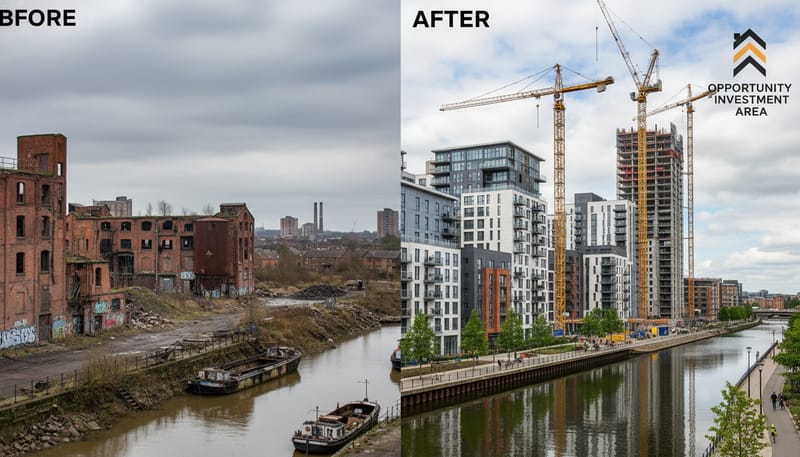
Regeneration areas represent some of the most compelling opportunities in the UK new build market today. When government bodies, local councils, and private developers commit billions of pounds to transforming a neighbourhood — bringing new transport links, schools, healthcare facilities, commercial spaces, parks, and cultural venues — the impact on property values can be extraordinary. Early buyers in regeneration zones have historically captured significant capital growth as infrastructure investment materialises and formerly overlooked areas become desirable destinations in their own right. In 2025 and 2026, the UK has more active regeneration programmes than at any point in recent history, from the iconic transformation of Battersea Power Station in south-west London to the ambitious reimagining of Liverpool’s docklands, from Meridian Water in north London to the Heart of the City project in Sheffield. This comprehensive guide examines every major regeneration zone in the country, analyses their investment potential, and helps you identify where the strongest new build opportunities lie.
Buying in a regeneration area is not without risk. Construction timelines can slip, promised infrastructure may be delayed or scaled back, and living in an area that is still being built around you requires patience and tolerance for disruption. However, for buyers who understand these dynamics and choose their location wisely, the rewards can be substantial. The data consistently shows that regeneration areas deliver above-average price appreciation over 5–10 year periods, with the strongest performers delivering 40–60% growth from announcement to completion — significantly outpacing the broader market.
What Makes a Successful Regeneration Area?
Not all regeneration projects deliver equally strong results for property buyers. Understanding the key ingredients of successful regeneration helps you distinguish between projects that will drive genuine long-term value and those that may underdeliver. The most successful regeneration areas share several common characteristics that prospective new build buyers should look for when evaluating opportunities.
First and most critically, successful regeneration requires significant transport infrastructure investment. Every major success story in UK regeneration — from London Docklands to Manchester’s Northern Quarter to the Olympic Park — has been underpinned by the arrival of new or improved transport connections. Without genuine accessibility to major employment centres, residential development alone cannot sustain property values. Look for regeneration areas where transport investment is committed and funded, not merely aspirational.
Second, successful regeneration areas attract employment alongside housing. The best regeneration zones create mixed-use communities where people can live, work, and socialise. This reduces commuting dependency, creates local economic activity, and generates demand for services and amenities that further enhance the area’s appeal. Areas where regeneration consists solely of residential towers without supporting employment and community infrastructure tend to underperform over the long term.
Third, scale and timeline matter. The largest regeneration programmes, typically those delivering 5,000 or more homes over 15–25 years, tend to deliver the strongest value uplift because they reach a tipping point where the area’s character fundamentally transforms. However, buyers must be prepared for extended construction periods and the reality that early phases may feel quite different from the finished vision. Choosing a development that is far enough along for the transformation to be visible, but early enough to capture remaining upside, is the ideal position.
Battersea and Nine Elms, London SW8/SW11
The Battersea and Nine Elms regeneration is one of the most high-profile urban transformation projects in Europe. Anchored by the stunning restoration of the Grade II* listed Battersea Power Station, this £15 billion programme has created an entirely new London neighbourhood on the south bank of the Thames between Vauxhall and Chelsea Bridge. The area, once dominated by industrial uses and a disused power station, now hosts luxury apartments, international restaurants, Apple’s European headquarters, a new US Embassy, independent shops, public gardens, and two new Northern Line tube stations — Battersea Power Station and Nine Elms.
The transformation has been remarkable. Early buyers who purchased off-plan in the initial phases of the Battersea Power Station development in 2013–2014 have seen values appreciate by 35–50%, and the area now commands per-square-foot prices comparable with established prime London neighbourhoods. Current new build prices in the area range from approximately £550,000 for a one-bedroom apartment to £1.2 million for a two-bedroom at Battersea Power Station itself, with more affordable options available in the wider Nine Elms area from developers including Bellway, Berkeley, and Barratt.
For buyers considering Nine Elms today, the opportunity lies in the remaining development phases and in surrounding streets where prices have not yet fully caught up with the core regeneration zone. The opening of the two Northern Line Extension stations in 2021 was transformative, cutting journey times to the West End to under 15 minutes and to the City to under 20 minutes. The ongoing delivery of commercial space, including Apple’s campus employing thousands of staff, is driving local demand for both rental and owner-occupied property. While early-phase price appreciation has already been captured, the area’s continued maturation suggests further upside as remaining phases complete and the neighbourhood fully establishes its identity.
Meridian Water, Enfield, London N18
Meridian Water is one of London’s most ambitious regeneration projects, transforming a 210-acre former industrial site in Enfield into a new mixed-use neighbourhood of up to 10,000 homes. The project, led by Enfield Council with development partner Vistry Group, is centred on the newly opened Meridian Water station on the Liverpool Street–Enfield line, providing direct rail services to central London in approximately 25 minutes. With a total projected investment of over £6 billion, Meridian Water represents one of the largest council-led regeneration initiatives in the UK.
The early phases of the development are now delivering homes, with two-bedroom apartments starting from approximately £340,000 and three-bedroom family homes from £450,000. The masterplan includes extensive green spaces along the River Lee Navigation, a new town centre with shops and restaurants, primary and secondary schools, healthcare facilities, and commercial workspace. The development is designed around sustainability principles, with low-carbon heating systems, extensive cycling infrastructure, and car-free zones within the residential areas.
For buyers considering Meridian Water, the key attraction is the combination of relatively affordable London prices, excellent rail connectivity, and the scale of committed investment. The project is still in its early stages, meaning there is significant scope for value appreciation as later phases complete and the neighbourhood matures. The 50% affordable housing target also suggests a genuinely mixed community rather than the exclusively market-rate developments seen in some other London regeneration zones. The main risk is timeline slippage, as projects of this scale frequently experience delays, but the council’s commitment and the presence of a major development partner provide reasonable confidence that the vision will be delivered.
Salford Quays and MediaCity, Greater Manchester
Salford Quays is widely regarded as one of the UK’s most successful regeneration stories. The former Manchester Ship Canal docklands, which fell into disuse after the decline of heavy industry, has been transformed into a vibrant waterfront neighbourhood that is now home to the BBC, ITV, the University of Salford campus, The Lowry arts centre, and the Imperial War Museum North. MediaCityUK, the development’s commercial centrepiece, employs over 7,000 people in media, technology, and creative industries. The residential market has grown in tandem, with new build apartments offering waterfront living within minutes of Manchester city centre.
The regeneration of Salford Quays demonstrates the long-term potential of patient investment. Property values in the area have increased by approximately 180% since the initial regeneration began in the 1990s, with the most significant acceleration occurring after the BBC’s relocation from London in 2011–2012. Today, new build apartments at Salford Quays start from approximately £195,000 for a one-bedroom unit and £260,000 for a two-bedroom, with premium waterfront positions commanding higher prices. Developers including Fortis, X1 Developments, and Peel Group are all active in the area, with several new phases under construction or recently launched.
The next phase of Salford Quays’ evolution centres on MediaCityUK Phase 2, a major expansion that will add further office space, studios, residential units, and public realm to the waterfront district. The Metrolink tram extension, which already connects Salford Quays to Manchester city centre in approximately 20 minutes, continues to be enhanced with increased frequency and new connections. For new build buyers, Salford Quays represents a relatively mature regeneration area where the principal risks have been mitigated by decades of successful delivery, but where ongoing expansion still offers growth potential. Rental yields of 6.0–7.0% are among the highest in Greater Manchester, reflecting strong tenant demand from the area’s large professional workforce.
Liverpool Waters, Liverpool
Liverpool Waters is one of the most ambitious waterfront regeneration projects in Europe, transforming 60 hectares of historic dockland along the River Mersey into a new city district capable of housing up to 20,000 residents. The £5.5 billion scheme, developed by Peel Group, encompasses multiple distinct neighbourhoods stretching from Princes Dock northward through Central Docks to the historic Stanley and Clarence Docks. When complete, Liverpool Waters will have fundamentally expanded the city’s geography, creating an entirely new waterfront quarter with residential, commercial, cultural, and leisure uses.
Early phases of Liverpool Waters are already delivered, with Princes Dock hosting completed apartment buildings alongside the Exhibition Centre Liverpool, Pullman Hotel, and various restaurant and bar outlets. Further north, the Central Docks area is seeing construction of new residential towers, while plans for the northern docks include heritage restoration, public spaces, and a significant cultural quarter. New build apartment prices at Liverpool Waters currently start from approximately £150,000 for a one-bedroom unit and £195,000 for a two-bedroom, making this one of the most affordable major regeneration zones in the country.
Transport connectivity is provided by the nearby Merseyrail network, with Liverpool James Street and Moorfields stations within walking distance of the southern portions of the site, and plans for enhanced pedestrian and cycling connections throughout. The Merseyrail fleet renewal, bringing brand-new Stadler trains to the network, will further enhance the area’s accessibility. Liverpool ONE shopping centre, the Albert Dock UNESCO World Heritage Site, and the city’s vibrant cultural scene are all within easy reach, providing an established backdrop of amenities that newer regeneration areas often lack.
Barking Riverside, London IG11
Barking Riverside is one of London’s largest residential-led regeneration projects, delivering up to 10,800 new homes on a 443-acre former industrial site on the north bank of the Thames in the London Borough of Barking and Dagenham. The project received a transformative boost with the opening of the Barking Riverside station on the London Overground in 2022, connecting the development directly to Barking (7 minutes) and Gospel Oak (46 minutes) via the north London line, with connections to the District, Hammersmith & City, and c2c lines at Barking.
The masterplan for Barking Riverside, developed by joint venture partners L&Q and the Mayor of London, creates seven distinct neighbourhoods, each with its own character and amenities. Current new build prices start from approximately £290,000 for a one-bedroom apartment and £370,000 for a two-bedroom, making this one of the most affordable new build options within Greater London with direct rail access. The development includes two new primary schools already open, with further schools and a healthcare centre planned for later phases. Extensive parks, riverside walks, and ecological areas provide green space that is increasingly rare in London developments.
Barking Riverside’s affordability within London, combined with the newly operational station and the scale of the masterplan, makes it a strong consideration for first-time buyers and young families who are priced out of inner London but want to remain within the city. The shared ownership options are particularly accessible, with 25% shares in one-bedroom apartments starting from approximately £82,500. As the development matures and amenities build out over the coming decade, early buyers are well-positioned to benefit from the value uplift that typically accompanies the transition from building site to established community.
Old Oak Common, London NW10/W3
Old Oak Common is poised to become one of London’s most significant new destinations. Designated as a Mayoral Development Corporation area, the 650-hectare zone around the planned HS2 and Elizabeth Line interchange station is earmarked for up to 25,500 new homes and 65,000 new jobs. When HS2 services begin, Old Oak Common station will be the only interchange between HS2, the Elizabeth Line, the Great Western Main Line, and potentially the West London Orbital railway — making it one of the best-connected stations in the entire national rail network.
While the full vision for Old Oak Common is still years from realisation, early development is already underway in the surrounding areas. North Acton and East Acton, served by the Central line, have seen significant new build activity with apartment developments from Acton Gardens (Countryside/L&Q partnership) and other developers offering two-bedroom units from approximately £425,000. Park Royal, the major industrial estate adjacent to Old Oak, is gradually being redeveloped with mixed-use schemes that combine workspace with residential. For patient buyers with a 5–10 year horizon, the Old Oak Common area offers one of London’s most compelling long-term growth stories.
Elephant and Castle, London SE1/SE17
Elephant and Castle has undergone one of the most dramatic transformations of any London neighbourhood in recent years. The demolition of the iconic (if unloved) 1960s shopping centre and the construction of the new Elephant Park development have created a modern urban quarter that bears little resemblance to the area’s former character. Lendlease’s Elephant Park development is delivering approximately 2,500 new homes alongside shops, restaurants, a new public park, and community facilities. The area benefits from superb transport connections, with the Northern and Bakerloo lines at Elephant & Castle station and Thameslink services at nearby Elephant & Castle mainline station.
New build prices at Elephant and Castle have risen substantially over the regeneration period, with two-bedroom apartments at Elephant Park now priced from approximately £625,000. However, the wider Elephant and Castle area still contains development sites at various stages of planning and construction, and prices in adjacent streets can be 15–20% lower than the premium Elephant Park command. For buyers, the area’s Zone 1 location, exceptional transport links (10 minutes to the City, 15 minutes to the West End), and the ongoing momentum of regeneration make it a strong proposition despite the relatively high entry price. The area’s cultural diversity, vibrant food scene, and proximity to the South Bank cultural quarter add lifestyle appeal that many newer regeneration areas cannot yet offer.
Sheffield Heart of the City
Sheffield’s Heart of the City II project is a £480 million programme to revitalise the city centre, creating new public spaces, offices, hotels, leisure facilities, and residential development. The scheme, led by Sheffield City Council with development partner Queensberry, builds on the success of the original Heart of the City programme which delivered the Winter Garden, Millennium Gallery, and Peace Gardens. Phase II extends the regeneration further with new blocks around a series of public squares and streets, creating a cohesive urban quarter that aims to attract new businesses and residents to the city centre.
Sheffield offers some of the most affordable new build prices in any major English city, with city centre apartments starting from approximately £145,000 for a one-bedroom unit and £185,000 for a two-bedroom. The city’s two universities generate a large student and graduate population that drives rental demand, while Sheffield’s growing reputation as a centre for advanced manufacturing, technology, and healthcare provides a broadening employment base. The Supertram network connects the city centre to outlying areas, and the TransPennine Route Upgrade will improve journey times to Manchester and Leeds.
For investors, Sheffield’s combination of low entry prices and high rental yields — averaging 7.0–8.5% for new build city centre apartments — is highly attractive. The Heart of the City II project provides confidence that the city centre will continue to improve, while the university-driven rental market offers reliable tenant demand. Capital growth has historically been more modest than in London or Manchester, but the low entry price means percentage returns can still be competitive. For owner-occupiers, Sheffield offers an exceptional quality of life with access to the Peak District National Park, world-class sporting facilities, and a growing cultural scene, all at a fraction of the cost of comparable cities.
Birmingham Smithfield and Eastside
Birmingham Smithfield represents the largest city centre development opportunity in the UK, transforming the 17-hectare former wholesale market site into a new mixed-use quarter adjacent to the Bullring and New Street station. The masterplan includes over 2,000 new homes, a new public market, cultural and leisure spaces, a public park, and commercial development. The project is one of several major regeneration initiatives reshaping Birmingham city centre, alongside the Eastside scheme near the new HS2 Curzon Street terminus and the ongoing transformation of the Jewellery Quarter.
Birmingham’s new build market has experienced remarkable growth in recent years, driven by the HS2 effect, the city’s hosting of the 2022 Commonwealth Games, and a sustained influx of major employers including Goldman Sachs, HSBC UK headquarters, and Deutsche Bank. Two-bedroom new build apartments in Birmingham city centre now start from approximately £240,000, with premium waterfront positions along the canal network commanding £280,000 or more. The Eastside area around the planned HS2 station is seeing particularly strong developer activity, with Galliard Homes, Court Collaboration, and Lendlease all progressing major residential schemes.
- ✓ HS2 connectivity to London (49 mins)
- ✓ Major employer relocations (HSBC, Goldman)
- ✓ Strong rental yields (5.5–6.5%)
- ✓ Prices 40–50% below London equivalents
- ✓ Multiple regeneration zones active
- ✓ Commonwealth Games legacy infrastructure
- ✗ HS2 delays create timeline uncertainty
- ✗ Potential oversupply in city centre apartments
- ✗ Some areas still in early planning stages
- ✗ Construction disruption across multiple sites
- ✗ Service charges on new apartments can be high
- ✗ Market dependent on HS2 delivery
Cardiff Bay Expansion, South Wales
Cardiff Bay’s original regeneration from derelict dockland to vibrant waterfront destination is one of the UK’s most celebrated success stories, and the area continues to evolve with new development phases that extend the regeneration further. The latest expansions focus on the areas around the International Sports Village, the Coal Exchange heritage building, and new residential quarters along the waterfront. Combined with the transformative South Wales Metro rail programme, Cardiff Bay and the wider Cardiff region are experiencing a new wave of investment that is creating fresh opportunities for new build buyers.
New build prices in Cardiff Bay currently start from approximately £210,000 for a two-bedroom apartment, with waterfront premium positions from £260,000. Family homes in the wider Cardiff area are available from around £275,000 for a three-bedroom new build. The South Wales Metro, a £1 billion programme to upgrade the Cardiff and Valleys rail network with new tram-train vehicles and increased frequencies, will dramatically improve connectivity between Cardiff Bay, the city centre, and the Valleys communities to the north. For new build buyers, this means that areas in the Valleys where three-bedroom houses start from as little as £170,000 will benefit from metro-frequency rail services to Cardiff within 20–30 minutes.
Regeneration Zones Compared: The Full Picture
With so many regeneration zones to choose from, how do they compare on the metrics that matter most to new build buyers? The following comprehensive comparison brings together data on pricing, yields, investment scale, and growth outlook across all ten zones covered in this guide, helping you identify which project best aligns with your budget, risk tolerance, and investment objectives.
Infrastructure Investment: Where the Money Is Going
The scale of infrastructure investment committed to UK regeneration areas is unprecedented. Understanding where government and private sector money is flowing helps identify which regeneration zones have the strongest foundations for success. The following breakdown shows the major categories of infrastructure spending across the regeneration zones covered in this guide, illustrating the breadth of investment that underpins successful urban transformation.
Transport investment dominates, accounting for 38% of total spend across the regeneration zones. This reinforces the critical role of connectivity in driving successful regeneration and property value growth. The Northern Line Extension to Battersea, the new Barking Riverside Overground station, the Merseyrail fleet renewal, the South Wales Metro, and HS2-related infrastructure all represent transformative transport investments that are directly supporting new build demand in their respective areas.
Expert Tips for Buying in Regeneration Areas
Buying in a regeneration area requires a different approach to purchasing in an established neighbourhood. The dynamics of a transforming area create both unique opportunities and specific risks that buyers must understand and manage. These expert tips will help you navigate the regeneration market successfully.
Risk Assessment: Navigating Regeneration Uncertainties
Every regeneration area carries specific risks that buyers should understand and evaluate. While the overall track record of UK regeneration is strongly positive, individual projects can and do underdeliver. The most common risks include timeline delays, where infrastructure improvements take longer than planned; scope reductions, where elements of the masterplan are scaled back or cancelled; market-cycle exposure, where buying at the wrong point in the economic cycle amplifies downside risk; and oversupply, where too many residential units are delivered simultaneously, temporarily depressing prices and rents.
Mitigating these risks involves thorough due diligence, realistic timeline expectations, and careful financial planning. Buyers should ensure they can comfortably afford their mortgage payments without relying on anticipated value appreciation, maintain sufficient savings to cover any period where the property may be difficult to sell or let, and choose developers with strong financial backing and proven track records of delivering in regeneration areas. Choosing a reputable developer with NHBC or equivalent warranty cover provides additional protection against build quality issues, which can be more prevalent in large-scale regeneration schemes where construction is delivered at pace.
Who Should Buy in Regeneration Areas?
Regeneration areas suit certain buyer profiles better than others. Understanding which type of buyer you are will help you select the right zone and the right timing for your purchase.
For more on how transport infrastructure is shaping the new build market, see our guide to new build homes near major commuter rail links. To explore established commuter markets, browse our comprehensive guide to the best new build developments in the Home Counties.