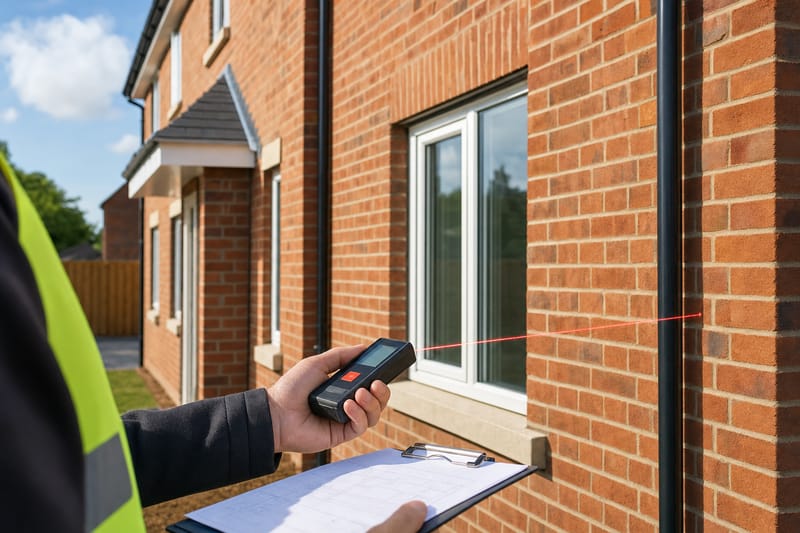
If you're buying a brand new home, it's easy to assume you can skip the survey. The house is new, it comes with a ten-year structural warranty, and a building control inspector has presumably already checked it over — so what's left to find? This is one of the most persistent myths in new build buying, and it catches out a lot of first-time buyers.
The short answer is: yes, you should still seriously consider a survey, and it does a different job to the warranty you've already paid for as part of the price. A structural warranty (commonly from NHBC, LABC or Premier Guarantee) is an insurance-backed promise to fix certain defects over a fixed period. A survey is an independent, in-person inspection carried out specifically for you, the buyer, to flag issues before or shortly after you've legally committed to the purchase. They overlap a little, but one does not replace the other.
This guide sets out exactly what your mortgage lender checks (and what it doesn't), what the warranty actually promises, what an independent survey or snagging inspection adds, and how to weigh up the cost against the risk for a new build specifically — which behaves differently to an older resale property in both construction risk and the paperwork protecting you.
If you've already read our First-Time Buyer Jargon Buster, you'll know that "survey", "valuation" and "snagging inspection" get used almost interchangeably by people who should know better. They are three distinct things, carried out by different people, for different purposes, at different points in your purchase. Getting that straight is the first step to deciding what, if anything, you need to pay for yourself.
What your mortgage lender's valuation actually checks
When you apply for a mortgage, your lender will instruct a valuation. On a new build this might be a desk-based valuation using comparable sales data, or a brief visit by a RICS-qualified valuer lasting perhaps 15–30 minutes. Either way, the purpose is narrow: to confirm the property is worth roughly what you're paying for it, so the lender's security for the loan is sound.
A mortgage valuation typically does not involve:
- Testing the electrics, plumbing, heating or ventilation systems
- Checking render, brickwork, roofing or insulation in detail
- Inspecting the loft space, under-floor areas or drainage
- Commenting on finish quality, fittings or snagging items
- Producing a report you're entitled to see in full, in many cases
Some lenders on new build cases rely heavily on the fact that NHBC or an equivalent warranty provider has already inspected the site during construction under building control arrangements, and treat this as sufficient comfort for lending purposes. That inspection, however, is about compliance with building regulations and the warranty provider's own technical standards — it is not commissioned by you, and you won't typically get a copy of its findings.
The valuation protects the bank's £250,000 loan. It was never designed to protect your £15,000 deposit or catch a botched plastering job.
This is the gap that catches first-time buyers out. Because the process involves so many professional-sounding inspections — building control, warranty provider site visits, a mortgage valuation — it feels thoroughly checked. In practice, none of these exist primarily to protect you personally as the end buyer with your own money and your own list of concerns about the specific plot and specific finish you're being handed the keys to.
If you're mid-way through exchange and completion, our guide on Exchange to Completion: What First-Time Buyers Need to Know covers the other paperwork milestones running alongside any survey decision you make.
What the structural warranty covers — and what it doesn't
Almost every new build in the UK is sold with a structural warranty, most commonly from NHBC (the largest provider), LABC Warranty or Premier Guarantee. Developers need one of these (or an equivalent) to satisfy mortgage lenders, so you'll get a policy booklet at completion whether you ask for one or not. It's a genuinely valuable protection, but it's narrower than many buyers assume.
The typical structure is two periods
- Years 1–2 (the defects insurance period): the developer is contractually obliged to fix defects that result from their failure to meet the warranty provider's technical standards — things like poor workmanship, non-compliant materials or installation faults. You report these to the builder first, not the warranty provider.
- Years 3–10 (the structural insurance period): cover narrows significantly to major structural problems — typically issues affecting foundations, load-bearing walls, roof structure and similar — and claims go to the warranty provider directly, usually with an excess payable by you.
Crucially, the warranty is reactive rather than preventative. Nobody from NHBC, LABC or Premier walks round with you before completion checking the specific finish of your specific plot against a checklist you control. Their site inspections during construction are sampling-based, focused on build-stage milestones, and the reports aren't typically shared with individual buyers in a form you can act on.
The warranty also won't help you negotiate a price reduction, a completion delay, or a list of fixes before you legally commit to the purchase — because by definition it only exists once you already own the property. For a deeper look at what's covered year by year, see First-Time Buyer Guide to Warranties and Aftercare.
None of this means the warranty is weak — it's a genuinely useful backstop, particularly for the serious structural risks that are expensive and hard to spot yourself. It simply means it isn't designed to do the job many buyers assume a survey would do, and it doesn't replace a pre-completion inspection carried out specifically on your behalf.
What an independent survey actually involves on a new build
A traditional RICS survey is designed around older housing stock, where the main concern is hidden deterioration — subsidence, damp penetrating old walls, ageing roofs, outdated wiring. On a new build, those risks are mostly absent (or should be), which is why some buyers conclude a survey is pointless. What a survey picks up on new build instead is different: quality of construction and finish, compliance with the specification you were sold, and defects that slipped past the site team.
The main survey types available
- RICS Home Survey Level 1 (Condition Report): a basic traffic-light report on condition, with no advice or valuation. Rarely the right choice for a new build.
- RICS Home Survey Level 2 (HomeBuyer Report): a more detailed mid-tier report covering visible defects, damp testing, and advice on repairs, aimed at conventional and fairly modern properties. Some surveyors will carry this out on a new build, though coverage of things specific to new homes (snagging-type cosmetic and finishing issues) is limited.
- RICS Home Survey Level 3 (Building Survey): the most thorough, intended for older, larger or unusual properties. Rarely necessary, and rarely offered, for a standard new build house or flat.
- New build snagging inspection: not a RICS survey at all, but a specialist inspection — often carried out by chartered surveyors who specialise in new builds, or dedicated snagging companies — that systematically checks finish, fittings, compliance with building regulations on visible items, and workmanship defects room by room.
A good new build snagging inspection typically checks doors and windows for alignment and draughts, paintwork and plastering, tiling and grouting, sealant around baths and showers, kitchen unit fitting, flooring, loft insulation where accessible, external brickwork and pointing, drainage gullies, guttering, and the operation of trickle vents, extractor fans and heating controls. Many inspectors also check against NHBC Technical Standards or the New Homes Quality Code, giving you a documented basis to raise issues formally with the developer.
New build survey vs snagging inspection: how they differ
Buyers often ask whether they need "a survey" or "a snagging inspection" as though they're interchangeable. They're not, and understanding the difference helps you choose — and in many cases you may decide you want elements of both, or that one covers your needs adequately on its own.
| Feature | RICS HomeBuyer Report (Level 2) | New Build Snagging Inspection |
|---|---|---|
| Regulated by | RICS | No single regulator; look for RICS-qualified or recognised trade body membership |
| Best suited to | Older, resale or part-exchange properties | New build houses and flats, pre- or post-completion |
| Checks structural condition | Yes, visually, with traffic-light ratings | Limited; focuses on visible defects and finish, not deep structural analysis |
| Checks damp, timber, roof condition | Yes, in some depth | Basic visual checks only |
| Checks fit and finish (doors, paint, tiling, fittings) | Limited coverage | Core focus, room by room |
| Produces a report for the developer | Not typically formatted for this | Yes, usually formatted as a snag list for the builder to action |
| Typical cost (2026, check current pricing) | £400–£700 | £300–£600 |
| Best timing | Rarely used on new build; more relevant on older or resale new-ish stock | Pre-completion "snagging week" or shortly after move-in |
On a genuinely new build, a specialist snagging inspection is usually the more useful spend than a generic RICS HomeBuyer Report — but neither replaces the structural warranty, and neither is compulsory.
There's a third option worth knowing about too: some surveyors now offer a hybrid "new build survey" that blends elements of both — a condition-style overview plus a detailed snag list — specifically marketed at new build buyers who want one appointment rather than two. If you can find a RICS-qualified surveyor offering this locally, it's often the most efficient route. Our separate piece on Professional New Build Snagging Surveys: Cost and Is It Worth It? goes into the cost-benefit case in more detail.
Is a new build survey actually worth it?
This is the question that matters most, and the honest answer is: it depends on the build quality risk at your specific development, your own ability to spot defects, and how much reassurance you want before signing off on the biggest purchase of your life so far.
Arguments in favour
- Reported defect rates remain significant. Industry customer satisfaction surveys (such as the annual HBF/NHQB new homes survey) have consistently found that a large majority of new build buyers report at least some snagging issues in their first year — typically well over eight in ten respondents in recent years. Most are minor, but not all.
- An independent inspector has no relationship with the site manager. You might feel awkward pointing out every imperfection yourself, especially under time pressure on completion day. A paid, independent inspector has no such hesitation.
- A documented snag list strengthens your position. Developers are generally more responsive to a formatted, professional report than a verbal list, particularly where you're asking for things to be fixed before completion rather than after.
- It can catch issues the warranty won't cover well. Cosmetic and finish defects reported promptly, in year one, are squarely within the developer's two-year defects obligation — but only if you've actually found and logged them.
Arguments against, or for scaling back
- If you're buying from a developer with a strong local reputation and recent New Homes Quality Board accreditation, risk is somewhat lower, though not eliminated.
- Snagging inspections duplicate some of what you can reasonably do yourself with a thorough, methodical walk-round and a good checklist, if you're confident and have the time.
- Cost is a real factor for first-time buyers who have already stretched to cover a deposit, stamp duty, and moving costs.
For most first-time buyers, the pragmatic middle ground is: do your own thorough walk-round using a structured checklist, and pay for a professional inspection if the property is a flat with complex M&E systems, if you're buying off-plan and can't easily judge quality yourself, or if anything about the development's reviews or your own early site visits has made you uneasy.
When to get a survey or inspection: before, at, or after completion
Timing matters because it changes what leverage you have. The earlier you find a problem, the more easily it gets fixed without a fight.
Pre-reservation or during build (off-plan purchases)
If you've reserved off-plan, you won't have much to survey yet, but some buyers commission periodic site visits or ask their solicitor to request copies of building control sign-off and warranty provider inspection records as they become available. This is more about due diligence than a formal survey.
Pre-completion ("snagging week")
Most developers invite you to a demonstration or "homeowner" appointment shortly before legal completion, where you're shown how systems work and can raise initial concerns. This is the single best window for a professional snagging inspection, because any defects identified can potentially be fixed before you complete and before the pressure of a moving day. In practice, build programmes are often tight and this window can be as short as a few days — book your inspector as soon as you have a realistic completion date.
At completion / moving-in day
Realistically, few buyers delay completion over snagging unless the issues are severe (e.g. non-functioning heating, missing fire doors, significant safety defects). Most snags identified at this stage go onto a list for the developer's aftercare team to action over the following weeks.
Within the first few weeks to two years
Many snags only become apparent once you're living in the property — a door that sticks once the heating's been running, a damp patch after the first heavy rain, a kitchen unit door that drops. A post-move-in snagging inspection, carried out within the first few weeks and again towards the end of year one, catches issues while you're still well within the developer's two-year defects period.
| Stage | What's realistic to check | Who typically inspects |
|---|---|---|
| Off-plan / during build | Progress, spec compliance, build control milestones | You (site visits), solicitor (paperwork) |
| Pre-completion demo day | Full internal snag list, systems demonstration | You, optionally a paid snagging inspector |
| Moving-in day | Final condition check against pre-completion list | You |
| First 1–11 months | Settling defects: cracks, draughts, damp, fittings | You, or a second paid inspection near month 10–11 |
| Years 3–10 | Major structural issues only | Warranty provider claims process |
If you're still at the early research stage, our guide to How to Read a New Build Floor Plan Before You Reserve a Plot is a useful companion piece, since spec and layout checks start well before any formal inspection.
Who should carry out the inspection, and how to choose
Because new build snagging sits in a slight regulatory grey area — it isn't a formal RICS product in the way a HomeBuyer Report is — the quality of inspectors varies more than you might expect. A few checks help you avoid paying for a superficial walk-round with a clipboard.
- Look for RICS membership or equivalent professional accreditation. Many reputable new build snagging specialists are chartered surveyors (MRICS or FRICS) who have chosen to specialise in this niche, which gives you recourse through RICS's complaints process if something goes wrong.
- Ask what standard they inspect against. Good inspectors reference NHBC Technical Standards, the relevant Building Regulations (Approved Documents), and, since its introduction, the New Homes Quality Code overseen by the New Homes Quality Board (NHQB) for developers who have signed up to it.
- Ask to see a sample report. A useful report is organised by room, photographs each defect, cross-references a severity rating, and is written in language you can hand straight to the developer's customer care team without translation.
- Check independence. Avoid any inspector recommended or employed by the developer itself — the entire point is an independent set of eyes with no commercial relationship to the build.
- Confirm turnaround time. If you're inspecting during a tight pre-completion window, ask how quickly you'll receive the written report, not just a verbal summary on the day.
It's also worth knowing where to escalate if a developer doesn't engage properly with a reasonable, documented snag list. Developers who are members of the New Homes Quality Board are bound by the New Homes Quality Code and have an independent New Homes Ombudsman Service route for unresolved disputes. Developers who aren't signed up may instead be covered by an older Consumer Code for Home Builders, with its own independent dispute resolution scheme. Check which applies to your specific developer before you complete, since it shapes how much weight a professional snag report will carry if things go wrong.
What a survey typically costs, and what you get for the money
Costs vary by region, property size and whether you're buying a house or a flat with shared building systems to check. The figures below are typical 2026 market ranges — always get a written quote and check the current figure with the firm you're considering, as pricing moves with inflation and local demand.
| Inspection type | Typical cost (2026) | What's included |
|---|---|---|
| Basic DIY checklist walk-round | Free (your time only) | Visual check against a structured checklist; limited technical depth |
| New build snagging inspection (2-bed house/flat) | £300–£450 | Full internal and accessible external check, photographed, written report |
| New build snagging inspection (4-bed+ house) | £450–£650 | As above, more rooms and external elevations to cover |
| RICS HomeBuyer Report (Level 2) | £400–£700 | Condition ratings, damp testing, some structural commentary, valuation opinion |
| Combined new build survey + snag list | £500–£800 | Hybrid report where offered locally; most comprehensive single-visit option |
| Second/follow-up inspection near month 10–11 | £150–£300 | Re-check of outstanding snags before the two-year defects period narrows further |
Some buyers assume they can roll this cost into legal fees or ask the developer to cover it. In practice, developers are very rarely willing to pay for an independent inspection themselves — it would undermine the point of independence — though some will reimburse costs if a serious, undisclosed defect is subsequently proven. Budget for it as a standalone cost alongside your other completion-week expenses: removals, buildings insurance from the completion date, and any furniture or white goods.
Think of a snagging inspection less as "checking the builder's work" and more as "creating the documented evidence that makes your warranty and aftercare claims easy to pursue later."
If cost is the deciding factor, prioritise the inspection for flats and apartments over simple two-storey houses, since flats typically have more building services (lifts, communal heating, fire safety systems, shared drainage) where a defect is both harder for you to spot yourself and more expensive to leave unresolved.
Common defects that surveys and snagging inspections actually find
It helps to know what you're actually looking for, whether you hire a professional or do your own walk-round first. These are consistently among the most commonly reported issues on new builds in UK industry snagging data and customer satisfaction surveys.
- Paint and plaster finish: uneven coverage, visible brush marks, hairline cracks at ceiling-to-wall joints as the building dries out and settles.
- Doors and windows: misaligned doors that don't close flush, draughts around window seals, trickle vents left closed or not functioning.
- Sealant and tiling: gaps or poor adhesion around baths, showers and sinks; uneven grout lines; missing sealant at skirting-to-floor junctions.
- Flooring: uneven subfloors, gaps in laminate or engineered flooring, carpet seams visible where they shouldn't be.
- Kitchen and utility fittings: cabinet doors out of alignment, worktop joints not sealed, appliances not fully plumbed or wired in.
- External finish: pointing and brickwork inconsistencies, render cracking, guttering not properly aligned or draining correctly.
- Drainage and external areas: gullies not graded correctly, paths or patios with poor falls causing pooling, unfinished landscaping as per the plot plan.
- Heating and ventilation: extractor fans not working to spec, thermostat zones mislabelled, underfloor heating manifolds not balanced.
- Damp and condensation: often a result of normal "new build drying out" in year one rather than a defect, but worth distinguishing — see our dedicated piece on Damp and Condensation in New Build Homes: Snagging or Normal? for how to tell the difference.
A smaller proportion of inspections turn up more serious issues — incomplete fire-stopping, missing insulation in accessible loft areas, or incorrectly installed safety glazing. These are rarer, but precisely the kind of thing a trained inspector is more likely to catch than an untrained eye, and precisely the kind of thing worth escalating formally and promptly rather than waiting to see if it resolves itself.
How to raise issues once you have a report
Finding defects is only half the job; getting them fixed promptly depends on how you raise them. A professional report earns you credibility, but the process still matters.
- Submit in writing, promptly. Email your snag list (or forward the professional report) to the developer's customer care or aftercare team rather than relying on a verbal conversation with the site manager. Keep a dated copy for your own records.
- Reference the relevant standard where you can. If your report cites NHBC Technical Standards, Building Regulations, or the New Homes Quality Code, include the specific reference — it moves the conversation from "I don't like this" to "this doesn't meet the applicable standard."
- Ask for a timeline, not just an acknowledgement. Reasonable developers will give you an indicative schedule for attending to snags, particularly for anything affecting daily use of the home (heating, hot water, security).
- Escalate in stages if nothing happens. Site manager or customer care team first, then regional customer service manager, then formal written complaint under the developer's own complaints procedure, which they're required to have and publish.
- Use the independent ombudsman route if unresolved. Depending on which scheme your developer is signed up to, this means the New Homes Ombudsman Service (for New Homes Quality Board members) or the relevant Consumer Code dispute resolution scheme. Keep your original survey or snagging report — it's often central evidence.
- For anything structural or serious after year two, contact your warranty provider directly to understand the claims process and any excess that applies.
A well-documented, independently produced snag report is often the single most useful piece of paper you'll have if a dispute with your developer ever needs to go to an ombudsman.
Keep everything — photographs, dated correspondence, the original report, and any replies from the developer — in one folder from day one. It costs nothing and can save weeks of back-and-forth if an issue drags on past the point where memory alone is good enough evidence.
Does your situation change the answer?
The general case for a snagging inspection or light-touch survey holds for most first-time buyers, but a few specific scenarios shift the calculation.
Buying a new build flat
Flats carry extra risk because you're also relying on communal systems — lifts, fire safety measures, shared heating, communal drainage — that you can't fully assess yourself and that a basic mortgage valuation won't touch. An independent inspection, or at minimum a careful read of the management company's handover documentation, is worth prioritising here over a house of equivalent price.
Buying via Shared Ownership or First Homes
The discount or part-ownership structure doesn't change the physical building or its defect risk at all — you're buying the same construction quality as a full-price purchaser on the same development. If anything, a snagging inspection matters more here, since a smaller deposit and tighter budget leave less room to absorb unexpected post-move-in costs. See our related guide on First Homes Scheme: How First-Time Buyers Get 30% Off a New Build for how eligibility and pricing work alongside this.
Buying "new build" that's actually 1–5 years old
Resold new builds still within their ten-year structural warranty are common, particularly where an original buyer used Help to Buy or is relocating early. Here, a standard RICS HomeBuyer Report (Level 2) becomes more relevant again, since the property has had time to show genuine condition issues beyond cosmetic snagging — alongside checking what warranty cover remains and whether it's transferable to you.
Buying off-plan, a long way from completion
You can't meaningfully survey a home that doesn't exist yet. Focus early due diligence on the developer's track record, published customer satisfaction scores, and site visits during construction if permitted, then book your snagging inspection as soon as a realistic completion date and access window are confirmed.
Buying through part-exchange
Because the new build purchase and the sale of your current home are bundled together, timelines can move quickly. Build your snagging inspection into the schedule early so it doesn't get squeezed out when completion dates are confirmed at short notice.
Frequently Asked Questions
Do you legally need a survey to buy a new build home?
No. There is no legal requirement to commission a survey or snagging inspection on any UK property, new build or otherwise. Your mortgage lender's valuation is the only inspection that's effectively compulsory, and that exists to protect the lender, not you.
Does the NHBC warranty mean I don't need a survey?
No. The warranty is a reactive, insurance-backed promise covering defects in workmanship (years 1–2) and major structural issues (years 3–10). It doesn't involve a pre-completion inspection carried out for your benefit, and it won't catch cosmetic or finish defects that fall outside its technical standards.
Is a RICS HomeBuyer Report worth it on a brand new home?
Generally not as your first choice. A HomeBuyer Report is designed around older property risks like damp, timber decay and ageing roofs, which are largely irrelevant on genuinely new construction. A dedicated new build snagging inspection, carried out by a surveyor who specialises in new homes, is usually more useful and often cheaper.
When's the best time to get a new build survey or snagging inspection?
Ideally shortly before legal completion, during the window the developer offers for a homeowner demonstration appointment, so any issues can potentially be fixed before you take ownership. A follow-up inspection around month 10–11 is also worth considering, while you're still within the two-year defects period.
How much does a new build snagging inspection cost in 2026?
Typically £300–£650 depending on property size, with flats and larger houses at the upper end. Always get a current quote, as prices vary by region and provider.
Can I do my own snagging inspection instead of paying for one?
Yes, and many buyers do a thorough DIY walk-round using a structured checklist, especially for simpler two-storey houses. A professional inspection adds most value where systems are complex (flats, more technical M&E), where you lack the time or confidence to be systematic, or where you want a formally documented report to support a developer complaint.
What happens if my survey finds a serious defect before completion?
Raise it immediately with your solicitor and the developer. Depending on severity, you may be able to negotiate a delay to completion until it's fixed, a retention of funds, or a price adjustment — though developers vary considerably in how flexible they'll be this close to completion, and build programmes can make last-minute fixes difficult.
Who do I complain to if a developer won't fix snagging issues?
Escalate through the developer's own complaints procedure first. If unresolved, use the New Homes Ombudsman Service if the developer is a member of the New Homes Quality Board, or the relevant Consumer Code for Home Builders dispute resolution scheme otherwise. For structural issues after year two, contact your warranty provider directly.
Next steps
Whether you decide to pay for a professional inspection or run your own thorough checklist, treat it as a standard part of your new build purchase timeline rather than an optional extra you'll get to "if there's time." Build it into your schedule as soon as you have a realistic completion date.
- Browse live developments to compare build quality reputations and customer reviews before you reserve.
- Check a specific builder's track record, warranty provider and New Homes Quality Board status before committing to a plot.
- Search current properties for sale to compare specification, price and completion timelines across sites.
- Use the map to see developments by location alongside transport links and local amenities.
- Explore our tools, including mortgage and affordability calculators, to plan your budget around the cost of a snagging inspection or survey.
- Use compare to weigh up two or more developments or plots side by side before you reserve.
If you only take one thing from this guide, make it this: a structural warranty and an independent survey or snagging inspection are not substitutes for each other. The warranty protects you years down the line against serious structural problems. A survey or snagging inspection protects you now, at the point you have the most leverage, against the everyday finish and workmanship issues the warranty was never designed to catch in the first place.