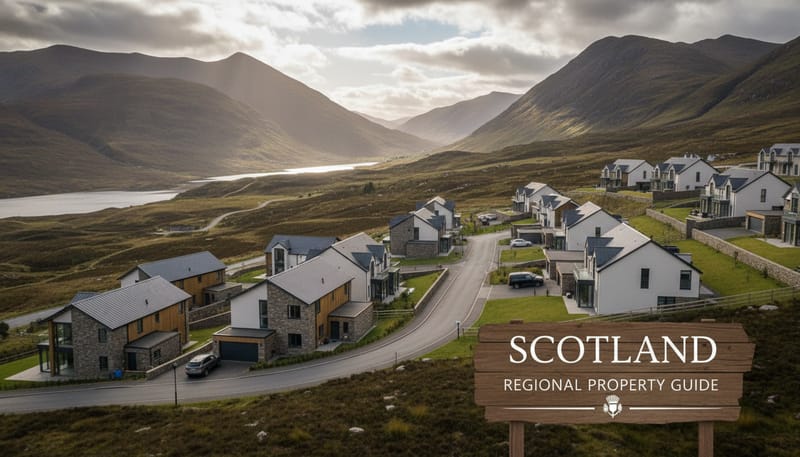
Scottish Property Law: Key Differences You Must Know
Before exploring specific locations, it’s essential to understand how buying property in Scotland differs from England and Wales. The Scottish legal system operates under a fundamentally different framework, and buyers — particularly those relocating from south of the border — need to be aware of these differences from the outset.
The most distinctive feature of the Scottish system is the “offers over” approach to pricing. Unlike England, where properties are typically marketed at a fixed asking price with negotiations downward, many Scottish properties are marketed at a price described as “offers over” (e.g., “Offers over £200,000”), with the expectation that buyers will bid above this figure. In competitive markets like Edinburgh, successful bids can exceed the asking price by 10-20% or more. However, for new build homes, the process is usually more straightforward, with developers setting a fixed price similar to the English system.
Scotland vs England: Property Purchase Differences
The Home Report is another distinctly Scottish requirement. Introduced in 2008, it requires sellers to provide a comprehensive property report before marketing, including a single survey, an energy performance certificate, and a property questionnaire. While new build homes are exempt from the Home Report requirement (since there is no existing property to survey), it’s important to understand the system if you’re also considering resale properties.
A significant advantage of the Scottish system is the reduced risk of gazumping. In Scotland, once a formal offer is accepted and missives are concluded, the agreement becomes legally binding much earlier than the equivalent stage in England. This provides greater certainty for buyers and sellers alike, and means that the stressful experience of having a purchase collapse — common in England — is relatively rare in Scotland.
LBTT vs Stamp Duty: Understanding Scottish Property Tax
Scotland replaced stamp duty with Land and Buildings Transaction Tax (LBTT) in April 2015, introducing its own system of property transaction taxes. The rates and bands differ from England’s stamp duty, and understanding these differences is crucial for budgeting your purchase correctly.
The practical impact of LBTT varies by price point. For homes under £145,000, there’s no tax at all, making entry-level new builds particularly attractive. For mid-range properties between £145,000 and £250,000, LBTT is slightly higher than the equivalent stamp duty. At higher price points, the differences become more pronounced, with LBTT often higher than SDLT. It’s essential to factor these costs into your budget from the start.
Help to Buy Scotland: What’s Different?
Scotland has operated its own version of Help to Buy, separate from the English scheme, and the details have differed in important ways. While the English Help to Buy equity loan scheme closed to new applications in 2022, Scotland has at various times offered its own support schemes for first-time buyers and those purchasing new build homes.
The Scottish Government’s approach to housing affordability has included initiatives such as the First Home Fund, the Help to Buy (Scotland) shared equity scheme, and the Affordable New Build Scheme. The specifics of these schemes change over time as government policy evolves, so it’s critical to check the current availability and terms directly with the Scottish Government or your solicitor at the time of your purchase.
One key difference is that Scottish housing support schemes have generally been available to a broader range of buyers, not just first-time buyers, and have sometimes included resale properties as well as new builds. The Scottish Government’s wider housing strategy also includes ambitious targets for affordable housing construction, which benefits new build buyers by increasing overall supply in the market.
Edinburgh: Scotland’s Capital
Edinburgh is Scotland’s most expensive property market and one of the UK’s most sought-after cities. The capital combines stunning architecture, world-class cultural events (including the Edinburgh Festival Fringe, the world’s largest arts festival), a thriving financial services sector, and a quality of life that consistently ranks among the highest in Europe.
The new build market in Edinburgh is constrained by the city’s geography — hemmed in by Arthur’s Seat, the Pentland Hills, and the Firth of Forth — which limits development land and keeps prices high. Major new build activity is concentrated in areas like Granton Waterfront on the north side, where an ambitious regeneration programme is delivering thousands of new homes alongside cultural and leisure facilities, and in the western suburbs around Edinburgh Park and the Gyle.
Edinburgh New Build Prices
Popular Edinburgh Areas
- Granton Waterfront — Major regeneration, waterfront apartments, improving connectivity
- Edinburgh Park — Modern business district, tram-linked, family homes
- Craigmillar — Regeneration area, more affordable, growing amenities
- South Queensferry — Forth bridges, village atmosphere, family housing
- Corstorphine/Murrayfield — Established suburbs, green spaces, premium pricing
Edinburgh’s tram network, extended to the airport and beyond, has improved connectivity for western and northern suburbs, boosting property values in areas it serves. The city’s employment market is dominated by financial services (it’s Europe’s fifth-largest financial centre), technology, tourism, and the public sector. For new build buyers, the combination of limited supply and sustained demand means Edinburgh properties tend to hold their value well, making them relatively safe investments even at premium prices.
Glasgow: Scotland’s Largest City
Glasgow is Scotland’s largest city by population and offers a very different proposition to Edinburgh. While Edinburgh is often perceived as formal and tourist-focused, Glasgow is known for its warmth, cultural vibrancy, and creative energy. The city has undergone a remarkable transformation since its year as European Capital of Culture in 1990, reinventing itself as a design and cultural hub with a world-class music scene, outstanding museums (including the Kelvingrove and the Riverside Museum), and some of the UK’s best dining.
For new build buyers, Glasgow offers significantly better value than Edinburgh. City-centre apartments start from as little as £150,000, and even desirable West End locations near the university and Kelvingrove Park offer two-bedroom new builds from around £220,000. The Clyde waterfront, stretching from the city centre through Pacific Quay and beyond, has seen extensive residential development alongside cultural landmarks like the SSE Hydro and the BBC Scotland headquarters.
Glasgow’s suburbs offer excellent family housing at prices that would be unimaginable in Edinburgh or southern England. Areas like Newton Mearns, Bearsden, and Milngavie to the south and north of the city combine outstanding schools, green spaces, and village atmospheres with easy commutes into the centre. New build four-bedroom detached houses in these areas typically cost between £350,000 and £550,000 — a fraction of equivalent properties in Edinburgh’s premium suburbs.
Aberdeen, Dundee, and Scotland’s Other Cities
Aberdeen, the “Granite City,” has long been one of Scotland’s wealthiest cities thanks to the North Sea oil and gas industry. However, the fluctuation in oil prices has had a significant impact on the local property market in recent years, creating both challenges and opportunities for buyers. During the oil boom years, Aberdeen’s property prices rivalled Edinburgh’s, but the downturn from 2014 onwards brought significant corrections. For new build buyers, this means that Aberdeen currently offers better value than at any point in the past two decades, with quality developments from major builders available at prices well below their peak.
Dundee, Scotland’s fourth city, has experienced a remarkable renaissance centred on the V&A Dundee museum, which opened in 2018 on the city’s redeveloped waterfront. This cultural landmark has catalysed wider regeneration, attracting investment, visitors, and new residents to a city that offers some of Scotland’s most affordable new build homes. Two-bedroom new build apartments in Dundee start from around £130,000, and family houses are available from approximately £185,000.
Stirling, Perth, and Inverness each offer distinctive propositions for new build buyers. Stirling, at the gateway to the Highlands, combines a rich history with a vibrant university culture and new build prices significantly below Edinburgh and Glasgow. Perth, recently granted city status, offers an attractive quality of life on the doorstep of the Highlands. Inverness, the capital of the Highlands, is the largest city in northern Scotland and offers a lifestyle centred on outdoor pursuits, with new build housing at competitive prices.
Major Developers in Scotland
Scotland’s new build market features a mix of national UK housebuilders and distinctly Scottish developers who understand the local market, planning system, and buyer preferences. Several of Scotland’s most prominent developers have their headquarters here, giving them deep local knowledge and strong relationships with Scottish local authorities.
CALA Homes, headquartered in Edinburgh, is often regarded as Scotland’s premier developer, building high-specification homes in desirable locations. Springfield Properties, listed on AIM and based in Elgin, has grown rapidly by focusing on community-scale developments across Scotland. Stewart Milne, based in Aberdeen, brings decades of experience in the Scottish market. For more on evaluating developers, see our guide on what to expect from major UK developers.
The Central Belt: Scotland’s Population Heart
The Central Belt — the corridor between Edinburgh and Glasgow — is home to the majority of Scotland’s population and the bulk of its new build activity. Towns along this corridor, including Falkirk, Livingston, Bathgate, Airdrie, and Motherwell, offer some of Scotland’s best value new build housing with direct rail and motorway access to both of Scotland’s major cities.
Falkirk, roughly equidistant between Edinburgh and Glasgow, has become increasingly popular with commuters to both cities. New build three-bedroom houses here are available from approximately £195,000, and the Falkirk Wheel and Kelpies sculptures have raised the town’s profile as a visitor destination. Livingston, one of Scotland’s new towns, offers modern infrastructure and a diverse range of new build developments, while East Kilbride, Scotland’s largest new town, provides easy access to Glasgow’s south side.
For buyers who work in Edinburgh or Glasgow but want more space and lower prices, the Central Belt towns represent an excellent compromise. Journey times to either city are typically 30-45 minutes by train, and the M8 motorway provides a direct road link. This combination of affordability and connectivity makes the Central Belt one of Scotland’s most active new build markets.
The Highlands and Beyond: Lifestyle Buying
For some buyers, Scotland’s appeal lies not in its cities but in its extraordinary natural landscapes. The Highlands, islands, and rural areas offer a lifestyle centred on outdoor pursuits, community, and a pace of life dramatically different from urban Scotland. While new build options are more limited in these areas, they do exist and can offer remarkable value.
Inverness has grown significantly as the Highland capital and now offers a range of new build developments from major and regional builders. The city benefits from its own airport, a direct rail connection to Edinburgh and Glasgow (including the scenic Highland Main Line), and access to some of the most dramatic landscape in Europe. New build three-bedroom houses in Inverness and its surrounds typically cost between £210,000 and £320,000.
The rise of remote working has made Highland and rural Scottish living more viable than ever before. Many buyers who previously felt tied to Edinburgh or Glasgow offices are now able to work from home for much of the week, making locations like Aviemore, Fort William, Oban, and even the islands genuinely viable options for those who prioritise lifestyle over urban convenience. However, it’s important to be realistic about the trade-offs: rural Scotland can experience challenging weather, limited services, and significant travel times to major centres.
Highland Living — Advantages
- ● World-class natural scenery on your doorstep
- ● Strong sense of community
- ● Lower property prices than urban Scotland
- ● Outdoor activities: hiking, skiing, fishing, climbing
Highland Living — Considerations
- ● Limited employment opportunities locally
- ● Long distances to hospitals and specialist services
- ● Harsh winter weather and short daylight hours
- ● Midges in summer can be challenging
Transport and Connectivity
Scotland’s transport network serves the Central Belt well but becomes sparser as you move north and west. Understanding connectivity is essential for choosing the right location, particularly if you need to commute or travel regularly for work.
Edinburgh Waverley and Glasgow Queen Street/Central are the country’s main rail hubs. Edinburgh to London takes approximately 4 hours 20 minutes by LNER services on the East Coast Main Line, while Glasgow to London takes around 4 hours 30 minutes via the West Coast Main Line to Euston. The Edinburgh-Glasgow route is one of Scotland’s busiest, with frequent services taking approximately 50 minutes.
Scotland has several airports. Edinburgh Airport is the country’s busiest, with extensive domestic and international connections. Glasgow Airport offers a similar range, while Glasgow Prestwick, Aberdeen, Inverness, and Dundee airports provide additional options. The M8 between Edinburgh and Glasgow, the M9 to Stirling, and the M74/A74(M) to England form the core of Scotland’s motorway network.
Edinburgh’s tram network, connecting the city centre to the airport and the western suburbs, has boosted property values along its route. There are ongoing discussions about extending the network to Granton and other areas, which could benefit new build buyers in these locations. For broader transport considerations, see our guide on commuter new builds near major cities.
Practical Tips for Buying in Scotland
Buying a new build in Scotland requires some specific knowledge and preparation, particularly if you’re moving from England or Wales. Here are the essential steps and considerations to ensure a smooth purchase.
First, appoint a Scottish solicitor early. The legal process in Scotland differs significantly from England, and your solicitor will handle tasks that would be split between a solicitor and estate agent in England. Many Scottish solicitors offer fixed-fee packages for new build purchases, and their fees are generally competitive.
Second, understand the missives process. In Scotland, the formal exchange of legal letters (missives) between your solicitor and the seller’s solicitor creates a binding contract. For new builds, this process is typically more straightforward than for resale properties, but it’s still important to ensure your solicitor reviews all documents thoroughly, including any conditions relating to the development, common areas, and factoring arrangements.
Third, be aware of factoring. In Scotland, many new build developments have a “factor” — a management company that maintains common areas, landscaping, and shared facilities. Factoring fees vary significantly between developments and can add a notable amount to your ongoing costs. Always check the factoring arrangements and projected fees before committing to a purchase.
- ✓ Appoint a Scottish solicitor experienced with new builds
- ✓ Budget for LBTT — rates differ from SDLT
- ✓ Check current government support schemes and eligibility
- ✓ Review factoring fees and arrangements carefully
- ✓ Understand the missives process and when you become committed
- ✓ Research the developer’s Scottish track record specifically
- ✓ Check council tax bands, which differ from English banding
Scotland offers new build buyers a distinctive and rewarding property market. From the cosmopolitan elegance of Edinburgh to the creative vibrancy of Glasgow, from the regenerating waterfronts of Dundee and Aberdeen to the wild beauty of the Highlands, there is truly something for every buyer. The differences in legal process and tax structure require some additional preparation, but they also bring benefits — the Scottish system’s reduced risk of gazumping and the transparency of the Home Report process make for a more secure buying experience. With competitive prices outside Edinburgh, strong developer competition, and a growing economy, Scotland deserves serious consideration from anyone looking to buy a new build home in the UK. For a comprehensive approach to evaluating any location, read our guide on how to research a location before buying a new build.