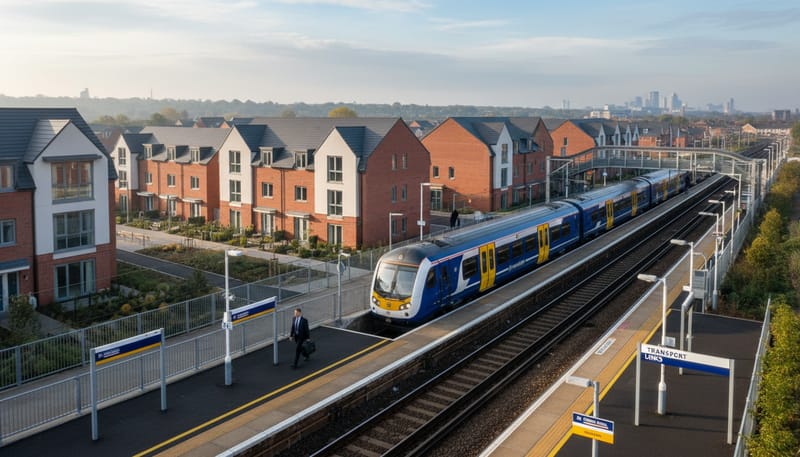
In the UK property market, few factors influence value and desirability as powerfully as proximity to a railway station with fast, frequent commuter services. For new build buyers in 2025 and 2026, the expanding network of high-speed and upgraded rail corridors presents a compelling opportunity: homes that combine modern specifications with genuine connectivity to major employment centres. From the transformative Elizabeth Line stretching across London into Berkshire and Essex, to the long-awaited HS2 reshaping the Midlands and the North, and from the upgraded Thameslink corridor threading through Hertfordshire to ambitious Northern Powerhouse Rail plans, the UK’s rail infrastructure is creating new property hotspots and unlocking value in locations that were previously overlooked. This comprehensive guide examines every major commuter rail corridor in the country, highlighting the best new build developments near key stations, comparing journey times and prices, and helping you identify the locations where rail connectivity and property investment align most strongly.
Whether you are a first-time buyer seeking an affordable home with a manageable commute, a family looking for space without sacrificing city access, or an investor targeting the price premiums that rail proximity commands, understanding the relationship between new builds and rail infrastructure is essential. The data is clear: properties within a 10-minute walk of a station with services to a major city centre command premiums of 10–25% over comparable homes further away. When that station sits on a newly opened or recently upgraded line, the premium can be even higher, as early buyers capture the full benefit of improved connectivity before prices fully adjust.
Why Rail Connectivity Drives New Build Values
The relationship between rail infrastructure and property values is one of the most well-documented phenomena in UK real estate. Research by the London School of Economics found that the announcement of the Elizabeth Line alone added an estimated £5.5 billion to property values along the route before a single train had run. Similar effects have been observed with HS1 in Kent, where properties near Ebbsfleet and Ashford International stations saw sustained appreciation well above county averages in the years following the line’s opening. For new build buyers, this creates a powerful dynamic: purchasing near a station on a new or upgraded line offers the potential for both lifestyle benefits and above-average capital growth.
The shift towards hybrid working since 2020 has amplified rather than diminished the importance of rail links. While many professionals now work from home two or three days per week, the days they do commute tend to cluster around midweek peaks, making journey time and reliability even more critical. A 25-minute fast train into the city centre is now seen as an acceptable commute for most professionals, expanding the viable radius for new build developments far beyond the traditional inner suburbs. This has been a boon for developers, who can offer larger homes at more competitive prices in locations that still deliver genuine city access.
Developers have responded to this demand by increasingly targeting sites near railway stations. Major housebuilders including Barratt Developments, Taylor Wimpey, Berkeley Group, and Persimmon now routinely cite station proximity as a key factor in their land acquisition decisions. The result is a wave of high-quality new build developments strategically positioned to benefit from rail connectivity, often incorporating design features that cater to commuters — such as secure cycle storage, home office spaces, and electric vehicle charging points for the drive-to-station market.
Elizabeth Line (Crossrail): London’s Game-Changing Railway
The Elizabeth Line, fully operational since late 2022, has fundamentally redrawn the commuter map of London and the South East. Stretching 73 miles from Reading and Heathrow in the west to Shenfield and Abbey Wood in the east, this £18.8 billion railway has slashed journey times, eliminated the need for tube changes across central London, and created new property hotspots at almost every station along its route. For new build buyers, the Elizabeth Line corridor represents perhaps the most significant opportunity of the past decade, with developments near stations continuing to see strong demand and above-average price growth.
The western section of the line has transformed Berkshire’s commuter dynamics. Reading, once a 25-minute journey to Paddington requiring a tube connection to reach the City or Canary Wharf, now offers direct services to Liverpool Street in under 60 minutes and to Canary Wharf without a single change. Berkeley Homes’ Green Park Village development near Reading station offers apartments from £295,000 and houses from £480,000, positioned within walking distance of the Elizabeth Line. Maidenhead and Slough have similarly benefited, with new apartment-led developments by Berkeley, Countryside, and L&Q capitalising on the dramatically improved connectivity.
The eastern section has been equally transformative. Abbey Wood, once a relatively unknown south-east London suburb, has experienced a wave of new build development since becoming the Elizabeth Line’s south-eastern terminus. Peabody’s Thamesmead and Abbey Wood regeneration is delivering thousands of new homes, with two-bedroom apartments starting from around £350,000. The ability to reach Liverpool Street in 18 minutes and Canary Wharf in 14 minutes without changing has made Abbey Wood one of the capital’s most exciting emerging locations. Romford and Ilford in east London have also attracted substantial new build investment, with Bellway, Weston Homes, and L&Q all active on sites near their respective Elizabeth Line stations.
For new build buyers considering the Elizabeth Line corridor, the key decision is balancing price against journey time. Western stations like Reading and Maidenhead offer lower prices and more space but longer journeys, while eastern stations like Stratford and Whitechapel offer rapid city access but at significantly higher prices. The sweet spot for many buyers lies in locations like Ealing Broadway, Romford, or Shenfield, where journey times of 22–30 minutes combine with prices that remain accessible to a broad range of budgets. Developers along the corridor continue to report strong sales, with off-plan purchases particularly popular among investors and buy-to-let landlords attracted by both rental yields and capital growth prospects.
- ✓ Lower entry prices from £295K
- ✓ Larger homes and more outdoor space
- ✓ Access to Thames Valley tech employers
- ✓ Heathrow Airport proximity
- ✗ Longer journey times (40–55 mins)
- ✗ Services may require changing at Paddington
- ✓ Faster journey times (8–30 mins)
- ✓ Direct Canary Wharf access
- ✓ Strong regeneration momentum
- ✓ Higher rental yields (4–5.5%)
- ✗ Higher prices in Zone 2–3
- ✗ Smaller unit sizes in urban locations
HS2: The Future of North–South Connectivity
High Speed 2 represents the largest infrastructure project in Europe, and despite delays and cost overruns, the first phase between London Euston and Birmingham Curzon Street is progressing towards completion. For new build buyers with a long-term investment horizon, the HS2 corridor offers a compelling proposition: locations along the route are already seeing property value uplift driven by improved future connectivity, even before trains begin running. The key is understanding which locations will benefit most and when those benefits will materialise.
The transformative promise of HS2 is simple: journey times between London and Birmingham will be cut to just 49 minutes, compared with the current 1 hour 21 minutes on conventional services. This makes Birmingham a genuinely viable commuter destination from London, and vice versa. More significantly for the property market, the intermediate stations and surrounding areas along the route — particularly in Buckinghamshire and the West Midlands — are experiencing a development boom as builders position themselves to capture demand from improved connectivity.
Old Oak Common in west London will serve as a major HS2 interchange, connecting the high-speed line with the Elizabeth Line, Great Western Main Line, and a potential future link to the West London Orbital railway. The Old Oak and Park Royal Development Corporation has plans for up to 25,500 new homes and 65,000 jobs in the area, making it one of London’s most significant regeneration projects. While much of this development is still in planning, early phases are underway, and buying near Old Oak Common today means securing a position in what will become one of London’s best-connected locations. Current new build prices in the surrounding areas of North Acton and East Acton range from £400,000 to £550,000 for two-bedroom apartments.
Birmingham Curzon Street, the HS2 terminus in the city centre, is the catalyst for the Birmingham Smithfield and Eastside regeneration programmes. Developers including Galliard Homes, Court Collaboration, and Lendlease are active in the area, with apartment prices starting from approximately £220,000 for a one-bedroom unit and £285,000 for a two-bedroom. The prospect of a 49-minute journey to London has attracted significant investor interest, with rental yields in Birmingham city centre currently averaging 5.5–6.5%. For new build buyers seeking long-term capital growth, Birmingham’s HS2 quarter offers one of the most compelling risk-reward profiles in the UK market.
Along the HS2 route through Buckinghamshire, towns like Aylesbury and the wider area around the planned Calvert interchange are seeing increased developer activity. Barratt Homes’ Kingsbrook development at Aylesbury offers over 2,400 homes with prices starting from £310,000 for three-bedroom houses, positioning buyers to benefit from future connectivity improvements. The HS2 effect on Buckinghamshire property values has been debated, with construction disruption causing short-term challenges in some areas, but the long-term outlook remains positive as improved transport links are expected to boost demand and values once services begin.
Thameslink: The Cross-London Commuter Backbone
The Thameslink programme, completed in 2018 at a cost of £6 billion, expanded the cross-London rail network to run 24 trains per hour through a central core that includes St Pancras International, Farringdon, City Thameslink, Blackfriars, and London Bridge. This north–south artery connects Bedford and Cambridge in the north with Brighton and Gatwick in the south, passing through some of the most desirable commuter towns in Hertfordshire, north London, and the Home Counties. For new build buyers, Thameslink stations offer the invaluable advantage of cross-London connectivity without the need to navigate the Underground.
Hertfordshire dominates the northern Thameslink corridor, with stations at St Albans, Harpenden, Luton, Hatfield, and Welwyn Garden City all offering fast services to central London. St Albans City station, with its 20-minute journey to St Pancras, is one of the most sought-after commuter stations in the country. New build opportunities in St Albans are limited due to strict planning controls, but when they do arise, they command premium prices — typically £550,000 or more for a two-bedroom apartment and £750,000 or more for a three-bedroom house. Berkeley Group and Cala Homes have both delivered recent developments in the city.
For more affordable Thameslink options, Luton has undergone significant transformation in recent years. The town’s regeneration programme, combined with fast Thameslink services (22 minutes to St Pancras), has attracted developers including Barratt Homes and Taylor Wimpey. New build prices in Luton start from approximately £230,000 for a two-bedroom apartment and £310,000 for a three-bedroom house, representing exceptional value for the journey time. The planned Luton DART people-mover connecting the town to London Luton Airport further enhances the area’s connectivity and investment appeal.
The southern section of Thameslink extends through Sussex and Surrey to Brighton and Horsham. Brighton, with its vibrant cultural scene and coastal lifestyle, has long attracted London commuters, and Thameslink’s direct services to City Thameslink and London Bridge (52–58 minutes) have strengthened this appeal. New build developments in Brighton and Hove include schemes by Hyde New Homes and Barratt, with two-bedroom apartments from £325,000. The Gatwick corridor, including Crawley, Horsham, and East Grinstead, offers more affordable options for families seeking larger homes while maintaining reasonable commuter access.
Bedford represents the northern extent of the Thameslink network and has emerged as a value hotspot. With fast trains to St Pancras in 39 minutes and new build prices starting from £260,000 for two-bedroom homes, Bedford offers perhaps the best value-for-time ratio on the entire network. Developers including David Wilson Homes and Bellway have large active sites in the Bedford area. The town also sits on the route of the planned East West Rail link, which will connect Bedford to Cambridge and Oxford, further enhancing its long-term connectivity and investment potential.
Northern Powerhouse Rail and TransPennine Upgrades
While much of the UK’s rail investment attention focuses on London-centric corridors, the north of England is experiencing its own transport revolution. The TransPennine Route Upgrade, a £11.5 billion programme to modernise the railway between Manchester, Huddersfield, Leeds, and York, is transforming east–west connectivity across the Pennines. Combined with proposals for new Northern Powerhouse Rail services linking Liverpool, Manchester, Leeds, Sheffield, and Hull, these investments are reshaping the property landscape of northern England and creating significant opportunities for new build buyers.
Manchester, the economic powerhouse of the north, sits at the centre of these improved connections. The city’s new build market has been thriving, with developments in Salford Quays, Ancoats, New Islington, and the Northern Quarter attracting strong demand from both owner-occupiers and investors. Journey times from Manchester to Leeds are being reduced from 49 minutes to approximately 33 minutes under the TransPennine Route Upgrade, while future Northern Powerhouse Rail services could cut this further to around 26 minutes. For new build buyers based in Manchester, this means access to two major employment centres — and for those in smaller towns along the route, such as Huddersfield and Dewsbury, it means genuinely viable commutes to both cities.
Leeds is another prime beneficiary, with the city centre experiencing a sustained new build boom. Developers including Citu, Latimer (Clarion Housing), and CEG are delivering mixed-use developments that combine residential units with workspace, retail, and leisure. Two-bedroom apartments in Leeds city centre start from around £215,000, with three-bedroom townhouses from £310,000. The South Bank regeneration area, centred on the former Tetley Brewery site and extending south of the river, is planned to double the size of Leeds city centre and deliver over 8,000 new homes. With improved rail links reducing commute times to Manchester, York, Sheffield, and Hull, Leeds-based new build buyers will enjoy unparalleled access to multiple northern employment centres.
The towns between Manchester and Leeds along the TransPennine corridor offer some of the most affordable new build options in the country. Huddersfield, where two-bedroom new build apartments start from approximately £165,000, benefits from fast trains to both Manchester (25 minutes) and Leeds (25 minutes). Dewsbury, Stalybridge, and Marsden similarly offer low entry prices with improving connectivity. For first-time buyers and investors, these locations present an opportunity to enter the market at accessible price points while benefiting from the transformative effect of improved rail infrastructure. With the TransPennine Route Upgrade progressing steadily, journey time reductions and reliability improvements are being delivered in phases, providing a rolling boost to property values along the corridor.
East West Rail: Connecting Oxford, Milton Keynes and Cambridge
East West Rail is one of the most ambitious new railway projects in the UK, aiming to create a direct rail connection between Oxford, Milton Keynes, Bedford, and Cambridge — four of the country’s most dynamic economic centres that have historically lacked direct east–west rail links. The western section, connecting Oxford with Milton Keynes and Bedford via Bicester and Bletchley, is the most advanced, with services expected to begin in the late 2020s. For new build buyers, the East West Rail corridor represents a generational investment opportunity in locations that are already thriving but will benefit enormously from improved connectivity.
Milton Keynes, positioned at the heart of the East West Rail route, is already one of the UK’s fastest-growing cities and a major new build hub. Developers including Bovis Homes, Taylor Wimpey, and David Wilson Homes have extensive developments across the city and its surrounding growth areas. New build prices in Milton Keynes range from approximately £250,000 for a two-bedroom apartment to £425,000 for a four-bedroom family home. The prospect of direct rail connections to Oxford (approximately 40 minutes) and Cambridge (approximately 50 minutes) will dramatically enhance the city’s appeal to academics, tech workers, and professionals who currently rely on road connections between these centres.
Bicester has been transformed by the combination of East West Rail and its designation as a garden town. The Bicester Village retail destination already draws millions of visitors annually, and the planned rail improvements will add direct connections to Milton Keynes, Bedford, and eventually Cambridge. Countryside Partnerships’ Kingsmere development and the wider NW Bicester eco-town project are delivering thousands of new homes, with prices from around £330,000 for a three-bedroom house. Bicester North station already benefits from fast Chiltern Railways services to London Marylebone in 46 minutes, so buyers gain dual connectivity — south to London and east-west along the new railway.
Cambridge, at the eastern end of the eventual full East West Rail route, is one of the UK’s most expensive and constrained property markets outside London. The city’s booming biotech and technology sectors drive enormous demand for housing, and new build developments by Barratt, Hill Residential, and Countryside Partnerships are consistently oversubscribed. Two-bedroom apartments in Cambridge start from around £375,000, with family homes from £520,000. The completion of East West Rail to Cambridge will connect the city directly with Oxford for the first time by modern rail, creating a knowledge corridor that could rival Silicon Valley in economic output and further driving property demand.
Merseyrail and Liverpool City Region
Merseyrail is one of the UK’s most efficient commuter rail networks, operating 67 stations across the Liverpool City Region with a punctuality record that consistently ranks among the best in the country. The network is currently undergoing a £500 million fleet renewal, replacing its ageing trains with brand-new, state-of-the-art rolling stock manufactured by Stadler. These new trains offer improved passenger comfort, step-free access, better reliability, and enhanced capacity — all of which are expected to boost the desirability of properties near Merseyrail stations.
Liverpool’s new build market offers some of the best value in any major English city, with two-bedroom apartments in the city centre starting from around £160,000 and three-bedroom family homes in the suburbs from £210,000. The Liverpool Waters regeneration scheme, a £5.5 billion development on the city’s historic waterfront, is delivering thousands of new homes alongside commercial, cultural, and leisure spaces. Peel Group, the developer behind Liverpool Waters, is creating a series of connected neighbourhoods that will eventually house up to 20,000 residents, all served by nearby Merseyrail stations.
The Wirral Peninsula, connected to Liverpool city centre via the Merseyrail underground loop, offers a suburban lifestyle with rapid city access. Stations at Birkenhead, West Kirby, and New Brighton all deliver journey times of 15–30 minutes to Liverpool centre. New build developments on the Wirral include schemes by Redrow, Bellway, and Elan Homes, with three-bedroom family homes from approximately £195,000. The Wirral Waters regeneration scheme on the Birkenhead waterfront is a particularly ambitious project, planning to deliver over 13,000 new homes alongside office space, a maritime museum, and public parkland.
To the north, the Merseyrail Northern Line serves Southport, Formby, and Crosby, with journey times to Liverpool of 35–50 minutes. These coastal and semi-rural locations appeal to families seeking space and quality of life, with new build developments by Taylor Wimpey and Story Homes offering three and four-bedroom homes from £240,000. The introduction of new Merseyrail rolling stock across the network is expected to provide a measurable boost to property values near all stations, replicating the effect seen with new rolling stock introductions elsewhere in the country.
ScotRail and Scottish Commuter Networks
Scotland’s rail network has seen significant investment in recent years, with new rolling stock, station upgrades, and electrification projects improving services across the Central Belt and beyond. For new build buyers in Scotland, rail connectivity between Edinburgh, Glasgow, and their surrounding commuter towns offers an attractive proposition combining affordable housing with fast city access. Scotland’s separate property market dynamics — including different legal frameworks and generally lower prices than southern England — add to the appeal for buyers seeking value.
Edinburgh, Scotland’s capital and one of the UK’s most expensive property markets outside London, has a thriving new build sector driven by strong demand from both domestic and international buyers. The city’s main commuter rail routes radiate outwards to North Berwick, Dunbar, Fife, Linlithgow, and Bathgate, all offering services of 20–45 minutes to Edinburgh Waverley or Haymarket. CALA Homes, Scotland’s leading premium developer, has multiple active sites across the Edinburgh commuter belt, with prices ranging from £280,000 for two-bedroom apartments to £600,000 or more for four-bedroom family homes in desirable locations like South Queensferry and Cramond.
Glasgow offers considerably lower prices than Edinburgh, with new build apartments in the city centre starting from approximately £155,000. The Glasgow commuter network, including services to Helensburgh, Milngavie, East Kilbride, Hamilton, and Ayr, offers journey times of 20–50 minutes. The Clyde Gateway regeneration area in the east end, site of the 2014 Commonwealth Games Athletes’ Village, continues to evolve with new residential development by CCG (Scotland) and other builders. The Falkirk area, positioned between Edinburgh and Glasgow with fast rail connections to both cities, is emerging as a particularly attractive new build location, with family homes from around £220,000.
Price Premium by Distance from Station
One of the most important factors for new build buyers to understand is how property values change with distance from a railway station. Research consistently shows a clear price gradient: homes closest to stations command the highest premiums, with values declining steadily as walking distance increases. Understanding this gradient helps buyers make informed decisions about how much extra they should expect to pay for station proximity and whether the premium represents good value for their commuting needs.
The data reveals that the most significant premium attaches to homes within a 5-minute walk (approximately 400 metres) of a station, where values average 22% above baseline. This premium falls to 15% at 5–10 minutes and drops more sharply beyond 10 minutes. For new build buyers, this means that paying a premium for the closest plots to a station is generally well justified, as the premium is likely to be maintained or even enhanced over time. Conversely, homes more than a 15–20 minute walk from a station see little measurable benefit from rail proximity, suggesting that buyers at this distance should prioritise other factors such as school catchments, green space, or development specifications.
Developers are acutely aware of this gradient and price their developments accordingly. Within a single development near a station, you will often find that plots closest to the station entrance carry a premium of £10,000–£30,000 over identical units on the far side of the site. When choosing a specific plot, consider not just the distance to the station entrance but also the quality of the walking route — a well-lit, paved path feels very different from a walk along a busy road, even if the distance is the same.
Development Spotlights: Best-Connected New Builds in 2025–2026
To illustrate the quality and range of new build developments near major rail links, here are standout schemes across different corridors and price points. Each has been selected for its combination of station proximity, developer reputation, specification quality, and value proposition.
Expert Buying Tips for Rail-Connected New Builds
Purchasing a new build near a major rail link requires a specific set of considerations beyond the standard new build buying process. These expert tips will help you navigate the unique dynamics of rail-connected property markets and ensure you secure the best possible home at the right price.
Future Rail Investment to Watch
Beyond the major projects already discussed, several forthcoming rail investments have the potential to create new property hotspots and enhance the value of existing new build developments. Savvy buyers who position themselves ahead of these improvements can capture significant upside as enhanced connectivity drives demand and prices.
The South Wales Metro deserves particular attention from new build buyers. This £1 billion-plus programme is converting the Valley Lines to a metro-style operation with new tram-train vehicles, increased frequencies, and new stations. Areas like Pontypridd, Treforest, Caerphilly, and the heads of the valleys will see dramatically improved rail services, with trains every 12 minutes during peak hours compared with the current 30-minute headways. New build prices in these areas currently start from as little as £170,000 for a three-bedroom house — remarkably affordable by UK standards and well-positioned to benefit from the metro transformation.
Comparing Rail Corridors: Which Offers the Best Value?
With so many rail corridors to choose from, how should buyers compare the different options? The answer depends on your priorities — whether you value the lowest entry price, the fastest journey time, the highest rental yield, or the strongest capital growth prospects. The following analysis brings together data from across all the corridors covered in this guide to help you identify the best fit for your needs.
For first-time buyers and investors seeking the lowest entry prices combined with strong yields, the TransPennine corridor, Merseyrail network, and ScotRail commuter routes offer the most accessible options. Entry prices below £200,000 for new build homes with genuine city access are increasingly rare in southern England but remain available across these northern and Scottish networks. The trade-off is that capital growth may be slower in absolute terms, though percentage returns can be highly competitive.
For buyers prioritising journey time and the established reliability of a fully operational line, the Elizabeth Line and Thameslink offer proven, high-frequency services with no uncertainty about delivery timelines. Prices are higher, but the premium reflects both the quality of service and the strength of southern property markets. For those willing to accept some delivery uncertainty in exchange for potentially higher returns, the HS2 corridor and East West Rail offer the most exciting growth prospects, as improved connectivity is not yet fully reflected in current pricing.
Conclusion: Rail Links as the Foundation of Smart New Build Buying
The UK’s rail network is undergoing its most significant period of investment and transformation since the Victorian era. From the completed Elizabeth Line redefining London’s commuter geography, to HS2 promising to reshape the relationship between London and Birmingham, to the TransPennine Route Upgrade enhancing east–west connectivity across the north, every major rail corridor is creating opportunities for new build buyers who understand the link between transport infrastructure and property value.
The evidence is overwhelming: new build homes near well-connected railway stations outperform the wider market in both capital growth and rental yield. The station proximity premium is real, persistent, and applies across every region of the country. By choosing a new build development within walking distance of a station on one of the corridors covered in this guide, you are not just buying a convenient commute — you are securing one of the most reliable drivers of long-term property value available in the UK market.
As you explore your options, remember to test commutes in person, research future infrastructure plans, factor in the full cost of commuting, and choose a developer with a strong track record in your target area. The right rail-connected new build home can deliver the best of both worlds: modern, energy-efficient living in a well-planned community, combined with the connectivity to keep you linked to the employment centres, cultural attractions, and opportunities that make the UK’s cities so dynamic. For more on emerging property hotspots, explore our guide to new build homes in regeneration areas, or browse our Home Counties guide for a regional deep dive into London’s commuter belt.