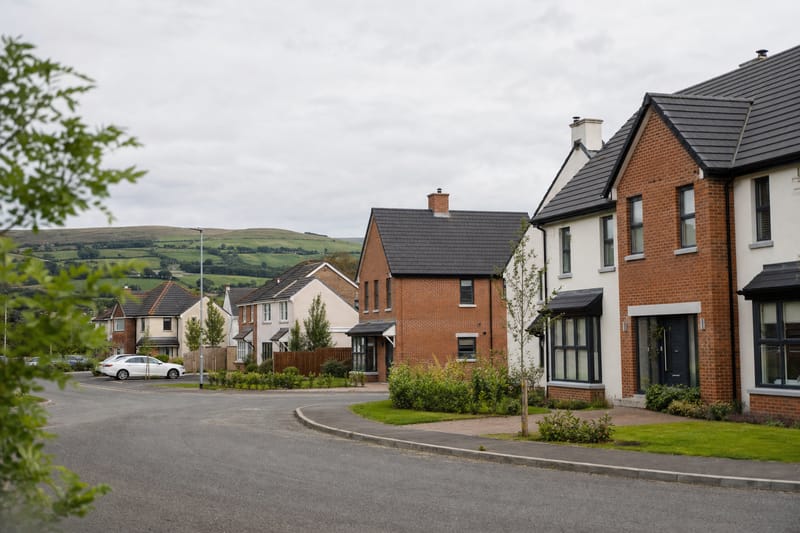
New build homes in Northern Ireland sit in a market that behaves differently from England, Wales and Scotland in almost every respect that matters to a buyer — price growth, the legal process, the mortgage products on offer and even the names of the housebuilders themselves. If you are weighing up a new build in Belfast, Lisburn, Bangor or one of the growing towns around Lough Neagh, this guide sets out where the activity is concentrated, how prices compare with the rest of the UK, and the practical differences in conveyancing and schemes you need to understand before you reserve a plot.
Northern Ireland's new build sector has historically been smaller and more fragmented than its equivalents across the Irish Sea. There is no single dominant national housebuilder with the scale of a Barratt or Taylor Wimpey operating here; instead, the market is built around a cluster of regional firms — some building a few hundred units a year, others delivering large mixed-tenure schemes in partnership with housing associations. That fragmentation matters for buyers because warranty cover, aftercare standards and build quality can vary more between developers here than in the more consolidated GB market.
This guide covers the geography of where new homes are being built, how the Northern Ireland housing market compares with Great Britain on price and demand, what legal conveyancing differences you will meet (Northern Ireland uses a similar but not identical system to England and Wales, distinct from Scotland's), the government and housing-association schemes available locally, and the mortgage lenders active in the region. We also cross-reference relevant UK-wide guidance where the rules are shared, including our First Homes Scheme guide and our piece on Scotland's LIFT scheme, since Northern Ireland runs its own parallel equivalent worth understanding by comparison.
Throughout, remember that Northern Ireland's property market is smaller and more locally driven than England's. Planning decisions, infrastructure investment and even political stability at Stormont can move local demand more visibly than UK-wide interest rate changes, so research at town and townland level matters more here than almost anywhere else in the UK.
Where New Build Activity Is Concentrated
Greater Belfast dominates new build supply in Northern Ireland, much as Greater Manchester or the Bristol area dominate their regions, but the concentration is more pronounced because Belfast is by far the largest urban centre in a relatively small country. Outside the city, activity clusters along commuter corridors served by Translink's rail and Glider rapid-transit network, and around a handful of regional towns experiencing their own independent growth.
Greater Belfast and the commuter belt
- Belfast city centre and Titanic Quarter — apartment-led schemes, often in former shipyard and dockland sites, aimed at young professionals and investors.
- South Belfast (Ormeau, Malone fringe, Shaftesbury) — smaller infill developments and conversions, typically family houses and townhouses at a premium to the city average.
- Lisburn and Dunmurry — one of the busiest new build corridors, with family estates aimed at buyers priced out of south Belfast.
- Newtownabbey and Carrickfergus — coastal and commuter towns on the Antrim side of Belfast Lough, popular for larger plots and sea views at lower prices than south Belfast.
- Bangor and Holywood — County Down coastal towns with strong commuter rail links into Belfast and a steady supply of new estates.
- Antrim and Templepatrick — growth driven partly by proximity to Belfast International Airport and the M2 corridor.
Regional towns with independent growth
- Derry/Londonderry — the second city, with new build activity concentrated around the Waterside and city outskirts, generally at prices well below Belfast.
- Craigavon, Portadown and Lurgan — the "Craigavon area" has large-scale estate development dating back decades, with newer phases still active.
- Newry — a cross-border commercial hub with growing residential schemes, benefiting from the A1/N1 road corridor to Dublin.
- Coleraine and the north coast — tourism and lifestyle-driven demand around the Causeway Coast pushes both second-home and primary-residence new build activity.
- Ballymena and Antrim — mid-Ulster towns with steady but less dramatic new build pipelines than the Belfast commuter belt.
Use the interactive map and developments search on New-Builds to filter live schemes by these towns rather than relying on postcode alone, since Northern Ireland postcodes (the BT prefix) cover very wide areas and do not map neatly onto local market conditions the way England's postcode districts often do.
Belfast New Build Developments in Detail
Belfast's new build market splits broadly into three distinct products, and conflating them is one of the most common mistakes buyers make when researching from outside Northern Ireland.
City-centre apartments
Titanic Quarter, the Gasworks, and sites around the River Lagan have seen sustained apartment development aimed at young professionals, downsizers and buy-to-let investors. Service charges and management company quality vary significantly between schemes, so request three years of service charge accounts where available, not just the budgeted figure quoted at reservation — the same due diligence we recommend in our guide to cladding and EWS1 costs for flat owners, since taller Belfast schemes are not immune to the same external wall system questions affecting flats across the UK.
Inner suburb townhouses and semis
Areas like east Belfast (Sydenham, Belmont), south Belfast fringes and parts of north Belfast see smaller infill schemes of terraced and semi-detached houses, often on brownfield or former institutional sites. Plot numbers are typically modest — 20 to 80 units — which means less choice of house type but often better build quality oversight by smaller contractors.
Outer estate developments
The largest family-home schemes sit on the city's edge and in the immediate commuter belt (Lisburn, Dundonald, Carryduff, Newtownabbey), where volume builders deliver phased estates of 100 to 500-plus homes over several years. These resemble the standard GB new build estate model most closely, with show homes, sales centres and phased release of plots.
Whichever segment you are considering, ask the agent or developer directly which warranty provider is backing the build — NHBC, Premier Guarantee and LABC Warranty all operate in Northern Ireland, but smaller local builders sometimes use lesser-known providers, and you should confirm the policy is active and transferable before exchanging.
Northern Ireland House Prices: New Build vs the Rest of the UK
Northern Ireland has typically recorded the lowest average house prices of the four UK nations, a gap that has persisted for over a decade even as price growth rates have at times outpaced England and Wales in percentage terms. This combination — low base, faster relative growth — is the single most important dynamic for anyone comparing Northern Ireland against buying in GB.
| Region | Typical average house price (2026, all stock) | Typical new build premium |
|---|---|---|
| Northern Ireland (NI average) | Lowest of the four nations — check the current NI Residential Property Price Index | Roughly 10–15% over comparable second-hand homes |
| Belfast and commuter belt | Above the NI average, below most English regional cities | Similar or slightly higher premium in city-centre apartment schemes |
| North West England | Broadly comparable to greater Belfast | Roughly 10–20% |
| England (national average) | Substantially above the NI average | Roughly 10–20%, higher in the South East |
| Scotland | Above NI, generally below England | Roughly 10–15% |
These figures are indicative and move every quarter — always check the current release of the UK House Price Index for Northern Ireland and the NI Residential Property Price Index published by Land & Property Services before relying on a specific number for a mortgage application or offer decision.
Why the gap persists
- Wage levels — average earnings in Northern Ireland have historically sat below the UK average, constraining what buyers can borrow.
- Housing stock legacy — a larger proportion of older, smaller properties and a slower rate of new household formation than some English city regions.
- Cross-border dynamics — proximity to the Republic of Ireland, where prices in Dublin and border counties are often markedly higher, pulls some demand north without lifting NI prices to parity.
- Political and investment risk premium — periods of instability at Stormont have historically dampened investor confidence relative to GB, though this has eased considerably in recent years.
The practical takeaway: a given budget typically buys more floor space and a larger plot in Northern Ireland than almost anywhere in England, but mortgage product choice and resale liquidity are narrower, so factor exit strategy into your decision as carefully as entry price.
Major Northern Ireland Housebuilders and Developers
The Northern Ireland new build market is led by a mix of private housebuilders and housing associations delivering mixed-tenure schemes, rather than the handful of listed national names that dominate GB sales charts. Some English and Scottish volume builders do operate in Northern Ireland, but their market share is smaller than you might expect given their UK-wide prominence.
| Developer type | Examples | Typical product |
|---|---|---|
| Regional private housebuilders | Lotus Homes, Braidwater, Heron Bros, Fitzwilliam Homes, Lagan Homes | Estate housing in commuter towns, family semis and detached homes |
| City-focused developers | Harcourt Developments and various joint ventures | Mixed-use regeneration, city-centre apartments |
| Housing associations | Clanmil Housing, Choice Housing, Apex Housing Association | Social, affordable and shared-ownership-equivalent housing, often alongside private sale phases |
| GB volume builders with NI operations | Various national names build selectively in Northern Ireland; presence varies year to year | Larger estate schemes where they operate |
Because the market is less consolidated, reputation research matters even more than in GB. Search for the specific development name and builder together, check reviews on independent forums, and ask neighbours on already-occupied phases about snagging turnaround and aftercare responsiveness before you commit. Our builders directory lets you compare developer profiles and past schemes side by side, and the comparison tool is useful once you have shortlisted two or three specific developments.
If a developer is acquired or enters administration mid-build — a risk that exists in any market but is amplified where firms are smaller and less diversified — the practical steps are the same as elsewhere in the UK. Our guide on what happens if your developer is taken over mid-build covers the warranty, deposit protection and completion implications in detail.
How Legal Conveyancing in Northern Ireland Differs
Northern Ireland's property law shares its roots with England and Wales rather than Scotland, so the broad concepts — freehold, leasehold, exchange and completion — are recognisably similar. However, there are enough practical differences that using a solicitor unfamiliar with the Northern Ireland system is a genuine risk, not a formality.
Key differences to understand
- Land registration — Northern Ireland has both a Land Registry and a much older Registry of Deeds system, and not all land is registered under the modern title system. Your solicitor needs to confirm which applies to your specific plot and, for new build, ensure the developer registers your title promptly after completion.
- "Articles" and pre-contract enquiries — the standard conveyancing enquiries used in Northern Ireland (often based on the Law Society of Northern Ireland's standard forms) differ in format and content from the Law Society of England and Wales equivalents, so templates from GB solicitors are not directly transferable.
- Completion timelines — new build completions in Northern Ireland can involve longer lead times between legal completion and physical handover on phased developments, particularly where roads and sewers have not yet been formally adopted.
- Road and sewer adoption — the adopting authorities differ from GB (Department for Infrastructure Roads and NI Water rather than a local council highways department and a water company), and bonds covering unadopted roads should be checked carefully, as unadopted roads can remain a maintenance liability for residents' associations for longer than buyers expect.
- Stamp Duty Land Tax — Northern Ireland uses the same SDLT regime as England (not Scotland's Land and Buildings Transaction Tax or Wales's Land Transaction Tax), so rates, bands and first-time buyer relief are calculated the same way as in England. Always verify current bands before budgeting, as thresholds are reviewed periodically.
| Stage | England & Wales equivalent | Northern Ireland practice |
|---|---|---|
| Pre-contract enquiries | Law Society of England and Wales standard forms (TA6, TA10, etc.) | Law Society of Northern Ireland standard "requisitions" and certificates, different format |
| Title system | Predominantly HM Land Registry | Mixed Land Registry and Registry of Deeds; new build is usually registered land but confirm |
| Property tax on purchase | SDLT | SDLT (same regime as England) |
| Typical solicitor engagement | Solicitor or licensed conveyancer | Solicitor only — licensed conveyancers are not a recognised profession in Northern Ireland |
Always instruct a solicitor who is a practising member of the Law Society of Northern Ireland and who regularly handles new build purchases specifically, since the developer's own solicitor will be acting for the builder, not for you, exactly as in the rest of the UK.
Government and Affordability Schemes in Northern Ireland
Northern Ireland runs its own suite of affordability schemes rather than directly mirroring England's First Homes or Scotland's LIFT, although the underlying goals — helping buyers onto the ladder without requiring a full market deposit — are similar.
Co-Ownership Housing (NI)
Co-Ownership Housing is Northern Ireland's long-running shared ownership equivalent, administered by a dedicated organisation rather than a housing association network. Buyers typically purchase a share of a property (commonly starting around 50–75%, though this varies by scheme and property) and pay rent on the remaining share, with the option to "staircase" up to full ownership over time. It is available on many new build developments across Northern Ireland and operates independently of England's Shared Ownership model, so eligibility criteria, income caps and the staircasing process should be checked directly with Co-Ownership rather than assumed to mirror GB rules.
First-time buyer support
- Lifetime ISA — available UK-wide including Northern Ireland, allowing first-time buyers to save towards a deposit with a 25% government bonus, subject to the property price cap.
- Mortgage guarantee-style products — low-deposit mortgage ranges from high street lenders operate in Northern Ireland, though product availability can lag slightly behind England, so compare specifically for NI-eligible postcodes.
- Developer incentives — smaller NI builders frequently offer deposit contributions, stamp duty contributions or carpet/flooring packages on new build reservations, similar to the incentive patterns covered in our UK-wide guide to new build incentives in 2026.
For buyers comparing devolved schemes across the UK before deciding where to buy, our guides to First Homes in England and the LIFT scheme in Scotland are useful reference points, even though Northern Ireland's Co-Ownership model is structured differently from both.
Mortgages for New Build in Northern Ireland
Mortgage availability in Northern Ireland is generally good, but the lender panel for new build specifically can be narrower than in England, and a handful of locally rooted building societies play a bigger role in the market than their relatively modest UK-wide profile suggests.
Lenders active in Northern Ireland
- UK high street banks and building societies — most major national lenders (Nationwide, Halifax, Santander, Barclays, and others) operate across Northern Ireland, though not every product range is identical to their England offering.
- Regional building societies — Progressive Building Society is Northern Ireland's own, locally headquartered building society and a significant presence in the NI mortgage market, often with new build-specific products and local branch underwriting knowledge.
- Northern Ireland-based banks — Danske Bank, Bank of Ireland UK and Ulster Bank (part of NatWest Group) have a long-standing retail mortgage presence in the region and understand local new build valuation quirks better than some GB-only lenders.
New build-specific considerations
- Valuation caution on phased estates — surveyors in Northern Ireland can be conservative valuing early phases of large new estates where comparable sales evidence is limited, similar to the pattern seen across the UK.
- Mortgage offer validity — standard offers typically run for three to six months; on longer-build-programme NI developments, ask your lender about extension policies before the offer expires.
- Help to Buy equivalents — Help to Buy equity loans closed across the UK including Northern Ireland; current government-backed support in the region centres on Co-Ownership Housing and standard low-deposit mortgage products rather than an equity loan scheme.
| Lender type | Strength for NI new build buyers |
|---|---|
| Local building societies (e.g. Progressive) | Local underwriting knowledge, often competitive on smaller loan sizes typical of NI prices |
| NI-based banks (Danske, Bank of Ireland UK, Ulster Bank) | Familiar with NI conveyancing and valuation norms, strong branch network |
| UK national lenders | Widest product range, but new build criteria and valuer panels may be less NI-specific |
Whichever lender you approach, use a mortgage broker who places business in Northern Ireland regularly, since product availability and criteria differences between NI and GB are easy for a GB-focused broker to miss. The mortgage and affordability tools on New-Builds can help you model a budget before you approach a broker, though always confirm final figures directly with a lender or adviser.
Transport, Commuting and Infrastructure
Transport links shape new build demand in Northern Ireland as much as they do anywhere in the UK, but the network itself is smaller and more road-dependent than in England, which changes how you should weigh "commuter town" claims in developer marketing.
Rail and rapid transit
- Translink NI Railways — connects Belfast to Bangor, Larne, Carrickfergus, Lisburn, Portadown, Newry and onward to Dublin via the Enterprise service, plus Derry/Londonderry via the Coleraine line. New build near these stations, particularly Bangor, Carrickfergus and Lisburn, commands a genuine commuter premium.
- Glider rapid transit — Belfast's bus rapid transit system serves east-west and city-centre routes; new build within walking distance of Glider stops is increasingly marketed on this basis, similar to how GB developments market proximity to tram or light rail.
Roads
Because rail coverage is limited outside the main commuter lines, most Northern Ireland commuters rely on the road network, particularly the M1, M2, A1 and A2. New build developments marketed as "15 minutes from Belfast" should be checked against realistic peak-time journey data rather than off-peak drive times quoted in sales brochures — a discipline covered more generally in our guide on researching a location before buying a new build.
Airports
Belfast International and George Best Belfast City airports both support growth in nearby towns (Antrim, Templepatrick, Holywood, east Belfast) where proximity to flights matters for buyers with Great Britain or international commuting patterns, though flight-path noise is worth checking before reserving a plot near either airport.
Costs Specific to Buying New Build in Northern Ireland
Alongside the purchase price, several Northern Ireland-specific costs and quirks affect the overall budget for a new build purchase.
Rates instead of council tax
Northern Ireland does not use council tax. Instead, properties are subject to domestic rates, calculated using a capital value assessment rather than the banded system used in England, Wales and Scotland. New build properties typically receive their first rates assessment some months after occupation, which can mean an unexpectedly large backdated bill if the valuation is delayed — budget for this rather than assuming the first bill reflects a full year.
Legal and registration costs
- Solicitor's fees for new build purchases in Northern Ireland are broadly comparable to England and Wales, though always obtain a fixed-fee quote rather than an hourly estimate.
- Land Registry (or Registry of Deeds) registration fees apply on completion, scaled to purchase price.
- Searches specific to Northern Ireland — including a statutory charges search and, where relevant, a planning search — differ in format from GB equivalents and should be handled by your NI solicitor as standard.
Snagging and warranty costs
NHBC, Premier Guarantee and LABC Warranty all operate across Northern Ireland, and the standard ten-year structural warranty period applies in the same way as in GB. Snagging practice is similar too — book an independent snagging inspection before and shortly after legal completion, following the same principles in our guides on soundproofing and party wall snagging, which apply equally to terraced and semi-detached new builds in Northern Ireland.
| Cost item | England & Wales | Northern Ireland |
|---|---|---|
| Ongoing property tax | Council tax (banded) | Domestic rates (capital value based) |
| Purchase tax | SDLT | SDLT (same regime) |
| Title registration | HM Land Registry | Land Registry NI / Registry of Deeds |
| Structural warranty | NHBC, Premier, LABC, others | Same providers typically operate |
Because rates are calculated differently from council tax, do not assume your previous GB property's ongoing tax bill is a useful benchmark — request the estimated capital value and rate poundage for the specific new build plot from the developer's sales team or Land & Property Services.
Weighing Up Northern Ireland Against the Rest of the UK
For buyers genuinely open to relocating anywhere in the UK, Northern Ireland's main appeal is straightforward affordability combined with strong commuter infrastructure around Belfast. The trade-offs are equally clear and worth stating plainly rather than glossing over.
Reasons buyers choose Northern Ireland new build
- Lower entry prices for a given house size and plot compared with most of England and much of Scotland.
- Strong landscape and lifestyle draw — the north coast, Mourne Mountains and Lough Neagh shoreline support a growing second-home and lifestyle-relocation market.
- Good air links to GB cities from Belfast's two airports, supporting longer-distance commuting or hybrid working patterns.
- A genuinely active new build pipeline in the Belfast commuter belt, giving reasonable choice of house type and location.
Reasons buyers hesitate
- Narrower mortgage lender panels and fewer specialist new build products than in England.
- Smaller, more fragmented housebuilder market, meaning more variability in aftercare and build quality between developers.
- Resale liquidity is generally lower outside Greater Belfast, which matters if your ownership horizon is short.
- Legal process differences mean GB-based buyers relocating need to budget time to find and brief a Northern Ireland-qualified solicitor.
If affordability is your primary driver and you have flexibility on location, Northern Ireland's commuter belt offers some of the best space-for-money ratios in the UK new build market — but go in with realistic expectations about resale timelines and a narrower lender panel.
For a broader comparison of regional new build markets across the UK, our guides to new build homes in Scotland and new build homes in Wales cover the other devolved nations using the same structure, making it easier to compare like for like before deciding where to focus your search.
Frequently Asked Questions
Is new build house price growth in Northern Ireland faster than in England?
It varies by cycle. Northern Ireland has at times recorded faster percentage growth than England because it is starting from a lower base, but this is not guaranteed year on year. Always check the latest UK House Price Index release for Northern Ireland rather than relying on a general reputation for strong growth.
Do I need a different type of solicitor to buy a new build in Northern Ireland?
You need a solicitor who is a practising member of the Law Society of Northern Ireland and experienced specifically in new build conveyancing. Licensed conveyancers, common in England and Wales, are not a recognised profession in Northern Ireland, and GB solicitors cannot generally act on Northern Ireland land transactions.
Is Stamp Duty Land Tax the same in Northern Ireland as in England?
Yes. Northern Ireland uses the same SDLT regime as England, unlike Scotland (Land and Buildings Transaction Tax) and Wales (Land Transaction Tax). Rates, bands and first-time buyer relief work the same way, though you should always confirm the current thresholds before budgeting.
What is Co-Ownership Housing and is it the same as Shared Ownership in England?
Co-Ownership Housing is Northern Ireland's own shared ownership-style scheme, administered separately from England's Shared Ownership and Scotland's LIFT. The underlying principle — buying a share and paying rent on the rest, with an option to staircase — is similar, but eligibility criteria, participating developments and administration are entirely separate, so check directly with Co-Ownership Housing for current rules.
Which Northern Ireland towns have the best rail commute into Belfast?
Bangor, Carrickfergus, Lisburn, Portadown and Larne have the most established rail commuter links via Translink NI Railways. Many other popular new build towns, including parts of Newtownabbey, Antrim and Craigavon, rely primarily on road travel, so check realistic peak-time journey times rather than rail timetables alone if commuting is a priority.
Are council tax bills the same as in England?
No. Northern Ireland uses domestic rates based on a capital value assessment rather than council tax bands. New build properties often receive their first rates bill some months after moving in, so budget for a potential backdated adjustment.
Do the same new build warranty providers operate in Northern Ireland?
Generally yes — NHBC, Premier Guarantee and LABC Warranty all operate in the region, and the standard ten-year structural warranty period is typical. Always confirm which provider is backing your specific development and check the policy is live before completion.
Is it harder to get a mortgage for a new build in Northern Ireland than in England?
Not inherently, but the panel of lenders actively offering new build-specific products in Northern Ireland is narrower than in England. Using a broker experienced in the Northern Ireland market, and considering locally rooted lenders such as Progressive Building Society alongside UK national names, typically widens your options.
Next Steps
Northern Ireland's new build market rewards buyers who research at town and even street level rather than relying on nation-wide averages, given how localised demand, infrastructure and pricing can be. Use these tools to take your search further:
- Browse live schemes across Belfast and the commuter belt in the developments directory, filtering by town rather than postcode given how broad Northern Ireland's BT postcode areas are.
- Check specific builder track records, including smaller regional names common in Northern Ireland, in the builders directory before reserving a plot.
- Search individual available properties directly if you already know which development or town you are targeting.
- Use the interactive map to assess proximity to Translink rail stations, Glider stops and the motorway network for realistic commute planning.
- Run the numbers with our mortgage and affordability tools before approaching a Northern Ireland-active broker or lender.
- Shortlist and weigh up two or three developments side by side using the comparison tool, particularly useful when comparing a Belfast apartment scheme against a commuter-belt house estate.
Before reserving, confirm which legal, warranty and affordability scheme rules apply specifically in Northern Ireland rather than assuming GB guidance transfers directly — the broad principles of new build buying are shared across the UK, but enough of the detail, from rates to Registry of Deeds searches, is genuinely different that local expertise is worth paying for.