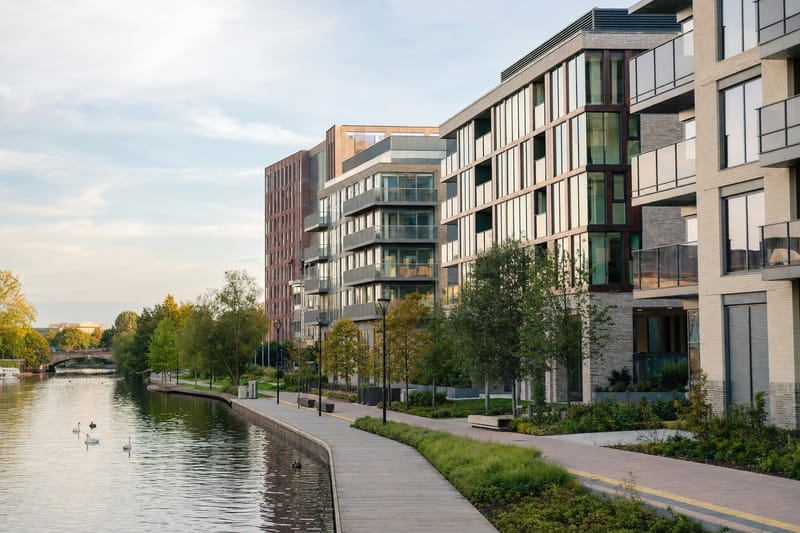
New build homes in Reading have become some of the most sought-after property in the Thames Valley over the past few years, and the reasons are straightforward: the Elizabeth line put the town centre within a 25–30 minute ride of Paddington, a wave of town centre regeneration has replaced tired retail units with apartment blocks and public realm, and major employers in pharma, tech and insurance continue to pull in professionals who need somewhere to live within commuting distance. If you are weighing up Reading new build developments against other Thames Valley towns, or simply trying to work out which part of Reading suits your budget and lifestyle, this guide walks through the areas where new build activity is concentrated, how prices differ between them, and what trade-offs you are actually making.
Reading is not one housing market — it is several overlapping ones. The central Station Hill and Kings Road schemes sell a very different lifestyle to the family estates going up on the southern and eastern fringes around Grazeley, Spencers Wood or the Shinfield growth area, and both are different again from the smaller infill schemes appearing in established suburbs like Caversham or Tilehurst. Reading Borough Council and neighbouring Wokingham Borough Council have both allocated significant greenfield and brownfield land for housing in their current local plans, so supply is reasonably steady, but plot availability and price per square foot vary a great deal depending on how close you are to the station and the river.
This guide covers the main new build hotspots, the commuter case for Reading versus other Thames Valley towns, the schemes that can help with affordability, and the practical things worth checking before you reserve a plot in any Reading development.
Why Reading Is a Major New Build Hotspot
Reading's growth as a new build market rests on three pillars that have held up well even through periods of wider market slowdown.
1. Elizabeth line connectivity
Reading station sits at the western end of the Elizabeth line, giving direct, frequent, air-conditioned services through central London to Canary Wharf and out to Essex without changing trains. Journey times to Paddington are typically around 25–30 minutes on the fastest services, which has materially widened the pool of London-based buyers and renters who now consider Reading a realistic commuter base rather than a fringe option.
2. Town centre regeneration
Reading's borough council has pushed hard on remaking the town centre around the station, with schemes at Station Hill and along Kings Road bringing thousands of new apartments, improved public space, and a shift away from the tired retail-led centre of the 2000s and 2010s. This regeneration has been the single biggest driver of new build supply in the Reading RG1 postcode area.
3. Employment base
Reading and its immediate surroundings host a dense cluster of employers: pharmaceutical and life sciences firms, major technology companies with UK headquarters or large offices along the M4 corridor, and financial and insurance businesses in the town centre and Green Park. This employment base generates consistent local housing demand that is less dependent on London commuting than many other Thames Valley towns, which has helped support new build prices even when wider affordability pressures bite.
| Driver | Effect on new build market |
|---|---|
| Elizabeth line | Shortened and smoothed London commute, widened buyer pool to London-based professionals |
| Station Hill & town centre regeneration | Significant apartment supply in RG1, improved amenity and public realm |
| Thames Valley Business Park / Green Park employers | Local demand independent of London commuting, supports south Reading pricing |
| M4 corridor access | Draws buyers working in Bracknell, Wokingham, Slough and west London |
| University of Reading | Rental demand in Earley and Caversham, some student-adjacent new build schemes |
Reading's new build market is unusual in the Thames Valley for combining a strong London commuter case with a genuinely large local employment base — it does not rely on one or the other.
That said, none of this guarantees uniform growth. Prices and rental demand still vary sharply by postcode, and the pace of new supply in some areas has been fast enough to put pressure on short-term resale premiums. It is worth reading up on how new build resale premiums actually play out in the data before assuming a Reading new build will outperform the secondhand market nearby.
Reading Town Centre and Station Hill: New Build Flats for Commuters
The highest concentration of new build apartments in Reading sits within a 10–15 minute walk of the station, in and around Station Hill, Kings Road, Queens Road and the stretch towards the Oracle shopping centre. This is where most of the schemes marketed heavily on "Elizabeth line access" sit, and it is the natural choice for solo professionals, couples and investors who want minimal commute friction and don't need outdoor space.
What you get
- Walk-to-station living, typically 5–12 minutes on foot depending on the block
- Modern apartment specifications: engineered wood or LVT flooring, integrated appliances, often a concierge or communal amenity space in larger schemes
- Good access to the Oracle for shopping, cafes and the riverside walk along the Kennet
- Service charges that are typically higher than suburban schemes, reflecting lifts, communal areas and sometimes concierge staffing
What to weigh up
- Town centre noise and footfall, particularly near nightlife-heavy streets
- Limited parking allocation on many schemes, often one space per unit or none for one-bedroom flats
- Service charges and ground rent structures vary a lot between developments — always get the leasehold pack reviewed by your conveyancer before exchange
- Resale and rental demand is strong but so is supply, since multiple large schemes have released phases in the same few years
If you are comparing a town centre flat against a house further out, it's worth reading our general guide on how to research a location before buying a new build so you weigh commute time savings against space and service charge trade-offs properly rather than on gut feel.
South Reading: Green Park, Shinfield and the Employment Corridor
South of the town centre, along the A33 towards the M4, Reading has a different kind of new build story. Green Park and the Thames Valley Business Park host major employers, and the housing built around this corridor — stretching down towards Shinfield, Spencers Wood and Three Mile Cross — has been some of the fastest-growing new build activity in the borough over the last decade.
Shinfield and the University of Reading growth area
Large-scale new build communities have been developed around Shinfield, partly on land connected to the University of Reading's estate, bringing several thousand new homes with a mix of apartments, terraces and family houses. This area suits buyers who want a genuinely new neighbourhood — new schools, new local centres, new drainage and road infrastructure — rather than infill into an established street.
Who this area suits
- Families wanting more space and garden for the money than central Reading offers
- Buyers working at or near Green Park, Thames Valley Business Park or the M4 corridor, where a car-based commute of 10–20 minutes is realistic
- Buyers happy to be further from the Elizabeth line station and more dependent on bus links or driving
What to check
- How far build-out is on large multi-phase sites — buying into phase one of a 2,000-home development means years of ongoing construction traffic and noise nearby; see our guide on buying a new build next to an active building site before committing
- Whether local infrastructure (GP capacity, school places, road capacity) has kept pace with the number of homes already completed
- Section 106 and CIL-funded infrastructure timelines — new schools and road improvements are sometimes delivered well after the first residents move in
| Sub-area | Typical profile | Commute style |
|---|---|---|
| Green Park fringe | Apartments and townhouses, employer-adjacent | Short drive or cycle to office parks |
| Shinfield | Large-scale mixed housing, new schools and centres | Car or bus into Reading; station further away |
| Spencers Wood / Three Mile Cross | Family houses, semi-rural edge | Car-dependent, M4 access good |
South Reading is generally the better fit if your household income is weighted towards local or M4-corridor employment rather than a London salary, since you get noticeably more square footage per pound than in RG1.
Riverside Reading: Caversham, Katesgrove and the Kennet and Thames
Reading sits at the confluence of the Thames and the Kennet, and some of its most attractive new build schemes trade on riverside or waterside settings. These sites tend to be smaller, more design-led schemes rather than volume estates, and command a premium accordingly.
Caversham
North of the river, Caversham is one of Reading's more established, leafy suburbs, with good schools and a village-like high street. New build activity here is more limited and tends to come through smaller infill or conversion-adjacent schemes rather than large estates, so availability can be patchy and competitive when it does appear.
Katesgrove and the Kennet-side developments
Closer to the town centre but south of the main shopping streets, areas like Katesgrove have seen new apartment and townhouse schemes built along former industrial land next to the Kennet. These offer a middle ground between full town-centre living and suburban quiet — walkable to the station, but with a slightly calmer residential feel.
Flood risk: the one thing to check carefully
Reading's river confluence means flood risk is a genuine consideration for riverside and low-lying sites, not just a box-ticking exercise. Before reserving on any riverside or Kennet-adjacent plot:
- Check the Environment Agency's flood risk maps for the specific plot, not just the general area
- Ask the developer what flood mitigation was built into the site design (raised ground floors, attenuation ponds, sustainable drainage systems)
- Check buildings insurance availability and indicative premiums before exchange — some riverside new builds carry higher premiums than buyers expect
- Review the site's drainage strategy in the planning documents, which are public via the council's planning portal
Riverside premium schemes typically sit above the town centre average on a per-square-foot basis, so weigh the lifestyle appeal against the practical flood and insurance checks before paying extra for the view.
Woodley, Earley and Lower Earley: Family Suburbs With New Build Pockets
East of Reading town centre, Woodley, Earley and Lower Earley form a well-established band of suburban housing with good schools and easy access to both the town centre and the M4 via the A329(M). New build supply here tends to be smaller infill schemes and occasional larger sites on former commercial or institutional land, rather than the scale of development seen in south Reading.
Why buyers choose this corridor
- Strong reputation for primary and secondary schools, a major draw for family buyers
- Reading station reachable by car or bus in 10–20 minutes, with Earley's own rail station offering a direct, if less frequent, service
- Established amenities: parks, sports clubs, supermarkets, and a settled community feel that newer greenfield estates take years to develop
- Proximity to the University of Reading campus, useful if a household member studies or works there
What to expect from new build stock here
Because land is scarcer and more fragmented than on the southern greenfield sites, new build schemes in Woodley and Earley tend to be smaller — a handful of houses or a low-rise apartment block rather than a thousand-home masterplan. This generally means less construction disruption once you move in, but also fewer plots to choose from and faster sell-out on good schemes.
| Area | New build character | Best suited to |
|---|---|---|
| Woodley | Smaller infill schemes, established amenities | Families wanting settled neighbourhoods |
| Earley | Mixed infill, own rail station, university proximity | Families and academic/university-linked buyers |
| Lower Earley | 1990s-2000s estate character with occasional new infill | Buyers wanting value and space, less reliant on brand-new stock |
If school catchment is a priority, verify the specific catchment and admissions criteria directly with Reading Borough Council or Wokingham Borough Council (Earley straddles both local authority areas in places), since catchment boundaries can shift and are not always obvious from a development's marketing material.
West Reading: Tilehurst, Calcot and Theale
West of the town centre, Tilehurst, Calcot and Theale offer a generally more affordable entry point into the Reading new build market, with a mix of established suburban streets and newer development around Theale's village centre and the A4 corridor.
Tilehurst
Tilehurst has its own rail station on the line into Reading and onward to Paddington, making it a reasonable commuter base without town centre prices. New build activity here is mostly smaller infill, with occasional larger sites where former institutional or industrial land has been released.
Calcot
Calcot sits just off the A4 and offers good road access towards the M4 at Junction 12, along with a well-known retail park. New build stock is limited but tends to be family-oriented houses rather than apartments.
Theale
Theale, technically in West Berkshire rather than Reading Borough, has seen more significant new build activity thanks to its own rail station and village-plus-commuter character. It offers a quieter, more rural-feeling base while still being within easy reach of Reading and the M4.
| Area | Station access | Typical price positioning |
|---|---|---|
| Tilehurst | Own station, direct to Reading and Paddington line | Below Reading town centre average |
| Calcot | No station; bus or car into Reading | Mid-range, family house focus |
| Theale | Own station on the Reading–Newbury/Paddington line | Mid-to-upper, village commuter premium |
West Reading generally suits buyers prioritising value and willing to trade some town centre convenience for lower prices and a quieter setting, while still keeping a workable commute into Reading or London.
Wokingham Borders: Winnersh, Arborfield and Barkham
Immediately south-east of Reading, within Wokingham Borough rather than Reading Borough, a cluster of large new build communities has grown up around Arborfield Garrison, Barkham and Winnersh. Wokingham's local plan has directed significant housing growth to these former Ministry of Defence and greenfield sites, making this one of the busiest new build corridors in the wider Reading commuter belt.
Arborfield Garrison
The redevelopment of the former army garrison has brought thousands of new homes, new schools and new local centres to what was previously closed military land. This is a genuinely new settlement in planning terms, built largely from scratch, which means consistent build quality within each phase but also a longer wait for mature amenities, established transport links and a settled community feel.
Winnersh
Winnersh has its own station and sits on the Reading–Guildford line, plus good access to the M4 via the Winnersh Triangle business area, which itself hosts employers that reduce the need to commute into Reading or London at all.
Barkham
A quieter, more rural setting between Wokingham and Arborfield, with smaller-scale new build schemes compared to the garrison redevelopment.
This corridor tends to offer more new build choice and slightly larger plots than equivalent-priced options closer to Reading town centre, at the cost of a longer and more car-dependent journey to the Elizabeth line station.
Reading Commuter Links: How the Elizabeth Line Changes the Maths
For many buyers, the single biggest factor in choosing a Reading new build over options in Oxford, Basingstoke or further out along the M4 is the commute into London. The Elizabeth line's arrival at Reading station has genuinely shortened and smoothed that journey, but it is worth being precise about what it offers rather than relying on marketing shorthand.
| Destination | Typical journey time from Reading station | Notes |
|---|---|---|
| London Paddington | Around 25–30 minutes on fast services | Elizabeth line and GWR mainline both serve this route; always check live timetables as service patterns change |
| Canary Wharf / City | Around 50–60 minutes, one direct Elizabeth line journey | No change needed, a key improvement over the pre-Elizabeth line era |
| Heathrow Airport | Around 30–40 minutes via connecting services | Useful for frequent flyers, though not a single direct Elizabeth line journey from Reading in all cases — check current routing |
| M4 Junction 11 / 12 | 10–15 minutes by car from most Reading new build areas | Journey times vary significantly at peak times |
What this means for new build pricing
Developments within easy walking distance of Reading station command a clear premium over otherwise comparable schemes a 15–20 minute drive away, because the station access is the single most marketable feature for London-linked buyers. This premium has narrowed slightly as more town centre supply has come to market, but it remains a consistent pattern across Reading's new build schemes.
If your work pattern is hybrid rather than five-days-a-week in London, it is worth running the actual numbers on how many premium pounds per square foot you are paying for walk-to-station convenience versus a slightly longer but still manageable bus or short drive commute from south or west Reading. For a wider look at how rail-linked locations are priced across the UK new build market, see our guide on new build homes near major commuter rail links.
Reading New Build Prices: Area-by-Area Comparison
New build pricing across Reading's various districts reflects the mix of station proximity, land values and typical property type. The figures below are indicative starting points as of 2026 for comparison purposes only — always check current price lists for the specific development and plot, since phased releases, Help to Buy's closure, and interest rate movements have all affected pricing patterns over recent years.
| Area | Typical new build type | Indicative starting price (2026) |
|---|---|---|
| Town centre (RG1, Station Hill area) | 1–2 bed apartments | £250,000–£450,000 |
| Katesgrove / Kennet-side | Apartments and townhouses | £300,000–£500,000 |
| Caversham | Limited infill houses/flats | £350,000–£650,000+ |
| South Reading / Shinfield | 3–4 bed houses | £380,000–£600,000 |
| Woodley / Earley | Mixed infill houses | £350,000–£550,000 |
| Tilehurst / Calcot | Family houses | £300,000–£480,000 |
| Theale | Village commuter houses | £380,000–£600,000 |
| Arborfield / Winnersh / Barkham | Large-scale family housing | £350,000–£650,000 |
Treat every figure in this table as a starting point for research, not a quote. New build pricing moves quickly with each phase release, help-to-buy-style incentives (where offered by the developer directly), and part-exchange deals, so the only reliable number is the one on the current plot price list.
Price per square foot matters more than headline price
A £320,000 two-bedroom flat in a cramped town centre block is not automatically better value than a £340,000 two-bedroom house with a garden in Calcot. Always ask for the internal floor area in square metres or square feet, not just the headline price and bedroom count, and compare like-for-like. Our guide on reading a new build floor plan before you reserve covers exactly how to do this properly.
Affordability Schemes for Reading New Build Buyers
With Help to Buy closed to new applications across England, Reading buyers looking for support with a new build purchase now need to look at the schemes that remain active, and check eligibility carefully against each development, since not every scheme applies to every site.
Shared Ownership
Several Reading and Wokingham new build schemes offer Shared Ownership through housing associations, letting you buy an initial share — typically starting around 10–75% depending on the provider's current rules — and pay subsidised rent on the remainder, with the option to staircase up over time. This is often the most realistic route into Reading town centre new build stock for buyers who would otherwise be priced out.
First Homes
The First Homes scheme, where included in a development's planning permission, offers a discount of typically 30% (sometimes more, depending on the local plan policy) against market value for first-time buyers meeting local eligibility criteria, usually including a household income cap and a local connection test. Availability depends entirely on individual planning permissions, so ask the developer directly whether a given scheme includes First Homes plots.
Deposit Unlock and mortgage guarantee-style schemes
Some developers participate in Deposit Unlock, a lender-and-builder-backed scheme allowing smaller deposits on new build purchases with mortgage products designed around that lower deposit. Availability varies by builder and by mortgage lender panel, so check which schemes a specific Reading developer currently supports.
Lifetime ISA
First-time buyers saving towards a Reading new build can use a Lifetime ISA to get a 25% government bonus on savings up to the current annual limit, provided the property price stays under the scheme's national price cap, which applies uniformly across England regardless of Reading's relatively high local prices.
| Scheme | Best suited to | Key check |
|---|---|---|
| Shared Ownership | Buyers needing a lower initial outlay | Confirm rent, service charge and staircasing terms |
| First Homes | Local first-time buyers under income cap | Confirm the specific development includes First Homes plots |
| Deposit Unlock | Buyers with a smaller deposit (5–10%) | Confirm builder and lender both participate |
| Lifetime ISA | First-time buyers under the national price cap | Check Reading property prices against the cap carefully |
Because scheme rules and funding allocations change, always verify current eligibility and figures directly with Gov.uk, the relevant housing association, or the developer's sales team before budgeting around any specific scheme.
Who Should Buy Where: Matching Areas to Buyer Types
Reading's new build market is varied enough that the "best area" question really depends on who is asking. Here is a practical breakdown by buyer profile.
London-commuting professionals, no children
Town centre Station Hill and Kings Road apartments are the natural fit, prioritising walk-to-station time over space. Katesgrove and Kennet-side schemes offer a slightly calmer alternative within a similar walking radius.
Growing families wanting space and schools
South Reading (Shinfield), Woodley, Earley and the Wokingham border developments (Arborfield, Winnersh, Barkham) tend to offer the best combination of house size, garden space and access to good schools, at the cost of a longer journey to the station.
Buyers prioritising value over location
Tilehurst, Calcot and the outer edges of south Reading generally offer the lowest entry prices for new build stock while still keeping a workable commute into Reading town centre and the M4.
Hybrid workers splitting time between home and office
A location a short drive or bus ride from the station — rather than directly on top of it — often makes more financial sense, since you are not paying a daily-commute premium for a journey you only make two or three times a week. South and west Reading suburbs fit this profile well.
Buy-to-let investors
Town centre one and two-bedroom flats tend to see the strongest rental demand, driven by the university, local employers and the Elizabeth line's appeal to young professionals. Investors should still run the numbers on service charges and ground rent, which eat into net yield more in apartment blocks than in houses.
| Buyer type | Best-fit area(s) |
|---|---|
| Young professional, London-linked | Station Hill, Kings Road, Katesgrove |
| Family, school-focused | Woodley, Earley, Shinfield, Arborfield |
| Value-focused buyer | Tilehurst, Calcot, outer south Reading |
| Hybrid worker | Winnersh, Theale, west Reading |
| Buy-to-let investor | Town centre apartments near the station |
Practical Checks Before You Reserve a Plot in Reading
Beyond choosing the right area, a handful of practical checks apply to almost any Reading new build purchase, regardless of which developer or scheme you are considering.
Check the build-out timeline
On large multi-phase developments — common across south Reading and the Wokingham border sites — ask how many phases remain and over what timeframe. Buying into an early phase of a development planned to run for another five to ten years means living alongside construction traffic, site compounds and incomplete amenities for a long time.
Confirm the warranty provider
Almost all new build homes in Reading will come with a structural warranty from NHBC, LABC Warranty, Premier Guarantee or a similar provider, typically covering 10 years. Check which provider applies to your specific plot and understand what is covered in years one to two versus years three to ten, since the developer's own defects liability period is usually much shorter than the full warranty term.
Check New Homes Quality Board coverage
The New Homes Quality Board and its associated Code apply to developers who have signed up, giving buyers a formal complaints route and clearer pre-sale information standards. Check whether your chosen Reading developer is a registered member, and understand how this differs from or complements the older Consumer Code for Home Builders.
Get an independent snagging inspection
Whichever area of Reading you buy in, an independent snagging survey before and shortly after legal completion is worth the modest cost relative to the value of the property. See our detailed breakdown of what a professional snagging survey costs and whether it's worth it for a realistic view of pricing and what to expect.
Review the management company and service charge estimate
Most larger Reading developments, whether apartment blocks in the town centre or house-based estates in Shinfield and Arborfield, come with an estate management company charging an annual fee for communal landscaping, play areas, and sometimes SUDS (sustainable drainage) maintenance. Ask for the current charge and a realistic projection for future years, since these fees tend to rise as landscaping matures and as more phases complete.
Which Developers Are Building in Reading?
Reading's new build pipeline includes a mix of large volume housebuilders delivering the bigger greenfield sites and smaller, more design-focused developers working on infill and regeneration plots in the town centre. Neither type is automatically "better" — they simply trade off differently on price, specification, build speed and aftercare.
Volume housebuilders
The large national housebuilders are typically behind the bigger multi-phase estates in Shinfield, Arborfield and the Wokingham border, where scale, standardised house types and established supply chains let them deliver hundreds of homes over several years. Specification tends to be solid and consistent, pricing is usually transparent via published price lists, and incentives (part-exchange, deposit contributions) are more commonly available than on smaller schemes.
Regional and boutique developers
Smaller, more design-conscious developers are more often behind the town centre apartment schemes and riverside infill sites, where a smaller number of units justifies a higher specification finish and sometimes more architectural ambition. These schemes can offer a more distinctive product but with less standardisation between developments, meaning more variation in quality and aftercare between one scheme and the next.
For a fuller comparison of how these two types of builder differ in practice — from build quality and aftercare to pricing flexibility — see our guide on volume housebuilders versus boutique developers.
| Developer type | Typical Reading locations | Strengths | Watch-outs |
|---|---|---|---|
| Volume housebuilder | Shinfield, Arborfield, Winnersh, Barkham | Scale, incentives, standardised NHBC-backed build | Long multi-phase build-out, less individuality |
| Regional/boutique developer | Town centre, Katesgrove, Caversham infill | Design quality, smaller more considered schemes | Variable aftercare, less price flexibility |
Whichever type of developer you buy from, check their track record on previous Reading or nearby Thames Valley schemes specifically — a strong national reputation does not always translate evenly across every regional office or site team.
Frequently Asked Questions
Are new build homes in Reading more expensive than the local resale market?
New build typically commands a premium over comparable secondhand homes nearby, reflecting the cost of warranties, energy efficiency and being first to live in the property. The size of that premium varies by area and has narrowed in some parts of the market as new build supply has increased. Check sold price data for both new and secondhand stock in your target streets before assuming the gap is as wide as national averages suggest.
Is Reading a good location for new build buy-to-let investment?
Reading's combination of Elizabeth line access, a large local employment base and a significant student and young professional population supports consistent rental demand, particularly for one and two-bedroom town centre apartments. As with any investment, run the numbers on service charges, ground rent, mortgage costs and realistic void periods before committing, rather than relying on headline yield figures from a developer's marketing material.
How long does the Elizabeth line journey from Reading to central London actually take?
Fast services to London Paddington typically take around 25–30 minutes, with direct Elizabeth line services through to Canary Wharf taking roughly 50–60 minutes without changing trains. Always check live timetables, since service patterns and stopping calls vary by time of day.
Which part of Reading has the best schools for a family buying new build?
Caversham, Woodley and Earley have strong reputations for primary and secondary provision, and some of the larger new communities such as Shinfield and Arborfield Garrison have had new schools built as part of their planning obligations. Catchment areas shift over time, so verify current admissions criteria directly with Reading Borough Council or Wokingham Borough Council rather than relying on a developer's marketing claims.
Do any Reading new build developments offer Shared Ownership or First Homes?
Many of the larger schemes, particularly in south Reading and the Wokingham border growth areas, include an affordable housing element delivered through Shared Ownership or, where included in the planning permission, First Homes. Availability and eligibility criteria vary by site, so ask the developer or the relevant housing association directly rather than assuming every scheme offers every option.
Is flood risk a real concern for new build homes in Reading?
It is a genuine consideration for sites near the Thames and Kennet rivers, though modern developments on previously flood-affected land are generally built with sustainable drainage and raised floor levels as planning conditions. Check the Environment Agency's flood maps for the specific plot and confirm buildings insurance availability and indicative cost before exchanging contracts.
How does buying new build in Reading compare with Wokingham, Bracknell or Basingstoke?
Reading generally commands a premium over Bracknell and Basingstoke thanks to the Elizabeth line and its larger town centre amenity base, while Wokingham sits close to Reading on price but with a more suburban, less apartment-heavy new build mix. The right comparison depends heavily on your commute pattern and whether town centre lifestyle or more space for your money matters more to your household.
Should I worry about buying into an early phase of a large Reading development?
Early-phase purchases can mean living alongside years of ongoing construction, incomplete amenities and shifting show home locations, but they sometimes come with lower prices before later phases are marketed at a premium. Weigh the discount against the disruption, and ask the developer for a realistic build-out schedule rather than a best-case estimate.
Next Steps
If Reading looks like the right fit after weighing up the areas, prices and commuter trade-offs above, the next step is to get into the detail of specific developments and plots rather than relying on general area reputation.
- Browse live developments across Reading and the surrounding Thames Valley to compare current phases, price lists and specifications side by side.
- Check which builders are active on the schemes you're interested in, and look into their track record on previous local sites.
- Search current new build properties for sale by bedroom count, price and area to shortlist realistic options within budget.
- Use the map to see exactly how far each development sits from Reading station, the M4 junctions, and the schools or employers that matter to you.
- Run the numbers with our tools, including mortgage affordability and moving cost calculators, before you commit to a reservation fee.
- Use compare to put two or three shortlisted Reading developments side by side on price per square foot, specification and warranty provider.
Reading's new build market rewards buyers who do the area-by-area homework rather than choosing on the strength of a single show home visit. Station proximity, flood risk, build-out timelines and which local authority a site falls under all materially affect what you are actually buying — take the time to check each one before you reserve.