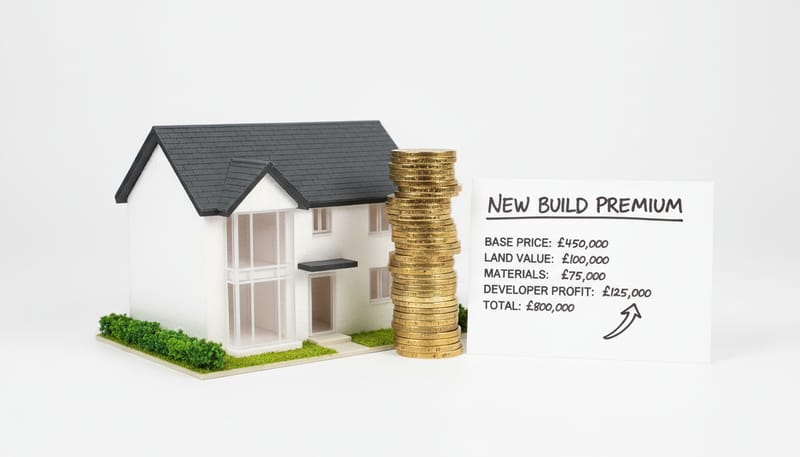
The New Build Premium: What It Is and Where It Comes From
The "new build premium" is the difference in price between a newly built property and a comparable existing property in the same area. It's not a fixed percentage — it varies by region, property type, and market conditions.
Current Premium Levels by Property Type
| Property Type | Typical New Build Price | Comparable Existing Price | Premium (£) | Premium (%) |
|---|---|---|---|---|
| 1-2 bed apartment (city) | £230,000 | £195,000 | £35,000 | 18% |
| 3-bed semi-detached | £320,000 | £275,000 | £45,000 | 16% |
| 4-bed detached | £450,000 | £390,000 | £60,000 | 15% |
| 2-bed terraced | £250,000 | £215,000 | £35,000 | 16% |
These are national averages. In some areas — particularly where new build supply is limited or demand is high — the premium can exceed 25%. In areas with abundant new build supply or weaker markets, it can be as low as 5-10%.
What You're Paying For
The premium isn't pure profit for the developer. It reflects genuine cost differences:
| Component | Share of Premium | Explanation |
|---|---|---|
| Building Regulations compliance | 25-30% | Current energy standards (Part L 2021), fire safety, accessibility, and acoustic requirements cost more than older construction methods |
| Developer profit margin | 20-25% | Developers target 15-20% profit on revenue; this is their business model |
| Marketing and sales costs | 10-15% | Show homes (£250,000+ each), sales centres, marketing materials, sales staff commissions |
| Section 106 / CIL contributions | 10-15% | Developer payments to local councils for infrastructure, affordable housing, schools, roads |
| Land cost recovery | 15-20% | Developers pay current market rate for land, which has increased significantly |
| Warranty and aftercare | 3-5% | NHBC registration, defect period obligations, customer service operations |
Understanding this breakdown matters because some of these costs deliver direct value to you (energy efficiency, warranties, safety standards) while others don't (marketing, profit margin). The question is whether the value you receive justifies the total premium.
The Hidden Costs of Buying an Older Property
When comparing prices, buyers often focus on the purchase price alone. But older properties carry costs that new builds don't — and these can add up quickly.
Immediate Costs (Year 1)
| Item | Typical Cost | How Common? |
|---|---|---|
| Redecoration (full house) | £3,000 – £8,000 | Very common — most buyers redecorate |
| New carpets/flooring | £2,000 – £6,000 | Common |
| Kitchen update or replacement | £5,000 – £15,000 | Common if kitchen is dated |
| Bathroom update or replacement | £3,000 – £8,000 | Common |
| Garden clearance and landscaping | £1,000 – £5,000 | Occasional |
| Damp treatment | £2,000 – £8,000 | Occasional — depends on survey findings |
Medium-Term Costs (Years 1-10)
| Item | Typical Cost | Likelihood in 10 Years |
|---|---|---|
| Boiler replacement | £2,500 – £4,500 | High if existing boiler is 10+ years old |
| Roof repairs | £3,000 – £15,000 | Moderate — depends on age and condition |
| Window replacement (full house) | £5,000 – £12,000 | Moderate if windows are 20+ years old |
| Rewiring | £3,000 – £5,500 | Moderate if wiring is pre-2000 |
| External rendering/pointing | £3,000 – £8,000 | Low to moderate |
| Central heating system replacement | £3,500 – £7,000 | Low to moderate |
| Drainage repairs | £2,000 – £6,000 | Low |
Not every older property needs all of these — some are in excellent condition. But on average, buyers of existing properties should budget £1,500-£3,000 per year for maintenance and repairs over the first decade, compared to £200-£500 for a new build.
Total Cost of Ownership: The Framework
To properly compare new build and existing property costs, we need to calculate the total cost of ownership (TCO). This includes every cost of buying and owning the home over the period:
| Cost Category | Included Items |
|---|---|
| Purchase costs | Purchase price, stamp duty, legal fees, survey fees, mortgage arrangement fees |
| Mortgage costs | Monthly mortgage payments over the period (capital + interest) |
| Energy costs | Annual gas, electricity, and water bills |
| Maintenance | Repairs, replacements, general upkeep |
| Insurance | Buildings insurance (contents insurance is comparable so excluded) |
| Service charges | Estate management fees (where applicable) |
| Renovation costs | Any significant works done to the property |
| Council tax | Excluded — typically the same band for comparable properties |
The following three worked examples use realistic 2025-2026 figures, a mortgage rate of 4.5% (fixed for 5 years, assumed rate over full period), and 3% annual energy inflation.
Worked Example 1: Starter Apartment (First-Time Buyer)
A first-time buyer choosing between a new build 2-bed apartment and an existing 2-bed apartment in the same area.
Purchase Comparison
| Item | New Build (£230,000) | Existing (£195,000) |
|---|---|---|
| Purchase price | £230,000 | £195,000 |
| Stamp duty (FTB relief) | £0 | £0 |
| Legal fees | £1,500 | £1,500 |
| Survey | £0 (warranty covers) | £500 |
| Mortgage arrangement fee | £999 | £999 |
| Total upfront costs | £232,499 | £197,999 |
| Premium paid | £34,500 | |
10-Year Running Costs
| Annual Cost | New Build | Existing |
|---|---|---|
| Mortgage payments (90% LTV, 4.5%, 30yr) | £12,588/yr (£1,049/mo) | £10,656/yr (£888/mo) |
| Energy bills | £900/yr | £1,500/yr |
| Service charge | £2,000/yr | £1,600/yr |
| Buildings insurance | £250/yr | £350/yr |
| Maintenance and repairs | £300/yr average | £1,500/yr average |
| Initial renovation (year 1) | £0 | £6,000 |
| Total annual (after year 1) | £16,038 | £15,606 |
10-Year Total Cost of Ownership
| Category | New Build | Existing |
|---|---|---|
| Purchase and upfront costs | £232,499 | £197,999 |
| Mortgage payments (10 years) | £125,880 | £106,560 |
| Energy (10 years, with 3% annual inflation) | £10,318 | £17,196 |
| Service charges (10 years, 4% annual increase) | £24,012 | £19,210 |
| Insurance (10 years) | £2,500 | £3,500 |
| Maintenance (10 years) | £3,000 | £15,000 |
| Initial renovation | £0 | £6,000 |
| Total 10-year cost | £398,209 | £365,465 |
| Difference | £32,744 more for new build | |
Verdict: For a starter apartment, the new build costs around £32,700 more over 10 years. The running cost savings (£25,766 lower energy, maintenance, and insurance) offset much of the £34,500 purchase premium, but not quite all of it. The remaining cost difference is modest — about £273 per month extra, which buys you a warranty, newer fixtures, and lower stress. Whether that's worth it depends on your budget tolerance and how you value certainty.
Worked Example 2: 3-Bed Family Semi
A family choosing between a new build 3-bed semi-detached house and an existing 1990s 3-bed semi in the same area.
Purchase Comparison
| Item | New Build (£320,000) | Existing (£275,000) |
|---|---|---|
| Purchase price | £320,000 | £275,000 |
| Stamp duty (not FTB) | £6,000 | £3,750 |
| Legal fees | £1,800 | £1,800 |
| Survey (HomeBuyer's Report) | £0 | £700 |
| Mortgage arrangement fee | £999 | £999 |
| Total upfront costs | £328,799 | £282,249 |
| Premium paid | £46,550 | |
10-Year Running Costs
| Annual Cost | New Build | Existing (1990s) |
|---|---|---|
| Mortgage payments (85% LTV, 4.5%, 25yr) | £16,344/yr (£1,362/mo) | £14,028/yr (£1,169/mo) |
| Energy bills | £1,100/yr | £1,800/yr |
| Service charge (estate management) | £350/yr | £0 (adopted roads) |
| Buildings insurance | £300/yr | £450/yr |
| Maintenance and repairs | £400/yr average | £2,200/yr average |
| Initial renovation (year 1) | £0 | £8,000 (kitchen, bathroom, decoration) |
| Major works (years 1-10) | £0 | £6,500 (boiler, windows section) |
10-Year Total Cost of Ownership
| Category | New Build | Existing |
|---|---|---|
| Purchase and upfront costs | £328,799 | £282,249 |
| Mortgage payments (10 years) | £163,440 | £140,280 |
| Energy (10 years, 3% inflation) | £12,611 | £20,634 |
| Service charges (10 years) | £4,200 | £0 |
| Insurance (10 years) | £3,000 | £4,500 |
| Maintenance (10 years) | £4,000 | £22,000 |
| Renovation and major works | £0 | £14,500 |
| Total 10-year cost | £516,050 | £484,163 |
| Difference | £31,887 more for new build | |
Verdict: The new build 3-bed semi costs around £31,900 more over 10 years. The running cost savings are substantial — £37,823 lower energy, maintenance, insurance, and renovation costs. This almost entirely closes the £46,550 purchase premium gap. The remaining difference works out to around £266 per month. For a family, the warranty protection and absence of renovation disruption may well justify this.
Extending to 25 Years
Over 25 years, the equation changes dramatically. The existing property will need:
- A second boiler replacement: £4,000
- Full window replacement: £8,000
- Potential rewiring: £4,500
- Second kitchen renovation: £10,000
- Bathroom renovation: £6,000
- External work (rendering, roofing): £10,000
- Ongoing higher maintenance: additional £1,800/year for years 11-25
Total additional 25-year maintenance for existing property: approximately £69,500 more than the new build (which will also need some work from year 10 onwards, but starting from a newer baseline).
Over 25 years, the total cost difference narrows to within £5,000-£10,000 — and in many scenarios, the new build becomes the cheaper option when all costs are included. The premium effectively pays for itself.
Worked Example 3: 4-Bed Detached House
An upgrader choosing between a new build 4-bed detached house and an existing 2000s 4-bed detached in the same area.
Purchase Comparison
| Item | New Build (£450,000) | Existing 2000s (£390,000) |
|---|---|---|
| Purchase price | £450,000 | £390,000 |
| Stamp duty | £12,500 | £9,500 |
| Legal fees | £2,200 | £2,200 |
| Survey | £0 | £900 |
| Mortgage arrangement fee | £999 | £999 |
| Total upfront costs | £465,699 | £403,599 |
| Premium paid | £62,100 | |
10-Year Total Cost of Ownership
| Category | New Build | Existing (2000s) |
|---|---|---|
| Purchase and upfront costs | £465,699 | £403,599 |
| Mortgage payments (10 years, 80% LTV) | £219,120 | £189,840 |
| Energy (10 years, 3% inflation) | £14,903 | £20,634 |
| Service charges (10 years) | £4,800 | £2,000 |
| Insurance (10 years) | £3,500 | £4,500 |
| Maintenance (10 years) | £5,000 | £18,000 |
| Renovation and major works | £0 | £8,000 |
| Total 10-year cost | £713,022 | £646,573 |
| Difference | £66,449 more for new build | |
Verdict: For a 4-bed detached, the new build costs £66,400 more over 10 years. The running cost savings (£25,931) only cover about 40% of the £62,100 premium because the existing property is relatively modern (2000s) and doesn't need the expensive repairs an older home would. When buying against a reasonably modern existing home, the new build premium is harder to justify financially.
This comparison would look very different if the existing property were Victorian or 1960s — the energy and maintenance savings would be much larger, potentially closing or eliminating the gap entirely.
How the Premium Varies by Region
The new build premium isn't uniform across the UK. Where you buy significantly affects whether the premium is worth paying.
| Region | Typical New Build Premium | Why | Premium Recovery Speed |
|---|---|---|---|
| London | 15-25% | High land costs, complex planning, expensive construction | Slower — existing stock holds value well |
| South East | 15-20% | Strong demand, limited land supply | Moderate |
| South West | 12-18% | Mixed — varies significantly by town | Moderate |
| East Midlands | 10-15% | More affordable base prices, good supply | Faster — lower premium to recover |
| West Midlands | 12-18% | Birmingham regeneration drives premium | Moderate to fast |
| North West | 10-15% | Good supply, competitive market | Faster |
| Yorkshire | 10-15% | Affordable base, growing demand | Faster |
| North East | 8-12% | Lower demand, more competitive pricing | Fastest — smallest premium to recover |
| Scotland | 10-15% | Different tax system (LBTT), good supply in central belt | Moderate |
| Wales | 10-15% | Lower base prices, reasonable supply | Moderate to fast |
The general pattern: the higher the base price, the larger the absolute premium — and the longer it takes for running cost savings to compensate. In the North East, a 10% premium on a £200,000 home (£20,000 extra) can be recovered through energy and maintenance savings in 8-12 years. In London, a 20% premium on a £500,000 home (£100,000 extra) may never be fully recovered through running costs alone.
The Breakeven Point: When Does the Premium Pay for Itself?
The breakeven point is when cumulative running cost savings equal the purchase premium. After this point, the new build becomes the cheaper option.
| Scenario | Premium Paid | Annual Running Savings | Breakeven Point |
|---|---|---|---|
| New build vs Victorian terrace | £40,000 | £3,500-£4,500 | 9-11 years |
| New build vs 1960s semi | £45,000 | £2,800-£3,500 | 13-16 years |
| New build vs 1990s house | £40,000 | £1,800-£2,500 | 16-22 years |
| New build vs 2000s house | £35,000 | £1,200-£1,800 | 19-29 years |
| New build apartment vs existing apartment | £35,000 | £1,500-£2,200 | 16-23 years |
Key insight: The older the existing property you're comparing against, the faster the premium pays for itself. Buying a new build instead of a Victorian home is a much better financial proposition than buying a new build instead of a 2000s home.
When the New Build Premium Is NOT Worth Paying
Based on the cost analysis, the premium is hardest to justify when:
- The existing alternative is relatively modern (2000s or later): The energy and maintenance savings are too small to close the premium gap within a reasonable ownership period
- You're in a high-price area: A 20% premium on a £500,000+ property means £100,000+ extra — running cost savings simply can't compensate at this scale
- You plan to move within 5-7 years: You won't stay long enough for running cost savings to accumulate, and you'll face premium deflation when selling
- The existing property is in excellent condition: A well-maintained older home with a recent boiler, good windows, and updated electrics eliminates many of the running cost advantages
- The new build has high service charges: Annual service charges of £3,000+ on a new build can actually make it more expensive to run than a freehold existing home
- You're comfortable with DIY: If you can do basic maintenance and decoration yourself, the running cost savings of a new build are reduced
When the New Build Premium IS Worth Paying
The premium makes strongest financial sense when:
- The existing alternative is pre-1980s: Older properties have dramatically higher energy costs and maintenance needs — the premium can pay for itself within a decade
- You plan to stay 10+ years: Long-term ownership allows running cost savings to accumulate and market growth to absorb the premium
- You're buying in an affordable region: Lower premiums (8-12% on sub-£250,000 homes) recover faster through savings
- Energy efficiency is a priority: If you're on a tight monthly budget, £50-£100/month lower energy bills make a real difference to quality of life
- You want certainty: The warranty and predictable costs of a new build have a real financial value — avoiding a surprise £8,000 roof repair is worth something, even if it's hard to quantify
- The developer is offering strong incentives: A 5% deposit contribution, stamp duty paid, and a £10,000 upgrade package can effectively reduce the premium by £15,000-£25,000
- You'd need to renovate the existing property: If the alternative would need £15,000-£25,000 of work before it meets your standards, the effective premium is much smaller than the headline difference
How to Reduce the Premium You Pay
The purchase price isn't always fixed. There are legitimate ways to reduce the new build premium.
Negotiation Strategies
| Strategy | Potential Saving | When It Works Best |
|---|---|---|
| Buy late in a phase | 3-8% discount | When developer needs to clear remaining plots before starting next phase |
| Buy the last few plots | 5-10% discount | Developer wants to close out the site and move on |
| Buy at financial year end | 2-5% via incentives | Developers (especially PLC builders) need to hit annual targets |
| Negotiate during slow market | 5-10% | When sales rates drop and developers need to move stock |
| Ask for price reduction instead of incentives | Variable | A lower price beats free flooring because it reduces your mortgage and stamp duty |
| Buy off-plan in early phase | 5-15% vs later phases | Developer offers launch pricing to generate early sales momentum |
What to Prioritise
If the developer won't reduce the price, prioritise incentives that save you real money:
- Stamp duty paid — saves actual cash you'd have to find
- Flooring throughout — costs £3,000-£6,000 if you do it yourself
- Turf and fencing — a genuine day-one cost you'd face anyway
- Upgraded kitchen appliances — worth it if the upgrade is to a significantly better brand
- Additional electrical sockets/points — cheap during construction, expensive to retrofit
Avoid overvaluing incentives that sound generous but have limited practical value, such as furniture packs (often low quality) or "free legal fees" (which may lock you into the developer's preferred solicitor).
Summary: Is a New Build Home More Expensive?
| Measure | New Build | Existing | Winner |
|---|---|---|---|
| Purchase price | 10-20% higher | Lower | Existing |
| Energy bills | £800-£1,200/yr | £1,200-£2,800/yr | New build |
| Maintenance (years 1-10) | £200-£500/yr | £1,500-£3,000/yr | New build |
| Insurance | Lower premiums | Higher premiums | New build |
| Service charges | Often applies | Usually none (houses) | Existing |
| Renovation needed | None | Often £5,000-£20,000 | New build |
| 10-year total cost | Higher (by £30-£66k) | Lower | Existing (usually) |
| 25-year total cost | Comparable or lower | Comparable or higher | Often a draw or new build |
The bottom line: New build homes are more expensive to buy, comparable to existing homes over 10 years when all costs are included, and often cheaper over 25 years. The premium is most justified when buying against an older property (pre-1980s), in an affordable region, and with a plan to stay long-term. It's least justified when buying against a modern existing home, in a high-price area, or with a short-term ownership horizon.
Related Guides
- New Build vs Existing Home: The Definitive UK Comparison — 15-factor comparison beyond just price
- Should You Buy a New Build? Decision Guide by Buyer Type — personalised assessment for FTBs, families, downsizers, investors, and relocators
- Do New Build Homes Hold Their Value? — premium deflation, resale timeline, and strategies to maximise value
- Buying Off-Plan: The Complete Guide — process, contracts, and how to protect yourself