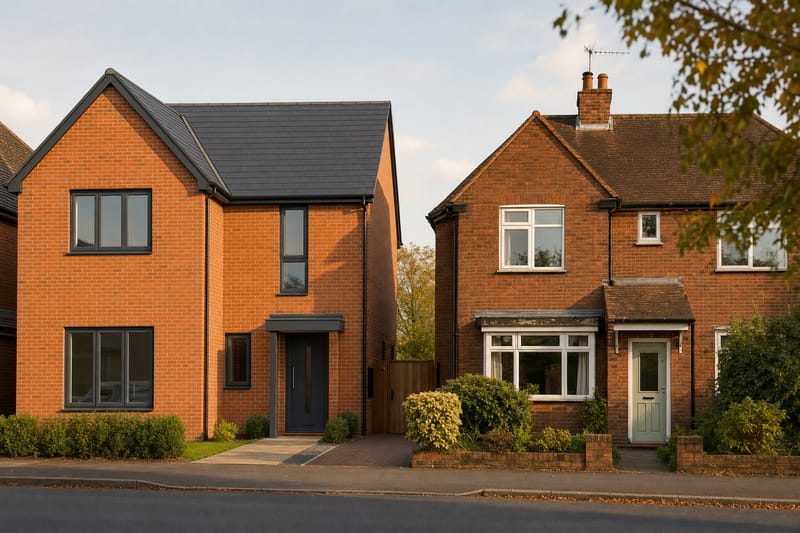
If you've been looking at new build homes, you've probably heard some version of this warning: "new builds lose value the moment you move in." It's one of the most repeated claims in UK property circles, usually delivered with total confidence and almost never backed by an actual figure. The reality, as shown by the available sales data, is more nuanced — and considerably more useful to a buyer trying to make a sound decision.
There is a genuine new build resale premium: new homes typically sell for more per square foot than comparable second-hand homes in the same area. What happens to that premium over time — whether it holds, shrinks, or disappears — depends heavily on region, property type, how long you keep the home, and decisions made by the original developer long after you've exchanged contracts. This article works through what the market data actually shows, rather than relying on the secondhand anecdotes that dominate forums and dinner-party conversation.
Two things are true at once, and both matter for your decision:
- New build buyers do typically pay more upfront than they would for an equivalent-aged or equivalent-sized resale property nearby.
- Whether that premium is "lost" on resale depends on what you're comparing against — a fresh new build premium from a rival development, or the general resale market — and over what time horizon.
We'll look at the size of the premium, why it exists, what happens when a new build owner comes to sell, and the practical factors within your control that influence whether your home holds its value over five or ten years.
How Big Is the New Build Premium, Really?
The premium is measurable, but it is not a fixed national number — it moves with the market, the mix of housing stock in an area, and the specific development. Several data sources are used to estimate it, each with limitations worth knowing about:
- Land Registry price-paid data records every transaction and flags new build sales, allowing like-for-like comparison with existing homes in the same output area. This is the most reliable public source, though it doesn't control perfectly for size, finish or exact location.
- Halifax and Nationwide house price indices occasionally publish new build versus resale splits, generally showing new builds commanding a premium in the low double digits as a UK average.
- Developer and estate agent commentary tends to cite higher premiums (sometimes 15–20%), but this data is self-reported and less independently verifiable.
Taking a conservative, cross-checked view, a realistic working figure as of 2026 is that new build homes sell for somewhere in the region of 8–15% more than comparable existing homes of similar size and location, with the premium typically wider in regions with limited new supply (parts of the South East, the Cotswolds, commuter towns) and narrower in areas with heavy new build concentration (some Build to Rent-adjacent urban regeneration zones, or towns with several competing large developments).
| Region type | Typical new build premium (indicative) | Why |
|---|---|---|
| Low-supply commuter towns | 12–18% | Scarce new stock, strong demand from relocating buyers |
| Major regeneration zones (e.g. parts of Manchester, Birmingham) | 5–10% | High volume of competing new schemes nearby |
| Rural/village infill sites | 10–15% | Limited comparable modern stock locally |
| Established city suburbs with mixed stock | 6–12% | Plentiful period and 1990s/2000s stock to compare against |
These figures are indicative and should be checked against current Land Registry and HM Land Registry UK House Price Index releases for your specific local authority area, since premiums can shift noticeably year to year as interest rates and incentive packages change.
The premium is real, but it is a local and time-specific number, not a fixed national rule — treat any headline percentage as a starting point for your own research, not a guarantee for your postcode.
Why the Premium Exists in the First Place
Before asking whether a premium "disappears," it helps to understand what you're actually paying for. The new build premium isn't simply marketing markup — it reflects several genuine cost and value differences versus buying an older home.
Build cost and land value
Developers price new homes to cover land acquisition, build costs, infrastructure (roads, drainage, landscaping), planning obligations such as Section 106 contributions, and profit margin. These costs have risen significantly since the early 2020s, and a chunk of the sale price reflects genuinely higher input costs rather than pure premium.
Specification and efficiency
A new build typically comes with a current Building Regulations-compliant fabric, better airtightness, modern insulation, and often an EPC rating of B or above — compared with the EPC C/D/E typical of much of the existing housing stock. Lower running costs have a real, quantifiable value to a buyer, particularly with energy prices remaining a significant household cost as of 2026.
Warranty and condition
A 10-year NHBC, LABC or Premier Guarantee warranty, combined with everything being unused and under manufacturer guarantee, reduces near-term maintenance risk in a way that has real monetary value, even if it's hard to put an exact number on it.
Convenience and "move-in ready" demand
Buyers who want to avoid renovation, rewiring, re-plumbing or kitchen replacement will pay more for a home that needs none of it. This demand is strongest among first-time buyers and downsizers, both significant segments of the new build market.
Understanding this breakdown matters because it tells you which parts of the premium are durable (energy efficiency, warranty while it lasts) and which are more likely to fade as the home ages and the "brand new" appeal wears off.
Do New Builds Lose Value? What Happens on Second Sale
This is the question that generates the most anxiety, and the most oversimplified answers. The honest position, based on available transaction data, has several layers.
The "new build discount" on first resale is a documented pattern
Multiple studies of repeat transactions — comparing the original new build sale price to the price achieved when the same property is resold a few years later — have found that first resales often happen at a smaller premium over local resale stock than the original purchase carried, and in some cases at roughly the same price per square foot as equivalent second-hand homes. In other words, part of the premium you paid as the first owner is effectively a "new build tax" that doesn't fully transfer to the next buyer, because the next buyer is purchasing a home that is no longer new.
But this is not the same as the home falling in value
Crucially, "losing the new build premium" and "losing money" are different things. If general house prices in the area rose by, say, 15% over your ownership period, and your home's new-build premium shrank by 8 percentage points relative to local resale stock, you could still sell for more than you paid — just not as much more as a simple extrapolation of local price growth would suggest.
| Scenario | What happens to premium | What happens to price paid |
|---|---|---|
| Strong local price growth, premium shrinks | Falls from, e.g., 12% to 4% over resale stock | Can still rise in absolute terms |
| Flat local market, premium shrinks sharply | Falls from 12% to 0% | May sell at or slightly below purchase price |
| Local market falls, premium narrows | Falls further | Likely loss versus purchase price |
| Limited new supply locally, premium persists | Stays relatively stable | Tracks or exceeds local market growth |
The pattern is strongest in the first two to four years of ownership, when the gap between "brand new" and "lightly used" is most visible to buyers, and when any snagging issues, estate completion works, or unfinished landscaping on a still-developing site can weigh on buyer sentiment.
The data supports a real but partial "new build discount" on quick resale — it is rarely a cliff-edge loss, and it narrows the longer you hold the property, particularly once the wider estate is fully built out.
Holding Period: Five Years, Ten Years, and the "Estate Completion Effect"
One of the clearest patterns in resale data is that how long you own the home before selling matters more than almost any other single factor you can control.
Selling within 1–3 years
This is when the new build discount on resale is most pronounced. Buyers comparing your home to a genuinely new unit on a neighbouring plot, or a newer phase of the same development, will often expect a discount for the fact that yours is "used," even lightly. If the wider site is still under construction, ongoing construction traffic, hoardings, and an unfinished show village can also depress buyer appetite and valuations.
Selling after the estate is fully built out (typically 4–8 years)
Once a development is complete — roads adopted, landscaping mature, no more construction traffic, management company bedded in — much of the discount associated with "buying into a building site" disappears. Data on repeat sales shows the gap between former new build homes and equivalent resale stock narrowing substantially at this stage, with many homes tracking general local price growth from this point onward.
Selling after 10+ years
At this point a former new build behaves, in valuation terms, much like any other home of its age and condition. The original premium is largely irrelevant; what matters is maintenance, extensions, kitchen/bathroom updates, local amenities, and the same factors that drive any resale valuation.
| Years owned | Typical premium behaviour | Key risk factor |
|---|---|---|
| 0–3 | Premium narrows fastest; discount versus brand-new stock most visible | Unfinished estate, construction disruption |
| 4–8 | Premium stabilises; estate completion improves buyer perception | Cladding/EWS1 issues on flats; service charge rises |
| 9+ | Behaves like standard resale stock; premium mostly irrelevant | General condition, updates, local market trends |
Houses Hold Value Differently to Flats
Property type is one of the sharpest dividers in new build resale performance, and the data here is fairly consistent across multiple sources.
New build houses (detached, semi, terraced)
Houses generally show the most resilient resale performance. Land is a bigger component of the value, there's no service charge uncertainty to spook buyers, and houses benefit from straightforward mortgage lending (no cladding or building safety paperwork to complicate a sale). Freehold houses, in particular, tend to track general market movements once the estate is complete.
New build flats
Flats face a more complex picture. Leasehold terms, service charges, ground rent structures (now capped on new leases under the Leasehold and Freehold Reform Act reforms, but still relevant on older new builds), and buildings insurance costs all factor into valuations in a way that doesn't apply to houses. Flats in blocks above 11 metres have also faced building safety scrutiny (EWS1 forms and remediation costs) since the post-Grenfell regulatory changes, which has at times restricted mortgage availability and depressed resale values on affected blocks, even where no safety defect actually exists on that particular building.
| Property type | Resale premium resilience | Main risk factors |
|---|---|---|
| Detached/semi-detached houses | Strongest | Estate completion timing, local competing supply |
| Terraced houses | Strong | Density of similar units on same development |
| Low-rise flats (under 11m) | Moderate | Service charge growth, management company quality |
| High-rise flats (over 11m) | More variable | Building safety remediation, service charge, lease terms |
If resale value and predictability are a priority for you, this is a meaningful factor to weigh against the (often real) lifestyle and location advantages of flat living. For more on the leasehold side specifically, see Leasehold Reform: How It Affects New Build Buy-to-Let Investors, and on the building safety angle, Cladding and EWS1 Costs: What New Build Flat Owners Could Face.
Regional Patterns in the Data
New build resale performance is not uniform across the UK, and regional supply-demand balance is one of the strongest drivers of the figures.
London and the South East
High land values mean new build premiums can be wide at point of purchase, but flats dominate much of new supply here, so building safety and service charge factors weigh more heavily on resale than in regions with more house-led development. Prime central London new builds aimed at investors have, in some cycles, shown weaker resale performance than family housing in outer boroughs.
North West, Midlands and Yorkshire
Larger urban regeneration schemes (Manchester, Leeds, Birmingham city centres) have seen substantial new flat supply land in a short period, which can compress resale premiums where several competing schemes sell simultaneously. Suburban and commuter-belt houses in the same regions have generally performed more steadily.
South West and East of England
Lower volumes of new supply relative to demand in many towns support firmer premiums, particularly for family houses in commuter-friendly locations with good rail links.
Scotland, Wales and Northern Ireland
Each nation has its own planning system, help-to-buy-style schemes (such as LIFT in Scotland) and typical tenure mix, which affects how new build resale data should be read. If you're buying outside England, treat England-wide statistics as a general guide only, not a direct read-across. See New Build Homes in Northern Ireland: Regional Guide and What Is the LIFT Scheme for New Build Buyers in Scotland? for nation-specific context.
| Region | Supply pressure | Typical resale resilience |
|---|---|---|
| Inner London (flats) | High competing supply | Weaker, variable |
| Outer London/commuter South East (houses) | Moderate | Firmer |
| Northern city centres (flats) | Very high in some cycles | Weaker during oversupply periods |
| Regional towns, villages (houses) | Low | Firmer |
Always check local sold-price data for your specific postcode rather than relying on national or even regional averages — the variation within a single city can be as wide as the variation between regions.
How Developer Incentives Distort the Headline Price
A significant chunk of apparent new build "overpaying" has nothing to do with intrinsic value and everything to do with how the original purchase price was constructed. Developers routinely use incentives — stamp duty contributions, deposit top-ups, carpets and flooring packages, part-exchange deals, or outright cashback — to support headline prices, particularly when sales are slow.
If the headline price included £15,000 of incentives that effectively inflated the "sticker price" without adding £15,000 of genuine property value, then of course the home will appear to "lose value" relative to that headline figure when resold on its true market merits. This isn't really depreciation — it's the unwinding of an inflated starting point.
This matters particularly for mortgage valuations: lenders have become increasingly alert to incentive-inflated prices and will often instruct surveyors to value based on comparable evidence rather than simply accepting the contract price, especially where incentives exceed a certain threshold (commonly around 5% of the purchase price). This is one reason new build mortgage valuations sometimes come in below the agreed price, even at the point of original purchase.
For a closer look at how these offers work and what to watch for, see New Build Incentives in 2026: What Discounts Are Really on Offer. Understanding the incentive structure on your specific purchase is one of the few genuinely actionable ways to interpret your own resale prospects realistically, rather than relying on generic premium statistics.
Comparing New Build Resale to "Nearly New" Resale Homes
A fairer comparison than "new build versus period home" is often "new build versus a three-to-seven-year-old home on the same or a similar estate." This comparison strips out some of the noise around construction disruption and incentive-inflated prices, and reveals a more balanced picture.
| Comparison | What the data typically shows |
|---|---|
| Brand new vs. 1–2 year old new build (same estate) | New build commands a premium reflecting zero wear and current incentive packages |
| 3–7 year old new build vs. equivalent period home | Former new build often trades close to or slightly above local averages once estate is settled |
| 3–7 year old new build vs. brand new equivalent on same estate | Noticeable gap persists if development is still actively selling, as developers compete on finance and incentives the resale owner cannot match |
This last point is an underappreciated factor: if you're reselling while the original developer is still marketing later phases on the same site, you are effectively competing against a seller who can offer part-exchange, deposit contributions, and brand-new specification — advantages you cannot match as a private seller. This dynamic typically resolves once the development is fully sold out, removing that direct competition.
Timing your resale, where you have a choice, to avoid direct competition with an active developer sales office on the same site can materially affect what buyers are willing to pay.
It's also worth noting that estate agents marketing a former new build sometimes struggle to position it correctly — too modern to market as "character," too lived-in to market as "brand new" — and a lack of recent comparable sales data in a newer area can lead to conservative valuations. Getting two or three independent agent valuations, rather than relying on an online estimate, is worthwhile for homes in this middle category.
What Actually Protects Resale Value in a New Build
While you can't control regional supply or the wider housing market, several factors within your influence make a measurable difference to how your new build holds up at resale.
Choice of plot
Corner plots, larger gardens, end-of-terrace positions, and homes not directly overlooked by car parking or bin stores tend to outperform standard mid-terrace or ground-floor-facing-car-park units within the same development. This is true at both original sale and resale.
Specification choices at point of purchase
Where you have a choice of optional upgrades, built-in wardrobes, better kitchen specifications, and additional parking tend to hold value better than cosmetic flooring upgrades, which depreciate quickly and rarely recoup their cost.
Avoiding over-improved incentive-heavy purchases
As covered above, a purchase price heavily supported by incentives creates a higher bar for future resale. Where possible, understanding the net price (post-incentive) gives a more realistic sense of your equity position from day one.
Management company and service charge quality
For both flats and houses on estates with shared amenities, a well-run, transparently priced management company materially supports resale value; a poorly run one with rising, opaque charges actively damages it. Ask to see service charge accounts and any sinking fund details before buying, not just the headline annual figure.
Snagging and build quality
Homes with persistent unresolved snagging issues, especially structural or damp-related ones, are harder to sell and more likely to be marked down at survey stage. Thorough snagging in the first two years, backed by the NHBC or equivalent warranty, protects your position considerably. See Hearing Neighbours Through the Wall: New Build Soundproofing Snagging for one common example of an issue that can affect buyer perception if unresolved.
What This Means If You're Buying to Let or Buying as an Investment
Investors and landlords read resale data differently from owner-occupiers, because total return includes rental yield as well as capital appreciation, and because mortgage and lease terms matter more to the next buyer in this segment.
New build flats aimed squarely at the buy-to-let market — particularly in city-centre regeneration schemes with large numbers of near-identical units — have shown some of the weakest resale premium retention in the data, because a glut of near-identical investor-owned units compete with each other when several owners sell around the same time, often five to ten years after a scheme completes and initial fixed-rate mortgage deals expire en masse.
Houses bought for long-term rental in more diverse, owner-occupier-dominated estates have generally fared better, both on rental demand and resale, because they're not competing against a cluster of identical units coming to market simultaneously.
| Investment type | Resale premium pattern | Key consideration |
|---|---|---|
| City-centre BTL flat, large scheme | Weaker, can cluster-sell and depress prices | Watch service charges and ground rent terms closely |
| Suburban house, mixed-tenure estate | Firmer, tracks local market | Generally easier exit via owner-occupier market |
| Build to Rent-adjacent unit sold on | Variable, depends on institutional investor activity nearby | Institutional sales can affect local comparables |
Leasehold reform changes are also reshaping this picture for new purchases, generally improving the position of leaseholders relative to freeholders/landlords on ground rent and enfranchisement rights, which should support resale values over time — though implementation has been gradual. See Leasehold Reform: How It Affects New Build Buy-to-Let Investors for the detail relevant to this buyer segment.
How to Check the Data Yourself Before You Buy
Rather than relying solely on national averages or developer sales patter, you can do a reasonable amount of your own due diligence on resale performance for a specific development or area.
- Search Land Registry price-paid data for the postcode, filtering for both new build and existing sales over the past five to ten years, to see how the gap has moved.
- Look at repeat sales on the same development via property portals' sold-price history tools — many flats and houses that changed hands once already will show their original new build price alongside the resale price, giving a direct before/after comparison.
- Check the development's build-out status — ask the developer or site team how many plots remain unsold and the expected completion date for the whole site, since active competing sales office activity affects your exit timing.
- Review service charge accounts and management company reviews for flats and estates with shared amenities, since these increasingly show up in resale negotiations.
- Ask local agents directly how similar new build homes from two or three developments in the area have performed on resale, rather than relying only on online valuation tools, which tend to lag in newer areas with thin comparable data.
None of this guarantees a particular outcome — housing markets move with interest rates, local employment and wider economic conditions well beyond any individual estate — but it gives you a far more grounded basis for a purchase decision than a generic "new builds always lose value" rule of thumb.
For wider context on how the new build market has been trending, UK New Build Market: Year in Review 2025 and New Build Sales Velocity and Market Confidence Trends provide useful background on sales volumes and buyer sentiment that feed into resale conditions.
Frequently Asked Questions
Do new builds really lose value the moment you move in?
Not in the dramatic, instant sense often implied. What the data shows is that part of the original premium over comparable resale stock tends to narrow when you come to sell, particularly within the first few years, but this is different from the property losing absolute value — in a rising market, you can still sell for more than you paid even as the premium shrinks.
How big is the new build price premium on average?
Estimates based on Land Registry and house price index data generally put the UK-wide premium somewhere in the region of 8–15% over comparable existing homes, though this varies significantly by region, property type and the specific development's incentive package. Always check current, local figures rather than relying on a single national average.
Does the premium ever fully disappear?
For houses on estates that have fully built out, the premium tends to stabilise and the property then broadly tracks the local market like any other home. For flats, particularly in large schemes with ongoing building safety or service charge issues, the premium can erode more persistently.
Is it better to buy a house or a flat if resale value matters most to me?
Data consistently shows houses retaining resale premiums more reliably than flats, mainly because flats carry additional leasehold, service charge and (in taller blocks) building safety considerations that can weigh on valuations and mortgage availability.
Should I avoid buying while a development is still under construction?
Not necessarily — many buyers successfully purchase early phases at lower prices. But be aware that reselling while the developer is still actively marketing later phases on the same site means you'll be competing against brand-new stock with incentive packages you can't match, which can affect your resale price and timeline.
How much do incentives like stamp duty contributions affect resale value comparisons?
Significantly. If your headline purchase price included several thousand pounds of incentives, your true net cost was lower than the contract price suggests, so comparing a future sale price to the inflated headline figure can make the home look like it has underperformed when, on a net-price basis, it may not have.
Do new build flats with cladding or EWS1 issues always lose value?
Not always, and government-backed remediation schemes have reduced the direct cost burden on many leaseholders since the building safety reforms, but affected properties have faced periods of restricted mortgage availability, which can depress achievable sale prices and lengthen sale timelines until remediation works are confirmed complete.
Where can I check resale data for a specific development before I buy?
Land Registry price-paid data (searchable by postcode) is the most reliable free source, supplemented by sold-price history on major property portals and direct conversations with local estate agents who have handled resales on that specific development or nearby comparable schemes.
Next Steps
Resale performance is just one factor in a new build purchase decision, but it's one you can research properly before you commit rather than guess at afterwards. A few practical next steps:
- Browse live developments and compare how far through build-out each one is — this affects both your purchase negotiating position and your future resale timing.
- Check builder profiles for the developer behind a scheme you're considering, including warranty provider and any track record you can find on completed, sold-out developments nearby.
- Search current properties for sale, including resale listings of former new builds, to see how pricing compares in practice to brand-new equivalents nearby.
- Use the map to assess how much competing new supply exists within walking distance of a development you're considering — a useful proxy for how much resale competition you might face later.
- Explore the tools section for mortgage affordability and cost calculators to model your net purchase price after incentives, rather than relying on the advertised headline figure.
- Use compare to weigh up specification, price per square foot, and location across several shortlisted developments side by side before you commit.
Treat any single statistic about new build resale premiums — including the ranges discussed in this article — as a starting point for your own research into the specific development, postcode and property type you're considering, rather than a rule that applies uniformly across the whole UK market.