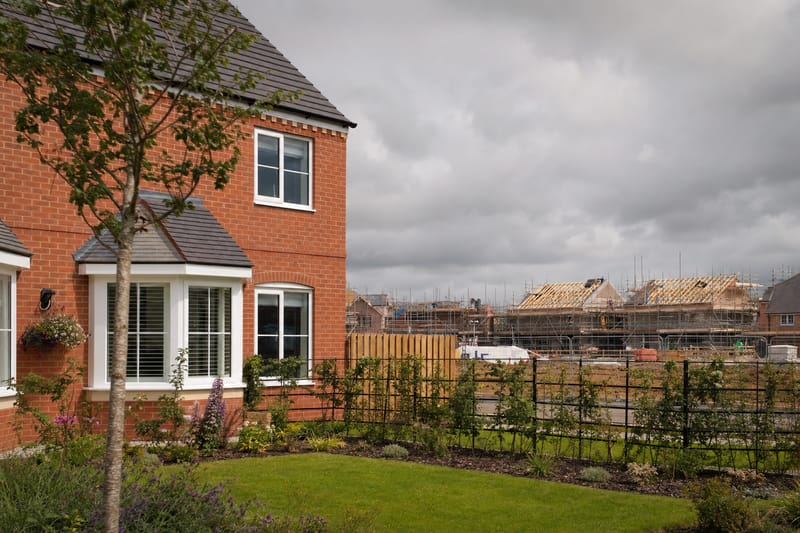
If you are buying an early plot on a large new build development, the glossy brochure and the pristine show home rarely tell the whole story. Many developments are built in phases over three, five, even ten years, and if your plot is one of the first to complete, you are not moving into a finished estate — you are moving into a live construction site that will continue, metres from your front door or back fence, for a long time to come.
This is not a reason to automatically avoid a phased development. Buying early often means lower prices, first choice of plots, and the best incentives a developer will offer. But it is a genuine trade-off, and it catches buyers out because viewings happen on quiet weekends, sales brochures show the finished masterplan, and nobody sits you down to explain what Monday to Saturday will actually sound and look like once you have the keys.
This guide sets out, honestly and phase by phase, what living next to an active building site for a new build typically involves: the noise, dust, mud and site traffic you should expect; how working hours and site management are usually controlled; what contractual and legal protections exist (and what doesn’t); and how to weigh the lower price and plot choice of an early phase against months or years of disruption.
None of this is unique to one developer or one site. It is simply how large-scale phased housebuilding works in the UK, and understanding the pattern before you reserve a plot will help you ask sharper questions, negotiate with your eyes open, and avoid the shock that otherwise arrives a few weeks after you move in, when the diggers start on the plot next door.
Why Phased Developments Work This Way
Large new build sites are almost never built in one go. Planning permission is typically granted under an outline consent with reserved matters, and the developer then builds out in phases — often called parcels, plots, or "land parcels" — releasing anywhere from 15 to 80 homes at a time. There are commercial, planning and practical reasons for this.
- Cash flow: housebuilders fund construction largely from sales receipts. Building 500 homes at once would require enormous upfront capital; phasing lets revenue from phase one part-fund phase two.
- Market absorption: local agents and developers monitor how quickly an area can absorb new stock without prices softening. Phasing controls the pace of supply.
- Infrastructure sequencing: roads, drainage, substations and sometimes a school or shop are built in stages tied to occupation thresholds set by the local planning authority (a Section 106 agreement).
- Section 106 and planning conditions: some infrastructure, like a new roundabout or a play area, may legally only need to be completed by the time a certain number of homes are occupied — not before the first residents move in.
The practical consequence is that your phase might complete and be handed over to residents while phases two, three and four are still fields, mud, or partially-built shells next door. On the largest sites — garden villages, urban extensions, or regeneration schemes of 1,000+ homes — build-out can genuinely take a decade or more, and the developer may bring in a second housebuilder to build out later phases under a different brand.
A reasonable rule of thumb: ask the sales team for the total number of homes across all phases and the developer’s stated annual build rate. Divide one by the other, and you get a rough minimum number of years the site will remain under construction — treat it as the floor, not the ceiling, since build rates slow in downturns.
Understanding this structure matters because it reframes the question. You are not asking "will there be some noise for a few weeks after I move in?" You are asking "how many years of my ownership will overlap with active construction, and how close will that construction be to my specific plot?"
What to Expect, Phase by Phase
Disruption is not constant — it changes shape as construction moves through its stages. Knowing what each stage sounds and looks like helps you judge how bad "right now" is likely to get before it gets better, and whether a particular season of noise is temporary or semi-permanent for your plot.
Groundworks and infrastructure (often the longest and loudest stage)
Before a single house is built, contractors strip topsoil, install drainage, lay roads and services, and often pile foundations. Expect: heavy plant movement, piling vibration if ground conditions require it, mud churned onto access roads (especially in wet UK winters), wheel-washing stations, and a near-constant flow of HGVs delivering aggregate and removing spoil. This stage can last six months to well over a year on a large parcel.
Superstructure (walls and roofs going up)
Once foundations are in, you’ll see cranes, scaffolding, brick and block deliveries, timber frame or masonry construction, and roofers. Noise is more intermittent — cement mixers, nail guns, generators — but scaffolding can block light and views for weeks per plot, and deliveries typically arrive from early morning.
Second fix and external works
Internally this is relatively quiet (plastering, carpentry, electrics) but externally this is when driveways, kerbs, fencing, landscaping and street furniture go in — more plant, more dust, and often when show homes and sales areas pop up nearby, bringing visitor traffic too.
Handover and snagging on your own phase
Even after you’ve moved in, expect contractors back on your own plot and close neighbours’ plots for snagging, NHBC-related remedial work, and landscaping completion for several months.
| Stage | Typical duration per phase | Main disruption |
|---|---|---|
| Groundworks & infrastructure | 6–18 months | Mud, HGVs, piling, dust, road closures |
| Superstructure | 4–12 months | Cranes, scaffolding, deliveries, cement mixers |
| Second fix & externals | 2–6 months | Dust, landscaping plant, visitor traffic |
| Snagging & defects period | Up to 24 months post-handover | Intermittent contractor visits next door |
Multiply this by the number of phases between you and the final homes, and you start to see why early buyers on a ten-phase scheme can reasonably expect disruption, somewhere on the development, for most of a decade — even if it moves further away from your own plot over time.
Noise, Dust and Mud: The Realistic Day-to-Day
Sales teams understandably focus on the finished product. It is worth translating "construction will continue on later phases" into what actually reaches your windows and garden.
Noise
Expect reversing beepers, generators, radios, power tools, delivery lorries with tail-lift winches, and occasional piling rigs. Sound travels further than you’d think across open ground with no mature buildings to break it up — a site 150–200 metres away can still be clearly audible, especially with windows open in summer or if your home backs directly onto the active parcel.
Dust
Dry groundworks and cement-related dust can settle on cars, windowsills, garden furniture and washing left out to dry. Developers are required to manage dust (dust suppression, wheel washing, sheeted lorries) under their Construction Environmental Management Plan, but control is rarely perfect, especially in dry, windy spells.
Mud and site traffic
Shared access roads used by both residents and construction traffic are a common source of complaints — mud tracked onto the public highway, HGVs queuing at pinch points, and temporary surfaces that are not yet adopted by the council (meaning potholes, poor drainage, and patchy street lighting persist until the road is formally adopted, sometimes years later).
Changing views and daylight
A plot bought for its open aspect over a field can, eighteen months later, face a terrace of houses, a crane, or a site compound with portable cabins and a security hoarding. If your reservation was partly motivated by an open outlook, get it in writing (or at least check the masterplan carefully) that the land in question is a later phase of housing rather than permanent open space.
None of this means every day is intolerable. Disruption is usually heaviest for discrete bursts (a few weeks of piling, a few weeks of heavy groundworks) rather than constant at maximum intensity throughout. But the cumulative effect over months, especially for anyone working from home, with young children napping, or with noise sensitivity, is the single most common regret reported by early-phase buyers.
Working Hours and Site Management: What's Actually Controlled
Construction sites in England and Wales are not free to operate at any hour. Working hours are typically set as a planning condition attached to the development's consent, and enforced (in theory) by the local planning authority's environmental health team.
Typical permitted hours
| Activity | Common permitted hours (check your local condition) |
|---|---|
| General construction work | Mon–Fri 08:00–18:00, Sat 08:00–13:00 |
| Noisy or vibration-heavy work (piling, demolition) | Often further restricted, e.g. Mon–Fri 09:00–17:00 only |
| Deliveries and HGV movements | May be restricted to avoid school run times on shared access roads |
| Sundays and bank holidays | Usually no construction work permitted |
These hours vary by council and by the specific planning condition for that site — they are not a national standard, so always ask the developer or check the planning portal for the exact wording that applies to your development.
Questions to ask the developer before reserving
- What are the agreed construction working hours for this site, and is there a Construction Environmental Management Plan (CEMP) I can see?
- Is there a dedicated construction access route, separate from the route residents use to reach their homes?
- Is there a site manager or community liaison contact for noise, dust or traffic complaints, and what is the typical response time?
- Will hoarding or fencing separate my plot from the active construction area, and when will that go up relative to my move-in date?
- Are there wheel-washing and dust suppression measures in place, and how often are access roads swept?
- What is the expected completion date for the phase directly adjacent to my plot?
Ask for answers in writing, or at minimum keep a dated note of what you were told verbally at the sales office. Verbal reassurances about "it'll all be finished by spring" carry little weight if the completion date slips — and on large sites, slippage is common.
In practice, enforcement of working-hour conditions depends on your local council's environmental health capacity, which varies enormously. Persistent breaches are usually best raised first with the developer's site manager, then escalated to the council's planning enforcement or environmental health team if unresolved, with dates, times and (where possible) evidence such as photos or a simple noise log.
Site Traffic, Access Roads and Security
One of the most underestimated issues for early-phase residents is sharing roads and junctions with construction traffic. Until a phase's roads are formally adopted by the local highway authority, they typically remain the developer's private responsibility — which matters both for maintenance standards and for who has priority on them.
What commonly goes wrong
- Shared single-access estates: if there is only one way in and out of the development, residents' cars, school-run traffic, delivery vans and HGVs carrying groundworks material or precast concrete all compete for the same narrow road, often with temporary surfacing and no footway yet.
- Parking for site workers: contractor vans and workers' cars sometimes spill onto resident parking bays or verges if the site compound doesn't have enough space, particularly in the groundworks phase before plots have driveways.
- Unadopted roads: potholes, standing water, poor lighting and patchy surfacing are common on roads awaiting adoption, and repairs are the developer's responsibility until formal adoption, which can take years after the last home on that phase completes.
- Security and site compounds: site cabins, generators running overnight for security lighting, and hoarding close to rear gardens can affect both noise and the sense of privacy, especially where a compound sits directly behind a cul-de-sac of completed homes.
What good practice looks like
On well-managed sites, the developer creates a dedicated construction haul road separate from the residential spine road, fences the site compound well away from occupied plots, times HGV movements to avoid peak resident traffic, and appoints a named site manager who residents can contact directly. Ask explicitly whether this is the plan for your development, and get it confirmed in writing where possible — verbal assurances at the sales office are not binding on the construction team managing the site day to day.
It's also worth walking the proposed route on foot or by car before you reserve, at different times of day if possible, to see how a construction compound entrance, a site office, or a stacked delivery queue might actually interact with your daily commute, school run or pram walk to the local shop.
Legal Protections: What's In Your Contract and What Isn't
It's natural to assume that living next to ongoing construction must breach some consumer right. In practice, UK new build law and consumer codes offer real but limited protection, and it's important to understand the boundaries before you reserve.
What the Consumer Code and New Homes Quality Code cover
Most major builders are signed up to either the Consumer Code for Home Builders or the newer New Homes Quality Code, overseen by the New Homes Quality Board (NHQB). These codes require developers to provide accurate pre-contract information, handle complaints fairly, and act with "reasonable skill, care and diligence." They do not, however, guarantee a construction-free environment, and they generally do not oblige a developer to compensate buyers simply because neighbouring phases are still being built — that is treated as a known characteristic of buying into a phased site, not a breach.
What your reservation and sales contract typically does and doesn't say
- Most reservation agreements and sales contracts for plots within a wider masterplan will reference the existence of future phases and ongoing development — read this clause carefully rather than skimming it.
- Developers are not usually contractually obliged to finish adjoining phases by a specific date; completion dates for later phases are typically described as estimates only.
- Your legal protection is strongest around defects in your own home (via NHBC, LABC or Premier Guarantee warranties) and weakest around general disruption from ongoing construction nearby, which the law and most contracts treat as a normal incident of buying into a developing area.
Statutory nuisance: a narrow but real route
Under the Environmental Protection Act 1990, a local authority can act against a statutory noise nuisance — but construction noise within permitted hours and reasonable limits is unlikely to meet this threshold. Persistent breaches of agreed hours, or genuinely excessive, unmanaged noise or dust, are more likely to succeed if reported with a clear log of dates, times and impact.
Treat planning conditions, the CEMP and the Consumer/New Homes Quality Code as tools for raising and escalating specific, evidenced problems — not as a guarantee that construction disruption itself is compensable or preventable.
If a developer's conduct falls genuinely below the standard required by the applicable code — for example, ignoring repeated complaints, breaching agreed working hours persistently, or providing materially misleading information about completion dates at the point of sale — you can raise a formal complaint, and ultimately refer unresolved disputes to the New Homes Ombudsman Service (for homes covered by the New Homes Quality Code) or the relevant Code administrator.
Can You Get Compensation or Goodwill Gestures?
Buyers often ask whether living next to construction entitles them to money off, free upgrades, or ongoing compensation. The honest answer is: rarely as a legal entitlement, but sometimes as a commercial gesture, and it's worth knowing the difference.
What developers sometimes offer
- Pre-sale incentives for early plots: the most common and reliable form of "compensation" is baked in before you buy — lower pricing, carpets, flooring or appliance packages, or part-exchange assistance offered specifically because early phases carry more disruption and less amenity (no shop, no finished landscaping, fewer neighbours).
- Goodwill gestures after the fact: some developers will offer a contribution toward cleaning, a car valet, or a small goodwill payment if dust or mud has caused clear, evidenced damage — this is discretionary, not a right, and depends heavily on the individual site manager and company policy.
- Service charge adjustments: on estates with an estate management company, some developers temporarily reduce or waive charges for unfinished communal areas (unmown verges, incomplete play areas) during active construction — check your estate management agreement for whether this is built in or simply at the manager's discretion.
What you generally cannot claim
- A reduction in purchase price after completion simply because construction took longer than expected on later phases.
- Compensation for a changed view, even if it was not made explicit at point of sale that the outlook would change once a later phase was built.
- Reimbursement for general inconvenience that falls within the working hours and management standards set out in the planning conditions and CEMP.
The most effective leverage buyers have is before exchange, not after: negotiating price, specification or incentives explicitly in recognition of the disruption, while you still have the choice to walk away or choose a different, later-building plot on the same site.
Weighing the Trade-Off: Price, Plot Choice and Timing
Buying early on a phased development is a genuine trade-off, not simply a downside to be endured. It's worth laying out both sides honestly before you decide where your priorities sit.
What you typically gain by buying early
- Lower price per square foot: developers commonly price the first phase of a site more competitively to build momentum and establish a sales track record, with prices rising on later phases as the development matures and local comparables improve.
- First choice of plot: the best-positioned plots — corner plots, those backing onto permanent green space, larger gardens — are usually released first, before the masterplan fills in around them.
- Stronger incentives: part-exchange, deposit contributions, free upgrades and flooring packages are more commonly offered to get early phases moving.
- More time to settle before the estate is at full density: schools, shops and community facilities, where included, are sometimes more accessible once fully occupied, but early residents also get first use of show homes, marketing suites and early landscaping.
What you typically give up
- Months or years of noise, dust, mud and site traffic directly affecting your home.
- A changing, unpredictable outlook until the masterplan is complete.
- Living on an unfinished estate — incomplete roads, limited amenities, few neighbours, and ongoing contractor presence.
- Less certainty about exactly how the finished development will look and function, since later phases can be amended through subsequent planning applications.
| Buying stage | Typical price position | Typical disruption remaining | Best suited to |
|---|---|---|---|
| Phase 1 (first release) | Lowest | Highest — years of construction likely | Buyers prioritising price and plot choice, tolerant of noise/dust |
| Mid-phase | Moderate | Moderate — some completed neighbours, some still building | Buyers wanting a balance of value and settled surroundings |
| Final phase | Highest | Lowest — estate largely finished | Buyers prioritising a finished, quiet environment over price |
There is no universally "right" answer — a family working from home with a toddler who naps daily has very different tolerance for a decade of intermittent disruption than a couple who are out at work all day and simply want the best possible price and plot.
Research Checklist Before You Reserve
Most of the disappointment reported by early-phase buyers traces back to questions that were never asked, or answers that were never put in writing. Before you put down a reservation fee, work through this checklist.
At the sales office
- Ask for the full masterplan showing all phases, not just your own, and identify what is planned directly behind, beside and opposite your plot.
- Ask for the total number of homes across the whole site and the developer's typical annual build rate, to estimate the realistic completion horizon.
- Ask whether a second housebuilder will build out later phases, and if so, which one — standards and site management can vary between builders on the same masterplan.
- Ask for the agreed construction working hours (the planning condition reference number, if possible) and whether there is a CEMP you can review.
- Ask whether construction traffic will use a dedicated access route separate from the residential road serving your plot.
Independent research
- Search the local council's planning portal for the outline permission and any reserved matters or phase-specific applications — conditions on working hours, access and landscaping are public documents.
- Look for the Section 106 agreement (often on the planning portal or available on request) to see what infrastructure is tied to occupation thresholds, and when.
- Check reviews and forums for existing residents of earlier phases on the same site — they are often the most candid source on what day-to-day life is actually like.
- Visit the site on a weekday during working hours, not just weekend viewings, to hear and see the construction activity for yourself.
- If buying a flat or apartment, ask specifically about scaffolding timelines for adjacent blocks, since high-rise construction can affect light and balcony use for extended periods.
If the sales team is reluctant to give straight answers to any of the above, treat that reluctance itself as useful information about how transparently the site is likely to be managed once you're living there.
Living With It: Practical Coping Strategies
If you do decide an early or mid-phase plot is right for you, there are practical steps that genuinely reduce the day-to-day impact of living beside an active site.
Inside the home
- Check the glazing specification — many new builds now use double glazing with acoustic-rated units as standard, but some developers offer upgraded acoustic glazing for an additional cost, which can be worth considering for rooms facing the active phase.
- Trickle vents and mechanical ventilation can be closed or adjusted during the dustiest periods; ask the site team to flag especially dusty operations (like dry cutting) in advance if possible.
- Keep windows closed during peak working hours if dust is a known issue that week, and consider washable, lighter window dressings that are easier to clean regularly.
Outside the home
- A simple car cover or regular washing routine reduces the visible impact of dust and cement residue on paintwork.
- Garden furniture covers and bringing washing in promptly on dusty, windy days are low-cost habits that make a noticeable difference.
- If fencing between your garden and the active site is not yet installed, ask the developer for a timeline — a basic estate fence is usually a relatively quick win they can prioritise on request.
Managing noise sensitivity
- If you work from home, ask about the loudest expected activities (piling, demolition) in advance so you can plan calls or deep-focus work around them where possible.
- Keep a simple diary of dates, times and nature of disruption — this is invaluable if you ever need to escalate a complaint, and it also helps you see patterns (e.g. disruption easing as that phase moves to internal fit-out).
Most residents report that the worst period is groundworks and early superstructure on the phase closest to their home — once that phase reaches second fix and landscaping, daily disruption drops markedly, even if construction continues elsewhere on the wider site.
It's also worth connecting with neighbours in the same position — a resident WhatsApp group or similar is a common, low-effort way to share updates on site manager contact details, planned noisy works, and collective feedback to the developer, which tends to carry more weight than individual complaints.
Frequently Asked Questions
How long will construction noise last if I buy an early phase?
It depends entirely on the size of the development and the developer's build rate, but on a large multi-phase site it is realistic to expect some level of nearby construction activity for several years, even if the most intense noise directly next to your plot typically eases once that specific phase moves past groundworks and superstructure, usually within twelve to eighteen months.
Can I refuse to complete if I discover the site is noisier than expected after exchange?
Generally no — once you have exchanged contracts you are legally committed to completing, and ongoing construction noise within permitted working hours is not usually grounds to withdraw without financial penalty. This is why thorough research before reservation and exchange matters so much more than trying to resolve concerns afterwards.
Will the developer tell me unprompted if my view is going to change?
Not necessarily, and you shouldn't assume it. Developers are required to provide accurate information under the Consumer Code and New Homes Quality Code, but the onus is largely on you to ask directly about what will be built on adjoining land and to check the full masterplan rather than relying on the view at the point of viewing.
Are weekend and evening working hours ever allowed?
Occasionally, for specific operations under special dispensation from the council (for example, a one-off concrete pour that cannot be paused), but routine Sunday and late evening work is usually prohibited under the planning condition. Always check the specific condition for your site rather than assuming a national standard applies.
Does buying from the developer directly give better protection than buying a resale on the same estate?
Not particularly in terms of construction disruption — both the original buyer and a subsequent resale buyer are equally subject to ongoing construction on later phases, since the masterplan and planning conditions attach to the site, not to the individual buyer or transaction.
Can I negotiate a lower price because of ongoing construction?
Yes, this is one of the more realistic forms of leverage available, particularly for plots closest to the active working area or compound. Many developers price such plots more competitively from the outset, but it's reasonable to raise the point directly and ask what allowance has been made.
What happens if the developer goes into administration mid-build?
This is a separate but related risk on long phased developments — later phases could be delayed, redesigned or taken over by another builder. See our related guide on what happens if your new build developer is taken over mid-build for more detail on this scenario.
Is there a way to check how a developer has managed disruption on previous phases?
Speaking directly to residents on earlier phases of the same site, or on a different site by the same builder in your region, is usually the most reliable method, alongside checking recent customer satisfaction scores published via the Home Builders Federation or NHQB's star rating system.
Next Steps
Buying into an early or mid-phase of a new build development can still be a smart move — better pricing, better plot choice and stronger incentives are real benefits, as long as you go in with accurate expectations rather than a brochure CGI of the finished estate.
- Browse live developments and check how many phases are planned and how many are already complete before you book a viewing.
- Compare builders active in your target area to see how different housebuilders are rated on site management and customer satisfaction.
- Search current properties for sale by plot and phase to identify which homes sit closest to, or furthest from, ongoing construction.
- Use the interactive map to see a development's position relative to existing infrastructure, access roads and neighbouring land that may form future phases.
- Explore our buyer tools to help with budgeting, mortgage affordability and research as you weigh an early-phase plot against a later, more settled one.
- Use compare to put two or more plots or developments side by side before deciding where the trade-off between price and disruption works best for you.
Related reading: New Build Location Checklist: What Smart Buyers Check, How to Research a New Build Development Before Buying, What to Check Before You Reserve a New Build, and Hearing Neighbours Through the Wall: New Build Soundproofing Snagging for the related issue of noise once your estate is fully built out.