If you're buying a new build flat, there's a good chance it won't have its own gas boiler. Instead, heat and hot water will arrive through a pipe from a shared district heating network (also called communal heating or a heat network), and you'll pay for it in a way that looks nothing like a normal gas bill. Understanding district heating in new build flats before you exchange contracts matters, because the way you're billed, who supplies the heat, and what happens if the system is poorly designed can all affect your running costs for decades.
Heat networks are common in apartment blocks, especially larger schemes near town centres, regeneration sites and tall residential towers, because it's often more efficient and lower-carbon to generate heat centrally — using gas boilers, heat pumps, combined heat and power (CHP) plant, or waste heat recovery — and distribute it to every flat, rather than fitting hundreds of individual boilers or heat pumps. As of 2026, an increasing share of new build flats in London and other major cities are connected to a heat network, and the government's broader net zero strategy actively encourages them as part of decarbonising heat in dense urban areas.
The trouble is that heat networks have historically operated with far less consumer protection than gas and electricity supply. There's no "switching supplier" option — you're tied to whoever runs the pipework under your building, usually for the life of your lease. Billing has often been opaque, standing charges have sometimes been high relative to the actual heat used, and maintenance of the in-flat equipment hasn't always been clear-cut. New Ofgem-led regulation, phased in through 2025 and 2026, is intended to fix much of this, but as a buyer you still need to know exactly what you're signing up for.
This guide walks through how the system physically works, how the bill is actually calculated, why standing charges can look steep compared with a typical gas tariff, what the new Ofgem regulatory regime changes, and the specific questions to ask a developer or estate agent before you commit to a flat connected to a heat network. It complements our wider look at New Build EPC Ratings Explained, since a flat's heat source directly affects its EPC banding and running-cost estimate.
How a District Heating Network Actually Works
A district or communal heat network has three main parts, and understanding each one helps explain why your bill is structured the way it is.
1. The energy centre
Somewhere in or near the development — often a plant room in the basement or a dedicated building — sits the energy centre. This is where heat is generated, typically by one or more of:
- Gas-fired communal boilers (the most common setup in existing schemes)
- Air source or water source heat pumps (increasingly common in new schemes built to meet current Building Regulations Part L and net zero ambitions)
- Combined heat and power (CHP) engines, which generate electricity and capture the waste heat
- Waste heat recovery from a nearby source, such as a data centre, energy-from-waste plant, or river/aquifer thermal store
2. The distribution network
Heat is carried as hot water through insulated pipework running through risers and corridors to every flat in the block, or across multiple blocks on a larger estate-wide scheme. Some heat is inevitably lost as it travels through the pipes — this "network loss" is a genuine cost of the system and is one reason communal heating standing charges tend to be higher than a single-household gas standing charge.
3. The Heat Interface Unit (HIU)
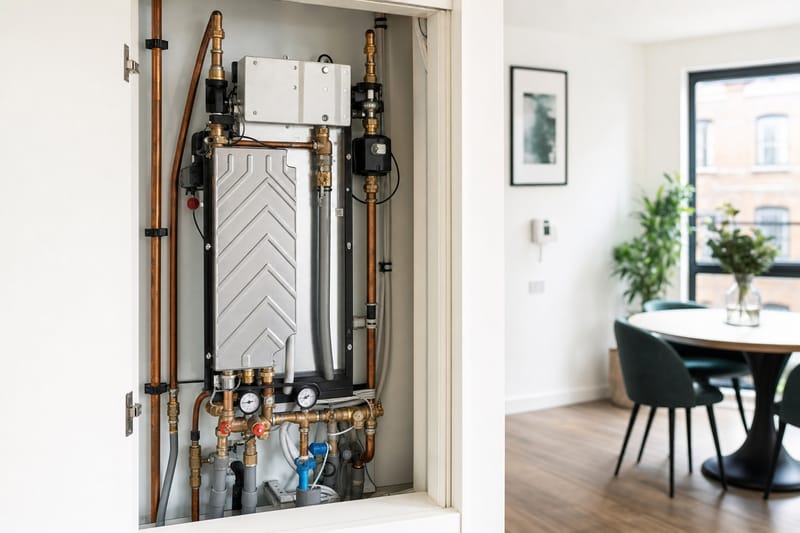
Inside your flat, usually in a utility cupboard or kitchen cupboard, is a compact unit called a Heat Interface Unit (HIU). This is the piece of kit that matters most to you day to day. The HIU takes the hot water arriving from the communal network and uses a heat exchanger to warm your own central heating circuit and produce instantaneous hot water at your taps — similar in principle to a combi boiler, except it doesn't burn any fuel itself. It also houses the heat meter that records how much energy you use.
Because there's no boiler flue, no gas supply into the flat, and no need for gas safety certification of an individual appliance, heat network flats often feel simpler from a safety perspective. The trade-off is that you have zero choice over who supplies your heat, and historically limited ability to shop around on price — which is exactly what recent regulation is trying to address.
Heat Network Billing Explained: What's Actually on Your Bill
Heat network bills typically have two components, much like a gas bill, but the numbers behind them work differently.
Standing charge
This is a fixed daily or monthly fee you pay regardless of how much heat you use. It's intended to cover fixed costs: maintaining the energy centre and pipework, metering and billing administration, HIU servicing, insurance and a share of the network's own energy losses. On a heat network, the standing charge is often noticeably higher than the standing charge on a typical domestic gas tariff, because those fixed network costs are being spread across a relatively small number of connected homes rather than millions of gas customers nationally.
Unit rate (per kWh of heat)
You're charged for the actual heat energy delivered to your flat, measured in kilowatt-hours by the meter in your HIU, at a pence-per-kWh rate set by the heat supplier. This rate should, under current guidance and the incoming Ofgem framework, be broadly comparable to what an efficient gas boiler customer would pay for equivalent heat — but because there's no competitive market, it can drift away from typical market rates in some schemes if not properly regulated.
Who bills you, and how often
Unlike gas or electricity, your heat supplier is not a household-name energy company. It's usually one of the following:
- The developer's chosen Energy Services Company (ESCo), set up specifically to run the network
- A specialist heat network operator contracted to manage supply and billing
- Occasionally the freeholder or managing agent directly
Bills are usually issued monthly or quarterly, based on actual meter readings taken remotely (most modern HIUs have smart, remotely-read meters), so estimated billing is less common than it used to be with older communal systems. You should still check your meter readings against your bill periodically, exactly as you would with gas or electricity.
| Bill component | What it covers | Typical driver of cost |
|---|---|---|
| Standing charge | Network maintenance, metering, HIU servicing, energy centre running costs, insurance | Number of connected homes; age and efficiency of the network |
| Unit rate (p/kWh) | Heat energy actually delivered to your flat | Underlying fuel cost (gas, electricity for heat pumps), network efficiency |
| Connection charge (one-off, sometimes) | Initial connection of your HIU to the network | Usually built into the purchase price for new build, but check |
Always ask for the current price per kWh and standing charge in writing before you exchange, and compare it against typical gas unit rates published by Ofgem — not just against what the sales team says is "competitive".
Why Are Heat Network Standing Charges Often Higher Than Gas?
This is the single most common complaint from heat network customers, and it's worth understanding the genuine reasons behind it rather than assuming you're simply being overcharged.
Scale is smaller
A national gas supplier spreads its fixed network and administration costs across millions of customers. A single heat network might serve anywhere from 50 to a few thousand homes. The same categories of fixed cost — metering, billing systems, maintenance contracts, compliance — are shared among far fewer bill payers, pushing the per-household standing charge up.
Heat is lost in the pipes
Every metre of pipe carrying hot water loses some heat to its surroundings, even when well insulated. Poorly designed or badly insulated networks — sometimes a legacy of cost-cutting during construction — can lose a significant proportion of the heat generated before it ever reaches a flat. Well-designed modern networks with good pipe insulation and shorter runs lose much less, which is one reason network design quality varies so much between developments.
The energy centre has its own running costs
Boilers, heat pumps, pumps, controls and CHP engines need regular maintenance, and this is a specialist, more expensive job than servicing an individual domestic boiler, often carried out by a contracted specialist firm rather than a local gas engineer.
Historically, limited competitive pressure
Because heat network customers have not been able to switch supplier the way gas and electricity customers can, some operators have had less commercial pressure to keep prices sharp. This is precisely the gap the new Ofgem-led regulatory regime is designed to close (see the next section).
This variability is exactly why you shouldn't take "it's on a heat network" as either automatically good or automatically bad news — you need the actual figures for that specific development, which links to our broader guide on how EPC ratings reflect a new build's real running costs.
Ofgem Heat Network Regulation: What's Changing
For years, heat networks in Great Britain sat largely outside energy regulation — unlike gas and electricity suppliers, heat network operators weren't licensed, didn't have to join an ombudsman scheme, and weren't subject to price transparency rules in the way mainstream energy suppliers are. That is changing.
Ofgem as heat network regulator
Under powers introduced by the Energy Act, Ofgem has become the official regulator of heat networks in Great Britain, with a phased rollout of its regulatory framework through 2025 and into 2026. The stated aims are to:
- Require heat network operators to register with Ofgem and meet minimum standards
- Introduce fair, transparent pricing rules so charges reflect genuine costs
- Guarantee heat network customers access to an independent ombudsman for complaints, similar to the Energy Ombudsman used by gas and electricity customers
- Set minimum standards for reliability and continuity of supply, including compensation where supply fails for extended periods
- Improve information given to prospective buyers and tenants before they connect to a network
The Heat Networks (Metering and Billing) Regulations
Separately from the new Ofgem regime, existing rules already require heat network operators to install accurate meters (rather than billing by flat size or a flat estimate) and to provide bills that clearly show consumption, in an effort to encourage customers to control their own usage. If your flat's bill doesn't reference your actual metered consumption in kWh, ask why.
Heat Trust
Before Ofgem's statutory powers took full effect, many reputable operators signed up voluntarily to the Heat Trust scheme, a customer protection framework covering standards of service, complaints handling and compensation for network outages. Checking whether your prospective development's heat supplier is Heat Trust registered, and increasingly whether it is properly registered under the new Ofgem regime, is one of the most useful due-diligence questions you can ask a sales team.
| Protection | Before regulation | Under the Ofgem-led regime |
|---|---|---|
| Independent complaints route | Voluntary (Heat Trust members only) | Mandatory ombudsman access for all registered networks |
| Price transparency | Inconsistent, operator-dependent | Standardised cost reflectivity and disclosure requirements |
| Supply failure compensation | Voluntary, Heat Trust members only | Minimum standards expected to apply across the market |
| Operator accountability | Largely unregulated | Must register with and report to Ofgem |
As of 2026, the regime is still being phased in — check Ofgem's current published timetable for your specific development, and don't assume full protections are automatically in place on day one of a very new scheme.
The Heat Interface Unit: Ownership, Servicing and Common Problems
Because the HIU sits inside your flat but is part of a shared system, responsibility for it is sometimes unclear to buyers — and it's one of the most important things to clarify before you exchange.
Who owns the HIU?
This varies by development. In some schemes the HIU is owned by the freeholder or the ESCo and treated as part of the network infrastructure, with servicing costs folded into your service charge or your heat bill's standing charge. In others, ownership passes to the leaseholder on completion, making you responsible for arranging and paying for servicing yourself, similar to owning a combi boiler. Ask your conveyancer to confirm this explicitly and check what the lease says, alongside your review of your legal rights if a developer runs into difficulty, since ESCo arrangements can be affected by developer or management company changes.
Servicing requirements
Like a boiler, an HIU needs periodic servicing (typically annually) to keep its heat exchanger working efficiently and to check for scale build-up, especially in hard-water areas. A poorly maintained HIU can lose efficiency over time, meaning you draw more heat from the network (and pay more) to achieve the same warmth at your radiators.
Common issues buyers should ask about
- Oversizing: Some HIUs are specified larger than a flat actually needs, which can reduce efficiency at low, everyday demand levels. Ask whether the HIU was sized to the specific flat or standardised across the block.
- Return temperature performance: A well-functioning network needs the water returning from your HIU to the energy centre to be sufficiently cooled. HIUs that don't cool the return water properly ("poor delta-T performance") reduce the whole network's efficiency, potentially affecting everyone's bills, not just yours.
- Standby losses: Some HIU designs keep a small amount of hot water primed for instant use, which uses a small but continuous amount of energy even when you're not drawing hot water — ask whether the specified model has good standby-loss performance.
- Noise: A cupboard-mounted HIU with a circulation pump can produce audible noise, particularly if it's against a bedroom wall — worth checking during a viewing or snagging inspection.
District Heating vs Gas Boiler vs Heat Pump: Comparing Running Costs
It's tempting to want a single answer to "which is cheapest?", but the honest answer is that it depends heavily on the specific scheme's design and efficiency, current wholesale energy prices, and how well the network is run. The table below sets out the general trade-offs to weigh up, rather than fixed figures — always request the actual current tariff for a specific development rather than relying on averages.
| Heating type | Typical standing charge | Typical running cost driver | Who controls maintenance |
|---|---|---|---|
| Individual gas combi boiler | Low-moderate (national gas standing charge) | Wholesale gas price, boiler efficiency | You, directly |
| Individual air source heat pump | Electricity standing charge (often higher than gas) | Electricity price, insulation quality, correct sizing | You, directly |
| Gas-fired district heating network | Often higher than individual gas due to shared fixed costs | Network losses, energy centre efficiency, unit rate set by operator | Operator/ESCo, funded via your bill and service charge |
| Heat-pump-powered district network | Similar or higher than gas network standing charge | Network efficiency, electricity wholesale price, network scale | Operator/ESCo |
A few practical points follow from this:
- You cannot directly compare a heat network's unit rate to a national average gas price without also factoring in the standing charge and any network losses baked into what you're billed for.
- A newer, well-insulated, correctly-sized network on a modern development is likely to perform much better than an older or poorly maintained one — scheme quality matters more than the underlying technology.
- Your flat's own fabric performance (insulation, glazing, airtightness) still matters hugely on a heat network, exactly as it would with any other heating system — see our guide to insulation types and thermal performance in new build homes for context on how the building itself affects your bills.
- EPC certificates for heat network flats should reflect the network's efficiency, but assumptions used in EPC modelling for communal systems have historically been criticised as sometimes optimistic — treat the EPC as a guide, not a guarantee, alongside our piece on how EPC rules affect new build buy-to-let investors if you're purchasing to let.
Ask the sales team or developer for at least 12 months of actual billing data from a comparable, already-occupied phase of the same development if one exists — real consumption data beats projected figures every time.
Questions to Ask Before Buying a Flat on a Heat Network
Because you can't switch supplier later, due diligence before exchange is your main point of leverage. Take a written list to your reservation appointment and ask the sales team, then get key answers confirmed by your conveyancer in the pre-contract enquiries.
Pricing and billing
- What is the current standing charge and unit rate (p/kWh), in writing, and how does it compare to the current Ofgem-published typical domestic gas unit rate?
- How and when do prices get reviewed or increased, and is there a cap or index (such as linkage to wholesale gas or CPI) written into the heat supply agreement?
- Are there separate charges for hot water versus space heating, or is it a single combined rate?
- Is there a minimum contract term or exit fee if you want to leave the network (relevant mainly if you might later disconnect, which is rare but not unheard of)?
The operator and its track record
- Who is the heat supplier/ESCo, and is it registered with Ofgem's heat network regulatory regime and/or Heat Trust?
- Does the operator have other schemes running, and can you find reviews or resident feedback on service reliability?
- What happens to the contract if the developer sells the ESCo or the freehold changes hands?
Reliability and maintenance
- What compensation applies if heating or hot water is out of service for an extended period?
- Who owns and services the in-flat HIU, and what's the servicing schedule and cost?
- Is the energy centre's maintenance contract funded through the general service charge, a separate heat-network charge, or both — and how transparent is that cost breakdown?
Documentation to request
- A copy of the heat supply agreement (sometimes called a Heat Supply Contract) you'll be asked to sign on completion
- The current service charge budget, broken down to show energy centre costs separately from general block maintenance
- Written confirmation of the HIU make/model and warranty period
Your Rights If Something Goes Wrong
Heat network complaints have historically been harder to resolve than gas or electricity ones, precisely because there was no statutory ombudsman route. That's now changing, but you should know what applies to your specific supplier today.
Step 1: Raise it with your heat supplier directly
Start with a written complaint to the ESCo or operator, keeping a clear record of dates, meter readings and any correspondence. Most operators have a formal complaints process with a set response timeframe (commonly eight weeks) before you can escalate.
Step 2: Check for Heat Trust or Ofgem registration
If your operator is Heat Trust registered, or registered under the Ofgem regime, you should have access to an independent complaints and redress process once internal routes are exhausted — potentially including compensation for prolonged supply interruptions or billing errors.
Step 3: Energy Ombudsman
As Ofgem's regulatory powers extend across the heat network sector through 2025 and 2026, access to the Energy Ombudsman (or an equivalent designated scheme) is intended to become a standard right for heat network customers, mirroring the protection gas and electricity customers already have. Confirm your specific operator's current ombudsman arrangements, since the rollout is phased and not every network will be at the same stage.
Billing disputes specifically
If you think you've been billed for more heat than you've actually used, ask for:
- A meter reading history covering at least the disputed period
- Confirmation of the meter's last calibration or accuracy check
- An explanation of how the standing charge is calculated and what it's currently funding
Keep your own log of thermostat settings and approximate usage patterns, particularly in your first year, so you have a baseline to challenge anything that looks anomalous.
Don't withhold payment entirely during a dispute unless formally advised to — instead, pay the undisputed portion and flag the disputed amount in writing, which keeps your account in reasonable standing while the issue is investigated.
If your development also has a wider service charge dispute — separate from the heat bill itself — the First-tier Tribunal (Property Chamber) can adjudicate on the reasonableness of service charges in England, which is a different route from a heat network billing complaint but sometimes runs alongside one.
Practical Ways to Reduce Your Heat Network Bill
You can't switch supplier, but you can still influence how much heat you actually consume, which is the part of the bill you do control.
Get comfortable with your HIU controls
Unlike a boiler, an HIU typically works alongside a separate room thermostat and, in many new builds, thermostatic radiator valves (TRVs) on individual radiators or a wet underfloor heating manifold. Learn how your specific setup is controlled — ask for the manufacturer's manual at handover, and check our guide to underfloor heating in new builds if your flat uses it, since underfloor systems respond much more slowly than radiators and are easy to accidentally overheat by adjusting too frequently.
Avoid excessive standby hot water settings
Some HIUs have a "comfort" or "keep warm" setting that primes hot water for instant use, trading a small continuous energy cost for faster hot taps. If instant hot water isn't essential to you, check whether this can be turned down or scheduled to reduce standby losses.
Bleed radiators and check for airlocks
Air trapped in radiators forces the HIU to work harder to achieve the same room temperature, drawing more heat from the network. This is a five-minute job you can do yourself with a radiator key.
Use smart thermostats and monitoring where available
Many new build flats on heat networks are fitted with smart thermostats or in-home displays showing real-time consumption. Using these to understand your actual usage patterns, rather than just glancing at a monthly bill, helps you spot waste early — see our related guide on smart home energy management for new builds.
Keep on top of servicing
A poorly maintained HIU loses efficiency, meaning you draw more heat for the same comfort. Don't skip the annual service if it's your responsibility — treat it exactly as you would a boiler service.
Insulate and draught-proof what you control
Even on a heat network, your own flat's heat retention determines how much energy you need to draw. Good curtains, draught excluders on external doors, and not blocking radiators or underfloor heating zones with furniture all reduce demand.
Heat Networks and Your Lease: What Sits in the Legal Documents
The heat supply arrangement doesn't just show up as a bill — it's woven into your lease and service charge documents, and it's worth understanding how before you sign.
Heat supply agreement vs lease
You'll typically be asked to enter into a separate heat supply agreement (sometimes bundled with your lease, sometimes a standalone contract) with the ESCo or operator, distinct from your lease with the freeholder. This is the document that actually sets out pricing, minimum term and termination rights — not the lease itself. Make sure your conveyancer reviews both documents and flags any inconsistency between them, particularly around who is liable for HIU faults or network outages.
Service charge interaction
Some costs associated with the heat network — energy centre plant maintenance, communal pipework repairs, insurance for the plant room — are often recovered through the general building service charge rather than your direct heat bill. This means your true "cost of heating" is really the heat bill plus a slice of your service charge, and you should ask for that split to be shown clearly rather than accepting a single bundled figure. This sits alongside other service charge considerations covered in our guide on what happens legally if your developer goes into administration, since ESCo continuity can be affected by broader corporate issues at the parent developer.
Freehold and management company changes
New build developments are frequently sold with the freehold retained initially by the developer or a linked management company, sometimes transferring later to a resident-controlled entity or a third-party investor. When this happens, the heat network operator and its contract terms can, in some cases, change too. Ask specifically whether the heat supply agreement survives a change of freeholder unchanged, or whether it's tied to the current management arrangement.
New Homes Quality Code and pre-sale disclosure
Developers registered under the New Homes Quality Board's Code are expected to give buyers clear, accurate information about the property before reservation, which should reasonably extend to disclosing that a flat is heat-network connected and outlining the likely running costs. If this information wasn't volunteered clearly during your reservation process, it's a fair and reasonable question to put directly to the sales team in writing.
Frequently Asked Questions
Is district heating more expensive than a gas boiler?
It depends on the specific scheme. Standing charges are often higher on heat networks because fixed costs are spread across fewer homes, but the unit rate for actual heat used can be competitive, especially on well-designed, low-loss networks. A poorly run network can end up more expensive than an individual gas boiler for equivalent comfort; a well-run one can be comparable or cheaper. Always request current, specific figures for the development rather than relying on general assumptions.
Can I switch my heat network supplier like I can with gas or electricity?
No. Heat networks are natural monopolies within a building or estate — there is only one pipe and one operator, so you cannot switch supplier the way you can with gas or electricity. This is precisely why regulatory protection, price transparency and complaints access matter more, not less, on a heat network.
What is a Heat Interface Unit (HIU) and do I need to maintain it myself?
An HIU is the compact unit in your flat that transfers heat from the communal network into your own heating and hot water system, and it also houses your heat meter. Whether you or the managing agent/ESCo is responsible for servicing it varies by development — confirm this in writing before you buy, as it directly affects your ongoing costs.
Does Ofgem regulate heat networks now?
Ofgem has become the statutory regulator for heat networks in Great Britain, with its regulatory framework being phased in through 2025 and 2026. This is intended to bring heat network customers protections closer to those enjoyed by gas and electricity customers, including registration requirements for operators, pricing transparency rules and access to an independent ombudsman. Check the current rollout status for your specific operator, as implementation is staged.
What happens if my heating breaks down on a communal network?
Report it to your heat supplier or managing agent immediately using their published fault line. Reputable operators, particularly those registered with Heat Trust or under the new Ofgem regime, are expected to meet minimum response times and may owe compensation for extended outages. Keep a written record of when the fault was reported and resolved in case you need to escalate a complaint later.
Will a heat network flat have a good EPC rating?
Not necessarily automatically. EPC assessments for heat network flats use standard assumptions about network efficiency that don't always reflect the real-world performance of a specific scheme. A modern, well-insulated heat-pump-powered network can support a strong EPC rating, but always treat the certificate as a modelled estimate rather than a guarantee of your actual bills — see our detailed guide on New Build EPC Ratings Explained.
Can I disconnect from the network and install my own heating system instead?
This is rarely straightforward and is usually restricted by your lease or heat supply agreement, since networks are designed around all connected properties participating, and disconnection can affect the network's overall efficiency and cost recovery for remaining residents. If this matters to you, ask about it explicitly before buying rather than assuming it will be possible later.
Are heat network charges included in my service charge or billed separately?
Both patterns exist. Some developments bill heat entirely separately from the general service charge; others fold some heat-network-related costs (like energy centre maintenance) into the service charge while billing your actual heat consumption separately. Ask for a clear, itemised breakdown so you understand your true total cost of occupying the flat.
Next Steps
Before you commit to a new build flat on a district heating network, get the running-cost and regulatory picture as clear as the layout and finish specification. A few practical next moves:
- Browse live schemes on Developments and check each listing's heating specification before booking a viewing.
- Use Builders to research a developer's track record and whether they've used the same ESCo or heat network operator on previous schemes.
- Search Properties for flats and filter by development to compare heating specifications across similar schemes in the same area.
- Use the Map to see which developments in a given area are part of larger district heating schemes, which is more common on big regeneration or town-centre sites.
- Explore Tools for calculators that can help you estimate and compare likely running costs and mortgage affordability alongside service charges.
- Use Compare to weigh up two or more shortlisted developments side by side, including their heating systems and service charge estimates.
Whatever you decide, insist on seeing the actual heat supply agreement, current tariff figures and HIU maintenance responsibility in writing before you exchange — a heat network isn't a reason to walk away from an otherwise good new build flat, but it is a cost and contractual commitment that deserves the same scrutiny as your mortgage rate or your service charge budget.