Disclaimer: This article provides general guidance on planning permission and building regulations in England & Wales. It is not legal advice. Always consult your solicitor or a qualified planning consultant for advice specific to your circumstances.
How Planning Permission Works for New Build Developments
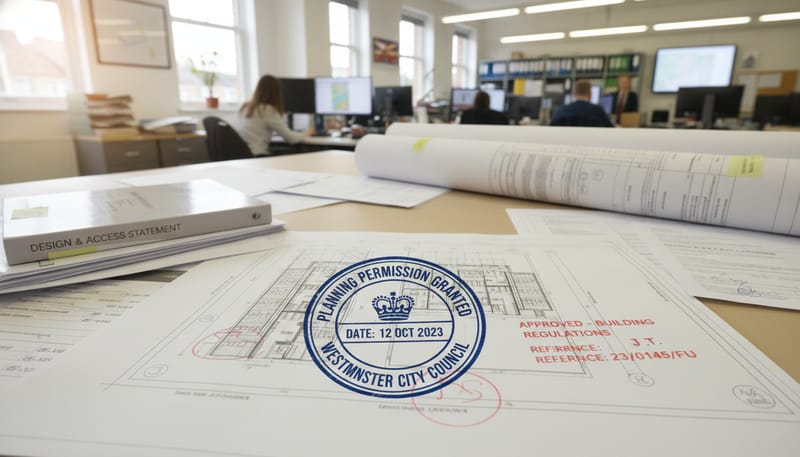
Every new build housing development in England & Wales requires planning permission before construction can begin. Planning permission is the process by which local planning authorities (typically district or borough councils) assess whether a proposed development is acceptable in terms of its impact on the local area, the environment, and existing communities. For buyers of new build homes, understanding the planning process provides valuable context about the development you are purchasing and any conditions or restrictions that may apply to your property.
The planning system in England & Wales is governed primarily by the Town and Country Planning Act 1990 and the National Planning Policy Framework (NPPF). These establish the legal framework within which all planning decisions are made. Local planning authorities also produce their own Local Plans, which set out the specific policies and allocations for development in their area.
For a major new build housing development, the planning process is extensive and can take months or even years from initial application to final approval. This process involves public consultation, assessment against national and local policies, negotiation of Section 106 agreements, and the imposition of planning conditions. The outcome of this process directly affects what the developer can build, how the development looks, and what amenities and infrastructure will be provided.
Outline vs Full Planning Permission
Planning permission for new build developments can be granted in two main forms: outline planning permission and full (or “detailed”) planning permission. Understanding the difference is important for buyers because it affects how much detail about the development has been fixed at the time of purchase.
Outline Planning Permission
Outline planning permission establishes the principle that a site is suitable for development. It confirms that the local planning authority accepts the general concept of housing development on the land, but it does not approve the specific details of the scheme. These details – known as “reserved matters” – must be submitted and approved separately before construction can begin.
Outline permission is commonly used by landowners or developers who wish to establish the development potential of a site before committing to the cost of producing detailed plans. It can also be used to secure the value of the land for future sale. An outline permission typically specifies the maximum number of dwellings, the broad layout, and any high-level design principles, but the precise house designs, landscaping, and infrastructure details are left to the reserved matters stage.
Full Planning Permission
Full planning permission provides a complete approval for the development, including all design, layout, landscaping, access, and infrastructure details. When a developer applies for full permission, they submit detailed architectural drawings, engineering plans, landscaping schemes, and supporting technical reports. The application is assessed in its entirety, and the approval (if granted) covers all aspects of the development.
For buyers, a development with full planning permission offers greater certainty about what will be built. The approved plans show the exact layout of the estate, the design of each house type, and the provision of roads, open spaces, and other amenities. Your solicitor should obtain a copy of the approved plans as part of the legal search process and check that what you are buying matches what was approved.
| Feature | Outline Permission | Full Permission |
|---|---|---|
| Level of detail approved | Principle of development only | All details including design, layout, landscaping |
| Reserved matters required | Yes – must be submitted within 3 years | No – all details are approved upfront |
| Validity period | Reserved matters within 3 years; development within 2 years of last approval | Development must commence within 3 years |
| Design certainty for buyers | Lower – details may change at reserved matters stage | Higher – approved plans show exactly what will be built |
| Cost for developer | Lower upfront; detailed design costs deferred | Higher upfront; all design costs incurred before application |
| Common use | Large strategic sites; land promotion; phased developments | Smaller developments; sites with detailed design proposals |
Reserved Matters: The Detail Behind the Permission
Where outline planning permission has been granted, the developer must submit and obtain approval for the “reserved matters” before construction can begin. Reserved matters are the detailed aspects of the development that were not determined at the outline stage. They are defined in law and cover five specific categories:
- Layout: The way in which buildings, routes, and open spaces are provided within the development and their relationship to buildings and spaces outside the site
- Scale: The height, width, and length of each building proposed in relation to its surroundings
- Appearance: The aspects of a building or place that determine the visual impression it makes, including external materials, architectural details, and design features
- Access: The means of approaching or entering the development site from adjacent land, including road junctions, pedestrian and cycle access, and public transport links
- Landscaping: The treatment of land (other than buildings) within and adjacent to the site, including planting, hard surfaces, boundary treatments, and ground levels
For buyers, the reserved matters stage is where the precise details of the development are finalised. If you are purchasing a property on a development where only outline permission has been granted, be aware that the reserved matters applications may not yet have been approved for all phases of the scheme. This means that aspects of the wider development – such as the design of neighbouring houses, the layout of roads and green spaces, and the provision of community facilities – may still be subject to change.
Your solicitor should check the planning history of the development as part of the legal search process and advise you on the status of any reserved matters applications. If you are buying on an early phase of a large development, it is worth asking the developer for a master plan showing the intended layout of future phases, while bearing in mind that these plans may be subject to change through the reserved matters process.
Building Regulations Compliance: Safety & Standards
Building regulations are a separate legal regime from planning permission, and they serve a different purpose. While planning permission controls the use, appearance, and impact of a development on its surroundings, building regulations ensure that the actual construction of buildings meets minimum standards of health, safety, welfare, energy efficiency, and accessibility.
In England, building regulations are set out in The Building Regulations 2010 and are supported by a series of Approved Documents (Parts A through S) that provide technical guidance on compliance. Key areas covered include:
- Part A – Structural safety: Requirements for foundations, walls, floors, and roofs to ensure the building can withstand the loads it will experience
- Part B – Fire safety: Comprehensive requirements for fire detection, means of escape, fire-resistant construction, and fire service access
- Part E – Sound insulation: Requirements to prevent the transmission of sound between dwellings and from external sources
- Part F – Ventilation: Requirements for adequate ventilation to maintain indoor air quality
- Part G – Sanitation and water: Requirements for water supply, bathrooms, and hot water systems
- Part L – Energy efficiency: Requirements for insulation, heating systems, and renewable energy provision to minimise carbon emissions
- Part M – Accessibility: Requirements for accessible entrances, internal layouts, and facilities for people with disabilities
- Part O – Overheating: Requirements (introduced in 2022) to prevent overheating in new residential buildings
- Part S – Electric vehicle charging: Requirements (introduced in 2022) for EV charging infrastructure in new dwellings
Every new build home must comply with the building regulations in force at the time of construction. Compliance is verified through a building control process, which is carried out either by the local authority’s building control department or by an approved private-sector inspector.
Building Control Inspections: NHBC, LABC & Approved Inspectors
Building control inspections are the mechanism by which compliance with building regulations is verified during and after construction. For new build homes, these inspections are typically carried out by one of three types of body:
NHBC (National House Building Council)
The NHBC is the UK’s largest provider of new home warranty and building control services. It acts as an approved inspector under the Building Act 1984, carrying out building control inspections throughout the construction process. When a developer uses NHBC building control, the home is also registered for the NHBC Buildmark warranty, which provides structural defect insurance for up to 10 years.
NHBC inspections cover key stages of construction, including:
- Foundation excavations and concrete pouring
- Damp-proof course installation
- Superstructure (walls, floors, roof) at various stages
- Pre-plaster stage (before internal finishes are applied)
- Final inspection and completion
LABC (Local Authority Building Control)
Local authority building control departments provide an alternative to private-sector inspectors like the NHBC. LABC inspectors are employed by the local council and carry out inspections at similar key stages of construction. When LABC is used for building control, the developer will need to arrange a separate new home warranty from a provider such as NHBC, Premier Guarantee, LABC Warranty, or another scheme accepted by mortgage lenders.
Approved Inspectors
In addition to the NHBC and LABC, there are various other approved inspectors authorised to carry out building control functions. These are private-sector companies registered with the Building Safety Regulator. Like the NHBC, they carry out inspections at key stages and issue completion certificates when satisfied that the building complies with the regulations.
| Building Control Body | Type | Warranty Included | Key Features |
|---|---|---|---|
| NHBC | Approved Inspector (private) | Yes – Buildmark 10-year warranty | Largest UK provider; combined building control and warranty |
| LABC | Local Authority | No – separate warranty required | Council-employed inspectors; statutory service |
| Premier Guarantee | Approved Inspector (private) | Yes – 10-year structural warranty | Combined building control and warranty; lender-approved |
| Other Approved Inspectors | Approved Inspector (private) | Varies – some offer combined packages | Various providers; check lender acceptance |
Completion Certificates
At the end of the construction process, the building control body issues a completion certificate (or, in the case of approved inspectors, a final certificate). This document confirms that the building work has been inspected and found to comply with the building regulations. Your solicitor should obtain a copy of this certificate as part of the conveyancing process – it is one of the key documents in your buyer paperwork checklist.
If a completion certificate has not yet been issued at the time of your purchase (which can happen if the development is still being finished), your solicitor should ensure that appropriate provisions are in place – such as a retention from the purchase price or an undertaking from the developer – to protect your position until the certificate is provided.
What Buyers Should Check About Planning Conditions
Planning conditions are requirements attached to a planning permission that the developer must comply with before, during, or after construction. They are a fundamental part of the planning system and are used to make developments acceptable that would otherwise be unacceptable. For new build buyers, understanding the key planning conditions attached to your development is important because some conditions can directly affect your use of the property.
Common Types of Planning Conditions
- Pre-commencement conditions: Must be satisfied before any construction work begins (e.g. submission of a construction management plan, archaeological investigation, or contamination assessment)
- During-construction conditions: Must be complied with throughout the build process (e.g. hours of working, dust and noise mitigation, protection of trees and wildlife)
- Before-occupation conditions: Must be discharged before anyone can move into the property (e.g. completion of access roads, provision of parking spaces, installation of landscaping)
- Ongoing conditions: Apply throughout the lifetime of the development (e.g. restrictions on permitted development rights, requirements to maintain landscaping or open spaces)
Conditions That Affect Buyers Directly
Certain planning conditions are particularly relevant to new build buyers and deserve specific attention from your solicitor during the conveyancing process:
- Removal of permitted development rights: A common condition on new build estates that removes your automatic right to extend or alter the property without planning permission. This means you will need to apply for separate planning permission for extensions, loft conversions, or outbuildings that would normally be permitted development on other properties
- Use restrictions: Conditions that limit the use of the property (e.g. residential use only, no running a business from home)
- Parking and access requirements: Conditions specifying the number and location of parking spaces that must be provided and maintained
- Landscaping maintenance: Requirements to maintain specific planting or landscaping schemes approved as part of the planning permission
- Affordable housing restrictions: If you are purchasing through a shared ownership or other affordable housing scheme, planning conditions may restrict the resale or letting of the property
Your solicitor should obtain a full list of the planning conditions attached to the development permission and identify any conditions that directly affect your property or your future use of it. If you are unsure about the implications of any condition, ask your solicitor to explain it in plain terms. For a comprehensive overview of what to check, see our pre-reservation checklist.
Permitted Development Rights on New Builds
Permitted development rights are a set of national planning rules that allow certain types of building work and changes of use to be carried out without the need for a separate planning application. They are granted by the Town and Country Planning (General Permitted Development) (England) Order 2015 and cover a wide range of alterations including single-storey rear extensions, loft conversions, porches, outbuildings, and solar panels.
However, permitted development rights on new build properties are frequently restricted by planning conditions. This is one of the most important points for new build buyers to understand, as it directly affects what you can do with your property after purchase.
Why Are Permitted Development Rights Removed?
Local planning authorities often remove permitted development rights on new build estates for several reasons:
- Design consistency: To maintain the approved architectural character and appearance of the estate
- Density management: To prevent additional habitable space being created on sites that were designed at a specific density
- Parking provision: To prevent extensions or conversions that would reduce on-site parking
- Amenity protection: To protect the privacy and light of neighbouring properties, particularly on higher-density developments
- Green space preservation: To prevent outbuildings or hard standing from encroaching on approved garden and green space areas
What This Means in Practice
If permitted development rights have been removed from your new build property, you will need to apply for planning permission for works that would otherwise be automatically permitted. This includes:
- Single-storey and two-storey extensions
- Loft conversions with dormer windows
- Construction of outbuildings (sheds, garages, summer houses)
- Installation of satellite dishes on front elevations
- Changes to the external appearance of the property (windows, doors, render)
A planning application involves fees (currently £258 for a householder application in England), a determination period of typically 8 weeks, and the possibility that permission may be refused. While this does not prevent you from altering your property, it does add cost, time, and uncertainty to any improvement project.
Before purchasing, ask your solicitor to check whether permitted development rights have been restricted and, if so, to what extent. This information should be available from the planning conditions attached to the development permission and can also be confirmed through a local authority search. For guidance on the full legal review process, see our exchange checklist.
Frequently Asked Questions
Can the developer change the plans after I have reserved my plot?
Developers may seek minor amendments to the approved plans during the course of construction. Planning legislation provides for “non-material amendments” and “minor material amendments” that allow changes to approved plans without requiring a completely new planning application. These amendments could affect the design, layout, or specification of your property or the wider estate. Your purchase contract should address this issue, and you should discuss with your solicitor what protections are in place to ensure that the property you receive matches what you agreed to purchase. The Consumer Code for Home Builders requires developers to notify buyers of significant changes.
What is the difference between planning permission and building regulations?
Planning permission and building regulations are two separate legal regimes that serve different purposes. Planning permission controls what can be built and where – it is concerned with the use of land, the appearance of buildings, and the impact on the surrounding area. Building regulations control how things are built – they set minimum standards for structural safety, fire safety, energy efficiency, accessibility, and other technical matters. A new build development requires both planning permission and building regulations approval. Compliance with one does not guarantee compliance with the other.
How can I find out the planning history of a new build development?
The planning history of any development is publicly available through the local planning authority’s online planning register. You can search by the site address, the developer’s name, or the planning application reference number. The register contains all planning applications, decision notices, conditions, and associated documents. Your solicitor should also check the planning history as part of the legal search process and highlight any issues or conditions that affect your purchase.
Do planning rules differ in Scotland and Northern Ireland?
Yes. Scotland has its own planning legislation (primarily the Town and Country Planning (Scotland) Act 1997, as amended by the Planning (Scotland) Act 2019) and its own building standards system (governed by the Building (Scotland) Act 2003). Northern Ireland also has a separate planning system under the Planning Act (Northern Ireland) 2011. While the general principles are similar across the UK, the specific requirements, procedures, and policies differ. If you are buying a new build in Scotland or Northern Ireland, you should instruct a solicitor qualified in the relevant jurisdiction.
What is a building control completion certificate and why is it important?
A building control completion certificate confirms that the building work has been inspected and found to comply with the applicable building regulations. It is one of the most important documents in a new build purchase, as it provides evidence that the property has been constructed to the required standards. Mortgage lenders typically require evidence of building regulations compliance, and the absence of a completion certificate can cause significant problems when selling the property in the future. Your solicitor should ensure that a valid completion certificate is obtained before or at completion of your purchase, as outlined in our buyer paperwork checklist.
Conclusion: Understanding the Framework That Shapes Your Home
Planning permission and building regulations form the legal framework that governs every new build home in England & Wales. Together, they ensure that developments are appropriate for their location, constructed to safe standards, and designed to meet modern requirements for energy efficiency, accessibility, and environmental performance.
For new build buyers, understanding this framework provides valuable context and helps you make informed decisions. By knowing how planning permission works, what conditions may apply to your property, and what building control inspections have been carried out, you can approach your purchase with greater confidence and ask the right questions of your developer and solicitor.
Key takeaways for new build buyers:
- Check whether your development has outline or full planning permission, and ask about the status of any reserved matters applications
- Ask your solicitor to identify any planning conditions that directly affect your property – particularly any restrictions on permitted development rights
- Verify that building control inspections have been carried out by a reputable body (NHBC, LABC, or an approved inspector) and that a completion certificate has been or will be issued
- Ensure your new build warranty is in place and covers structural defects for the full 10-year period
- Consider commissioning a professional snagging survey before or shortly after completion to identify any defects
For further guidance on the legal aspects of buying a new build, explore our comprehensive resources on the conveyancing process, leasehold vs freehold, and stamp duty for new build homes.