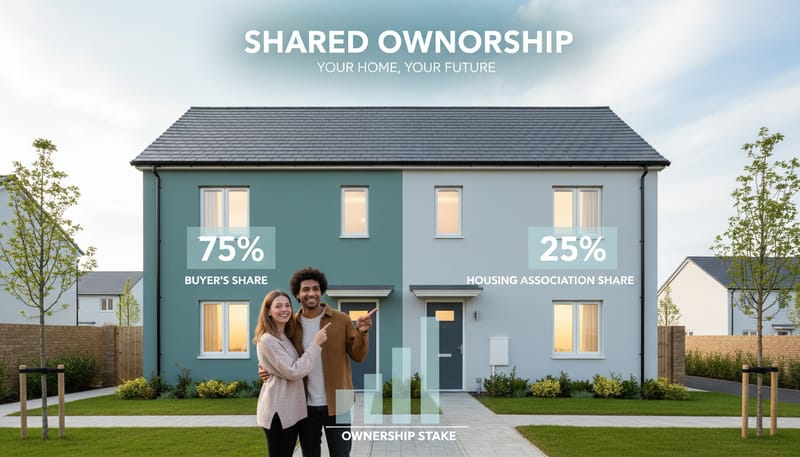
How Shared Ownership Works
Shared ownership is a government-backed scheme delivered through housing associations (also called registered providers). Here's the basic structure:
| Element | How It Works |
|---|---|
| Your share | You buy between 25% and 75% of the property's market value |
| Housing association's share | The housing association owns the remaining percentage |
| Your mortgage | You take out a mortgage on your share only (not the full property value) |
| Rent | You pay rent to the housing association on their share — typically 2.75% of their share's value per year |
| Service charge | You pay the full service charge (not a proportion) — this covers building maintenance, communal areas, and insurance |
| Staircasing | Over time, you can buy additional shares until you own 100% ('staircasing') |
| Lease | You're a leaseholder — the housing association is the freeholder (or head leaseholder) |
The New Model Shared Ownership (Post-2021)
In April 2021, the government introduced the 'new model' shared ownership lease for homes funded by the 2021-2026 Affordable Homes Programme. Key changes from the old model:
| Feature | Old Model | New Model (2021 onwards) |
|---|---|---|
| Minimum initial share | 25% | 25% (unchanged) |
| Minimum staircasing increment | 10% (typical) | 1% for the first 15 years (up to a total of 15% additional) |
| Initial repair period | None — buyer responsible for all internal repairs from day one | Housing association responsible for essential structural repairs for the first 10 years |
| Resale nomination period | Varies — typically 8-12 weeks | Standardised 8-week nomination period, then you can sell on the open market |
| Rent cap | Usually 2.75% of unsold share | 2.75% of unsold share (unchanged), but annual increases capped at CPI + 1% (replacing RPI + 0.5%) |
Not all shared ownership properties use the new model — it depends on when the development was funded. Your housing association will confirm which model applies to your property.
Who Is Eligible?
Shared ownership has eligibility criteria set by Homes England (in England). The rules differ slightly in Scotland, Wales, and Northern Ireland.
England — Eligibility Requirements
| Requirement | Detail |
|---|---|
| Household income | Maximum £80,000 per year (£90,000 in London) |
| First-time buyer or... | Must be a first-time buyer, a previous homeowner who can't afford to buy now, or an existing shared owner looking to move |
| Unable to buy outright | You must demonstrate that you cannot afford to buy a suitable home on the open market in your area |
| No current property ownership | You must not own another property at the time of purchase (or must have sold it) |
| UK resident or right to remain | Must have indefinite right to remain in the UK |
| No rent arrears | Must not have significant rent arrears or a poor tenancy record |
| Financially assessed | Must pass a financial assessment — usually through the housing association's approved financial adviser |
| Local connection (sometimes) | Some developments prioritise applicants with a local connection (living or working in the area) |
Priority Groups
Some developments prioritise certain groups:
- Military personnel: Current and former armed forces personnel often receive priority
- Local residents: People already living or working in the local authority area
- Key workers: Some London developments still prioritise NHS staff, teachers, police officers, and firefighters
- Existing social housing tenants: People in council or housing association rented homes
Scotland, Wales, and Northern Ireland
| Nation | Scheme Name | Key Differences |
|---|---|---|
| Scotland | Shared equity (not shared ownership) — various schemes through Scottish Government | Different structure — typically equity loan rather than part-buy/part-rent. No ongoing rent on the unsold share in most schemes |
| Wales | Shared ownership through Homebuy / housing associations | Similar to English model; income limits and eligibility set by Welsh Government |
| Northern Ireland | Co-Ownership Housing | Managed by Co-Ownership Housing Association; buy 50-90% shares; no rent on the unsold share (replaced by a small monthly charge) |
What Shared Ownership Really Costs Each Month
The headline attraction of shared ownership is a lower deposit and lower mortgage. But your monthly costs include multiple components that together can be higher than many buyers expect.
Monthly Cost Breakdown
| Cost | Who Pays | Typical Amount | How It's Calculated |
|---|---|---|---|
| Mortgage repayment | You | Varies by share size, interest rate, and term | Based on mortgage on your share only |
| Rent to housing association | You | Usually 2.75% of the unsold share's value per year, paid monthly | If property is £300,000 and you own 40%, rent is 2.75% × £180,000 = £4,950/year = £412/month |
| Service charge | You (100%, not proportional) | £100-£350/month for flats; £50-£200/month for houses | Set by the housing association or management company; covers maintenance, insurance, communal areas |
| Ground rent | You | Peppercorn (zero) for leases post-June 2022 | Leasehold Reform (Ground Rent) Act 2022 applies |
| Council tax | You (full amount) | £100-£300/month depending on band and area | Full council tax regardless of your share percentage |
| Buildings insurance | Usually included in service charge | Included | Arranged by the housing association/freeholder |
| Contents insurance | You | £15-£40/month | Your responsibility to arrange |
Worked Example: 2-Bed New Build Flat at £300,000
| Cost | 25% Share (£75,000) | 40% Share (£120,000) | 50% Share (£150,000) |
|---|---|---|---|
| Deposit (5% of share) | £3,750 | £6,000 | £7,500 |
| Mortgage (95% LTV, 5%, 30yr) | £382/month | £612/month | £765/month |
| Rent (2.75% of HA share) | £516/month | £412/month | £344/month |
| Service charge | £200/month | £200/month | £200/month |
| Council tax (Band C) | £150/month | £150/month | £150/month |
| Contents insurance | £25/month | £25/month | £25/month |
| Total monthly | £1,273 | £1,399 | £1,484 |
The Same Property Bought Outright
| Cost | Full Purchase (£300,000) |
|---|---|
| Deposit (10%) | £30,000 |
| Mortgage (90% LTV, 4.5%, 30yr) | £1,368/month |
| Rent | £0 |
| Service charge | £200/month |
| Council tax | £150/month |
| Contents insurance | £25/month |
| Total monthly | £1,743 |
The 25% shared ownership option costs £470 less per month than buying outright — but you only own 25% of the property. You're paying rent on the other 75% with no equity built. The real question is whether the lower entry point justifies the long-term cost structure.
The Deposit: How Much You Actually Need
| Full Property Value | Your Share (25%) | Deposit (5% of share) | Deposit (10% of share) |
|---|---|---|---|
| £200,000 | £50,000 | £2,500 | £5,000 |
| £250,000 | £62,500 | £3,125 | £6,250 |
| £300,000 | £75,000 | £3,750 | £7,500 |
| £350,000 | £87,500 | £4,375 | £8,750 |
| £400,000 | £100,000 | £5,000 | £10,000 |
The low deposit requirement is shared ownership's biggest attraction. A £3,750 deposit on a £300,000 property is dramatically more achievable than the £15,000-£30,000 needed for a full purchase. But remember: you'll also need funds for solicitor fees, stamp duty (on your share), searches, and moving costs. For full deposit planning, see our deposit guide.
Stamp Duty on Shared Ownership
Shared ownership buyers have two options for stamp duty (SDLT in England):
| Option | How It Works | When It's Better |
|---|---|---|
| Option 1: Pay on initial share only ('market value election') | You pay SDLT only on the value of your initial share. But you pay again each time you staircase above 80% | Better if your initial share is small and you don't plan to staircase quickly to 80%+ |
| Option 2: Pay on full market value upfront ('election to pay in full') | You pay SDLT on the full property value at purchase. No further SDLT when you staircase | Better if the full value falls within first-time buyer nil-rate band (up to £300,000 post-April 2025) or if you plan to staircase to 100% |
Example: £300,000 Property, 25% Share (£75,000), First-Time Buyer
| Option | SDLT at Purchase | SDLT on Staircasing to 100% | Total SDLT |
|---|---|---|---|
| Option 1 (share only) | £0 (below £125,000 threshold) | SDLT due on the share that takes you above 80% — could be significant depending on market value at that point | Variable — depends on future property value |
| Option 2 (full value) | £0 (FTB relief covers up to £300,000) | £0 — already paid on full value | £0 |
For a £300,000 property, Option 2 is clearly better for first-time buyers because the entire amount falls within the FTB nil-rate band. Your solicitor should advise you on the best option for your specific circumstances.
Rent: How It Works and How It Increases
The rent you pay on the housing association's share is a significant ongoing cost that many buyers underestimate.
| Rent Element | Detail |
|---|---|
| Initial rent level | Typically 2.75% of the unsold share's value per year (some housing associations charge less, rarely more) |
| Annual increase | New model (2021+): CPI + 1% maximum. Old model: RPI + 0.5% (or as stated in the lease) |
| Rent review | Usually reviewed annually on the anniversary of the lease |
| Rent and staircasing | As you buy more shares, the unsold share decreases, and your rent decreases proportionally |
| Rent at 100% ownership | Once you own 100%, rent stops entirely |
Rent Escalation Over Time
Even with the new CPI + 1% cap, rent increases compound over time. Here's how the rent on a 75% unsold share (property value £300,000) could grow assuming 3% annual increases:
| Year | Annual Rent | Monthly Rent | Cumulative Rent Paid |
|---|---|---|---|
| Year 1 | £6,188 | £516 | £6,188 |
| Year 5 | £6,966 | £581 | £32,838 |
| Year 10 | £8,077 | £673 | £70,939 |
| Year 15 | £9,364 | £780 | £115,285 |
| Year 20 | £10,856 | £905 | £166,740 |
| Year 25 | £12,586 | £1,049 | £226,396 |
Over 25 years, you could pay over £226,000 in rent on the unsold share — with no equity built from those payments. This is the fundamental trade-off of shared ownership: lower entry costs, but ongoing rent that builds no ownership stake.
Staircasing: Buying More of Your Home
Staircasing is the process of buying additional shares in your property, increasing your ownership percentage towards 100%. It's one of the main selling points of shared ownership — the idea that you can gradually buy your way to full ownership.
How Staircasing Works
| Step | What Happens |
|---|---|
| 1. Request a valuation | You instruct an independent RICS surveyor to value the property at current market value (you pay for this — typically £300-£500) |
| 2. Calculate the share cost | The additional share is priced at the current market value (not what you originally paid) — e.g., if the property is now worth £350,000, a 10% share costs £35,000 |
| 3. Arrange funding | Either remortgage to release equity, use savings, or take a larger mortgage |
| 4. Legal process | Your solicitor handles the staircasing transaction — similar to a mini-conveyancing process |
| 5. Rent reduces | Your rent decreases proportionally as the unsold share reduces |
| 6. Full ownership | When you reach 100%, the rent stops and (for houses) the freehold transfers to you. For flats, you remain a leaseholder |
Staircasing Increments
| Lease Type | Minimum Increment | Maximum Increments |
|---|---|---|
| Old model (pre-2021) | Usually 10% minimum | Unlimited — can staircase to 100% in any combination |
| New model (2021+) | 1% for the first 15 years (up to a total of 15% additional through 1% increments) | Also unlimited for larger purchases; can mix 1% and larger increments |
Staircasing Costs
Each time you staircase, you pay:
| Cost | Typical Amount |
|---|---|
| RICS valuation | £300-£500 |
| Solicitor fees | £500-£1,500 |
| Mortgage arrangement fee (if remortgaging) | £0-£1,000 |
| Stamp duty (only if staircasing above 80% on Option 1, or none on Option 2) | Variable |
| Land Registry fee | £50-£300 |
| Total per staircasing event | £850-£3,300+ |
The transaction costs of staircasing mean that doing it in many small increments is expensive. Each 1% staircase under the new model still incurs £850+ in fees. Larger, less frequent staircases are more cost-effective.
The Property Value Problem
When you staircase, additional shares are valued at the current market value, not the original purchase price. This means:
- If the property has increased in value: Each additional share costs more than it would have at purchase. You're buying into your own property's appreciation
- If the property has decreased in value: Additional shares are cheaper, which is good for staircasing — but your existing share is also worth less
Staircasing Example
| Staircasing Event | Property Value | Share Bought | Cost | Total Owned | Remaining Rent Share |
|---|---|---|---|---|---|
| Initial purchase | £300,000 | 25% = £75,000 | £75,000 | 25% | 75% |
| Staircase year 3 | £330,000 | 15% = £49,500 | £49,500 + fees | 40% | 60% |
| Staircase year 7 | £370,000 | 20% = £74,000 | £74,000 + fees | 60% | 40% |
| Staircase year 12 | £420,000 | 40% = £168,000 | £168,000 + fees | 100% | 0% |
| Total cost to reach 100% | £366,500 + fees |
In this example, you pay £366,500 to buy a property that originally cost £300,000 — because each staircase is priced at the current (higher) market value. Add the rent paid over 12 years (roughly £70,000-£90,000 depending on staircasing timing) and the total cost significantly exceeds buying outright at the beginning.
Selling a Shared Ownership Property
Selling shared ownership is more restricted than selling a property you own outright.
The Nomination Period
| Stage | What Happens | Timeframe |
|---|---|---|
| 1. Notify the housing association | You must tell the housing association you want to sell | Before marketing the property |
| 2. Valuation | Independent RICS valuation to set the sale price (you pay) | 1-2 weeks |
| 3. Nomination period | Housing association has the right to find a buyer from their waiting list | 4-8 weeks (new model: 8 weeks standard) |
| 4. If a buyer is found | Sale proceeds with the nominated buyer at the valuation price | Standard conveyancing timeline |
| 5. If no buyer is found | You can sell on the open market through an estate agent | After the nomination period expires |
Selling at Less Than 100% Ownership
If you sell before staircasing to 100%, you sell your share only. The new buyer takes over the shared ownership lease on the same terms (paying rent on the unsold share). This limits your buyer pool to people who are eligible for shared ownership and can secure a shared ownership mortgage.
Selling at 100% Ownership
If you've staircased to 100%, you can sell like any other homeowner — no nomination period, no restrictions, full market sale. For houses, you'll also own the freehold. For flats, you remain a leaseholder (with a long lease).
Costs of Selling
| Cost | Amount |
|---|---|
| RICS valuation | £300-£500 |
| Estate agent (if selling on open market after nomination) | 1-2% of your share value |
| Solicitor fees | £800-£1,500 |
| Housing association administration fee | £0-£500 (varies) |
| Mortgage exit fees | Varies by lender |
Service Charges and Ongoing Costs
One of the most common complaints from shared ownership buyers is that service charges are higher than expected — and you pay the full amount, not a proportion based on your ownership share.
| What's Covered | Typical Annual Cost (Flat) | Your Share of the Cost |
|---|---|---|
| Building insurance | £200-£500 | 100% |
| Communal cleaning and maintenance | £500-£1,500 | 100% |
| Grounds maintenance | £200-£600 | 100% |
| Lift maintenance (if applicable) | £200-£500 | 100% |
| Communal electricity | £150-£400 | 100% |
| Management company fees | £300-£800 | 100% |
| Reserve/sinking fund | £200-£600 | 100% |
| Typical total | £1,800-£4,500/year | 100% |
For a comprehensive guide to service charges and how to challenge them, see our service charges guide.
Repairs and Maintenance
Old Model Leases
Under old model shared ownership leases, you are responsible for all repairs and maintenance inside the property from day one — just as if you owned it outright. This means plumbing, electrics, boiler, kitchen, bathroom, and everything inside the front door.
New Model Leases (2021+)
Under the new model, the housing association is responsible for essential structural repairs for the first 10 years. This covers:
- External walls, roof, and foundations
- External doors and window frames (structural, not cosmetic)
- Guttering and external drainage
- Communal structure (for flats)
It does not cover:
- Internal decoration
- Plumbing, heating, or electrics inside the property
- Kitchen and bathroom fixtures
- Flooring, carpets, or other finishes
- Gardens (for houses)
After 10 years, full repair responsibility transfers to you.
Mortgages for Shared Ownership
Not all mortgage lenders offer shared ownership products. The market is smaller than the standard residential mortgage market, which means:
| Factor | Standard Mortgage | Shared Ownership Mortgage |
|---|---|---|
| Number of lenders | 100+ | Around 20-30 active lenders |
| Interest rates | Competitive — wide range of products | Slightly higher on average; fewer deals to choose from |
| Deposit required | 5-25% of property value | 5-10% of your share value |
| Affordability assessment | Based on mortgage only | Based on mortgage + rent + service charge combined |
| Product transfer/remortgage | Wide choice of lenders | Fewer options — some lenders don't remortgage shared ownership |
| Overpayments | Usually permitted within limits | Usually permitted — reduces your mortgage but not the rent |
Important: Your affordability is assessed on the total monthly commitment: mortgage + rent + service charge + council tax. This means you may be able to borrow less than you'd expect, because the rent and service charge reduce the amount lenders will lend for the mortgage.
The Honest Pros and Cons
| Advantage | The Reality |
|---|---|
| Lower deposit — as little as £2,500-£7,500 | Genuinely the biggest benefit. Makes homeownership accessible years earlier than saving for a full deposit |
| Lower mortgage — only borrow on your share | True, but you pay rent on the rest. Total monthly costs are lower than buying outright, but not dramatically so |
| Foot on the property ladder | You build equity in your share, and if values rise, your share increases in value too. But appreciation benefits are proportional to your share |
| Staircasing to full ownership | Possible in theory, but expensive in practice. Each staircase is valued at current market prices, plus fees every time |
| New model 10-year repair responsibility | Helpful for the first decade — reduces unexpected repair costs |
| Security of tenure | You have a lease — much more secure than renting. Can't be evicted without cause |
| Disadvantage | The Reality |
|---|---|
| Rent on the unsold share builds no equity | You're paying rent to the housing association with no return — this can total £100,000+ over 15-20 years |
| Rent increases annually | CPI + 1% or RPI + 0.5% compounds over time, making rent increasingly expensive |
| Full service charge liability | You pay 100% of service charges regardless of your ownership share — on some developments this is £200-£400/month |
| Restricted resale process | Nomination period means you can't just sell on the open market immediately. Limited buyer pool for sub-100% sales |
| Staircasing is expensive | Valuation fees, legal fees, and buying at current market value mean the total cost of reaching 100% often exceeds the original property price |
| Fewer mortgage options | Smaller lender market means less choice and potentially higher rates |
| Leasehold complications | You're a leaseholder with all the associated restrictions — alterations, subletting, pets may all require permission |
| Perception of 'not really owning' | Some buyers feel shared ownership doesn't give them true homeownership — particularly when they need permission for changes |
| Negative equity risk is amplified | If the property falls in value, you're still paying rent on the unsold share at the original higher value |
Shared Ownership vs Other Options
| Option | Deposit Needed | Monthly Cost (£300k property) | Equity Built | Flexibility |
|---|---|---|---|---|
| Shared ownership (25%) | £3,750 | ~£1,273 | Partial (25% of appreciation) | Restricted resale |
| Full purchase (95% LTV) | £15,000 | ~£1,743 | Full (100% of appreciation) | Full freedom |
| Full purchase (90% LTV) | £30,000 | ~£1,568 | Full (100% of appreciation) | Full freedom |
| Renting | £0 (plus bond) | ~£1,200-£1,600 | None | Full flexibility |
| Deposit Unlock (5% deposit on full purchase) | £15,000 | ~£1,743 | Full | Full freedom |
If you can save a 5% deposit on the full purchase price, buying outright is almost always the better financial decision long-term. Shared ownership is most valuable when the deposit gap is genuinely unbridgeable in a reasonable timeframe.
The Conveyancing Process for Shared Ownership
Shared ownership conveyancing is more complex than a standard purchase because it involves additional documents, eligibility checks, and the housing association as a third party.
| Additional Element | What It Involves |
|---|---|
| Eligibility confirmation | Housing association confirms you meet shared ownership criteria |
| Financial assessment | Housing association's financial adviser assesses your affordability |
| Shared ownership lease | Your solicitor reviews the shared ownership lease (more complex than a standard lease) |
| Section 106 restrictions | Check whether the S106 agreement imposes local connection or income restrictions that survive resale |
| Housing association consent | Housing association must approve the sale — they're effectively a party to the transaction |
| Memorandum of staircasing | Document recording your initial share and the terms for future staircasing |
Because of this complexity, shared ownership conveyancing typically takes longer and costs more than a standard purchase. Budget £1,200-£2,500 for solicitor fees (including the leasehold premium). For the full conveyancing process, see our conveyancing guide.
Common Mistakes Shared Ownership Buyers Make
| Mistake | The Problem | How to Avoid It |
|---|---|---|
| Focusing only on the mortgage payment | Total costs (mortgage + rent + service charge) are much higher than the mortgage alone | Calculate all monthly costs before committing |
| Underestimating service charges | Service charges on new builds can be £200-£400/month and increase annually | Ask for the actual service charge budget, not just an 'estimate' |
| Assuming rent stays the same | Rent increases every year — over 10-20 years this significantly increases monthly costs | Model the rent over 10-25 years to see the true long-term cost |
| Planning to staircase 'soon' without checking the cost | Staircasing is based on current market value — if the property has risen, each share costs more than expected | Get a realistic sense of what staircasing will cost based on potential property value growth |
| Not understanding resale restrictions | The nomination period and limited buyer pool can make selling slower and more restrictive | Understand the resale process before buying |
| Choosing the wrong stamp duty option | Paying on the share when paying on the full value (Option 2) would have been cheaper | Get specific advice from your solicitor on which SDLT option is best for your situation |
| Not checking the lease terms | Some shared ownership leases have restrictive terms about pets, subletting, alterations, and parking | Read the lease carefully — your solicitor should explain all key restrictions |
| Ignoring the total cost of ownership | Mortgage + rent + service charge + council tax + staircasing costs can exceed the cost of buying outright | Compare the 25-year total cost against saving longer and buying at a higher share or outright |
Is Shared Ownership Right for You?
Shared ownership works well if:
- You genuinely can't save a 5% deposit on a full purchase within a reasonable timeframe
- You want the security of homeownership rather than renting
- The total monthly costs (mortgage + rent + service charge) are affordable and sustainable
- You have a realistic plan for staircasing (or are comfortable staying at your initial share)
- You understand the resale restrictions and are planning to stay for several years
Shared ownership may not be the right choice if:
- You could save a 5-10% deposit on a full purchase within 1-2 years — the long-term costs of shared ownership usually exceed the cost of waiting and buying outright
- The total monthly costs (especially rent + service charge) are barely affordable — they will increase every year
- You want maximum flexibility to sell, sublet, or make alterations
- You're uncomfortable being a leaseholder with a housing association as your landlord
Shared Ownership Checklist
- Confirmed eligibility with the housing association
- Passed the financial assessment
- Calculated total monthly costs: mortgage + rent + service charge + council tax
- Modelled rent increases over 10-25 years
- Understood the staircasing process, costs, and how shares are valued
- Checked the service charge budget (not just an estimate)
- Reviewed the lease terms: restrictions on alterations, subletting, pets
- Understood the resale process and nomination period
- Chosen the correct stamp duty option (share only vs full value)
- Instructed a solicitor experienced in shared ownership conveyancing
- Secured a mortgage Agreement in Principle from a shared ownership lender
- Compared total 10-year and 25-year costs against renting and against saving for a full purchase
- Checked whether the property uses the old or new model shared ownership lease
- Asked about the 10-year repair responsibility (new model only)
- Understood that you pay 100% of service charges regardless of your ownership share