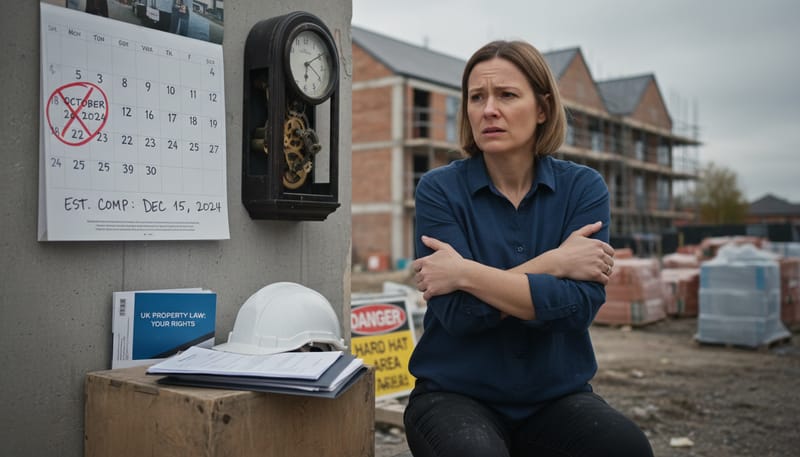
When Your New Build Home Is Not Ready on Time
One of the most stressful experiences for any new build buyer is being told that your home will not be ready when expected. Completion delays are, unfortunately, not uncommon in the new build sector. Whether caused by supply chain disruptions, labour shortages, adverse weather, or planning issues, a delayed completion can have serious financial and practical consequences for buyers who have already legal checklist before exchangingd contracts and made arrangements to move.
This guide explains your legal rights if your new build completion is delayed, the remedies available to you under both contract law and the Consumer Code for Home Builders, and the practical steps you should take to protect your position. Understanding these rights is essential for any buyer who has exchanged contracts on a new build property or is considering doing so.
Jurisdictional note: This guide covers the law in England & Wales. Scotland operates a different system of property law (based on missives and settlement), and Northern Ireland has its own statutory framework. If you are buying in Scotland or Northern Ireland, seek advice from a locally qualified solicitor.
Disclaimer: This article provides general guidance on legal rights relating to new build completion delays. It does not constitute legal advice. Individual circumstances vary, and you should consult a qualified solicitor for advice specific to your situation.
What Constitutes a Delay & Contractual Long-Stop Dates
To understand your legal position, you first need to understand how completion dates work in new build contracts. Unlike a standard resale transaction where a fixed completion date is agreed at exchange, new build contracts typically operate on a different basis.
How New Build Completion Dates Work
Most new build contracts use one of two mechanisms for determining the completion date:
- Notice-based completion: The developer gives you a specified period of notice (typically 10–14 working days) that the property is ready for completion. The contract will also include an “estimated completion date” or “anticipated completion date,” but this is usually expressed as an estimate, not a binding commitment.
- Fixed completion date: Less common for new builds, but some contracts specify a fixed date. If the developer cannot complete by this date, they are in breach of contract unless the contract provides for extensions.
The Long-Stop Date
The critical date in any new build contract is the long-stop date (sometimes called the “sunset date” or “backstop date”). This is the absolute latest date by which the developer must complete the property. If the developer fails to complete by the long-stop date, you typically have the right to:
- Rescind (cancel) the contract
- Receive a full refund of your deposit
- Potentially claim compensation for losses incurred
Long-stop dates are typically set at 12–24 months from the date of exchange, depending on the stage of construction at the time you exchanged contracts. Your solicitor should have checked the long-stop date before you exchanged — as part of the pre-exchange checklist — and ensured it is reasonable.
When Does a “Delay” Legally Arise?
| Scenario | Legal Position | Your Rights |
|---|---|---|
| Estimated completion date passes but long-stop date has not | Developer not technically in breach if estimated date was not contractually binding | Limited; may claim under Consumer Code but not necessarily in contract |
| Fixed completion date passes | Developer in breach of contract | Claim for damages; potentially serve notice to complete |
| Long-stop date passes without completion | Developer in fundamental breach | Right to rescind contract and recover deposit plus damages |
| Developer serves completion notice but property has defects | Depends on severity; minor snagging checklist does not justify refusal to complete | Must complete but can pursue defects under warranty and defects liability period |
| Force majeure event causes delay | Developer may be excused from delay if contract includes force majeure clause | Long-stop date may be extended; check contract terms carefully |
Developer Obligations Under the Consumer Code
The Consumer Code for Home Builders (the “Consumer Code”) sets out standards of good practice that registered developers must follow. Most major UK house builders are signed up to the Consumer Code as a condition of their NHBC Buildmark warranty or equivalent warranty registration.
Key Consumer Code Protections on Completion Delays
The Consumer Code contains specific provisions about completion timescales and delays:
- Reliable completion information: Developers must provide buyers with reliable and realistic information about when the home will be completed. They must not give unreasonably optimistic timescales to secure a sale.
- Timely notification of delays: If the anticipated completion date changes, the developer must notify the buyer as soon as reasonably practicable, explain the reasons for the delay, and provide a revised estimated completion date.
- Right to cancel: If the delay exceeds a specified period (or the long-stop date passes), the Consumer Code supports the buyer’s right to cancel the contract and receive a full refund of their reservation fee and deposit.
- Compensation for delays: The Consumer Code requires developers to have a complaints and disputes procedure. While the Code does not specify exact compensation amounts, it establishes the principle that buyers should not suffer unreasonable financial hardship as a result of developer delays.
Limitations of the Consumer Code
It is important to understand that the Consumer Code is an industry code of practice, not legislation. While developers who are signed up to the Code are expected to comply with its provisions, enforcement is through the Code’s own dispute resolution process (operated by the Independent Dispute Resolution Scheme) rather than through the courts. The Code provides a useful framework for resolving disputes, but it does not replace your contractual and statutory rights.
The Financial Impact of Completion Delays
A delayed new build completion can result in significant additional costs for buyers. Understanding these costs is important both for budgeting purposes and because many of them may be recoverable from the developer if the delay amounts to a breach of contract.
Common Additional Costs
| Cost Category | Description | Typical Amount |
|---|---|---|
| Extended rental costs | If you have given notice on your current rental or sold your existing home, you may need temporary accommodation | £800–£2,500+ per month depending on location |
| Storage costs | If you have packed up your belongings in anticipation of moving, you may need to pay for storage | £100–£300 per month |
| Mortgage offer expiry | If the delay causes your mortgage offer to expire, you may face higher interest rates or need to pay for a new valuation | Valuation fee: £250–£600; increased monthly payments variable |
| Chain-related costs | If you are selling a property to fund the purchase, the delay may cause your own sale to collapse | Potentially thousands in abortive legal fees and remarketing costs |
| Lifetime ISA complications | Bonus payment timing may be affected if completion is delayed beyond scheme deadlines | Up to £3,000 bonus at risk if terms are not met |
| Additional legal fees | Your solicitor may charge additional fees for the extra work caused by the delay | £200–£500+ |
It is essential to keep detailed records of all additional costs incurred as a result of the delay. Save invoices, receipts, tenancy agreements, storage contracts, and correspondence with your mortgage lender. These records will be vital if you later pursue a claim for compensation.
Legal Remedies & When You Can Withdraw
Your legal remedies for a delayed new build completion depend on the specific terms of your contract, the length and nature of the delay, and whether the developer has breached any of their obligations.
Contractual Remedies
- Rescission at long-stop date: If the developer has not completed the property by the contractual long-stop date, you are typically entitled to rescind (cancel) the contract and receive a full refund of your deposit. This is usually the most straightforward remedy and should be clearly set out in your contract.
- Damages for breach of contract: If the developer is in breach of a contractual obligation to complete by a certain date, you may be entitled to claim damages. The measure of damages is typically the financial loss you have suffered as a direct result of the breach — for example, additional rental costs, storage fees, and mortgage-related expenses.
- Specific performance: In theory, you could apply to the court for an order requiring the developer to complete the property. In practice, this is rarely appropriate for new builds because the court cannot force a builder to finish construction to a particular standard or by a particular date.
- Interest on deposit: Some contracts provide for the developer to pay interest on the deposit if completion is delayed beyond the estimated date. Check your contract to see if this provision exists.
Statutory Rights
In addition to your contractual rights, you may have statutory rights under consumer protection legislation:
- Consumer Rights Act 2015: If the purchase is a consumer transaction (which most residential purchases are), the developer must perform their obligations with reasonable care and skill and within a reasonable time. A significant delay may constitute a breach of these implied terms.
- Misrepresentation Act 1967: If the developer made specific promises about completion dates that induced you to enter into the contract, and those promises were false, you may have a claim for misrepresentation. This could entitle you to rescind the contract or claim damages.
When Can You Legally Withdraw?
You can withdraw from a new build purchase without penalty in the following circumstances:
- The contractual long-stop date has passed and the property is not ready for completion
- The developer has fundamentally breached the contract (for example, by building something materially different from the agreed specification)
- You have been induced to enter the contract by a material misrepresentation
- Both parties agree to rescind the contract by mutual consent
You cannot simply walk away from the contract because the estimated completion date has passed (unless the estimate was contractually binding) or because you have changed your mind about the purchase. Doing so without legal grounds would result in forfeiture of your deposit and potential liability for the developer’s additional losses.
Force Majeure Clauses & Exceptional Circumstances
Many new build contracts include a “force majeure” clause that allows the developer to extend the completion deadline (and potentially the long-stop date) in certain exceptional circumstances beyond the developer’s reasonable control.
Common Force Majeure Events
Force majeure clauses typically cover events such as:
- Severe adverse weather conditions (beyond normal seasonal expectations)
- National or regional emergencies (pandemic restrictions, for example)
- Strikes or industrial action affecting the construction industry
- Shortages of essential building materials caused by events beyond the developer’s control
- Government-imposed restrictions on construction activity
- Natural disasters (flooding, earthquakes, etc.)
Challenging a Force Majeure Claim
Developers cannot invoke force majeure to excuse any and all delays. The clause typically requires the developer to demonstrate that:
- The event was genuinely beyond their reasonable control
- The event has directly caused or contributed to the delay
- The developer has taken all reasonable steps to mitigate the impact of the event
- The delay would not have occurred but for the force majeure event
If you believe the developer is improperly relying on a force majeure clause to excuse delays that are actually caused by poor project management, labour shortages due to the developer’s own planning failures, or financial difficulties, your solicitor should challenge this. A developer cannot use force majeure to paper over foreseeable or self-inflicted delays.
It is also worth noting that force majeure clauses vary significantly from contract to contract. Some are broadly drafted and may give the developer considerable latitude, while others are more narrowly defined. Your solicitor should have reviewed this clause as part of the contract review process before exchange.
Practical Steps to Take If Completion Is Delayed
If you receive notification that your new build completion will be delayed, here are the practical steps you should take to protect your legal and financial position:
Immediate Actions
- Contact your solicitor immediately: Inform your solicitor of the delay and ask them to review the contract terms, particularly the long-stop date, force majeure provisions, and any compensation clauses. Your solicitor can also write to the developer’s solicitor requesting formal confirmation of the reasons for the delay and a revised completion timeline.
- Notify your mortgage lender: Contact your lender to explain the delay and ask about the expiry date of your mortgage offer. If the offer is at risk of expiring, request an extension. Most lenders will grant extensions of 3–6 months for genuine completion delays, but they may require a new valuation or reassessment of your financial circumstances.
- Review your financial position: Calculate the additional costs you are likely to incur as a result of the delay. If you are renting, check the terms of your tenancy agreement — you may need to extend or negotiate a rolling tenancy. If you have given notice to your landlord, explain the situation as soon as possible.
- Keep detailed records: From this point forward, keep a record of all communications with the developer, your solicitor, your mortgage lender, and any other parties affected by the delay. Save emails, letters, and notes of telephone conversations. Record all additional expenses with supporting evidence (receipts, invoices, bank statements).
Ongoing Actions
- Request regular updates: Ask your solicitor to maintain regular contact with the developer’s solicitor for progress updates. A responsible developer will keep buyers informed, but if communication is poor, formal written requests for updates create a useful paper trail.
- Consider the Consumer Code complaint process: If you believe the developer is not handling the delay in accordance with the Consumer Code for Home Builders, you can raise a formal complaint through the Code’s dispute resolution scheme.
- Assess your options as the long-stop date approaches: If the delay is significant and the long-stop date is approaching, discuss your options with your solicitor. You may wish to negotiate an extension of the long-stop date (in exchange for compensation or other concessions from the developer), or you may decide to exercise your right to rescind the contract.
- Do not agree to vary the contract without legal advice: The developer may ask you to agree to an extension of the long-stop date or other contract variations. Do not agree to any changes without first consulting your solicitor. Any variation should be properly documented and, ideally, should include some form of compensation for the inconvenience and additional costs caused by the delay.
Frequently Asked Questions
Can I claim compensation from the developer for a delayed completion?
Yes, in many cases you can claim compensation, but the basis for your claim depends on the contract terms and the nature of the delay. If the developer is in breach of a contractual obligation to complete by a specified date, you can claim damages for the losses you have suffered (additional rent, storage costs, mortgage expenses, etc.). If the delay exceeds the long-stop date, you can typically rescind the contract and recover your deposit in full. If the developer is a signatory to the Consumer Code, you may also pursue a claim through the Code’s dispute resolution process. Your solicitor can advise on the most appropriate route based on your specific circumstances.
My mortgage offer has expired because of the delay. What can I do?
Contact your lender immediately to request an extension. Most lenders are sympathetic to delays caused by the developer and will extend the offer, although they may require a fresh valuation or credit check. If the lender will not extend the offer, you will need to apply for a new mortgage, potentially at a different interest rate. The additional costs of a new mortgage application (valuation fees, higher interest rates) are losses that may be recoverable from the developer if they are in breach of contract. Keep records of all costs incurred.
The developer says the delay is caused by “force majeure.” Can they just extend the deadline indefinitely?
No. Force majeure clauses typically allow the developer to extend the completion deadline by a reasonable period, but they cannot be used to extend it indefinitely. The developer must demonstrate that the delay was genuinely caused by an event beyond their reasonable control and that they have taken all reasonable steps to mitigate its impact. Furthermore, most contracts set an outer limit — the long-stop date — which may or may not be extended by force majeure. Check the specific wording of your contract, as some contracts expressly state that the long-stop date is not affected by force majeure.
Can I visit the site to check on progress during the delay?
You do not have an automatic legal right to access the construction site before completion, as it is the developer’s property (and an active construction site with health and safety restrictions). However, many developers will accommodate reasonable requests for progress visits, particularly if you express concerns about the delay. Ask politely and be flexible about timing. If the developer refuses all access, this may be a concern, and your solicitor can make formal enquiries about the progress of construction.
What if I have already sold my existing home and have nowhere to live?
This is one of the most difficult situations arising from a completion delay. You may need to arrange temporary rental accommodation, stay with family or friends, or negotiate a delayed completion on your own sale if possible. All additional costs (temporary accommodation, storage, removal firm cancellation fees) should be documented carefully, as they may be recoverable from the developer. If the situation is causing you severe financial hardship, instruct your solicitor to make urgent representations to the developer. Some developers will offer to cover or contribute to temporary accommodation costs as a goodwill gesture, even if they do not accept legal liability for the delay. For more on what to expect during the new build buying process, see our step-by-step guide.
Conclusion: Know Your Rights and Act Promptly
A delayed new build completion is frustrating and can be expensive, but it is important to understand that you do have legal rights and practical options. The key points to remember are:
- Check your contract for the long-stop date and any compensation provisions
- Contact your solicitor immediately upon learning of a delay
- Notify your mortgage lender and discuss extending your offer
- Keep detailed records of all additional costs and communications
- Do not agree to contract variations without legal advice
- Consider the Consumer Code complaint process if the developer is not acting reasonably
- Exercise your right to rescind at the long-stop date if the delay is unacceptable
The earlier you take action, the better your position will be. A solicitor experienced in conveyancing process-process-new-build">new build conveyancing can guide you through the process and help ensure that the developer meets their obligations — or that you are properly compensated if they do not.
For related guidance, see our articles on understanding new build contracts and what to check before reserving a new build.
This article provides general information about legal rights relating to new build completion delays in England & Wales. It does not constitute legal advice. Always seek professional legal advice from a qualified solicitor or licensed conveyancer for guidance tailored to your specific circumstances.