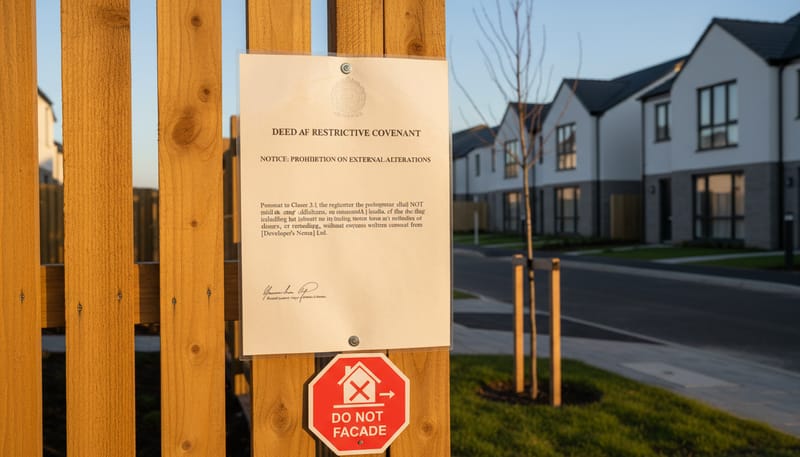
What Are Restrictive Covenants and Why Do They Matter?
When you purchase a new build home, you are not simply buying bricks and mortar — you are also accepting a set of legally binding obligations that will govern how you can use and modify your property for years to come. These obligations are known as restrictive covenants, and they are a standard feature of virtually every new build development in England & Wales.
Restrictive covenants are conditions written into the title deeds of a property that restrict the owner’s use of the land in some way. They are designed to preserve the character, appearance, and value of the wider estate by preventing individual homeowners from doing things that might adversely affect their neighbours or the development as a whole. While many covenants are perfectly reasonable — and can even protect your own property’s value — others can be unexpectedly limiting, and it is essential that you understand them fully before you exchange contracts on your new build home.
This guide explains what restrictive covenants are, the most common types found on new build estates, who enforces them, how long they last, and what your options are if you want to modify or remove them in the future.
Jurisdictional note: This guide covers the law in England & Wales. Scottish property law handles real burdens (the equivalent of restrictive covenants) differently under the Title Conditions (Scotland) Act 2003. Northern Ireland has its own framework. Seek local legal advice if buying outside England & Wales.
Disclaimer: This article provides general information about restrictive covenants on new build properties. It does not constitute legal advice. You should always consult a qualified solicitor for advice on the specific covenants affecting your property.
Restrictive Covenants Explained
A restrictive covenant is a legally binding obligation that restricts the use of land or property. In legal terms, it is a negative obligation — it prevents you from doing something, rather than requiring you to do something (the latter being a “positive covenant”). Restrictive covenants “run with the land,” meaning they bind not only the original purchaser but also all future owners of the property.
How Restrictive Covenants Are Created
On new build estates, restrictive covenants are typically created in one of two ways:
- In the transfer deed (TR1): When the developer sells an individual plot, the transfer deed will contain a schedule of covenants that the buyer agrees to observe. These are then registered at the Land Registry as part of the title.
- In a deed of covenant or estate management deed: Some developers use a separate deed that sets out the obligations of all homeowners on the estate. This deed may be linked to the management company structure and create mutual obligations between all homeowners.
The Legal Framework
The law governing restrictive covenants in England & Wales is largely based on case law, dating back to the landmark case of Tulk v Moxhay (1848). The key legal principles are:
- A restrictive covenant must be negative in nature (it must restrict rather than require action)
- It must be intended to benefit neighbouring land (known as the “dominant tenement”)
- The person imposing the covenant must retain land that benefits from it
- It must be properly registered to bind subsequent purchasers
- Positive covenants (requiring action, such as maintaining a fence) do not generally bind future owners of freehold land, although they can be enforced through indirect mechanisms such as estate management schemes
This last point is particularly important on new build estates, where developers often try to impose both positive and negative obligations. Your solicitor should explain which obligations are legally enforceable as covenants and which rely on other mechanisms for enforcement.
Common Restrictive Covenants on New Build Estates
While the specific covenants vary from development to development, certain restrictions appear on virtually every new build estate. Here is a comprehensive overview of the most common covenants you are likely to encounter:
| Covenant Type | Typical Restriction | Practical Impact |
|---|---|---|
| No commercial use | Property must be used as a single private dwelling only; no business, trade, or commercial activity | Running a business from home may breach the covenant, even if you have planning permission. Home working (office-based) is usually acceptable; visible trade activity is not |
| Vehicle restrictions | No caravans, motorhomes, boats, or commercial vehicles to be kept or stored on the property or its curtilage | Cannot park a work van on the driveway or store a caravan in the garden; may affect tradespeople who use commercial vehicles |
| Fencing restrictions | Front boundaries must remain open-plan or use only specified fencing types; rear fencing limited to certain heights and materials | Cannot erect solid front fences or walls; must use specified styles for rear boundaries; may need consent for changes |
| Satellite dishes and aerials | No satellite dishes, aerials, or similar apparatus on front elevations or visible from the public highway | Satellite dishes must be installed on rear elevations only; may affect signal reception in some cases |
| Exterior alterations | No external alterations, extensions, or additions without prior written consent of the developer or management company | Cannot add conservatories, extensions, or alter the exterior (windows, doors, render) without permission — even if planning permission is not required |
| Garden structures | No sheds, outbuildings, greenhouses, or similar structures without consent; size and position restrictions | May need written consent for a garden shed, even if it falls within permitted development rights |
| Property subdivision | Property must not be divided into flats or separate dwellings | Cannot convert a house into flats even with planning permission; prevents HMO conversions |
| Animal restrictions | No livestock, poultry, or animals that may cause a nuisance; sometimes limits on the number of domestic pets | Cannot keep chickens, goats, or other livestock; restrictions on breeding animals commercially |
Less Common but Notable Covenants
Some developments include more unusual or restrictive covenants that can catch buyers by surprise:
- Colour restrictions: Requirement to maintain the exterior in its original colour scheme; no painting or rendering in different colours without consent
- Washing line restrictions: No washing or laundry to be hung outside where visible from the public highway or neighbouring properties
- Sign restrictions: No signs, notices, or advertisements (including estate agent boards) without consent — though this is difficult to enforce regarding “For Sale” boards
- Hardstanding restrictions: Cannot pave over front gardens or create additional parking without consent
- Tree and hedge restrictions: Requirement to maintain specified trees or hedges planted by the developer; restrictions on removing boundary hedging
- Short-term letting: No letting of the property for periods of less than six or twelve months (preventing holiday lets and Airbnb-style use)
Who Enforces Restrictive Covenants?
Understanding who has the right to enforce a restrictive covenant is crucial, because a covenant is only as effective as the willingness and ability of the person entitled to enforce it.
Parties Who May Enforce Covenants
- The developer: As the original party who imposed the covenants, the developer can enforce them for as long as they retain land that benefits from the covenants. On large phased developments, the developer may retain land for many years. Once the developer has sold all plots and retains no land in the vicinity, their ability to enforce may lapse.
- The management company: On estates with a residents’ management company, the benefit of the covenants is often assigned or transferred to the management company. This gives the RMC (and by extension, the residents collectively) the right to enforce covenants against individual homeowners.
- Neighbouring homeowners: If the covenants are structured as a “building scheme” (or “scheme of development”), each homeowner on the estate may have the right to enforce the covenants against every other homeowner. This creates mutual rights and obligations across the estate. For a building scheme to exist, certain legal criteria must be met, including evidence that the covenants were intended to benefit all plots equally.
- Successors in title: The benefit of restrictive covenants can pass to future owners of the land that benefits from them. So even after the original developer has sold up, a successor landowner may be able to enforce the covenants.
Enforcement in Practice
In practice, enforcement of restrictive covenants on new build estates varies considerably. Some management companies actively police covenant compliance, writing to homeowners who breach the rules and, in extreme cases, taking legal action. Others take a more relaxed approach, only intervening when neighbours complain. The key points to understand are:
- Breach of a restrictive covenant can result in a court injunction requiring you to undo the breach (for example, removing an unauthorised extension) and potentially damages for any loss caused
- Even if a covenant has not been actively enforced for years, it may still be legally enforceable — the doctrine of “laches” (unreasonable delay in enforcement) can provide a defence in some cases, but this is uncertain
- Restrictive covenant insurance is available to cover the risk of enforcement, but insurers will not provide cover if you have already drawn attention to the issue (for example, by applying for consent to modify the covenant)
How Long Do Covenants Last & Can They Be Modified?
One of the most common questions buyers ask is whether restrictive covenants expire or can be changed. The short answer is that most covenants last indefinitely, but there are legal mechanisms for modification or removal.
Duration of Restrictive Covenants
Restrictive covenants on freehold land in England & Wales do not have an automatic expiry date. Unless the covenant itself specifies a time limit (which is unusual), it will continue to bind the land and all future owners in perpetuity. This means that the covenants imposed when your new build estate was first developed could theoretically be enforced 50, 100, or even 200 years from now.
However, the practical enforceability of a covenant may diminish over time if the character of the area changes significantly, if the person or body entitled to enforce it no longer exists or no longer has an interest, or if the covenant has been widely breached without any enforcement action being taken.
Mechanisms for Modification or Removal
| Method | How It Works | Practical Considerations |
|---|---|---|
| Consent from the beneficiary | The person or body with the right to enforce the covenant agrees to waive or modify it | Most straightforward route; the developer or management company may charge an administrative fee or request payment for giving consent. Fees can range from £50 to several thousand pounds |
| Application to the Upper Tribunal (Lands Chamber) | Under Section 84 of the Law of Property Act 1925, you can apply to the Tribunal to discharge or modify a restrictive covenant | Must demonstrate one of the statutory grounds (e.g., the covenant is obsolete, impedes reasonable use of the land, or causes no injury to the beneficiary). Process can take 6–12 months and costs £2,000–£10,000+ in legal fees |
| leasehold vs freehold">deed of variation | A formal legal document agreed between the parties that amends the terms of the original covenant | Requires agreement from all parties with the benefit of the covenant; must be registered at the Land Registry |
| Insurance | Rather than removing the covenant, you can obtain restrictive covenant indemnity insurance to cover the risk of enforcement | Suitable for low-risk breaches where the covenant holder is unlikely to enforce; relatively inexpensive (often a one-off premium of £100–£500). Do not approach the covenant holder before obtaining insurance, as this may invalidate the policy |
Impact on Future Modifications & Property Value
Restrictive covenants can have a significant impact on your ability to modify your property in the future and, in some cases, on its resale value.
Planning Permission vs Covenant Consent
One of the most important things to understand is that planning permission and restrictive covenant consent are completely separate legal requirements. Having planning permission to build an extension does not override a covenant that prohibits extensions without the developer’s consent. Similarly, the absence of a covenant does not mean you do not need planning permission. You may need both.
This catches many new build homeowners by surprise. They apply for and receive planning permission for an extension, conservatory, or loft conversion, only to discover that their title deeds contain a covenant preventing alterations without consent from the developer or management company. Proceeding with the works without covenant consent puts you at risk of an injunction and a claim for damages.
Impact on Property Value
The effect of restrictive covenants on property value is nuanced:
- Positive effects: Covenants that maintain the character and appearance of the estate (such as preventing commercial use, keeping front gardens open-plan, or requiring exterior maintenance) can actually support property values by preventing the estate from deteriorating
- Negative effects: Overly restrictive covenants (such as blanket prohibitions on extensions) may reduce the appeal of a property to buyers who want to extend or modify, potentially affecting resale value
- Mortgage implications: Most mortgage lenders are comfortable with standard restrictive covenants, but unusual or particularly onerous covenants may raise concerns. Your lender’s solicitor will review the covenants as part of the mortgage process
Common Scenarios and What to Do
- You want to build an extension: Check your title deeds for covenants restricting alterations. If a covenant exists, apply to the developer or management company for consent before starting work. Budget for a consent fee.
- You want to run a business from home: Review the “no commercial use” covenant carefully. Working from home in an office capacity (no visitors, no signage, no deliveries) is unlikely to breach most covenants, but running a visible commercial operation may.
- You want to park a commercial vehicle: If your title deeds prohibit commercial vehicles, you may need to park your work van elsewhere. Consider whether this is a deal-breaker before you reserve your new build.
- You want to install a garden office or shed: Check whether the covenant covers “outbuildings” or “structures.” Many new build covenants require consent for any structures in the garden, regardless of size.
Checking Covenants Before Purchase
The time to understand and assess restrictive covenants is before you exchange contracts, not after. Once you have exchanged, you are legally bound by every covenant in the title, and trying to get them changed after the event is far more difficult and expensive.
What Your Solicitor Should Do
As part of the conveyancing process-process-new-build">conveyancing process, your solicitor should:
- Obtain and review the draft transfer deed, including all proposed covenants
- Provide you with a clear, plain-English summary of every covenant and its practical implications
- Identify any covenants that may be unusually restrictive or potentially problematic
- Advise on whether any covenants are likely to affect your intended use of the property
- Where appropriate, negotiate with the developer’s solicitor to amend or remove unreasonable covenants
- Check whether the covenants are part of a building scheme (giving all homeowners mutual enforcement rights) or are enforceable only by the developer or management company
Questions to Ask Your Solicitor
- Are there any covenants that would prevent me from extending the property in the future?
- Is there a covenant restricting parking of commercial vehicles?
- Who has the right to enforce the covenants? Is it the developer, the management company, or other homeowners?
- If I want to make changes in the future, what is the process for obtaining consent?
- Are any of the covenants unusually restrictive compared to similar developments?
- How do the covenants interact with the management company obligations?
Due Diligence Checklist for Covenants
- Read the full schedule of covenants in the transfer deed (ask your solicitor for a copy if not already provided)
- Compare the covenants with your intended use of the property (do you plan to extend? work from home? park a commercial vehicle?)
- Check whether the covenants require you to obtain consent for common modifications (extensions, fencing, outbuildings, satellite dishes)
- Understand the consent process and any associated fees
- Consider whether the covenants will affect the property’s resale value or appeal to future buyers
- If buying leasehold, check the lease for additional restrictions beyond those in the transfer deed
Frequently Asked Questions
Can I ignore a restrictive covenant if everyone else on the estate does?
This is a risky strategy. While widespread non-enforcement may weaken the practical likelihood of a covenant being enforced against you, it does not eliminate the legal risk. A covenant remains enforceable until it is formally discharged or modified, regardless of how many people have breached it. If you breach a covenant and someone decides to enforce it — whether a neighbour, the management company, or a new owner of the developer’s retained land — you could face an injunction requiring you to undo the breach (such as demolishing an extension) and pay damages. The safest approach is to obtain proper consent or restrictive covenant insurance before proceeding.
Do restrictive covenants apply to leasehold properties as well?
Yes, but for leasehold properties (such as new build flats), the restrictions are typically contained in the lease rather than in separate covenants on the freehold title. Leasehold restrictions are legally distinct from freehold restrictive covenants and are generally easier to enforce because they are part of the landlord-tenant relationship. If you are buying a leasehold new build, your solicitor should review the lease terms carefully, as they may include restrictions that go beyond the standard covenants found on freehold estates.
Can I get restrictive covenant insurance instead of seeking consent?
Restrictive covenant indemnity insurance is available and can be a practical solution for breaches where the risk of enforcement is low. The insurance covers the cost of legal action and any damages or costs awarded if someone enforces the covenant against you. However, there are important limitations: the insurance will typically only cover you if you have not already drawn attention to the breach (by approaching the covenant holder for consent), the risk of enforcement must be assessed as low by the insurer, and the policy will not cover the cost of undoing the breach if an injunction is granted. Insurance is best suited for minor or technical breaches rather than major alterations.
What happens if I want to sell and the buyer’s solicitor raises concerns about covenants?
When you sell your property, the buyer’s solicitor will review the title, including all restrictive covenants. If there are any breaches (for example, an extension built without covenant consent), the buyer’s solicitor may require you to obtain retrospective consent, provide restrictive covenant insurance, or reduce the price to reflect the risk. Unresolved covenant issues can delay or even prevent a sale, so it is always better to deal with covenant compliance proactively rather than waiting until you come to sell.
Are new build covenants negotiable before exchange?
In theory, yes — your solicitor can ask the developer’s solicitor to amend or remove specific covenants. In practice, most developers use standard covenant packages across all plots on an estate and are reluctant to make individual exceptions, as this would create inconsistency and complicate estate management. However, it is always worth asking, particularly if a specific covenant would prevent you from using the property in a way that is important to you. The worst that can happen is that the developer says no, and you can then make an informed decision about whether to proceed with the purchase.
Conclusion: Read the Small Print Before You Buy
Restrictive covenants are a fact of life on new build estates, and most are reasonable measures designed to maintain the character and value of the development. However, they can also be surprisingly restrictive, and failing to understand them before you buy can lead to costly problems down the line.
The key takeaways from this guide are:
- Restrictive covenants are legally binding and run with the land indefinitely
- Common new build covenants cover commercial use, vehicles, fencing, satellite dishes, exterior alterations, and garden structures
- Planning permission does not override a restrictive covenant — you may need both
- Covenants can be enforced by the developer, the management company, and (on building scheme estates) by neighbouring homeowners
- Modification or removal is possible but requires either consent from the beneficiary, an application to the Upper Tribunal, or a deed of variation
- Always check and understand the covenants before you exchange contracts
If you are buying a new build home home, make sure your solicitor provides you with a clear and comprehensive explanation of all restrictive covenants before exchange. If any covenant concerns you, raise it early — it is far easier to negotiate or walk away before exchange than to deal with the consequences of a covenant breach after you have moved in.
For related guidance, see our articles on management company setup on new build estates and legal searches for new build buyers.
This article provides general information about restrictive covenants on new build properties in England & Wales. It does not constitute legal advice. Always seek professional legal advice from a qualified solicitor for guidance on the specific covenants affecting your property.