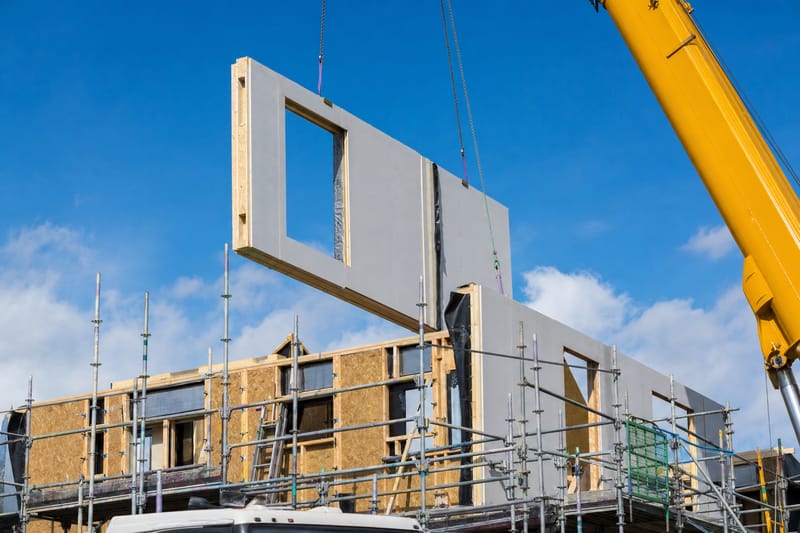
What "modular" and "offsite" actually mean
If you have been browsing new build listings and noticed phrases like "offsite manufactured", "modern methods of construction" or "volumetric modular", you are seeing the industry's long-running attempt to build homes more like products and less like one-off construction projects. The promise is simple: build large chunks of a house in a factory under controlled conditions, then transport and assemble them on site in days rather than months.
In practice, "modern methods of construction" (MMC) is an umbrella term covering several quite different approaches, and the differences matter enormously to you as a buyer — they affect mortgage availability, warranty cover, resale value and how the finished home actually performs.
- Volumetric modular — complete 3D room modules (with plumbing, wiring and sometimes finishes already installed) are built in a factory and craned into position on site. This is the most "factory-built" end of the spectrum.
- Panelised systems — flat panels (walls, floors, roofs), often timber frame or structural insulated panels (SIPs), are manufactured offsite and assembled on site like a kit of parts. This is by far the most common form of offsite construction in UK housebuilding today.
- Hybrid and pods — a traditionally built home with factory-made components for specific areas, most commonly bathroom pods or staircases.
- Site-based MMC — things like thin-joint blockwork or tunnel-form concrete that speed up traditional on-site building without moving manufacturing into a factory.
This matters because when people talk about modular housing "failing" or "succeeding", they are often talking about one narrow slice — volumetric modular — while ignoring the much larger, quieter growth of panelised and hybrid methods that are now routine on many developments across England, Scotland and Wales.
This article separates the hype from the reality: how much of current new build supply genuinely uses MMC, why some high-profile modular housebuilders have collapsed despite years of government backing, and what it practically means if you are choosing between a modular-built and a traditionally built new home today.
How much of UK new build supply is actually modular or offsite?
This is the question the industry has been reluctant to answer precisely, partly because reporting is patchy and definitions overlap. But the broad picture, drawing on housebuilder trading updates, trade body commentary and government housing statistics, is reasonably clear.
Across England, modern methods of construction — in any form — are typically estimated to account for somewhere in the region of 10–15% of new homes completed each year, though you should treat any single figure as an approximation rather than an official count, since MHCLG (the Ministry of Housing, Communities and Local Government) does not publish a definitive annual census of build method. Within that minority share, the split is heavily skewed:
- Timber frame and panelised systems make up the large majority of MMC homes, and are long-established, particularly common in Scotland (where timber frame has been the dominant method for decades) and increasingly used by volume housebuilders in England.
- Volumetric modular — the fully factory-built, crane-lifted module approach that attracts most media attention — remains a small fraction of total output, typically cited in low single-digit percentages of annual completions.
- Bathroom pods and other hybrid components are now genuinely mainstream, used by several major housebuilders on standard brick-and-block developments without buyers necessarily being aware of it.
| Build method | Approximate share of UK new build supply (2026, indicative) | Typical use case |
|---|---|---|
| Traditional brick and block (masonry) | Roughly 80–85% | Volume housebuilder estates nationwide |
| Timber frame / panelised (closed or open panel) | Roughly 10–15% | Scotland widely; increasing in England, especially for mid-rise flats |
| Volumetric modular | Low single digits | Affordable/social housing, some BTR, select private schemes |
| Hybrid (pods, panels within a masonry shell) | Growing, embedded within other categories | Bathroom pods, staircases, plant rooms on standard developments |
Treat these figures as directional rather than exact — always check the current figure from sources such as the NHBC, the Home Builders Federation (HBF) or MHCLG if you need a precise number for a specific purpose. The direction of travel, however, is not in dispute: offsite methods have grown steadily from a very low base over the past decade, even if the "modular revolution" promised around 2017–2020 has not materialised anywhere near as fast, or in the form, that was originally pitched.
The honest summary: offsite construction is a growing minority practice reshaping parts of UK housebuilding quietly, not the wholesale replacement of traditional building that was once predicted.
Why government and housebuilders pushed so hard for MMC
The enthusiasm for modular and offsite construction did not come out of nowhere. Several structural pressures on UK housebuilding converged to make factory-built homes look like an obvious answer, and understanding these drivers helps explain why the push has not simply disappeared despite some well-publicised setbacks.
The housing supply gap
Successive governments have set targets for new homes (figures such as 300,000 homes a year in England have been widely referenced, though actual annual completions have typically fallen short). Offsite construction was pitched as a way to build faster without proportionally increasing the skilled on-site workforce, which is itself in persistently short supply.
Skills shortages in traditional trades
The construction industry has faced a well-documented ageing and shrinking skilled trades workforce — bricklayers, carpenters and site supervisors in particular. Factory production lines can, in theory, use a more standardised, trainable workforce and reduce dependence on scarce on-site trades.
Quality and defects
Factory conditions allow more consistent quality control, protection from weather during construction, and in principle fewer of the snagging issues that plague some site-built homes — relevant if you have read about damp and condensation snagging issues or wondered whether a professional snagging survey is worth paying for.
Net zero and energy performance
Factory-built panels can achieve tighter airtightness and more consistent insulation installation than on-site work exposed to weather and time pressure, which matters as the Future Homes Standard pushes new builds toward lower carbon emissions and higher fabric performance.
Government funding and signalling
Homes England and predecessor bodies allocated funding specifically to support MMC housebuilders, and public procurement for affordable and social housing increasingly favoured offsite methods, at least for a period, as a way of demonstrating commitment to innovation and faster delivery.
These drivers remain genuine and unresolved, which is why MMC has not disappeared despite high-profile failures — the problems it was meant to solve are still there. What has changed is a more realistic, less hyped understanding of which parts of the MMC toolkit actually deliver on the promise at scale.
Why high-profile modular housebuilders have collapsed
If modular construction solves such a clear problem, why have several well-funded, well-publicised modular housebuilders gone under in recent years? This is the question buyers researching MMC homes most often ask, and it deserves a straight answer rather than either dismissal or doom-mongering.
Several volumetric modular manufacturers backed by major housebuilders, housing associations or private investment entered administration or wound down factory operations in the early-to-mid 2020s, despite having secured significant government support and order pipelines. The pattern across these cases tends to share common themes:
- Factory economics need volume to work. Offsite factories carry very high fixed costs — buildings, machinery, a permanent workforce — that only pay off if production lines run near capacity continuously. Housebuilding demand is cyclical and lumpy; a dip in order pipeline that a traditional site-based contractor can absorb by slowing down can be financially fatal for a factory that still has to pay for an idle production line.
- Standardisation clashed with planning reality. UK planning policy, local design codes and site-specific constraints often demand bespoke house types, varied elevations and site-specific adaptations. This undermines the core economic logic of modular manufacturing, which depends on repeating a limited catalogue of designs at scale.
- Upfront capital costs are front-loaded. A modular developer has to invest heavily in a module before it is sold, rather than drawing down costs progressively as a traditional site-based build does. This creates working capital pressure that is harder to manage through a market downturn.
- Transport and site logistics are unforgiving. Moving large 3D modules by road has practical constraints (module size limits, local infrastructure, crane access) that are easy to underestimate on a feasibility study and expensive to solve in practice.
- Mortgage lender and warranty caution slowed sales. Even well-built modular homes have sometimes struggled to sell quickly because lenders and surveyors were cautious about non-traditional construction, creating a vicious circle where slower sales worsened the cash flow pressures already described.
The failures seen in UK volumetric modular housing have generally been failures of business model and scale economics, not proof that factory-built homes are inherently lower quality — but the practical effect for buyers and the market has been the same: reduced confidence and fewer modular options on the ground.
It is worth being precise here rather than naming any single company as representative of the whole sector — the pattern has repeated across more than one well-known venture, and you should treat any claim about a specific named company's current trading status as something to verify directly, since the picture changes quickly. The broader lesson for the market is that volumetric modular at national housebuilder scale has proven commercially fragile in the UK, even where the underlying homes performed well for the people living in them.
Mortgages, warranties and insurance: the practical hurdles
Whatever the theoretical merits of offsite construction, none of it matters to you if you cannot get a mortgage or a warranty on the finished home. This has historically been one of the biggest brakes on modular housing adoption, and it is still worth checking carefully plot by plot.
Mortgage lending on non-traditional construction
Mainstream mortgage lenders assess "non-standard construction" with more scrutiny than brick-and-block homes, because resale liquidity and long-term durability data are less established. Many lenders will lend against panelised timber frame without hesitation, since it is a long-established and well-understood method, particularly in Scotland. Lending against volumetric modular has historically been more variable — some lenders are comfortable, others require specific warranty accreditation or decline altogether, and criteria can change without much notice.
Why warranty accreditation matters so much
A recognised structural warranty — from providers such as NHBC, LABC Warranty, Premier Guarantee or similar — is usually the single biggest factor in whether a lender will accept a modular or offsite-built home as security. For non-traditional construction, lenders and warranty providers often also look for BOPAS accreditation (Buildoffsite Property Assurance Scheme), which specifically certifies that an offsite-manufactured home has an expected design life comparable to traditional construction, typically 60 years or more.
Buildings insurance
Standard buildings insurance is generally available for accredited offsite homes, but always disclose the construction type accurately when arranging cover — non-disclosure of non-standard construction can invalidate a claim later, which matters far more than most buyers realise at the point of purchase.
Resale further down the line
The mortgage and warranty questions do not go away after your own purchase — they become your future buyer's problem too. A second-hand buyer of your home, five or ten years from now, will face the same lender scrutiny you did. If the original warranty has expired and no clear BOPAS or equivalent accreditation exists, resale can be slower and may attract a more cautious valuation, similar in principle to the dynamics explored in coverage of the new build resale premium.
| Factor | Timber frame / panelised | Volumetric modular |
|---|---|---|
| Mortgage lender acceptance | Generally straightforward, widely understood | Variable; check lender panel before reserving |
| Warranty availability | Standard NHBC/LABC/Premier cover typical | Available but confirm BOPAS or equivalent accreditation |
| Resale liquidity | Close to traditional build | Can be slower; depends on local comparables and warranty status |
| Insurance | Standard policies widely available | Available; always disclose construction type accurately |
Traditional build vs modular: how they actually compare
Strip away the marketing language and the practical differences between a traditionally built new home and a modular or heavily offsite-manufactured one come down to a handful of factors that matter to you directly as a buyer.
| Factor | Traditional brick and block | Modular / heavy offsite |
|---|---|---|
| Typical on-site build time | Months per phase; weather-dependent | Can be significantly faster once modules arrive — often days to weeks for the shell |
| Design flexibility | High; easier to vary layouts, elevations and late-stage changes | More limited; changes after manufacture begins are costly or impossible |
| Quality consistency | Depends heavily on site supervision and weather conditions during the build | More consistent factory quality control, though site junctions and connections remain a risk point |
| Airtightness and thermal performance | Achievable but harder to guarantee consistently | Often better and more consistent, supporting Future Homes Standard compliance |
| Mortgage and warranty ease | Straightforward in almost all cases | Generally fine with accreditation, but always confirm before reserving |
| Availability of options/extras at reservation | Wide range typically offered (kitchen, flooring, fittings) | Often more limited; many choices must be locked in before factory production begins |
| Noise and disruption during construction | Extended period of on-site noise and activity | Shorter on-site disruption, though can still be significant during delivery and crane lifts |
| Long-term track record in the UK | Decades of established performance data | Shorter track record overall, though timber frame specifically has decades behind it |
Notice that the comparison looks quite different depending on whether "modular" means panelised timber frame (where the gap with traditional building is small and well understood) or full volumetric modular (where the differences, and the residual uncertainty, are larger). This is exactly why it pays to ask a developer precisely which MMC category a specific development actually uses, rather than accepting a general "offsite" or "modern methods" label at face value.
Ask for the specific build system by name — "timber frame" or "SIPs panel" tells you something very different from "volumetric modular pods" or "light gauge steel frame", even though a sales brochure might group them all under one buzzword.
If you are weighing up a modular plot against a traditionally built equivalent on the same development or nearby, the differences between volume housebuilders and boutique developers are also worth understanding, since larger housebuilders are generally the ones with the balance sheet to experiment with MMC at scale, while smaller developers more often stick to traditional methods they know well.
Who is actually building modular and offsite homes in 2026
The modular housing landscape has consolidated significantly since the peak of enthusiasm around 2018–2021. Rather than name specific companies as currently trading or not (status changes quickly and you should always verify independently before relying on it), it is more useful to understand the categories of organisation still active in offsite construction.
- Volume housebuilders using panelised timber frame at scale. Several major listed housebuilders now use timber frame systems, often through in-house or joint-venture factories, for a meaningful share of their output — particularly in Scotland and on sites where speed or sustainability credentials matter to planning approval.
- Specialist offsite manufacturers serving housing associations and build-to-rent. Social and affordable housing providers, along with the growing build-to-rent sector, have generally been more consistent adopters of volumetric modular than the private sale market, because a single institutional client ordering many near-identical units suits factory economics far better than a developer selling varied homes to individual buyers.
- Bathroom pod and component manufacturers. This is the quietest and most durable success story in UK offsite construction — pod manufacturers supplying standard housebuilders are well established, profitable and largely uncontroversial, precisely because they occupy a narrow, repeatable niche rather than trying to modularise an entire variable house design.
- Mid-rise and student/BTR modular specialists. Volumetric modular has found a more durable niche in taller, highly repetitive buildings — purpose-built student accommodation, build-to-rent blocks and some mid-rise apartment schemes — where design repetition across many identical units suits factory production far better than varied suburban house types.
For you as a private buyer, this means the realistic chance of being offered a genuinely volumetric modular home on a typical suburban housebuilder development remains relatively low, while the chance of living in a home that uses panelised timber frame, or has a factory-made bathroom pod, is considerably higher — often without it being heavily advertised, because for the buyer it simply looks and performs like a normal new home.
Government funding bodies, including Homes England, continue to support MMC adoption through specific funding programmes and planning policy encouragement, so the direction of travel remains toward greater offsite content — just more gradually, and more concentrated in panelised and component methods, than the earlier "factory-built housing revolution" narrative suggested.
How to evaluate a modular or offsite new build before you reserve
If a development you are considering uses modular or offsite construction — whether advertised prominently or mentioned only in passing — a short, specific set of questions will tell you most of what you need to know before you commit a reservation fee.
- Ask for the precise construction method by name. "Offsite" and "modern methods of construction" are marketing umbrella terms. Ask whether the home is timber frame, SIPs, light gauge steel frame, or volumetric modular, and ask to see this confirmed in writing in the specification documents.
- Confirm the warranty provider and check for BOPAS or equivalent accreditation. This is the single most important document for your future mortgageability and resale prospects. Ask to see the certificate, not just a verbal assurance.
- Check with your own mortgage broker before reserving, not after. Ask your broker to confirm which lenders on their panel will lend against the specific construction type and warranty combination, ideally getting this in writing or at least a clear agreement in principle before you pay a non-refundable reservation fee.
- Ask about the factory's track record and financial position. If a single manufacturer is responsible for the modules, ask the developer how established that supply chain is and what happens to build quality and defects remediation if the manufacturer were to cease trading mid-build — a real risk given the sector's recent history.
- Understand what customisation is actually available. Many modular homes lock in layout and specification choices much earlier than traditional builds, sometimes before you have even reserved. Ask precisely which choices (kitchen, flooring, fittings) remain open at the point you are being asked to commit.
- Read the floor plan with construction method in mind. Module dimensions can create internal features — load-bearing walls between modules, for example — that would not exist in an equivalent traditional layout. The general principles in our guide on how to read a new build floor plan before you reserve apply here, with extra attention to where module joints fall.
- Ask about acoustic and fire performance between units, if buying a flat or terrace. Junctions between modules are a recognised area of building control and NHBC technical scrutiny; ask how compliance has been tested and signed off for the specific scheme.
None of these questions should put you off a modular or offsite home outright — a well-specified, properly accredited offsite-built home can be an entirely sound purchase. The point is that the questions worth asking are slightly different from a standard brick-and-block reservation, and skipping them is where buyers run into avoidable trouble later.
Government policy, planning reform and the push for faster delivery
Policy continues to lean toward encouraging offsite construction, even though it has pulled back from some of the more optimistic targets floated in the late 2010s. Several current and recent policy threads are worth understanding because they shape whether MMC adoption accelerates or stays gradual over the next few years.
Planning reform and standardised design codes
Government planning reforms, including moves toward more standardised local design codes and pattern books for new developments, are partly intended to make repeatable house types easier to get through planning — which, if it works as intended, would remove one of the structural obstacles that undermined modular economics in the past (the need for bespoke, site-specific designs). Progress on this has been slower and more contested than originally hoped, given legitimate local concerns about design quality and local character, so treat any claim of imminent transformation with caution.
Future Homes Standard and fabric performance
Tightening energy efficiency requirements under the Future Homes Standard push all housebuilders, traditional and offsite alike, toward better airtightness, insulation and heating systems (typically heat pumps rather than gas boilers in new builds). Offsite manufacturers have generally marketed this as a natural advantage, since factory-controlled assembly can more reliably hit airtightness targets than on-site work exposed to weather, though well-managed traditional sites can and do achieve comparable results.
Homes England funding and affordable housing procurement
Homes England and equivalent bodies in Scotland and Wales have continued to channel funding toward MMC-capable developers and housing associations, particularly for affordable and social housing delivery, reflecting continued (if more measured) confidence that offsite methods can help meet delivery targets where repetition and institutional procurement suit factory economics. This is consistent with trends covered in our look at affordable housing supply trends in new build and the broader question of how government policy changes are shaping new build markets.
Building safety regulation
Post-Grenfell building safety reforms, overseen by the Building Safety Regulator, apply additional scrutiny to higher-risk buildings regardless of construction method, but have specific implications for modular and modern methods where fire compartmentation between factory-made modules needs clear, well-documented compliance evidence — an area regulators have paid close attention to following the broader focus on construction quality assurance.
What the trajectory actually looks like for buyers
Pulling the threads together, here is a realistic reading of where modular and offsite construction is heading in the UK new build market, and what it means practically for your house-hunting decisions over the next few years.
- Timber frame and panelised methods will keep growing quietly. This is the safest bet in the whole MMC story — a well-understood, mortgageable, warrantable technology that is already mainstream in Scotland and gaining share in England, particularly for mid-rise and higher-density schemes.
- Volumetric modular will stay a niche for private sale homes. Expect it to remain concentrated in build-to-rent, student accommodation, social housing and specific institutional-funded schemes rather than becoming a common feature of standard suburban developments you would browse on a typical property portal.
- Component-level offsite manufacturing will become almost invisible. Bathroom pods, pre-fabricated plant rooms and similar components will increasingly be used inside otherwise traditional homes, to the point where many buyers of "ordinary" new builds are already living with offsite-manufactured elements without realising it.
- Further consolidation and some failures are likely. Given the fragile economics already described, it would not be surprising to see further modular manufacturers scale back, merge, or exit the market as demand cycles put pressure on factory utilisation — this is a sector-level risk to be aware of rather than a reason to avoid an individual, well-accredited home.
- Buyer caution will persist for a while yet. Market sentiment and mortgage lender appetite for non-traditional construction tend to lag behind the underlying technical reality, so even genuinely sound modular homes may continue to face a slightly more cautious reception from some lenders and surveyors for some years, similar to patterns explored in coverage of buyer sentiment and confidence in the new build market.
The realistic forecast is evolution, not revolution: a gradually rising share of offsite content within new build supply, concentrated in the methods and sectors where the economics genuinely work, rather than the rapid wholesale shift toward factory-built housing that was promised in the previous decade.
For context on the wider pressures shaping how many homes get built at all, it is worth reading alongside our coverage of the new build land market and development pipeline and the UK housebuilder output report, both of which show that land availability, planning timescales and finance conditions remain at least as significant a constraint on overall supply as construction method.
Frequently Asked Questions
Is a modular new build home as good a quality as a traditionally built one?
It can be, and in some respects factory-controlled production reduces certain defects (weather damage during construction, inconsistent insulation installation). But quality still depends heavily on the specific manufacturer, the accreditation in place (such as BOPAS), and how well on-site junctions between modules are executed and inspected. Treat it as "can be excellent with the right provider" rather than an automatic guarantee either way.
Can I get a mortgage on a modular new build home?
Often yes, but not automatically with every lender. Timber frame and panelised homes are generally straightforward for most mainstream lenders. Volumetric modular homes need checking lender by lender — speak to a mortgage broker with experience of non-standard construction before you reserve, and confirm the warranty and BOPAS accreditation position in writing.
Why have some modular housebuilders gone out of business despite government support?
Mostly due to factory economics: high fixed costs that need consistent order volume to break even, front-loaded capital requirements, clashes between standardised designs and bespoke planning requirements, and cautious lender appetite that slowed sales. These are business model and market-scale problems rather than evidence that the underlying construction technology does not work.
Will my home's resale value be affected if it is modular?
Potentially, if the construction method is unusual for the local area or if warranty/accreditation documentation is unclear by the time you sell. A well-documented, BOPAS-accredited timber frame or panelised home in an area where this is common should sell much like any other new build. A more unusual volumetric modular home in an area with few comparables may take longer to sell or attract more cautious valuations — keep all accreditation paperwork safe for this reason.
What is the difference between "modular" and "modern methods of construction (MMC)"?
MMC is the broader umbrella term covering any construction approach that moves work away from fully traditional on-site brick-and-block building, including panelised timber frame, volumetric modules, pods and site-based efficiency techniques. "Modular" strictly refers to the 3D volumetric approach, but is often used loosely in marketing to mean any form of offsite manufacturing.
Does modular construction mean the home will be built faster overall?
The on-site assembly phase is typically much faster once modules arrive, but total project time also depends on factory lead times, planning approval, infrastructure works and site preparation, which are not necessarily any quicker for a modular scheme. Ask the developer for a realistic overall completion date rather than assuming "modular" automatically means a dramatically earlier move-in.
Are bathroom pods a sign of lower quality?
No — factory-made bathroom pods are a mature, widely used technology across many mainstream housebuilders and are generally considered a quality improvement, since they are assembled and tested under controlled conditions before being fitted as a complete unit. Their use is not a red flag in itself.
How can I find out if a specific development uses modular or offsite construction?
Ask the sales team directly and request written confirmation in the specification or technical information pack, since marketing materials do not always mention it. Your conveyancing solicitor and, if used, an independent snagging inspector can also flag construction type during their checks.
Next steps
Whether you end up buying a traditionally built home or one using panelised, modular or hybrid offsite methods, the fundamentals of due diligence stay the same: confirm the warranty, check mortgage lender appetite before you commit, and read the detail rather than the marketing label.
- Browse current schemes on Developments and check the technical specification for each plot before assuming a construction method.
- Compare track records and build approaches across Builders, including which ones use timber frame, modular or traditional methods as standard.
- Search live listings on Properties and ask sales teams directly about construction type for any plot you are seriously considering.
- Use the Map to see how a development's location and density might make build-to-rent or mid-rise modular schemes more or less likely nearby.
- Explore mortgage, affordability and running-cost calculators in Tools before approaching a lender about a non-standard construction property.
- Use Compare to weigh up two or more developments side by side, including build method, warranty provider and specification, before deciding where to reserve.
Modular and offsite construction remain a genuinely important thread in how UK new build supply is evolving — just a more gradual, more targeted one than the headlines of the past decade suggested. Understanding where it has actually taken hold, and where it has struggled, puts you in a stronger position to judge any individual new build on its real merits rather than on a buzzword.