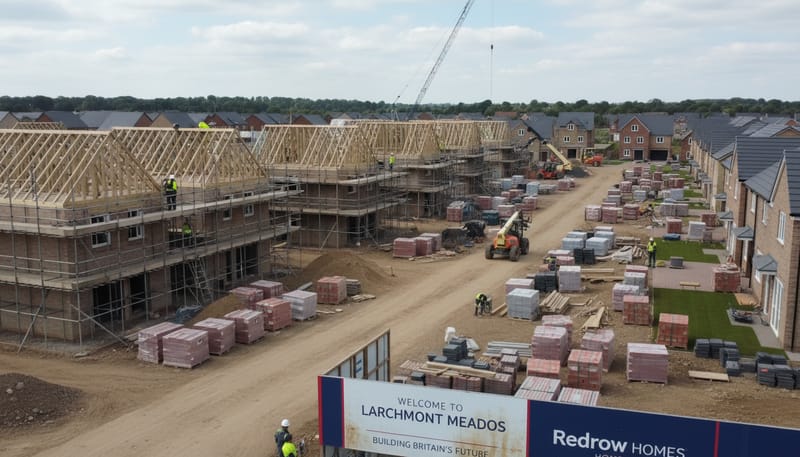
The UK housebuilding sector enters 2026 in a fundamentally different shape to where it stood just two years ago. The sharp contraction triggered by the 2022-2023 interest rate shock has given way to a broad-based recovery in output, with the major listed builders reporting rising completions, expanding outlet counts, and growing forward order books. Yet the sector remains well below its pre-pandemic peak output, and the gap between current delivery and the government's ambitious target of 300,000 homes per year (equivalent to 1.5 million over the parliament) is stark. Meeting that target would require a step-change in output that the industry, in its current configuration, is not equipped to deliver without significant structural reform, increased planning throughput, and a revival of the SME builder segment that has been progressively marginalised over the past two decades.
This annual output report provides a detailed examination of the UK's leading housebuilders by volume, analyses their financial performance and strategic priorities, assesses the state of land banks and the planning pipeline, and examines the role of SME builders in meeting housing need. Drawing on company results, NHBC registration data, DLUHC statistics, and industry analysis from the HBF and Lichfields, it offers the most comprehensive picture available of where the sector stands and where it is heading. Whether you are a buyer assessing which developers to trust, an investor evaluating sector fundamentals, or a policy professional tracking housing delivery, this report provides the data and context you need.
UK Housing Completions: The National Picture
Total new build housing completions in England reached an estimated 228,000 in the year to September 2025, according to DLUHC statistics. This represents a 6% increase on the prior year (215,000) but remains 12% below the 2019/20 peak of 259,000. When Scotland (approximately 22,000), Wales (approximately 7,500), and Northern Ireland (approximately 9,200) are included, the UK-wide total reaches approximately 266,700 — meaningful progress but still well short of the 300,000+ needed to address the housing shortfall.
NHBC registrations — which record the number of new homes registered for warranty cover before construction begins — provide the best leading indicator of future completions, typically running 12-18 months ahead. At 162,400 in 2025, registrations are up 11% from 2024 but remain 18% below the 2019 peak of 197,600. Assuming typical build programmes and lead times, this suggests that completions in 2026 could reach 240,000-250,000 in England — an improvement but still insufficient to close the target gap.
Top 10 UK Housebuilders by Completions
The UK housebuilding industry is highly concentrated, with the top 10 builders accounting for approximately 55% of all new build completions. The landscape has been reshaped by the Barratt-Redrow merger (completed in 2024), which created the UK's largest housebuilder by volume, and by Vistry Group's strategic pivot towards partnership housing. Below is the definitive ranking for the 2025 financial year.
The combined output of the top 10 builders totals approximately 81,600 homes — representing roughly 55% of English completions and highlighting the sector's extreme concentration. The remaining 45% comes from a long tail of mid-tier regional builders (firms delivering 500-3,000 homes per year), SME builders (under 500 homes), housing associations, and self/custom builders. The Barratt Redrow entity, the result of the largest merger in UK housebuilding history, now leads the rankings with 17,200 completions, though Vistry Group is close behind at 16,800 thanks to its aggressive partnership housing strategy.
Average selling prices vary enormously across the top 10, reflecting different geographic focuses and market segments. Berkeley Group's £610,000 ASP reflects its concentration on high-value London and South East regeneration schemes, while Keepmoat's £213,000 ASP reflects its focus on affordable, partnership-led housing in the Midlands and North. For more detail on how sales rates compare, see our analysis of new build sales velocity and market confidence trends.
Land Bank Analysis
A housebuilder's land bank is the foundation of its future output — the inventory of planning-consented and strategically controlled land from which it draws its development pipeline. The size, quality, and geographic mix of the land bank determines a builder's capacity to respond to demand, its margin trajectory, and its competitive positioning. After a period of cautious acquisition during the 2023-2024 downturn, the major builders have returned to active land purchasing, though the composition of acquisitions has shifted towards smaller, faster-turning sites that can be brought to market more quickly.
Land bank sizes vary significantly across the builders, reflecting different business models. Persimmon's 6.0-year consented supply and relatively small strategic land bank reflects its historical model of acquiring largely consented sites and building them out quickly. Berkeley Group's exceptional 11.3-year consented supply reflects its focus on large-scale regeneration projects that deliver over many years. Taylor Wimpey's large strategic land bank (86,000 plots) positions it well for long-term growth, as strategic land — acquired cheaply before planning permission is obtained — delivers the highest margins when it moves through the planning process.
Strategic land refers to sites that a housebuilder controls (typically through option or conditional purchase agreements) but that do not yet have planning permission. These sites are purchased or optioned at agricultural or hope values — a fraction of their consented value — and represent a pipeline of future development. The process of securing planning permission on strategic land typically takes 3-7 years and involves significant planning risk, but the margin uplift when permission is granted can be transformative: land that was acquired at £15,000-£25,000 per plot in an option agreement may be worth £40,000-£80,000 per plot with outline planning consent.
Financial Performance and Margins
The financial recovery of the major listed housebuilders has been meaningful but uneven. Gross margins, which compressed sharply during the 2023-2024 downturn as incentive levels rose and build cost inflation outpaced selling price growth, have begun to recover as the balance of supply and demand has improved. However, margins remain below the sector's historical norms, and the additional costs associated with the Future Homes Standard, building safety remediation contributions, and nutrient neutrality mitigation are creating ongoing margin pressure.
The gap between the current 21.4% gross margin and the pre-pandemic norm of 24.6% reflects the structural cost increases that the sector has absorbed: build cost inflation (materials and labour), Future Homes Standard compliance costs, higher Section 106 contributions, and residual building safety levies. Most analysts expect margins to continue recovering gradually through 2026 and 2027 as these costs are progressively passed through to selling prices, but a full return to pre-pandemic margins is unlikely in the near term.
Strategic Priorities: What the CEOs Are Saying
The strategic commentary from the major builders' latest results presentations reveals a sector that is cautiously confident about the demand outlook but acutely focused on operational efficiency and margin recovery. Several common themes emerge.
Every major builder is planning to increase its active outlet count through 2026. Barratt Redrow is targeting 350+ outlets (up from 305), Taylor Wimpey is targeting 260+ (up from 238), and Persimmon is targeting 300+ (up from 264). New outlets take 12-18 months to open after planning consent, so these targets reflect land already secured and planning either granted or advanced. The sector-wide outlet expansion is the clearest signal of confidence in sustained demand recovery.
The reputational damage suffered by several major builders over build quality issues in 2020-2023 has prompted a sector-wide investment in quality assurance. HBF customer satisfaction scores have improved for the third consecutive year, reaching 91% in 2025 (the proportion of buyers who would recommend their builder). Several builders have introduced independent post-completion inspections, and the New Homes Quality Code — the industry's self-regulatory quality standard — is now mandated for all HBF members.
The Future Homes Standard, effective from June 2025, requires all new homes to produce 75-80% fewer carbon emissions than the 2013 Building Regulations standard. This has necessitated significant investment in air source heat pumps, enhanced insulation, triple glazing, solar PV panels, and EV charging infrastructure. Most builders report that FHS compliance adds £5,000-£8,000 to per-unit build costs, though this is expected to decline as supply chains mature and specifications are optimised. Several builders are positioning FHS compliance as a marketing advantage, emphasising the lower running costs and higher EPC ratings of their new homes compared to the existing housing stock.
Vistry Group has led the industry's pivot towards partnership and affordable housing delivery, but other builders are following. Barratt Redrow has expanded its partnership housing division, and Persimmon has established a new partnerships team targeting housing association bulk sales. The appeal is clear: partnership housing provides forward-sold volume that smooths revenue volatility and reduces sales risk. The growth of the build-to-rent (BTR) sector is creating an additional channel for forward-sold volume. For more on this trend, see our analysis of BTR sector growth and its impact on the new build market.
SME Builders: The Missing Middle
The decline of the SME housebuilder is one of the most significant structural changes in the UK housing market over the past 30 years — and one of the biggest barriers to meeting the government's housing targets. In 1988, small builders (those delivering fewer than 100 homes per year) accounted for 39% of total output. By 2025, that figure had fallen to approximately 12%. The causes are well-documented: increasing planning complexity and cost, higher regulatory burden, difficulty accessing development finance, and the dominance of large builders in land markets.
The decline of SME builders matters for several reasons. Small builders tend to build on small sites (typically 1-50 units) that the volume builders overlook, contributing to geographic diversity of supply. They are more responsive to local demand conditions and can start and complete sites more quickly. They provide training and employment in areas where major builders have limited presence. And research by Lichfields suggests that if SME output could be restored to its 1988 share of the market, it would add approximately 60,000 homes per year to national output — going a significant way towards closing the target gap.
The government has introduced several measures aimed at supporting SME builders, including the Levelling Up Home Building Fund (a £1.5 billion lending programme), small site planning reforms (allowing more sites under 50 units to be approved through delegated powers), and the proposed Infrastructure Levy exemption for sites under 10 units. Early signs are cautiously positive: the Federation of Master Builders (FMB) reported a 6% increase in SME housing starts in 2025, the first annual increase since 2017. However, a sustained recovery will require not just financial support but also planning reform that genuinely reduces the time and cost of securing consent for small sites.
Modern Methods of Construction: Gaining Traction?
Modern Methods of Construction (MMC) — encompassing modular, timber frame, light steel frame, and other factory-produced building systems — has been positioned as a potential game-changer for UK housing delivery. In theory, MMC can deliver homes faster (reducing on-site build time by 30-50%), more consistently (factory quality control), and with less dependence on scarce on-site trades. In practice, the UK's MMC sector has had a troubled recent history, with several high-profile failures (Ilke Homes, Swan Housing's modular operation) shaking confidence.
Despite these setbacks, MMC usage is growing from a low base. NHBC data for 2025 shows that approximately 22% of new home registrations incorporated some form of MMC, up from 16% in 2022. Timber frame construction (MMC Category 2) remains the most widely adopted system, particularly in Scotland where it has been the dominant construction method for decades. Volumetric modular (MMC Category 1 — fully factory-assembled room modules) accounts for approximately 4% of registrations, concentrated primarily in the affordable and BTR sectors where the speed and consistency advantages are most valued.
Frequently Asked Questions
Conclusion: Recovery Underway, Target Still Distant
The UK housebuilding sector in 2026 is in recovery mode. Output is rising, margins are improving, and developer confidence — as measured by land investment, outlet openings, and forward order books — is at its highest level since 2019. The Barratt Redrow merger has created a national champion capable of delivering nearly 20,000 homes a year, while Vistry Group's partnership model has demonstrated that volume housebuilding can thrive outside the traditional open-market model. Every major builder is targeting meaningful output growth over the next two to three years.
Yet the 300,000-home target remains distant. Even the most optimistic projections do not see England exceeding 260,000 completions before 2028, and the gap to 300,000 requires contributions from segments of the industry — SME builders, housing associations, custom and self-builders — that are currently under-delivering for well-understood structural reasons. Closing the gap will require not just continued demand-side support (through mortgage availability and buyer incentives) but also supply-side reform: faster planning decisions, reduced regulatory complexity for small builders, a viable model for scaling MMC, and sustained investment in the skills pipeline to address chronic labour shortages. The government's ambitions are directionally correct; the question is whether the delivery infrastructure exists to turn policy into homes on the ground.
Data sources: DLUHC Housing Supply Statistics, NHBC, company annual reports and results presentations, HBF, Lichfields, Federation of Master Builders, BCIS, ONS. Data current as of January 2026.