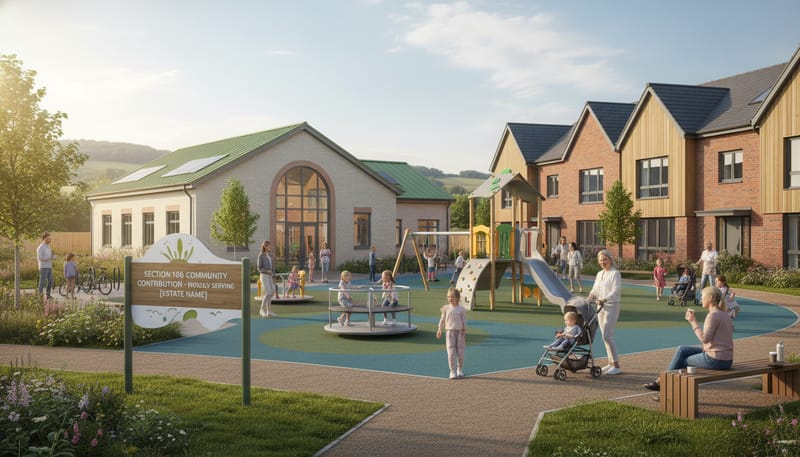
When new homes are built in the UK, they do not arrive in isolation. Every significant residential development triggers a cascade of infrastructure investment that benefits not only the new residents but often the wider established community as well. New schools and nurseries to educate children, parks and playing fields for recreation and wellbeing, GP surgeries and healthcare facilities to support growing populations, highways improvements to ease traffic flow, public transport enhancements, community centres, public art, ecological habitats and affordable housing — all of these are funded, in whole or in part, by the developers who build the homes. The mechanisms that secure these contributions, principally Section 106 planning obligations and the Community Infrastructure Levy, represent one of the most significant but least understood aspects of the UK planning system.
The scale of developer contributions is remarkable. Industry data from the Home Builders Federation and the Department for Levelling Up, Housing and Communities shows that housebuilders contribute over 7 billion pounds annually toward community infrastructure across England alone. This figure encompasses direct financial payments, land transfers, the construction of on-site infrastructure and the delivery of affordable housing at below-market values. To put this in perspective, the annual developer contribution to community infrastructure exceeds the total budget of many Government departments. Yet this investment often goes unrecognised by the public, who may perceive new developments as a burden on local services rather than a significant net contributor. This article provides a comprehensive guide to how developer contributions work, what they fund and the transformative impact they are having on communities across the country.
Section 106 Agreements: The Foundation of Developer Contributions
Section 106 (S106) of the Town and Country Planning Act 1990 is the legal mechanism through which local planning authorities can require developers to provide contributions toward community infrastructure as a condition of receiving planning permission. These planning obligations, negotiated between the developer and the local authority, are legally binding agreements that attach to the land and must be fulfilled before or during the development process.
S106 agreements are site-specific and bespoke, meaning their content varies according to the needs of the local area and the scale and nature of the development. A large residential scheme of 500 homes might generate S106 obligations worth several million pounds, covering contributions toward primary and secondary school places, healthcare provision, highway improvements, public open space, community facilities, ecological mitigation and affordable housing. A smaller development of 50 homes might have more modest obligations focused on the most pressing local needs.
The S106 system is governed by three legal tests established in the Community Infrastructure Levy Regulations 2010. Each obligation must be: (a) necessary to make the development acceptable in planning terms, (b) directly related to the development, and (c) fairly and reasonably related in scale and kind to the development. These tests ensure that developers are not asked to fund infrastructure that is unrelated to their development or disproportionate to its impact, providing a framework of fairness that protects both developers and communities.
The Community Infrastructure Levy (CIL)
The Community Infrastructure Levy (CIL), introduced in 2010, provides a complementary mechanism for funding infrastructure. Unlike S106, which is negotiated on a site-by-site basis, CIL is a fixed charge levied on new development according to a published charging schedule. The rate is set by the local authority based on evidence of infrastructure need and development viability, and it applies automatically to qualifying developments without the need for individual negotiation.
CIL revenues can be spent on a wide range of infrastructure to support growth, including transport, education, health, flood defences, green spaces and community facilities. A mandatory proportion of CIL receipts (either 15% or 25% where a neighbourhood plan is in place) is passed directly to the parish or neighbourhood council where the development takes place, giving local communities a direct financial stake in growth and a say in how the money is spent.
Not all local authorities have adopted CIL; those that have not continue to rely solely on S106 for developer contributions. The Government has signalled its intention to reform the system through the proposed Infrastructure Levy, which would replace both S106 and CIL with a single, more streamlined mechanism. However, until this reform is enacted, the dual S106/CIL system continues to operate and generate substantial community investment.
New Schools: Building Educational Capacity
Education is typically the largest single category of S106 expenditure after affordable housing, reflecting the significant demand for school places generated by family-oriented residential developments. Developer contributions toward education can take several forms: financial payments toward the expansion of existing schools, the provision of land for new school buildings, or the direct construction and handover of complete schools as part of the development.
The scale of developer-funded school provision is substantial. Major developments routinely include new primary schools, and the largest schemes incorporate secondary schools, sixth form facilities and special educational needs provision. The cost of a new two-form entry primary school, accommodating 420 pupils, typically ranges from 8 to 12 million pounds, a cost that is either fully funded by the developer or shared between developer contributions and Government capital funding.
Real-world examples illustrate the impact. Barratt Developments' Kingsbrook development in Aylesbury, Buckinghamshire, a 2,450-home scheme, includes a brand new primary school and financial contributions exceeding 15 million pounds toward secondary school provision. Taylor Wimpey's developments in Didcot, Oxfordshire, have funded multiple new primary schools and contributed to the expansion of Didcot's secondary schools. Countryside Partnerships' Beaulieu development in Chelmsford includes two new primary schools and a secondary school, all funded through a combination of S106 contributions and direct delivery by the developer.
Developer-Funded School Places by Region (estimated annual)
Education Impact: The HBF estimates that developer contributions fund approximately 55,000 new school places per year across England. Without this investment, local education authorities would face severe capacity pressures, and existing schools would become significantly overcrowded.
Parks, Open Spaces and Green Infrastructure
The provision of high-quality open space is a fundamental requirement of modern residential development. Planning policy requires developments to include sufficient green space for recreation, amenity, ecology and sustainable drainage, and the best developers go well beyond minimum requirements to create landscapes that enhance both the development and the surrounding area.
Developer-funded parks and open spaces take many forms: formal parks with play equipment, sports pitches and pavilions; informal natural green spaces including wildflower meadows, woodlands and wetlands; allotments and community growing spaces; linear parks and greenways that connect the development to the wider countryside; and pocket parks that provide intimate green spaces within the built fabric of the development.
Berkeley Group has been recognised as an industry leader in landscape design and green space provision. Its developments consistently include generous, well-designed open spaces that are integral to the masterplan rather than afterthoughts. The Kidbrooke Village development in south-east London includes over 30 acres of new parkland, including a major new park with a lake, play areas, sports facilities and ecological habitats. This parkland was created on previously developed land and has transformed the character of the area, attracting wildlife and providing a major recreational resource for both new and existing residents.
The mandatory 10% Biodiversity Net Gain (BNG) requirement, which came into effect for major developments in early 2024, is further strengthening the ecological quality of developer-provided green spaces. BNG requires a measurable improvement in biodiversity compared to the pre-development state, assessed using a standardised metric. This means that even where a development is built on low-value agricultural land, the finished landscape must support more diverse and abundant wildlife than what was there before. Developers are achieving this through habitat creation, native planting, wildlife ponds, bat and bird boxes, hedgehog highways and the management of open spaces for ecological rather than purely aesthetic value.
Redrow has been particularly proactive in wildlife-friendly landscaping, incorporating ecological principles into its standard landscape specifications. The company has created over 1,000 acres of new green space across its developments and plants thousands of native trees and hedgerow species annually. Its developments regularly include wildlife corridors, insect hotels and nesting features that contribute to local biodiversity well beyond the 10% BNG minimum. For more on how sustainability is being embedded in new developments, see our article on how developers are reducing carbon footprints in new builds.
Healthcare Facilities and NHS Capacity
Healthcare provision is an increasingly important area of developer contributions, reflecting the pressures on NHS primary care capacity in areas of significant housing growth. Developer funding helps expand existing GP surgeries, build new healthcare facilities and support the delivery of community health services in rapidly growing areas.
The typical S106 contribution toward healthcare ranges from 300 to 600 pounds per dwelling, depending on the local authority's healthcare needs assessment. For a development of 1,000 homes, this can generate contributions of 300,000 to 600,000 pounds specifically for healthcare infrastructure. On the largest developments, contributions can fund the construction of entirely new GP surgeries, dental practices or community health centres.
Practical examples are widespread. Taylor Wimpey's developments in the north of England have contributed to new GP surgery buildings in several locations, including purpose-built facilities in County Durham and Cheshire. Barratt's large-scale developments in Cambridgeshire and Oxfordshire have generated multi-million-pound healthcare contributions that have funded both new facilities and the expansion of existing practices. On the largest strategic developments, such as Ebbsfleet Garden City in Kent, developer contributions are funding a comprehensive healthcare strategy including new GP surgeries, pharmacy provision and community mental health services.
Typical S106 Contribution Per Dwelling by Category
Transport and Highways Infrastructure
Transport infrastructure is often the most visible and immediately impactful category of developer contributions. New developments generate additional traffic and travel demand, and developers are required to mitigate this impact through a combination of on-site transport provision and financial contributions toward off-site improvements.
On-site transport infrastructure typically includes the construction of new estate roads, pedestrian and cycle paths, bus stops and turning facilities, and electric vehicle charging points. Off-site contributions fund highway junction improvements, traffic signal upgrades, new bus services, cycle lane extensions and pedestrian crossings. On the largest developments, contributions can extend to entirely new road links, roundabouts and even railway station improvements.
Sustainable transport is increasingly prioritised. Modern developments are designed to encourage walking, cycling and public transport use over private car journeys. Developer-funded cycle storage, car club memberships, bus service subsidies and travel plan coordinators all contribute to reducing the transport-related carbon impact of new communities. Some developments even fund new bus routes for an initial period, ensuring that public transport is available from the point of first occupancy rather than years later when the development is complete.
Community Centres, Libraries and Social Infrastructure
Beyond the headline categories of education, healthcare and transport, developer contributions fund a wide range of social infrastructure that enriches community life. Community centres, village halls, libraries, youth facilities, sports pavilions, places of worship and public art are all regularly delivered or funded through S106 and CIL.
On larger developments, community centres are often among the first buildings to be completed, providing a gathering point for early residents and a focus for community formation. These facilities typically include multi-purpose halls, meeting rooms, kitchen facilities and outdoor areas, and they can serve as venues for everything from playgroups and exercise classes to parish council meetings and community celebrations. Some developments go further, incorporating cafes, co-working spaces and maker workshops that reflect the way modern communities use shared facilities.
Public art is an increasingly important element of developer contributions. Many local authorities require a proportion of development costs to be spent on public art, and developers are commissioning high-quality works from local and nationally recognised artists. These installations — sculptures, murals, landscape features, lighting installations and wayfinding elements — give new communities a sense of identity and cultural richness from the outset. Berkeley Group has been particularly proactive in arts commissioning, with its developments featuring curated art programmes that engage local communities in the creative process.
Affordable Housing: The Largest Single Contribution
By financial value, affordable housing is by far the largest component of developer contributions. The provision of affordable homes through S106 agreements represents a transfer of value from the developer to the community worth billions of pounds annually. Affordable homes are sold to housing associations at below-market prices, enabling them to be rented at social or affordable rents or offered through shared ownership schemes.
The scale of this contribution is enormous. Developers deliver approximately 50,000 affordable homes per year through the planning system, representing more than half of all affordable housing supply in England. Without this developer-funded provision, the country's social housing waiting lists, which already contain over 1.2 million households, would be significantly longer.
Case Studies: Transformative Developer Contributions
Beaulieu, Chelmsford (Countryside Partnerships): This 3,600-home development has generated over 100 million pounds in community infrastructure. Two new primary schools, a secondary school, a community centre, extensive parkland, allotments, sports pitches, highway improvements and a new bus service have all been delivered or funded by the developer. The development has effectively created a new village within Chelmsford, complete with the social infrastructure needed to support a thriving community from day one.
Ebbsfleet Garden City, Kent (Multiple Developers): One of the most ambitious development projects in the UK, Ebbsfleet will ultimately deliver up to 15,000 homes alongside commercial space, schools, healthcare facilities, parks, sports centres and transport links. Developer contributions across the various development parcels are funding a comprehensive infrastructure strategy coordinated by the Ebbsfleet Development Corporation. New primary and secondary schools are already open, with further education facilities planned as the population grows.
Kingsbrook, Aylesbury (Barratt Developments): This 2,450-home development includes over 15 million pounds in education contributions, a new primary school, extensive wildlife habitats created in partnership with the RSPB, community woodland, allotments, sports facilities and highway improvements. The development's ecological strategy has created a nature reserve within the scheme, including wetland habitats, wildflower meadows and nesting sites for declining species such as the house sparrow and swift.
Industry Total: According to the HBF, the total value of developer contributions to community infrastructure across the UK exceeds 7 billion pounds per year. To put this in context, this is equivalent to building approximately 10 new NHS hospitals annually, or funding the salaries of over 200,000 teachers. New development is not a drain on local services — it is a major net contributor.
The Neighbourhood Share: Putting Money in Local Hands
One of the most innovative aspects of the CIL system is the neighbourhood share — the mandatory proportion of CIL receipts that is passed directly to parish or neighbourhood councils. Where a neighbourhood plan is in place, this share increases to 25% of CIL receipts, providing a powerful incentive for communities to engage constructively with the planning process.
The neighbourhood share gives communities direct control over a portion of developer contributions, enabling them to fund local priorities that matter most to residents. Examples of how neighbourhood CIL funds have been spent include village hall renovations, play area improvements, allotment creation, community defibrillators, tree planting, local footpath improvements, memorial garden maintenance and public seating. These small-scale, locally prioritised investments often generate disproportionate community goodwill and demonstrate that development brings tangible benefits to existing residents as well as new ones.
The Future: Infrastructure Levy Reform
The Government has proposed replacing the current S106/CIL dual system with a single Infrastructure Levy. The proposed levy would be charged as a percentage of the final value of the development, calculated at the point of sale or occupation rather than at the planning application stage. The intention is to create a simpler, more transparent system that generates at least as much infrastructure funding as the current arrangements while reducing the negotiation complexity that can delay planning decisions.
The proposed reform has generated significant industry discussion. Developers generally welcome simplification but have expressed concerns about the mechanics of the levy, particularly the risk of front-loading financial obligations before sales revenue is received, and the challenge of ensuring that affordable housing delivery is maintained at current levels. The Government has committed to extensive piloting and consultation before full implementation, and the industry is engaged constructively in shaping the details of the new system.
Regardless of the specific mechanism, the fundamental principle that developers contribute substantially to community infrastructure is deeply embedded in UK planning practice and will continue under any reformed system. The HBF and individual developers have consistently expressed their willingness to fund their fair share of infrastructure, recognising that well-served, well-designed communities are both a social good and a commercial asset. For homebuyers, this means that choosing a new build home is not simply a housing decision; it is an investment in a community that has been planned and funded to provide the schools, parks, healthcare and transport connections that make for a good quality of life.
The story of developer contributions is one of the most positive aspects of UK housebuilding, yet it remains surprisingly little known. Every new home sold helps fund a classroom, a park bench, a GP consultation room, a cycle lane or a community centre. The cumulative impact of these contributions, running to billions of pounds every year, is transforming communities across the country and ensuring that housing growth is accompanied by the infrastructure investment that residents need and deserve. For more on the positive impact of responsible housebuilding, see our articles on apprenticeships and community support and how developers are tackling the housing shortage.