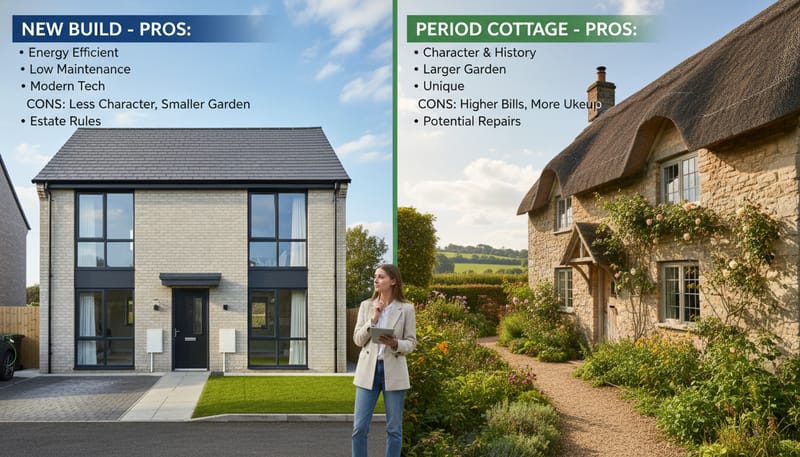
Why This Decision Matters for First-Time Buyers
As a first-time buyer, choosing between a new build and an older property is one of the biggest decisions you will face. Both routes have genuine advantages, and the right choice depends entirely on your circumstances — your budget, your priorities, and the kind of lifestyle you want. There is no universally “better” option; there is only the option that is better for you.
This guide offers a balanced, side-by-side comparison so you can weigh up every factor with confidence. We cover build quality, energy efficiency, running costs, warranties, mortgage availability, stamp duty, the buying process, and more. Whether you are drawn to the blank-canvas appeal of a new build home or the charm of a character property, the facts below will help you make a well-informed choice.
Before diving in, make sure your finances are in good shape. Our guide to saving for a deposit is a great starting point, and understanding your credit score will set you up for a smoother mortgage application regardless of which type of property you pursue.
Build Quality & Construction Standards
Modern new build homes are constructed to the latest Building Regulations (Part L 2021 and beyond), which set strict requirements for structural integrity, fire safety, ventilation, and thermal performance. Every home undergoes multiple inspections during construction and must pass final sign-off before you can move in. Many leading developers also hold quality marks such as the NHBC Buildmark, LABC, or Premier Guarantee certifications.
Older homes were built to the standards of their era. A Victorian terrace, for instance, was built with solid brick walls and lime mortar — techniques that have proven remarkably durable over 100+ years. An Edwardian semi may offer generous room proportions and higher ceilings that are increasingly rare in modern designs. A 1960s or 1970s property might sit somewhere between the two: functional, often spacious, but potentially in need of updating.
Neither approach is inherently superior. New builds benefit from precision engineering, factory-quality components, and up-to-date regulation. Older homes benefit from having already proven their longevity — any major structural issues have typically shown themselves by now and been addressed.
Key Differences at a Glance
| Factor | New Build | Older Home |
|---|---|---|
| Building regulations | Latest Part L 2021+ standards | Standards of the era (varies widely) |
| Insulation | Cavity walls, triple/double glazing, loft & floor insulation standard | May need retrofitting – solid walls, single glazing common in pre-1930s |
| Wiring & plumbing | Brand new throughout | May need rewiring or re-plumbing depending on age |
| Room proportions | Efficient but sometimes compact | Often more generous, especially Victorian & Edwardian |
| Character & individuality | Clean, modern aesthetic; limited variation | Original features, unique layouts, period charm |
| Structural inspections | Builder & warranty provider inspections during build | Survey strongly recommended at purchase |
| Snagging | Cosmetic issues common but typically fixed under warranty | Issues found in survey – negotiate price or repairs |
If you lean towards a new build, read our snagging guide to understand what to check before you move in. For older homes, a full structural survey (RICS Level 3) is strongly recommended.
Energy Efficiency & Running Costs
This is arguably the area where new builds hold the most measurable advantage. Homes built to current regulations typically achieve an EPC rating of A or B, thanks to high levels of insulation, efficient boilers (or heat pumps), double or triple glazing, LED lighting, and airtight construction. According to the Home Builders Federation, the average new build home costs around £1,050 to £1,400 per year to heat, compared with £2,200 to £2,900+ for a typical older property with a D or E rating.
That said, older homes can be made more efficient. Loft insulation, cavity wall insulation (where applicable), modern boilers, and upgraded windows can significantly improve an older property’s performance. The cost of these upgrades varies from a few hundred pounds for loft insulation to £10,000+ for external wall insulation on a solid-walled home.
For a deeper dive into EPC ratings and what they mean for your bills, see our guide on new build EPC ratings.
Annual Energy Costs by EPC Rating
Estimates based on a typical 3-bed semi. Actual costs vary by location, usage, and tariff.
Running Costs Beyond Energy
Energy is only part of the picture. Here are other running costs to consider:
- Council tax: New build estates sometimes fall into a higher council tax band because valuations are based on current market value. Older homes may sit in a lower band if they haven’t been reassessed since 1991 (England) or 2003 (Wales).
- Service charges: New build developments — especially apartments — often come with annual service charges for communal areas, landscaping, and management. These can range from £1,000 to £4,000+ per year. Older homes with a share of freehold or on a private road may have similar costs, but it’s less common for houses.
- Insurance: New builds can be slightly cheaper to insure because the roof, wiring, and plumbing are new. Older homes may attract higher premiums, especially if they have flat roofs, old electrics, or are in a flood-risk area.
- Water rates: Similar for both, though new builds come with water meters as standard.
Warranty, Maintenance & Repairs
One of the strongest selling points of a new build is the structural warranty. The vast majority of new homes in the UK come with a 10-year warranty — typically from the NHBC, LABC Warranty, or Premier Guarantee. During the first two years (the “defects period”), the developer is responsible for fixing most issues. For years 3 to 10, the warranty covers major structural defects such as foundations, load-bearing walls, and the roof.
You can learn more in our comprehensive guide to new build warranties.
With an older home, there is no builder warranty. You rely on your survey to identify issues before purchase, and any repairs after that point come out of your own pocket. On the positive side, older homes have an established track record — if the roof has lasted 80 years, it is unlikely to fail overnight (though it may need attention in the medium term).
Typical Maintenance Timelines
| Maintenance Item | New Build | Older Home (pre-1980) |
|---|---|---|
| Boiler replacement | 15–20 years (new boiler installed) | May be needed immediately or within 5–10 years |
| Roof repairs | Unlikely for 20–30 years | May need repointing, slate replacement, or flashing repairs |
| Window replacement | 20–25 years (double/triple glazed) | May be needed soon if single glazed or old uPVC |
| Rewiring | Not needed for 25–30 years | May be needed if wiring is pre-1980s |
| Damp treatment | Rare – modern damp-proofing standard | Common in older homes, especially solid-walled |
| Decorating | Personal choice – walls are fresh | Often needed immediately to refresh |
| Garden & landscaping | Garden often needs establishing from scratch | Established garden – may need maintenance |
For first-time buyers on a tight budget, the predictability of a new build’s maintenance costs is a real advantage. Our budgeting beyond the deposit guide helps you plan for ongoing costs regardless of which route you choose.
Mortgages, Stamp Duty & Financial Considerations
Both new builds and older homes are readily mortgageable, but there are some differences worth understanding.
Mortgage Availability
Most mainstream lenders offer mortgages on both property types. However, new builds sometimes come with higher loan-to-value (LTV) restrictions — some lenders cap new build mortgages at 85% LTV rather than the 95% available on existing properties. This means you may need a slightly larger deposit for a new build, though many developers offset this through incentive packages that can include deposit contributions.
On the other hand, new builds benefit from the new build premium — lenders recognise the warranty protection and energy efficiency, which can work in your favour during the assessment. For a complete walkthrough, see our guide to understanding your mortgage offer.
Stamp Duty for First-Time Buyers
First-time buyers in England and Northern Ireland currently benefit from stamp duty relief. As of 2025, first-time buyers pay no stamp duty on the first £300,000 of a property priced up to £500,000. Above £300,000 (up to £500,000), you pay 5%.
This relief applies equally to new builds and older homes, so there is no stamp duty advantage either way for most first-time buyers. For full details and worked examples, visit our stamp duty relief guide.
The New Build Premium
New builds typically cost 10–20% more than a comparable older property in the same area. This premium reflects the modern specification, warranty, energy efficiency, and the fact that everything is brand new. It is important to factor this in when comparing like-for-like, because an older home may offer more space or a better location for the same budget.
However, the lower running costs of a new build can offset part of the premium over time. Our analysis of new build pricing premiums breaks down the numbers in detail.
Financial Comparison at a Glance
- Purchase price: New builds are typically 10–20% higher for equivalent size and location
- Deposit: May need 10–15% for new build (some lenders restrict 95% LTV); 5–10% possible for older homes
- Stamp duty: Same relief applies to both for first-time buyers
- Solicitor/conveyancing fees: Similar, though new build conveyancing can be slightly more due to additional checks
- Survey costs: New builds often only need a basic valuation; older homes benefit from a full survey (£400–£1,500+)
- Moving-in costs: New builds are move-in ready; older homes may need immediate decorating or repairs budgeted at £2,000–£10,000+
- Annual energy bills: New builds typically £1,000–£1,500 less per year
The Buying Process Compared
The process of buying a new build differs from purchasing an older property in several important ways.
New Build Buying Process
When you buy a new build, you typically start by visiting a show home or sales centre. You will reserve your chosen plot with a reservation fee (usually £500–£2,000), which takes the property off the market while you arrange your mortgage and solicitor. The developer’s sales team will guide you through the process and provide a timeline for completion.
One major advantage is that new build purchases are almost always chain-free. You are buying directly from the developer, so there is no seller who needs to find their next home before they can sell to you. This can significantly reduce the risk of the sale falling through and makes completion dates more predictable.
If you are buying “off-plan” (before the home is built), there is a wait while construction is completed. This can be anywhere from a few months to over a year, which gives you time to save but also means your mortgage offer must remain valid until completion. See our reservation guide for a full walkthrough.
Older Home Buying Process
With an older property, you will typically find listings on property portals, arrange viewings through estate agents, and make an offer through the agent. Once accepted, you instruct a solicitor and arrange a mortgage and survey. The process is less structured than a new build purchase and relies on a chain of buyers and sellers completing in sequence.
Chain collapses are one of the biggest risks — roughly 30% of property sales fall through before exchange. Gazumping (where a seller accepts a higher offer after yours) is also a possibility, though it is less common than headlines suggest.
Timeline Comparison
| Stage | New Build (ready to move in) | Older Home |
|---|---|---|
| Finding the property | 1–4 weeks | 2–12+ weeks |
| Reservation / offer accepted | Same day – 1 week | 1–4 weeks of negotiation |
| Mortgage application | 2–6 weeks | 2–6 weeks |
| Conveyancing | 4–8 weeks | 8–16 weeks |
| Exchange to completion | Often same day or within 2 weeks | 2–8 weeks |
| Total (typical) | 8–16 weeks | 12–24+ weeks |
For the complete step-by-step process, our new build buying process guide covers everything from reservation to key collection.
Which Home Suits Your Budget & Priorities?
There is no one-size-fits-all answer. Here is a practical framework to help you decide based on what matters most to you.
Choose a New Build If…
- You want low running costs and energy efficiency from day one
- You value predictable maintenance with warranty protection for 10 years
- You prefer a modern, open-plan layout with integrated technology
- You want a chain-free purchase with a more structured buying process
- You are comfortable with a potentially higher purchase price for the same size
- You do not mind a newer estate that is still being developed around you
- You want to take advantage of developer incentives like furniture packs or deposit contributions
Choose an Older Home If…
- You want more space or a better location for your budget
- You value character, period features, and individuality
- You are handy with DIY and happy to renovate or improve over time
- You prefer established neighbourhoods with mature gardens, local shops, and community
- You want to add value through home improvements (extensions, loft conversions)
- You are comfortable with the survey process and potential for unexpected repair costs
- You want flexible negotiation on price with a motivated seller
New Build Strengths
Lower bills, 10-year warranty, chain-free, modern spec, developer incentives, move-in ready, current building standards.
Older Home Strengths
More space per pound, character, established areas, renovation potential, often lower purchase price, mature gardens.
If you are buying with a partner, our guide to buying a new build as a couple covers how to navigate joint decisions and finances.
Frequently Asked Questions
Are new builds worth the premium over older homes?
It depends on your priorities. The premium (typically 10–20%) buys you a 10-year warranty, significantly lower energy bills, modern building standards, and a chain-free purchase. Over 10 years, the energy savings alone can recoup £10,000–£15,000 of the premium. However, an older home may offer more space or a more desirable location for the same price. Weigh up the total cost of ownership, not just the purchase price.
Do new builds hold their value as well as older homes?
Historically, new builds can experience a slight dip in value in the first 1–2 years as the “new” premium fades — similar to driving a new car off the forecourt. However, over the medium to long term (5–10+ years), new builds on well-planned developments in good locations appreciate in line with or above the local market. Location remains the most important factor for any property’s long-term value.
Is it easier to get a mortgage on a new build or an older home?
Both are widely mortgageable. The main difference is that some lenders restrict new build mortgages to 85% or 90% LTV, while 95% LTV products are more readily available on existing properties. However, many developers offer incentives that can bridge this gap, and specialist new build mortgage products are available through brokers. See our best mortgage rates for new builds guide for current options.
What hidden costs should I budget for with each option?
For new builds: service charges (especially apartments), potentially higher council tax bands, garden setup costs, and optional developer upgrades. For older homes: survey costs (£400–£1,500), potential immediate repairs (rewiring, damp, roof), higher energy bills, and decorating costs. Our budgeting beyond the deposit guide covers both scenarios.
Can I negotiate the price on a new build like I can with an older home?
Yes, though negotiation works differently. With older homes, you negotiate directly on the asking price. With new builds, the listed price is often less flexible, but developers regularly offer valuable incentive packages — stamp duty paid, flooring included, white goods, furniture packs, or deposit contributions. These can be worth thousands of pounds and effectively reduce your total outlay.
Making Your Decision with Confidence
There is no wrong answer when choosing between a new build and an older home — only the answer that is right for your budget, your lifestyle, and your priorities. New builds offer certainty, efficiency, and modern living with strong warranty protection. Older homes offer character, space, and the potential to add value through improvements.
Take the time to view both options. Visit show homes and attend open house viewings for older properties in your area. Compare the total cost of ownership over 5–10 years, not just the headline purchase price. Factor in energy bills, maintenance, commuting costs, and lifestyle value.
Whatever you choose, the fact that you are getting on the property ladder is what matters most. Explore our full library of new build guides for further support on every step of the journey, and remember that careful planning today will pay dividends for years to come.