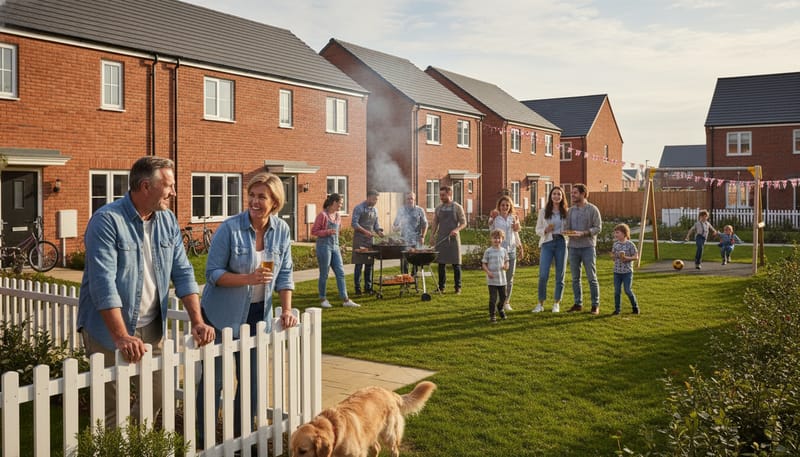
Why New Build Estates Create Unique Communities
Moving into your first home is exhilarating, nerve-wracking, and occasionally lonely in equal measure. You have spent months navigating the buying process, choosing your plot, and dreaming about paint colours — but when the removal van pulls away and the front door closes for the first time, reality can hit hard. Suddenly you are in a new area, possibly miles from friends and family, surrounded by unfamiliar streets and neighbours you have never met.
Here is the good news: if you have bought on a new build development, you have one enormous advantage that buyers of older properties simply do not have. Everyone around you is new too.
Unlike moving into an established street where neighbours have known each other for decades, a new build estate is a blank slate. Nobody has “been here since the beginning” because the beginning is right now, and you are all part of it. That shared experience of being the new arrival — of figuring out which bin goes out on which day, of wondering why the streetlights are not working yet, of waiting for the landscaping to be finished — creates a bond that turns strangers into neighbours and neighbours into genuine friends.
Research from the Home Builders Federation suggests that over 80% of new build homeowners report feeling satisfied with their neighbourhood, and community spirit is frequently cited as one of the biggest positives of new build living. It is not difficult to see why: when 50, 100, or even 500 households all arrive within the same 12–24 months, there is a natural momentum to connect, share information, and build something together.
This guide is for first-time buyers who are about to move onto a new development — or who have recently arrived and are wondering how to build a life there. We will cover everything from how developers are actively fostering community, to the digital tools that help neighbours connect before they have even moved in, to practical tips for making genuine friendships in your new home. If you are moving into your first new build, the community you build around you will be one of the most rewarding parts of the journey.
How Developers Foster Community Spirit
It might surprise first-time buyers to learn just how much thought major UK developers now put into community building. This is not simply altruism — developers understand that happy, connected communities lead to positive reviews, referrals, and smoother estate management. But the result for residents is genuinely beneficial, and the scale of investment in community infrastructure has grown enormously in recent years.
Welcome Events and Social Initiatives
Many developers host welcome events for new residents, ranging from casual summer barbecues to more structured meet-and-greet evenings. These are designed to break the ice and give neighbours a reason to introduce themselves in a relaxed setting. Some developers go further, organising seasonal events throughout the year — Easter egg hunts for children, Christmas wreath-making workshops, or community litter-picking mornings.
Barratt Homes, for example, runs community engagement programmes on many of its larger developments, while Taylor Wimpey has invested in community spaces and events as part of its sustainability commitments. Bellway, Persimmon, and other volume housebuilders have followed suit, recognising that the development does not end when the last brick is laid — it continues with the people who live there.
Physical Community Spaces
The best new build developments are designed with community at their heart. This means dedicated spaces where residents can meet, socialise, and build relationships. Depending on the size and type of development, you might find:
- Community centres or clubhouses: Dedicated buildings with meeting rooms, kitchens, and event spaces that residents can book for gatherings, parties, or community meetings
- Allotments and community gardens: Shared growing spaces where residents can cultivate fruit and vegetables, swap tips, and enjoy the therapeutic benefits of gardening together
- Play areas and adventure playgrounds: Well-designed, age-appropriate play spaces that naturally become gathering points for families — parents chat while children play
- Green spaces and pocket parks: Open areas with benches, walking paths, and landscaped gardens that encourage people to spend time outdoors and meet neighbours naturally
- Sports facilities: Some larger developments include multi-use games areas (MUGAs), tennis courts, or outdoor gym equipment that provide shared activity spaces
If you are still in the process of choosing a developer, it is well worth asking about the community infrastructure planned for the development. These spaces can make an enormous difference to daily life, particularly for first-time buyers who may not have a garden or outdoor space of their own.
Developer Community Initiatives
The table below highlights some of the community-building approaches taken by major UK housebuilders. Bear in mind that specific initiatives vary by development and region, so always ask your sales adviser what is planned for your particular estate.
| Developer | Community Approach | Common Features |
|---|---|---|
| Barratt Homes | Community engagement officers on larger sites; partnership with community organisations | Welcome events, play areas, community noticeboards, green spaces |
| Taylor Wimpey | Sustainability-driven community investment; social value commitments | Allotments, wildlife corridors, communal gardens, event programmes |
| Bellway | Section 106 community contributions; partnership with local councils | Community centres, public open space, sports facilities |
| Persimmon | Community Champions programme; charity and volunteering initiatives | Play areas, landscaped parks, community events during build phase |
| Redrow | Heritage-focused design; emphasis on streetscape and social interaction | Village greens, tree-lined avenues, community orchards, walking trails |
| Berkeley Group | Place-making philosophy; long-term community stewardship | Concierge services, residents’ lounges, co-working spaces, rooftop gardens |
| L&Q / Housing Associations | Community development teams; mixed-tenure integration events | Community halls, youth programmes, neighbour introductions, resident panels |
What is encouraging is that this is not a one-size-fits-all approach. Developers are increasingly tailoring community features to the specific needs of the people buying on each development. A family-focused estate in the suburbs might prioritise play areas and school walking routes, while an urban apartment development aimed at young professionals might focus on co-working spaces and social lounges.
Getting Involved: Management Companies and Residents’ Associations
Almost every new build development has some form of estate management arrangement, and understanding how it works is important for both practical and community reasons. For first-time buyers, this is often an entirely new concept — but getting involved can be one of the best ways to shape your community and meet like-minded neighbours.
How Estate Management Works
When a developer builds an estate, the communal areas — roads that have not been adopted by the council, landscaping, play areas, lighting, and shared facilities — need to be maintained. This is typically handled in one of two ways:
Management companies: Most new build estates are managed by a private management company appointed by the developer. Residents pay an annual service charge (often £150 to £500 per year for houses, or £1,500 to £3,000+ for apartments with more extensive facilities) that covers maintenance of communal areas, landscaping, lighting, and shared building costs.
The service charge covers essential maintenance — cutting the grass on communal areas, maintaining play equipment, repairing shared pathways, managing bin stores on apartment developments, and sometimes building insurance for apartment blocks. As a first-time buyer, factoring this into your monthly costs is important when comparing affordability.
Residents’ associations (RAs) and Right to Manage: Many estates eventually form a residents’ association — a voluntary group of homeowners who represent the community’s interests. On leasehold developments, leaseholders also have the legal right to take over management of their building through a “Right to Manage” company under the Commonhold and Leasehold Reform Act 2002. This gives residents direct control over how their service charges are spent and which contractors are used.
Why Getting Involved Matters
Joining your residents’ association or attending management company AGMs is not just about scrutinising invoices (though that is valuable too). It is one of the most effective ways to:
- Meet engaged neighbours: The people who turn up to RA meetings tend to be the most community-minded residents on the estate. These are the people who organise events, look out for neighbours, and take pride in the development
- Have a voice in decisions: From the colour of replacement fencing to whether the community room should allow evening bookings, the RA is where these decisions are discussed. If you do not get involved, decisions are made for you
- Improve your environment: Want better lighting on the path to the car park? A noticeboard in the communal area? A community WhatsApp group linked from the RA’s notice? These ideas need someone to champion them
- Build leadership skills: For first-time buyers who are often younger residents, serving on an RA committee is genuine community leadership experience. It looks good on a CV, it builds confidence, and it gives you a tangible stake in your neighbourhood
- Protect your investment: A well-managed estate with an engaged community maintains its property values better than a neglected one. Getting involved is an investment in your home’s future value
If your development does not yet have a residents’ association, consider starting one. It does not need to be formal — even an informal group that meets quarterly over coffee can make a real difference. The management company will usually welcome a constructive RA as a single point of contact for resident concerns.
The Building Site Phase: Bonding Through Shared Experience
If you are among the early movers on a development that is still being built, you will experience something unique: the “living on a building site” phase. Lorries rumbling past at 7am, temporary road surfaces, hoarding around unfinished plots, and the constant soundtrack of hammering and power tools. It is not always pleasant — but it creates an extraordinary sense of camaraderie among early residents.
Why the Build Phase Bonds People
There is something about shared inconvenience that brings people together. When your neighbour is also stepping over muddy paths, also wondering when the road will be finished, and also slightly baffled by the temporary parking arrangements, you have an instant conversation starter. The build phase strips away the social awkwardness that can make meeting new people difficult — you are all in the same boat, and that shared experience creates genuine connection.
Many long-term residents of new build estates report that their closest friendships were formed during the build phase. The couples who moved in during “Phase 1” and navigated the mud and noise together often remain the tightest social group on the estate years later. If you are moving in early, embrace it — you are not just buying a home, you are becoming a founding member of a community.
Practical Tips for Making Friends on Your New Development
Whether you are arriving during the build phase or moving onto a more established estate, making friends requires a little initiative. Here are practical, tried-and-tested approaches that work particularly well on new build developments:
- Knock on doors (yes, really): It might feel old-fashioned, but introducing yourself to immediate neighbours when you first move in is powerful. A simple “Hi, we have just moved in next door — I am Sarah” with a smile costs nothing and establishes a connection that makes everything easier going forward
- Host a housewarming: You do not need a finished house or expensive catering. A “come round for a cuppa and see the new place” invitation to your closest neighbours is enough. People appreciate being included
- Be visible: Walk to the local shop instead of driving. Use the communal areas. Walk the dog at regular times. Say hello to everyone. Over time, familiar faces become friendly faces, and friendly faces become friends
- Find shared interests: If you run, mention it in the estate group — someone else probably runs too. If you garden, chat to the person tending their front border. Shared activities are the fastest route to friendship
- Accept invitations: If a neighbour invites you to a barbecue, a coffee morning, or a walk, say yes. Even if you are tired, even if you are introverted, even if you would rather stay home. The early months are when social patterns are set, and being present matters
- Organise a street event: Street parties, barbecues, and communal dinners are brilliant for building connections across a wider group. They do not need to be elaborate — a shared WhatsApp message saying “bring a chair and a drink to the green at 4pm on Saturday” can be enough
- Do not compare to your old social life: If you have moved away from established friends and family, it is natural to feel that new friendships are not the same. Give it time. Friendships built through proximity and shared experience can become just as deep and meaningful
Remember, almost everyone on a new build estate is in the same position. The person in the house opposite who seems perfectly settled is probably just as keen to make friends as you are. The difference between a connected, happy community and a collection of strangers living next to each other often comes down to one or two people who were willing to make the first move. That person could be you.
Children, Families, Safety, and the Wider Neighbourhood
For first-time buyers who are starting a family or already have young children, the community aspect of a new build development takes on an even greater significance. The support network you build around you can make the difference between thriving and merely surviving those intense early years of parenthood.
Building a Family Network
New build estates tend to attract a high proportion of young families and first-time buyers at similar life stages. This concentration of people going through the same experiences — pregnancy, sleepless nights, first steps, school applications — creates a natural support system that is genuinely invaluable.
School runs and childcare: Once children reach school age, the daily school run becomes one of the most powerful community-building activities on any estate. Parents walking the same route twice a day, waiting at the same school gate, and navigating the same homework challenges form bonds quickly. On new developments near newly built schools, the effect is even stronger — the school community and the estate community become one and the same.
Play dates and informal childcare: One of the greatest practical benefits of knowing your neighbours is the ability to share childcare informally. “Can you keep an eye on mine for twenty minutes while I pop to the shops?” is only possible when you trust and know the people around you. Building that trust takes time, but it starts with the small interactions — chatting at the playground, walking to school together, and being present in communal spaces.
Baby and toddler groups: Many new build communities organise their own baby and toddler groups, either in communal spaces on the estate or in nearby community centres. These groups are a lifeline for new parents, particularly those who are at home during the day and may feel isolated.
Safety and Community Watch
Safety is a common concern for first-time buyers, particularly those who have previously lived in shared accommodation or with family. The good news is that new build developments tend to be designed with security in mind, and a connected community is the single most effective deterrent against crime.
Secure by Design: Many new build estates are built to “Secured by Design” standards, a UK police initiative that promotes crime prevention through environmental design. This includes features like well-lit pathways, overlooked parking areas, restricted rear access, and high-quality door and window locks.
Neighbourhood Watch: Formal or informal neighbourhood watch schemes are common on new build estates. The estate WhatsApp group often serves this function naturally — if someone spots suspicious activity, the whole community knows within minutes. Many developments also register with the local police Neighbourhood Watch scheme, which can provide additional signage and resources.
Parcel watching: In the age of online shopping, porch piracy is a real concern. On a well-connected estate, neighbours look out for each other’s deliveries — taking in parcels when someone is out, keeping an eye on the doorstep when a delivery notification arrives. This is community in its most practical, everyday form.
Connecting with the Wider Neighbourhood
A new build estate does not exist in isolation. It sits within a wider neighbourhood with its own history, character, and community. Integrating with the existing local area is important — both for your own quality of life and for building positive relationships between established residents and newcomers.
- Explore local amenities: Visit the local pubs, cafés, shops, and restaurants. Becoming a regular at the local coffee shop or supporting the independent greengrocer helps you feel part of the wider community and builds goodwill
- Join local clubs and organisations: Sports clubs, hobby groups, faith communities, and voluntary organisations are all excellent ways to meet people beyond your estate. The local library, community centre, and parish council are good starting points for finding what is available
- Attend local events: Village fetes, farmers’ markets, firework displays, and community festivals are opportunities to connect with the broader area. They are also fun — and after weeks of unpacking boxes, you deserve some fun
- Use local services: Register with a local GP, dentist, and optician. Find a local hairdresser or barber. These regular appointments create familiarity and routine in your new area
- Be a good neighbour to existing residents: If your development borders an established residential area, make an effort to be respectful and friendly. Some existing residents may have concerns about new development in their area. Demonstrating that the new community is considerate and engaged goes a long way towards building positive relationships
Choosing the right development in the right location makes all of this easier. If you are still exploring your options, our guide to new builds versus older homes discusses how location and community differ between the two.
Frequently Asked Questions
How do I find the WhatsApp group or Facebook page for my new build estate?
The easiest way is to ask the site sales team or site manager when you collect your keys — they will often know if a group exists and can put you in touch with the organiser. Alternatively, search Facebook for your development name (e.g., “Woodlands Park Residents”) or ask in local area Facebook groups whether anyone knows of an estate group. Many developers also include community contact information in the new home welcome pack they provide on completion day. If no group exists yet, you have a wonderful opportunity to start one — post a friendly message on the site noticeboard with a QR code linking to a new WhatsApp group.
I am naturally introverted — how do I build community without feeling overwhelmed?
Building community does not require you to be the life and soul of the party. Start small: a smile and a “good morning” to neighbours you pass regularly, joining the online group and contributing occasionally, or attending one community event per month. Quality matters more than quantity when it comes to neighbourly relationships. Many introverts find that one-to-one connections — a cup of tea with the neighbour next door, a walk with a fellow dog owner — are far more comfortable than large group events. Find the level of social engagement that works for you, and remember that being a good neighbour does not mean being available to everyone all the time. Simply being friendly, reliable, and respectful is enough.
What if my development does not have a residents’ association — should I start one?
If your development has been occupied for six months or more and there is no residents’ association, starting one is an excellent idea. Begin informally: suggest a meeting in the estate group chat and see who responds. Even four or five committed residents can form the core of an effective RA. The key roles are usually a chair, secretary, and treasurer. Your management company may have a template constitution, and organisations like the Federation of Private Residents’ Associations (FPRA) provide guidance for new groups. An active RA gives residents a collective voice, helps resolve issues more efficiently, and often becomes the social heart of the development.
How are service charges managed, and do I get a say?
Your service charge is set by the management company and covers maintenance of communal areas, landscaping, lighting, insurance (for apartments), and a sinking fund for major future repairs. As a homeowner, you are entitled to see an annual statement of how the service charge has been spent. On leasehold properties, leaseholders have additional legal rights under the Landlord and Tenant Act 1985, including the right to challenge unreasonable charges. Through a residents’ association, you can negotiate with the management company, attend AGMs, and influence decisions about spending priorities. For freehold estates, residents may collectively own a share of the management company (a “resident-owned management company”), giving direct control over estate management. Typical annual service charges range from £150 to £500 for houses and £1,500 to £3,500 for apartments.
Is it true that living on a building site is really difficult during the early phases?
The honest answer is that it can be inconvenient, but it is rarely as bad as people fear. Construction hours are typically restricted to 8am–6pm Monday to Friday and 8am–1pm on Saturdays, with no work on Sundays or bank holidays (though this varies by local planning conditions). You may experience noise, dust, and temporary disruptions to access routes. However, developers are required to manage construction impacts under the Consumer Code for Home Builders, and most have dedicated customer care teams to address residents’ concerns during the build phase. Many early residents actually find the build phase exciting — watching the community grow around them, seeing green spaces take shape, and experiencing the estate evolve from drawings to reality. And as we mentioned earlier, the camaraderie among early residents is often the strongest on the entire estate.
Your Community Starts with You
Moving onto a new build development as a first-time buyer is a fresh start in every sense. You have a new home, a new neighbourhood, and the rare opportunity to be part of a community that is forming from scratch. Unlike moving into an established area where social circles are already set, a new development is a blank canvas — and every resident who makes an effort to connect, contribute, and show up is painting the picture of what that community will become.
The tools for building community are already in your hands. The WhatsApp group that pings with useful information and friendly hellos. The playground where you will come to recognise every parent by name. The residents’ association meeting where your voice shapes how £thousands of service charges are spent. The knock on a neighbour’s door with a friendly introduction. The street barbecue on a warm Saturday afternoon.
None of this happens automatically. It requires someone to take the first step, to be the person who sends the first message, organises the first event, or simply smiles and says hello. But on a new build estate, where everyone is navigating the same newness, that first step is easier than you might think — because the person you are reaching out to is almost certainly hoping someone will.
If you are about to move into your first new build home, take a moment to appreciate the opportunity in front of you. The bricks and mortar are just the beginning. The life you build around your home — the friendships, the support networks, the sense of belonging — is what turns a house into a home and a housing estate into a community. And that life starts the moment you walk through the front door and decide to be part of something bigger than four walls.
For more guidance on settling into your new home, explore our guides to moving into your first new build, furnishing on a budget, and the new build garden setup guide to make your outdoor space a place where community connections grow.