Why Roof and Loft Snagging Matters
The roof is arguably the most critical element of any home. It bears the brunt of wind, rain, snow, and sun, and even minor defects can lead to water ingress that damages ceilings, walls, insulation, and electrics throughout the property. Yet the roof is the one area most new build buyers never inspect, simply because it’s out of sight. This is a costly mistake. Data from the NHBC shows that roof-related claims account for approximately 18% of all warranty claims in the first two years, with an average remediation cost of £2,400 per claim.
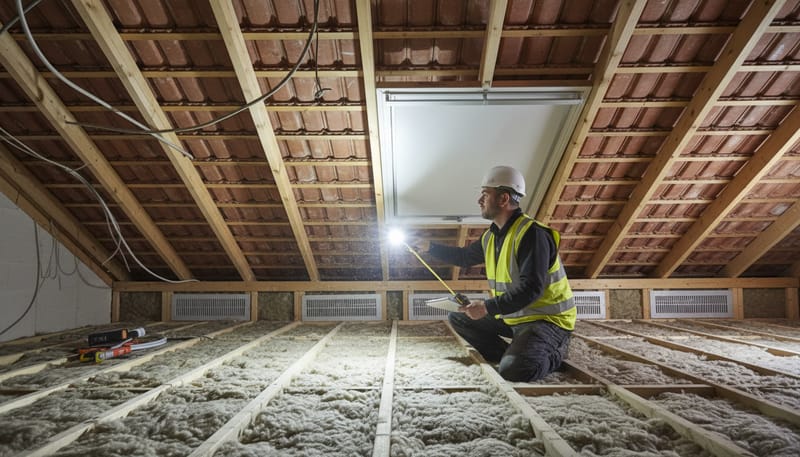
Loft spaces are equally overlooked. The loft is where your insulation, ventilation, water tanks, and much of your wiring reside, and it’s also where construction shortcuts are most likely to be hidden. Insulation that doesn’t meet the specified depth, missing fire stopping around service penetrations, displaced ventilation baffles, and damaged trusses are all common defects that go unnoticed unless someone physically enters the loft and inspects it thoroughly.
A thorough roof and loft snagging inspection requires access to the loft hatch and, ideally, binoculars or a drone for the external roof. This guide covers every check you should carry out, from tile alignment and flashing through to insulation depth and truss condition, giving you the confidence to identify defects that could cost thousands if left unchecked. For a full-property walkthrough, see our complete snagging checklist.
Tile and Slate Alignment
The first thing to check is the overall appearance of the roof covering. Whether your new build has concrete tiles, clay tiles, or natural slate, the courses should be straight, evenly spaced, and consistent in colour. Stand at ground level and look at the roof from several angles. Use binoculars to examine individual tiles more closely. You’re looking for tiles that are sitting proud (raised above their neighbours), slipped tiles that have moved downward, cracked or chipped tiles, and any areas where the tile courses are noticeably uneven.
On concrete and clay tile roofs, check the verge (the edge of the roof at the gable end). Verge tiles should be bedded neatly on mortar or mechanically fixed with dry verge systems. Since 2015, BS 8612 requires all tiles on the perimeter of the roof — verges, eaves, and ridges — to be mechanically fixed rather than relying solely on mortar bedding. If your roof was completed after this date, mortar-only verges are not compliant.
For slate roofs, check that the slates lie flat without any lifting, that the head lap (the overlap between courses) is consistent, and that no fixing nails are visible. Slates should be double-nailed using copper or stainless steel nails, not galvanised steel which can corrode within 15–20 years. If you can see rust streaks running down from any fixing point, the nails may already be deteriorating.
Ridge Tiles and Hip Tiles
Ridge tiles run along the apex of the roof, while hip tiles cover the external angles where two roof slopes meet. These are high-stress areas because they’re exposed to the strongest wind loads. Traditionally bedded in mortar, ridge and hip tiles on new builds should now be mechanically fixed using a dry ridge or dry hip system in compliance with BS 8612.
Check that the ridge line is straight when viewed from ground level. Wobbly or uneven ridges suggest poor installation. Each ridge tile should sit level with its neighbours and the joints between tiles should be consistent. If a dry ridge system is used, the ridge tiles will have visible clips or brackets holding them in place, and a ventilated ridge roll should be visible underneath providing loft ventilation. If mortar is used, it should be neatly pointed and free from cracks.
Hip tiles should be firmly fixed and should follow the roof line smoothly from the ridge down to the eaves. The bonnet hip tile at the bottom of each hip should be securely bedded and cut neatly into the eaves course. Missing or loose hip tiles are particularly common on new builds because this is fiddly work that’s often rushed. A single loose hip tile can admit enough rain to soak through the underlay and cause significant water damage to the rooms below.
Flashing and Lead Work
Flashing is the waterproof material — usually lead, but sometimes a lead-alternative product — used to seal the junctions between the roof and walls, chimneys, vent pipes, soil pipes, and other penetrations. These junctions are the most vulnerable points on any roof, and poor flashing is one of the most common causes of water ingress in new build homes.
Check all lead flashings with binoculars or from the loft. Lead should be dressed neatly over the tiles with no gaps, kinks, or lifted edges. Where the lead enters a mortar joint in the brickwork (the chase), it must be wedged in with lead wedges and pointed with mortar or sealed with a proprietary sealant. The lead should extend at least 150mm over the tiles and should overlap at joints by at least 100mm. Under BS 6915, the minimum lead thickness for flashings is Code 4 (1.8mm) for most applications and Code 5 (2.24mm) for gutters and valleys.
Where a roof meets a wall (an abutment), there should be a stepped flashing that follows the line of the brickwork courses, tucked into the mortar joints at each step. Back gutters behind chimneys and dormer cheeks are notorious weak points — check that the gutter trough is wide enough, properly formed, and drains to the side rather than collecting standing water. If you can access the loft, look for any signs of water staining on the underside of the roof at these critical junctions.
Soffit, Fascia and Guttering
The soffit (the horizontal board under the eaves), fascia (the vertical board at the bottom edge of the rafters), and guttering work together to channel rainwater safely away from your home. Defects in any of these components can lead to water running down external walls, saturating foundations, or backing up under the roof covering.
From ground level, check that the fascia boards are straight, level, and consistently aligned. Look for any warping, bowing, or gaps between joints. If your fascias are uPVC (most common on new builds), check that the fixing clips are secure and that no sections have pulled away from the wall. For painted timber fascias, check for any areas where the paint has been missed or where the timber shows signs of movement at the joints.
Guttering alignment is crucial. All gutters should fall towards the nearest downpipe at a minimum gradient of 1:350. You can spot incorrect alignment by visiting on a rainy day or by pouring water into the gutter from a watering can — it should flow steadily toward the outlet without pooling. Standing water in a gutter section is a clear sign the fall is wrong. Check every joint and stop end for leaks, and verify that all downpipes are properly connected to the underground drainage system or soakaway rather than discharging onto the ground.
The eaves tiles (the first course of tiles at the bottom of the roof) should overhang into the gutter by 25–50mm. If the overhang is too short, rainwater will run behind the gutter and down the fascia. If it’s too long, it will overshoot the gutter in heavy rain. Also check that the soffit vents are unblocked — builders sometimes paint over them or push insulation against them from inside the loft, which severely restricts loft ventilation.
Loft Insulation Depth and Coverage
Loft insulation is one of the most cost-effective ways to reduce heat loss from your home, and Building Regulations require new builds to meet stringent thermal performance standards. The current requirement under Approved Document L is for the loft to achieve a U-value of 0.16 W/m²K or better, which typically requires a minimum insulation depth of 270mm of mineral wool or equivalent.
Access the loft and measure the insulation depth at several points using a ruler or tape measure. Check the centre of the loft and all four corners, as insulation is often thinner or missing entirely at the edges where the roof meets the external walls. These eaves areas are the most important to insulate because they’re where cold bridging is most likely to occur, yet they’re also the hardest to reach during installation.
Look for gaps in the insulation around pipes, cables, downlighters (which require fire-rated hoods if insulation is placed over them), and service penetrations. Any water tanks in the loft should be insulated on all sides and the top, but not underneath — the warmth from below helps prevent freezing. Pipes running through the loft must be lagged, and any electrical cables should ideally be routed above the insulation to prevent overheating.
The loft hatch itself is a common weak point. It should be insulated to the same standard as the ceiling and fitted with a draught seal around its perimeter. Many new builds have uninsulated loft hatches that create a significant cold spot directly below — you may notice this as a cold draught or even condensation on the ceiling around the hatch during winter. This is a straightforward fix but one the developer should have completed before handover.
Loft Ventilation and Hatch Fit
Adequate ventilation in the loft is essential to prevent condensation, which can lead to mould growth on timber trusses and the underside of the roof membrane. Building Regulations Approved Document C and NHBC Standards Chapter 7.2 specify ventilation requirements based on the roof design. For a typical pitched roof with a cold loft space, continuous ventilation equivalent to a 10mm gap must be provided at the eaves on both sides of the roof, plus 5mm equivalent at the ridge for roofs with a pitch over 15 degrees.
Check that the eaves ventilation is not blocked by insulation. Ventilation baffles — plastic or cardboard troughs that sit between the rafters at the eaves — should be in place to maintain an airway even where insulation is pushed right to the wall plate. These baffles are frequently missing or displaced in new builds, particularly when insulation is installed by a different team than the one that fitted the baffles.
At the ridge, look for a ventilated ridge system or tile vents spaced along the ridge line. The loft should feel dry with no musty smell. If you can see water droplets on the underside of the breathable membrane or on the truss timbers, ventilation is inadequate. Also look for any signs of black mould on timber, which indicates a condensation problem that needs urgent attention. This is a defect the developer must resolve under the NHBC warranty, but the sooner it’s caught the less damage will occur.
The loft hatch should fit snugly in its frame with an even gap of 2–3mm all round. It should be easy to open and close without sticking, and there should be a drop-down or fold-down loft ladder if one was specified. Check the hatch from inside the loft as well — there should be a catch or stay that holds it open while you’re in the loft to prevent it falling shut.
Visible Truss or Rafter Damage
While you’re in the loft, take time to inspect the structural timber. Roof trusses in new builds are factory-manufactured to precise specifications and should arrive on site in perfect condition. However, damage during delivery, storage, and installation is not uncommon. Look for any trusses that are cracked, split, twisted, or bowed. Pay particular attention to the connector plates (the metal nail plates that join the truss members together) — these must be fully embedded in the timber with no plates that have pulled away or become misaligned.
Check that no trusses have been notched or drilled to accommodate services. Plumbers and electricians sometimes cut into trusses to run pipes or cables, which can seriously compromise the structural integrity of the roof. Any cuts or notches to truss members are almost always unauthorised and should be reported as a structural defect. Your developer will need to have the affected trusses assessed by a structural engineer.
Also look for adequate bracing. Roof trusses should be braced together with diagonal and longitudinal timber members to prevent the trusses from twisting or racking under wind loads. The bracing pattern should match the truss manufacturer’s specification, which your developer should be able to provide. Finally, check that all timber is clean and dry with no signs of staining, fungal growth, or insect infestation. While new timber should be treated, check for any areas where the treatment has been cut away during installation, exposing untreated wood to the loft environment.
A thorough roof and loft inspection may feel daunting, but it’s one of the most important parts of your snagging process. Catching issues now, while your developer is still responsible under the builder warranty period, can save you thousands in repair costs and protect one of your most valuable assets. If you’re not confident inspecting the loft yourself, a professional snagging inspector will include this as standard in their report — see our handover guide for more on choosing an inspector.