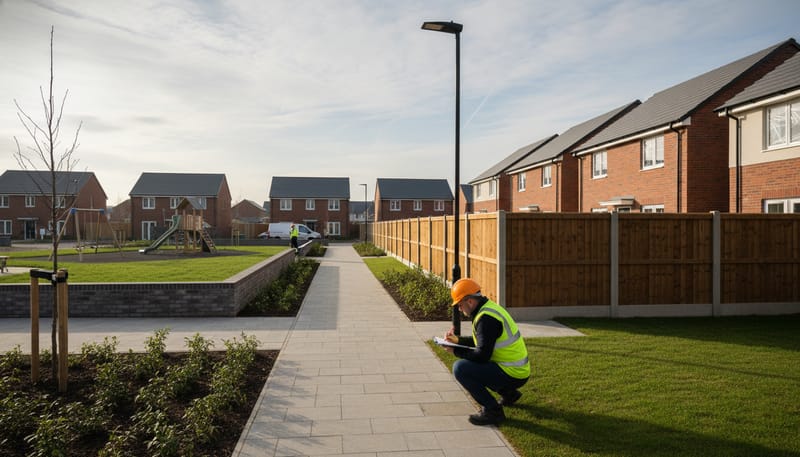
Why External Works Matter as Much as Your Home
When most buyers think about snagging their new build, they focus on what’s inside the four walls — the cracked tiles, the dodgy paintwork, the squeaky doors. But the external works on your development are just as important and often far more problematic. Roads, pavements, street lighting, drainage, fencing, and landscaping all affect your daily life, your property value, and your safety.
External works are typically the last items to be completed on a new build development, often finished long after the first residents have moved in. This means you may be living with unfinished roads, temporary surfaces, missing street lights, and incomplete landscaping for months or even years. Understanding what the developer is obligated to deliver — and the timescales involved — is essential for holding them to account.
This guide covers every common external works defect you should look for, from communal areas and road surfaces to drainage and S38/S104 adoption issues. Whether you’ve just moved in or your development has been occupied for some time, these are the snags that matter beyond your front door.
Road Surfaces, Pavements, and Kerbs
The roads and pavements on a new build development are built by the developer but are intended to be “adopted” by the local council under a Section 38 agreement of the Highways Act 1980. Until adoption occurs, the developer remains responsible for maintenance. This process can take two to five years or more, and during that time, residents often experience significant issues.
Common road and pavement defects include:
- Unfinished top course — many developments have only a base course of tarmac for months, with the final wearing course not laid until building work is complete
- Potholes and cracking — heavy construction traffic damages road surfaces, leaving potholes, rutting, and cracked tarmac
- Poorly aligned kerbs — kerb stones that are uneven, cracked, or have excessive gaps between units
- Pavement trip hazards — uneven paving slabs, sunken or raised sections creating a trip risk
- Damaged or missing dropped kerbs — essential for wheelchair and pushchair access
- Incomplete road markings — missing yellow lines, parking bay markings, or junction markings
If your development roads are still unadopted and in poor condition, report defects to both the developer and your local council’s highways department. The council has a vested interest in ensuring the roads meet adoption standard, and pressure from the authority can speed up remedial work.
Drainage, Gullies, and Flooding
Drainage is one of the most critical external works elements and one of the most common sources of complaints on new developments. Surface water drainage (rainwater from roads and roofs) and foul water drainage (sewage) are separate systems, each with their own adoption pathway.
Common drainage defects on new build developments include:
- Blocked or slow-draining gullies — road gullies filled with construction debris (sand, cement, aggregate)
- Standing water after rain — puddles that don’t drain within a reasonable time, indicating grading or drainage design issues
- Manhole covers that sit too high or low — trip hazards or covers that allow surface water ingress
- Collapsed or damaged pipes — caused by construction traffic driving over shallow drains before protective covers were installed
- SuDS features not working — Sustainable Drainage Systems (swales, attenuation ponds, permeable paving) that are blocked, overgrown, or not functioning as designed
Drainage issues should be reported urgently as they can cause flooding to properties and create health hazards. If the sewers are still unadopted, report to the developer. If adoption has completed, contact your water company. You can check adoption status by contacting your local water company’s developer services team.
Fencing, Boundaries, and Landscaping
Boundary treatments (fences, walls, hedges) and landscaping are frequently left until late in the development programme and are common sources of disputes. Your purchase contract should specify what boundary treatments are included, but the standard of installation is where problems arise.
Landscaping snags are equally common. Developers are usually required by planning conditions to implement an approved landscaping scheme, but the quality of execution is often poor. Look for dead or dying trees and shrubs (which should be replaced during the first planting season), areas of bare soil that should be turfed, and any differences between the approved landscaping plan (available from your local council’s planning portal) and what has actually been planted.
Check your transfer deed and title plan to understand which boundaries you own and which belong to neighbouring properties. The developer should have provided this information at completion. If a boundary fence was included in your specification but has not been erected, or has been erected in the wrong position, raise this as a snag immediately.
Street Lighting, Utilities, and Play Areas
Street lighting on new developments is another common area of concern. Lights may be installed but not connected, flickering, pointing in the wrong direction, or casting excessive light into bedroom windows (known as light pollution or light spill). Until the street lights are adopted by the council or a management company, the developer is responsible for their operation and maintenance.
Other utility-related external works to check include:
- Meter boxes — properly sealed, doors that open and close correctly, accessible for meter readings
- Utility covers and chambers — flush with ground level, not rocking or broken
- EV charging points — if included in the specification, check they are installed, connected, and working
- Communal TV aerials or satellite dishes — where specified, check signal quality and connections
For developments with play areas, these are often required by the planning approval and must meet specific safety standards. If the play area was a selling point when you purchased, ensure it has been built to the standard shown in the marketing materials. Check for proper safety surfacing under all equipment, adequate fencing to prevent children running onto roads, and compliance with BS EN 1176 for playground equipment.
Communal Areas and Shared Spaces
Modern new build developments often include communal areas such as green spaces, footpaths, cycle paths, communal parking, and visitor parking. These are either adopted by the council, managed by a residents’ management company, or retained by the developer. Understanding who is responsible for each area is crucial when reporting defects.
If your development has a residents’ management company, check what is covered by the annual service charge. Common complaints include high management fees for areas that haven’t been completed or aren’t being maintained. Your conveyancer should have advised you about management company obligations before you completed the purchase, but many buyers only discover the details after moving in.
Visitor parking areas should be clearly marked, properly surfaced, and adequate for the development size. If visitor spaces were shown on the site plan you were given at reservation, they should be provided as specified. Missing or relocated parking is a common complaint and may constitute a breach of the sales specification.
S38 and S104 Adoption Issues: What Happens When It Stalls
The adoption process is where many external works problems become entrenched. Section 38 (roads) and Section 104 (sewers) agreements are made between the developer and the relevant authority before construction begins. These agreements require the developer to build infrastructure to an agreed standard and then hand it over for public maintenance.
When the adoption process stalls, residents are left in limbo: the developer may have moved on to the next project and have little incentive to complete the works, while the council and water company won’t adopt substandard infrastructure. This is a common problem on developments where the builder enters financial difficulty or simply deprioritises completion.
If you are experiencing adoption delays on your development, the first step is to contact the developer’s customer care team and request a written update on the adoption timeline. If you get no satisfactory response, contact your local council’s highways department (for S38) or your water company’s developer services (for S104) to find out the status of the agreement and whether the developer has applied for final inspection.
In extreme cases, the council can use the bond held under the S38 agreement to complete the road works themselves if the developer fails to do so. For sewers, the Water Industry Act provides mechanisms for the water company to intervene. Your local councillor and MP can also help apply pressure if the adoption process has stalled for an unreasonable period.
How to Report and Escalate External Works Defects
Reporting external works defects differs from reporting internal snags because the responsibility may not sit solely with the developer. Here is a structured approach to getting external works issues resolved on your development.
For a full guide on how the snagging rectification process works, including escalation routes and your rights under the Consumer Code, see our guide to common defects in new build homes. If your developer is unresponsive about external works, consider contacting the New Homes Quality Board or your warranty provider for additional support and guidance.
External works may feel like they’re “someone else’s problem,” but they directly affect your quality of life and property value. Don’t let the developer off the hook simply because the defects are outside your front door rather than inside it.