What the Handover Inspection Is (and Is Not)
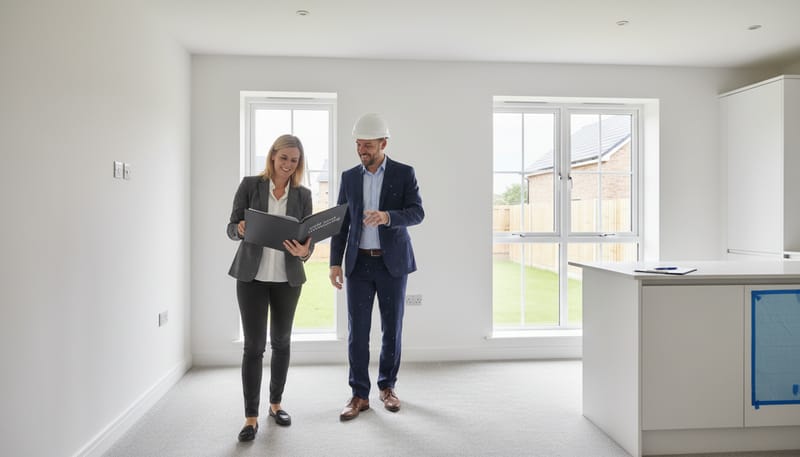
The handover inspection — sometimes called a home demonstration, pre-completion visit, or demo day — is a formal walkthrough of your new build property with the site manager or customer care representative. It typically takes place between 1 and 7 days before legal completion.
What the Handover Includes
| Element | What Happens | Your Role |
|---|---|---|
| Property walkthrough | Site manager takes you through every room | Observe, ask questions, take notes |
| Systems demonstration | They show you how boiler, heating, MVHR, alarms, and appliances work | Ask for written instructions if anything is unclear |
| Meter locations | Gas, electricity, and water meter positions shown | Note locations and take photographs |
| Safety features | Smoke alarms, CO detectors, fire doors, window restrictors demonstrated | Test each one |
| External areas | Garden, boundaries, parking, bin storage, shared areas | Confirm matches your contract specification |
| Documentation handover | Manuals, warranty certificates, EPC, compliance certificates | Check everything is present |
What the Handover Is Not
The handover inspection is not a professional snagging survey. The site manager is there to demonstrate the property and hand over documentation — they are not independently assessing the quality of the build. It is your responsibility (or your snagging inspector's) to identify defects. The site manager may point out minor items they are aware of, but they will not conduct a systematic inspection.
It also does not replace a conveyancing survey or structural survey. Those are separate professional assessments.
Preparing for Your Handover Inspection
Preparation makes the difference between a useful inspection and a wasted visit. Here is what to do before the day.
What to Bring
| Item | Why You Need It |
|---|---|
| Smartphone with charged battery | Photographs of defects, video of demonstrations, reference for later |
| Notepad and pen | Write down defects as you find them — do not rely on memory |
| Torch / phone torch | Inspect under kitchen units, inside cupboards, loft spaces, dark corners |
| Spirit level (small) | Check kitchen worktops, shelving, and tiling are level |
| Tape measure | Verify room dimensions match specification (especially if buying furniture) |
| Plug-in electrical tester | Inexpensive devices that confirm sockets are wired correctly — available from DIY stores for under £15 |
| Your purchase specification | The list of included fixtures, fittings, and any upgrades you selected |
| Blue painter's tape or sticky notes | Mark defect locations on walls, doors, and surfaces for easy reference |
| This snagging checklist (printed) | Systematic room-by-room guide to follow |
How Long Should the Inspection Take?
| Property Type | Minimum Time | Recommended Time |
|---|---|---|
| 1-2 bed apartment | 1 hour | 1.5-2 hours |
| 2-3 bed house | 1.5 hours | 2-3 hours |
| 4-5 bed house | 2 hours | 3-4 hours |
| Large detached / executive home | 2.5 hours | 4+ hours |
Developers typically allocate 1-2 hours for a handover. If you need more time, ask in advance. Do not let the site manager rush you — this is your home, and you are entitled to inspect it properly.
Room-by-Room Snagging Checklist
Work through each room systematically. For every defect you find, photograph it, note its location, and describe the issue clearly. This becomes your formal snagging list.
General Checks (Apply to Every Room)
| Area | What to Check | Common Defects |
|---|---|---|
| Walls | Smooth finish, no bumps, cracks, or nail pops. Paint even coverage, no drips or missed patches | Hairline cracks at corners, uneven plasterwork, paint splashes on skirting |
| Ceilings | Level finish, no sagging, cracks at joints or around light fittings | Plasterboard joint lines showing through, artex-style ridges on supposedly smooth ceilings |
| Floors | Level, no creaking on timber floors, carpet laid smoothly, no gaps at edges | Uneven screed under tile/vinyl, squeaky floorboards, carpet not tucked at grippers |
| Skirting boards | Tight to wall, mitred corners neat, no gaps, painted evenly | Gaps between skirting and wall/floor, poor mitring, filler showing |
| Doors | Open and close smoothly, latch clicks properly, no rubbing on carpet, all handles tight | Doors catching on frame, loose handles, fire door labels missing, gaps at frame |
| Windows | Open, close, and lock smoothly. Seals intact, no condensation between panes, trickle vents functional | Stiff handles, damaged seals, scratched glass, restrictors not fitted on upper floors |
| Light switches and sockets | All working, straight on wall, no cracked faceplates | Crooked alignment, screw burrs, non-functional sockets |
| Radiators (if fitted) | Secure on wall, heating evenly when tested, no leaks at valves | Cold spots (air trapped), loose brackets, paint damage |
Kitchen
| Area | What to Check | Common Defects |
|---|---|---|
| Worktops | Level (use spirit level), no chips or scratches, joints sealed, overhang even | Chips at cut-outs, uneven joints, silicone gaps, worktop not level |
| Cabinets | All doors open and close, soft-close working, drawers slide smoothly, no damage to faces | Misaligned doors, failed soft-close, scratched faces, missing shelf pegs |
| Sink and taps | Hot and cold working, drainage clear, no leaks underneath, silicone seal complete | Slow drainage, dripping taps, gaps in silicone around sink |
| Appliances | All included appliances present and working (oven, hob, extractor, dishwasher, fridge/freezer if specified) | Missing appliance manuals, oven not heating evenly, extractor noisy |
| Splashback / tiling | Grouting complete, tiles level, no chips, silicone at edges clean | Cracked tiles, uneven grout lines, missing grout, dirty silicone |
| Flooring | Even, no damage, properly sealed at edges if vinyl/tile | Lifted edges, uneven tiles, poor cutting around pipes |
| Under units | Use torch to check — pipework connected, no leaks, no construction debris | Standing water, loose connections, building waste left behind |
| Extractor / ventilation | Extraction fan working, filters accessible, ductwork connected | Fan not connected, poor extraction rate, missing filters |
Bathroom and En-Suite
| Area | What to Check | Common Defects |
|---|---|---|
| Toilet | Flush working, no rocking, silicone sealed at base, cistern filling correctly | Running cistern, loose toilet, poor silicone, slow fill |
| Basin | Hot and cold working, plugs sealing, waste draining, overflow working | Dripping taps, slow drain, overflow not connected |
| Bath | Taps working, plug sealing, panel secure, no chips, silicone sealed | Chips in enamel, panel not secure, gaps in silicone at wall |
| Shower | Temperature controls working, drainage clear, screen sealing, pressure adequate | Leaking screen, poor pressure, temperature fluctuation, drainage slow |
| Tiling | All tiles secure, grouting complete, no chips, straight lines, silicone at junctions | Hollow-sounding tiles (not fully adhered), missing grout, cracked tiles |
| Extractor fan | Running when light switched on (or humidistat triggered), adequate extraction | Fan not wired, weak extraction, noisy bearing |
| Towel rail / radiator | Heating, level, secure on wall | Not connected, cold spots, loose fixings |
| Mirror / cabinets | If specified, securely fitted, no damage | Crooked fitting, scratched mirror |
Bedrooms
| Area | What to Check | Common Defects |
|---|---|---|
| Fitted wardrobes (if included) | Doors slide/open smoothly, shelving level, hanging rail secure | Misaligned sliding doors, sagging rail, scratched doors |
| Carpet | Smooth, no wrinkles, properly fitted at edges, colour consistent | Wrinkles that indicate poor stretching, visible joins, carpet not tucked at doorways |
| Window operation | Open fully (or with restrictor on upper floors), lock properly, trickle vents work | Stiff mechanisms, damaged restrictors, painted-shut windows |
| Radiator position | Not blocking furniture placement, heating evenly | Positioned where bed would naturally go, cold spots |
Living Room and Dining Room
| Area | What to Check | Common Defects |
|---|---|---|
| Fireplace (if fitted) | Surround level, hearth flat, any gas fire properly commissioned with documentation | Uneven surround, gas fire not commissioned, missing fire certificate |
| Patio / French doors | Open, close, and lock smoothly, multipoint locking engaging, draught seals intact | Stiff locks, misaligned doors that do not close flush, draughts at threshold |
| Flooring transitions | Clean transitions between rooms (carpet to tile, etc.), threshold strips secure | Missing threshold strips, uneven transitions, gaps |
| TV / media points | Aerial, satellite, phone, and ethernet points present and in correct locations | Missing points, not connected at the other end, damaged faceplates |
Hallway, Stairs, and Landing
| Area | What to Check | Common Defects |
|---|---|---|
| Staircase | Handrail secure, spindles tight (try to twist each one), no creaking treads, carpet smooth | Loose spindles, creaking on specific treads, handrail wobble |
| Under-stairs cupboard | If included — door fits, light working, consumer unit accessible | Door not aligned, no light fitted, difficult access to consumer unit |
| Smoke and CO alarms | All present and working — press test button on each | Missing units, dead batteries, not interconnected |
| Loft hatch | Opens smoothly, insulation visible, loft ladder if specified | Painted shut, no insulation, hatch not insulated |
Garage (If Applicable)
| Area | What to Check | Common Defects |
|---|---|---|
| Garage door | Opens and closes smoothly, locks securely, electric opener working if specified | Stiff mechanism, poor sealing at base, remote not programmed |
| Floor | Level, no cracks, drainage if applicable | Uneven surface, standing water near entrance |
| Electrics | Light and at least one socket working | No power, light not working, consumer unit not labelled |
| Fire door to house | If garage is integral — fire door fitted, self-closing, proper seal | Self-closer not fitted or too weak, gaps in fire seal |
External Areas
| Area | What to Check | Common Defects |
|---|---|---|
| Brickwork / render | Consistent colour, mortar joints neat, no cracks, render smooth | Mismatched brick colour, cracked render, poor pointing |
| Roof (visual check) | Tiles aligned, ridge tiles secure, no visible damage, gutters straight | Slipped tiles, damaged ridge, sagging gutters |
| Gutters and downpipes | Connected, no visible damage, draining to correct location | Disconnected joints, draining onto neighbour's land |
| Driveway | Level, no ponding areas, edges neat, matches specification | Uneven surface, poor drainage, damage from construction vehicles |
| Garden | Topsoil applied, turf or seed as specified, fencing complete, boundaries clear | Subsoil only (no topsoil), fencing incomplete, rubble in garden |
| Drainage | Manhole covers level, gullies clear, no standing water | Blocked gullies, manhole covers not level with surface |
| External taps | Working if specified | Not connected, leaking at connection |
| Bin storage | Area defined, bins provided if included | No bins provided, storage area not built |
Documentation You Should Receive at Handover
The developer is required to provide substantial documentation at or around the time of handover. Under the Consumer Code for Home Builders, you must receive adequate information about your home and its systems.
Essential Documents Checklist
| Document | What It Is | Why It Matters |
|---|---|---|
| NHBC / Premier / LABC warranty certificate | Confirms your home is registered with a warranty provider | Covers structural defects for 10 years (varies by provider) |
| Energy Performance Certificate (EPC) | Rates the energy efficiency of your home from A to G | Legal requirement for all property sales; new builds should typically be B or above |
| Building control completion certificate | Confirms the property meets Building Regulations | Essential — without this, the build is technically not legally complete |
| Gas Safe certificate | Confirms gas installation has been safety tested | Legal requirement for all gas installations |
| Electrical installation certificate | Confirms electrics comply with Part P of Building Regulations | Certifies the electrical installation is safe |
| FENSA / CERTASS certificate | Confirms windows and doors comply with Building Regulations | Required for all new window installations |
| Boiler commissioning certificate | Confirms the boiler has been properly installed and tested | Required for manufacturer's warranty to be valid |
| Appliance manuals and warranties | Instruction booklets for all included appliances | Need these for warranty claims and operating instructions |
| MVHR commissioning report (if fitted) | Confirms mechanical ventilation system has been balanced and tested | MVHR systems must be commissioned to work correctly; without this, extraction rates may be wrong |
| Fire safety information | Location of alarms, fire doors, escape routes | Particularly important for apartments and buildings over 11 metres |
| Homeowner's manual | Developer-provided guide to living in and maintaining your home | Covers everything from heating schedules to decorating timescales |
| Emergency contact numbers | Developer after-sales team, site manager, out-of-hours contact | Essential for reporting urgent defects in the first weeks |
| Planning permission documentation | Conditions attached to the development that may affect you | Some conditions restrict future modifications (extensions, satellite dishes, etc.) |
If any documents are missing, note this on the handover form and request them in writing. Do not assume the developer will send them later — follow up within 7 days if they have not arrived.
Professional Snagging Inspections
While your own inspection is valuable, a professional snagging inspector will identify issues you are likely to miss. They have experience, specialist tools, and knowledge of building standards.
DIY Inspection vs Professional Snagging
| Factor | DIY Inspection | Professional Snagging Inspector |
|---|---|---|
| Cost | Free (your time) | £300-£600 depending on property size |
| Typical defects found | 20-40 items | 50-150+ items |
| Technical knowledge | Limited to obvious issues | Knows Building Regulations, NHBC standards, tolerances |
| Equipment | Basic (torch, spirit level) | Specialist (moisture meters, thermal imaging, electrical testers, laser levels) |
| Report | Your own notes and photos | Formal report with photographs, locations, and standards references |
| Developer response | May dispute items without technical backing | Harder for developers to dismiss a professional report |
| Time required | 2-4 hours of your time | 2-4 hours of their time; you receive the report |
When to Book a Professional Snagging Inspector
Ideally, book the inspection before legal completion — between exchange and completion, during the handover inspection window. Some developers resist allowing independent inspectors on site before completion; the Consumer Code states you should be given reasonable opportunity to inspect. If the developer refuses, book the inspector for the day of completion or the first few days after.
Most warranty providers (NHBC, Premier Guarantee, LABC) allow snagging claims within the first 2 years under the builder's initial warranty period. So even if you cannot get a professional in before completion, you have time — but sooner is always better.
What to Look for in a Snagging Inspector
| Criteria | What to Check |
|---|---|
| Qualifications | Construction-related qualifications (RICS, CIOB, or equivalent). Membership of professional bodies |
| Experience | Specifically experienced with new build snagging, not just general surveys |
| Insurance | Professional indemnity insurance |
| Report quality | Ask for a sample report — should include photographs, specific locations, and reference to standards |
| Reviews | Check independent reviews (Trustpilot, Google) |
| Turnaround | Report should be available within 24-48 hours of the inspection |
How to Submit Your Snagging List
Once you have completed your inspection (DIY or professional), you need to submit the snagging list formally to the developer.
Best Practice for Snagging Submissions
| Element | Recommendation |
|---|---|
| Format | Written list (email or letter) with each item numbered, described, and located |
| Photographs | Include dated photographs for every item — reduces disputes |
| Submission method | Email to the developer's after-sales team (creates a paper trail). Copy to site manager for awareness |
| Response deadline | Request acknowledgement within 5 working days and a remediation timeline within 10 working days |
| Priority classification | Mark items as urgent (safety, leaks, no heating), standard (cosmetic, functional), or minor (cosmetic only) |
| Keep copies | Save copies of everything you submit and every response you receive |
What Developers Must Do Under the Consumer Code
The Consumer Code for Home Builders (2024 edition) requires developers to:
- Provide an accessible after-sales service
- Have a system for receiving, recording, and dealing with snagging items
- Provide a timeline for dealing with reported issues
- Distinguish between snagging items (minor defects) and warranty claims (structural or systemic issues)
- Not unreasonably refuse to address legitimate defects
For full details on the after-sales process, escalation paths, and your rights when developers are slow to respond, see our after-sales support guide.
Common Snagging Issues by Severity
Not all snagging items are equal. Understanding severity helps you prioritise and communicate with the developer.
Critical Issues (Require Immediate Action)
| Issue | Why It Is Critical | Expected Response |
|---|---|---|
| No heating or hot water | Uninhabitable in cold weather, breach of building regulations | Same day or next working day |
| Water leak (active) | Causes progressive damage to structure and finishes | Emergency response (same day) |
| Electrical fault (exposed wiring, tripping consumer unit) | Safety hazard | Emergency response |
| Gas leak or smell | Immediate danger — call National Gas Emergency on 0800 111 999 first | Emergency response |
| Non-functioning smoke / CO alarms | Life safety equipment required by Building Regulations | Same day |
| Insecure external doors or windows | Security risk, insurance implications | Same day or next working day |
Standard Issues (Fix Within Weeks)
| Issue | Typical Cause | Expected Timeframe |
|---|---|---|
| Doors not closing properly | Settlement, adjustment needed | 2-4 weeks |
| Dripping taps | Washer or cartridge issue | 1-2 weeks |
| Window mechanisms stiff or faulty | Adjustment or replacement parts needed | 2-4 weeks |
| Kitchen cabinet alignment | Adjustment of hinges and catches | 1-2 weeks |
| Toilet running / not flushing correctly | Valve adjustment or replacement | 1-2 weeks |
| MVHR system not extracting properly | Needs recommissioning or filter cleaning | 2-4 weeks |
| External drainage issues | Blocked or misaligned pipes | 2-4 weeks |
Minor Cosmetic Issues (Fix Within Months)
| Issue | Typical Cause | Expected Timeframe |
|---|---|---|
| Paint touch-ups needed | Marks from fitting, transport, or cleaning | Batch repair visit (4-8 weeks) |
| Hairline cracks at plasterboard joints | Normal drying and settlement — expected in new builds | Usually repaired at 6-12 month review visit |
| Scratches on worktops or surfaces | Installation damage | 2-6 weeks (may need replacement) |
| Gaps at skirting or architrave | Timber shrinkage as the building dries out | Usually repaired at 6-12 month visit (let the building dry out first) |
| Grout missing or uneven | Rushed finishing | 2-4 weeks |
New Build Drying Out: What to Expect in the First Year
New build homes contain a significant amount of moisture from construction — concrete, plaster, mortar, and timber all carry water that needs to evaporate over time. This drying-out process takes 9-12 months and causes effects that are normal, not defects.
Normal Drying-Out Effects
| Effect | What You Will See | What to Do |
|---|---|---|
| Hairline cracks | Fine cracks at ceiling/wall junctions, around door frames, at plasterboard joints | Do not fill them yet — wait until the building has dried out (9-12 months), then fill and redecorate |
| Gaps at skirting and architrave | Small gaps appearing between timber and walls as the timber and plaster dry at different rates | Normal shrinkage — fill at 12-month point |
| Condensation on windows | Water droplets on inside of windows, especially in bedrooms overnight | Ventilate well — open trickle vents, use MVHR system, wipe down in the morning |
| Stiff doors | Doors that fitted perfectly at handover start sticking or not closing | Moisture in timber changes dimensions — adjust or wait for settling |
| Damp patches on walls | Dark spots appearing on external walls after heavy rain | Check brickwork outside for mortar gaps; if persistent after 12 months, report as a defect |
| Mould spots | Small mould spots in corners, behind furniture, in wardrobes | Usually caused by condensation during drying-out — improve ventilation, clean with mould spray, do not place furniture flush against external walls |
Developers will typically schedule a 6-month or 12-month revisit to address settlement-related issues. Many snagging items related to cracking and shrinkage are best resolved at this point rather than immediately.
For a detailed maintenance schedule for your first years and beyond, see our new build maintenance guide.
Your Rights and the Developer's Obligations
Consumer Code for Home Builders
All major UK housebuilders are signed up to the Consumer Code (2024 edition). It requires developers to:
- Allow you reasonable opportunity to inspect the property before completion
- Provide a complaints procedure and handle disputes fairly
- Complete agreed snagging works within a reasonable timeframe
- Not unreasonably restrict independent inspections
Warranty Provider Protection
| Period | Coverage | Who Fixes It |
|---|---|---|
| Years 1-2 (builder warranty period) | Any defect or damage caused by non-compliance with warranty provider's technical standards | The developer / builder |
| Years 3-10 (structural insurance period) | Structural defects, including foundations, load-bearing walls, roof structure, waterproofing | The warranty provider directly (NHBC, Premier, LABC) |
The distinction matters: in years 1-2, the developer must fix defects. If they refuse or are too slow, you can escalate to the warranty provider. From year 3 onward, you deal directly with the warranty provider for structural issues.
For comprehensive coverage of warranty claims, escalation procedures, and what to do if the developer is unresponsive, see our after-sales support guide.
Frequently Asked Questions
Can I refuse to complete if there are snagging issues?
No. Once you have exchanged contracts, you are legally committed to complete. Snagging issues do not give you the right to delay or refuse completion — they are expected in new builds and addressed through the after-sales process. The only exception would be if the property is fundamentally incomplete or unsafe, in which case your solicitor should advise.
How many snagging items is normal for a new build?
A professional snagging inspection typically finds 50-150 items on a new build home. Most are minor cosmetic issues. Finding 30-60 items yourself is normal. Zero items would be unusual. Do not feel that a long list means your home is poorly built — most are easily remedied.
Can the developer refuse to let me bring a snagging inspector?
They can make it difficult, but the Consumer Code states you should have reasonable opportunity to inspect. Before completion, the developer controls access. After completion, the property is yours and you can bring in anyone you wish. If the developer refuses access before completion, book the inspector for the day of completion.
Should I do my own inspection even if I hire a professional?
Yes. You live in the property and will notice things a professional may not — how doors feel to use, noise levels, which sockets are convenient, water pressure at peak times. The professional catches technical defects; you catch the livability issues.
What if new defects appear after I move in?
New defects can and do appear, especially during the first year as the building dries out. Report them to the developer's after-sales team as you find them. You have 2 years under the builder warranty period to report defects caused by the builder's workmanship, and 10 years for structural defects.
How long should the developer take to fix snagging items?
There is no legal deadline, but the Consumer Code requires a reasonable timeframe. Emergency items should be fixed within 24 hours. Standard items typically within 2-4 weeks. Cosmetic items may be batched and fixed during scheduled visits. If the developer is persistently slow, escalate through the warranty provider or Consumer Code dispute resolution. See our after-sales support guide.