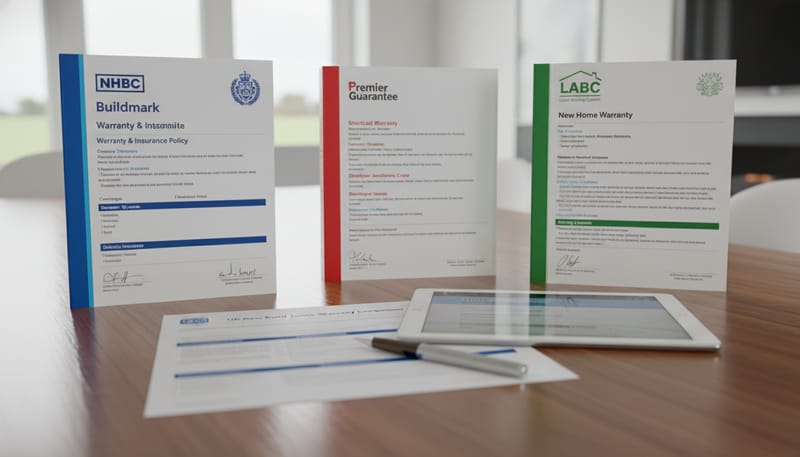
How New Build Warranties Work: The Basic Structure
All major UK new build warranties follow the same general structure, regardless of provider. Understanding this structure is essential before looking at individual providers.
The Three Periods
| Period | Duration | Who's Responsible | What's Covered |
|---|---|---|---|
| Pre-completion cover | From exchange of contracts until completion | Warranty provider (insurance) | Protects your deposit and exchange monies if the developer goes bust before completing your home. Typically covers up to £100,000 |
| Defects liability period (builder's warranty) | Years 1-2 after completion | Developer (directly) | The developer must fix any defect that doesn't meet the warranty provider's technical standards or building regulations — cosmetic, functional, and structural |
| Structural insurance period | Years 3-10 after completion | Warranty provider (insurance) | The warranty provider's insurance covers structural defects only — physical damage caused by a defect in specified structural elements |
Key Points Most Buyers Miss
- Years 1-2 are NOT insurance — the developer fixes defects directly. The warranty provider only steps in if the developer refuses or goes bust
- Years 3-10 are insurance with exclusions — the warranty provider pays for structural defects only. Cosmetic issues, wear and tear, and non-structural problems are excluded
- You must report defects promptly — delayed reporting can weaken your claim, especially if the provider argues damage was caused by neglect
- The warranty transfers with the property — if you sell your home, the remaining warranty cover passes to the new owner automatically
- Your mortgage lender requires a warranty — without one, most lenders won't lend. The warranty protects them as much as you
NHBC Buildmark: The Market Leader
NHBC (National House Building Council) is the largest warranty provider in the UK, covering approximately 80% of all new build homes. Their warranty product is called Buildmark.
Buildmark Cover Breakdown
| Cover Element | Period | What It Covers | Maximum Claim |
|---|---|---|---|
| Pre-completion (Section 1) | Exchange to completion | Deposit protection if developer fails to complete. Covers exchange deposit and any stage payments | Up to £100,000 |
| Builder warranty period (Section 2) | Years 1-2 | Developer must fix defects that breach NHBC Standards. NHBC's Resolution Service mediates if developer doesn't respond | No monetary cap — developer must fix |
| NHBC insurance (Section 3) | Years 3-10 | Physical damage to the home caused by a defect in specified structural elements: foundations, load-bearing walls, external render/cladding, roof structure, floors, stairs (as structure), retaining walls, below-ground drainage | Original purchase price (index-linked) |
| Contaminated land cover | Full 10 years | If the land your home is built on is subsequently found to be contaminated, requiring remediation | Included in main cover |
What NHBC Buildmark Does NOT Cover
| Exclusion | Why |
|---|---|
| Cosmetic defects after Year 2 | Paint, plaster finish, tile appearance — these are only covered during the builder warranty period (Years 1-2) |
| Wear and tear | Normal ageing of materials and components |
| Damage caused by homeowner | Alterations, DIY work, failure to maintain |
| Shrinkage cracks under 2mm | Considered normal settlement in new buildings |
| Fences, paths, and non-structural landscaping | External works beyond the building envelope are generally excluded from structural cover |
| Kitchen and bathroom fittings | Appliances, sanitaryware, worktops — covered by manufacturer warranties, not Buildmark |
| Boiler and heating system | Covered by manufacturer warranty (typically 5-10 years) and Gas Safe certificate |
| Condensation from occupant lifestyle | If caused by inadequate ventilation by the occupant rather than a construction defect |
| Damage from events (flood, storm, subsidence from non-construction cause) | Covered by buildings insurance, not warranty |
| Shared drainage beyond property boundary | Adopted drainage is the water company's responsibility |
NHBC Resolution Service (Years 1-2)
If your developer doesn't fix defects during Years 1-2, NHBC offers a Resolution Service:
- Report to developer first — you must give them reasonable time to respond (typically 28-56 days depending on severity)
- Contact NHBC — if the developer hasn't responded or you're not satisfied with their response, contact NHBC
- NHBC investigation — an NHBC inspector visits your property and assesses each reported defect against NHBC Standards
- Resolution report — NHBC issues a report identifying which items breach their standards and directs the developer to fix them
- Developer complies (or doesn't) — most developers comply with NHBC directions. If they don't, NHBC can arrange repairs directly (at the developer's cost) in extreme cases
The Resolution Service is free. It's not a complaints process — it's a technical assessment of whether defects breach NHBC Standards.
NHBC Claims Process (Years 3-10)
- Contact NHBC claims team — phone or online. Provide your Buildmark policy number, property address, and description of the problem
- Initial assessment — NHBC may ask for photos, arrange a phone consultation, or schedule a surveyor visit
- Surveyor inspection — an NHBC surveyor visits to assess whether the damage is caused by a defect in a covered structural element
- Decision — NHBC accepts or declines the claim. If accepted, they specify the remedial work required
- Repair work — NHBC appoints contractors or agrees a cash settlement. You don't choose the contractor (though you can discuss the scope of works)
- If declined — you receive a written explanation. You can appeal or escalate to the Financial Ombudsman Service (NHBC is regulated by the FCA for insurance)
Premier Guarantee
Premier Guarantee (part of MD Insurance Services) is the second largest warranty provider in the UK. Their cover is broadly similar to NHBC but with some differences.
| Cover Element | Period | Details |
|---|---|---|
| Pre-completion | Exchange to completion | Deposit protection up to £100,000 if developer fails |
| Defects insurance period | Years 1-2 | Developer must fix defects. Premier Guarantee can intervene if developer doesn't respond. They call this the "Developer's Defects Insurance Period" |
| Structural insurance | Years 3-10 | Physical damage from defects in structural elements. Cover up to rebuild cost (index-linked) |
Key Differences from NHBC
- Resolution process — Premier Guarantee has its own technical advisory service and dispute resolution. Process is similar to NHBC but handled by Premier's own surveyors
- Standards — Premier Guarantee has its own technical standards (not NHBC Standards). In practice, both sets of standards closely align with building regulations
- Regulatory status — Premier Guarantee is regulated by the Financial Conduct Authority (FCA), same as NHBC
- Market share — approximately 10-15% of UK new builds. More common with smaller and regional developers
LABC Warranty
LABC Warranty is provided by Local Authority Building Control, the professional body representing council building control surveyors. Their warranty product integrates building control inspections with warranty cover.
| Cover Element | Period | Details |
|---|---|---|
| Pre-completion | Exchange to completion | Deposit protection up to £100,000 |
| Defects period | Years 1-2 | Developer's obligation to fix defects. LABC assists with mediation |
| Structural insurance | Years 3-10 | Structural defects cover similar to NHBC and Premier Guarantee |
Key Differences
- Integration with building control — LABC's warranty inspections are conducted by the same local authority building control officers who sign off the building regulations. This can mean more thorough on-site inspections during construction
- Market share — approximately 5-8% of UK new builds
- Regulatory status — FCA-regulated for insurance products
Other Warranty Providers
| Provider | Market Position | Key Features |
|---|---|---|
| Checkmate | Specialist provider, smaller market share | 10-year structural warranty. Often used by self-builders, housing associations, and smaller developers. FCA regulated |
| ICW (International Construction Warranties) | Growing provider | 10-year structural warranty. Used by developers, housing associations, and commercial projects. FCA regulated |
| Protek | Established niche provider | 10 and 12-year warranty options. Used by smaller developers and self-builders. Flexible cover for non-standard construction methods |
| BOPAS (Build Offsite Property Assurance Scheme) | Specialist for modern methods of construction (MMC) | Not a warranty itself but an accreditation scheme that confirms MMC properties are mortgageable. Used alongside a standard warranty provider |
| Architect's certificate | Alternative to warranty for self-build and conversions | Not accepted by all mortgage lenders. An architect certifies the build quality rather than a warranty provider insuring it. Weaker protection than a proper warranty |
All Providers Compared Side by Side
| Feature | NHBC Buildmark | Premier Guarantee | LABC Warranty | Checkmate |
|---|---|---|---|---|
| Total cover period | 10 years | 10 years (12-year option) | 10 years | 10 years |
| Pre-completion deposit cover | Up to £100,000 | Up to £100,000 | Up to £100,000 | Up to £100,000 |
| Builder warranty (Years 1-2) | All defects vs NHBC Standards | All defects vs PG Standards | All defects vs LABC Standards | All defects vs provider standards |
| Structural insurance (Years 3-10) | Up to purchase price (index-linked) | Up to rebuild cost (index-linked) | Up to rebuild cost | Up to rebuild cost |
| Resolution/mediation service | Yes — free NHBC Resolution Service | Yes — Technical Advisory Service | Yes — mediation service | Yes — dispute service |
| FCA regulated | Yes | Yes | Yes | Yes |
| Financial Ombudsman access | Yes | Yes | Yes | Yes |
| Accepted by all mortgage lenders | Yes (most widely recognised) | Yes (accepted by all major lenders) | Yes (accepted by all major lenders) | Yes (most lenders — check with yours) |
| Construction inspections | NHBC inspectors (independent of building control) | Premier Guarantee inspectors | Local authority building control officers | Checkmate inspectors |
| On-site inspection frequency | Key stage inspections (typically 5-8 visits) | Key stage inspections | Building control inspections (may be more frequent) | Key stage inspections |
| Market share (approx.) | ~80% | ~10-15% | ~5-8% | ~2-3% |
What 'Structural Defect' Actually Means
During Years 3-10, your warranty only covers "structural defects." This is a specific technical term, not a general description.
Structural Elements That Are Covered
| Element | What This Includes | Examples of Covered Claims |
|---|---|---|
| Foundations | Concrete foundations, piles, ground beams, raft foundations | Foundation settlement causing cracking in walls. Heave damage from clay soil movement. Piling failure |
| Load-bearing walls | Internal and external walls that support the structure above | Wall cracking from structural movement. Wall tie failure. Load-bearing wall subsidence |
| Non-load-bearing walls (affecting stability) | Partition walls that, while not load-bearing, affect the stability of the structure | Bracing walls failing. Return walls cracking |
| External render, cladding, and external walls | The external weatherproof envelope of the building | Render cracking and falling off. Cladding failure. Cavity wall problems allowing water penetration |
| Roof structure | Roof trusses, rafters, purlins, ridge board, wall plate | Truss failure. Roof spreading. Roof structure deflecting |
| Roof covering (weatherproofing function) | Tiles, slates, flashings, valleys — as they provide weather protection | Widespread tile failure. Systematic flashing failure allowing water ingress |
| Floors | Ground floors and upper floors as structural elements | Floor slab cracking from settlement. Suspended floor joists failing. Beam and block floors collapsing |
| Ceiling and wall finishes (if affecting habitability) | Only where damage is caused by a structural defect | Plaster cracking caused by structural movement (not normal shrinkage). Ceiling damage from roof defect |
| Below-ground drainage | Drainage within the property boundary that was built as part of the development | Drain collapse. Root ingress from developer's landscaping. Drain settlement causing blockage |
| Retaining walls | Walls designed to hold back earth | Retaining wall failure or movement |
| Staircases (structural element) | The staircase structure itself | Staircase structurally failing. Not cosmetic issues like squeaking |
What Is NOT a Structural Defect
| Issue | Why It's Not Covered (Years 3-10) | Who Covers It Instead |
|---|---|---|
| Plaster cracking from shrinkage | Not caused by a structural defect — normal drying/settlement | Developer in Years 1-2. Homeowner after Year 2 |
| Boiler failure | Mechanical/electrical component, not structural | Boiler manufacturer warranty (5-10 years typically) |
| Window condensation | Ventilation/lifestyle issue, not structural | Developer in Years 1-2 if construction defect. Window manufacturer warranty if sealed unit fails |
| Kitchen unit doors misaligned | Fitting/joinery issue, not structural | Developer in Years 1-2. Kitchen manufacturer warranty |
| Poor paintwork | Cosmetic decoration, not structural | Developer in Years 1-2 only |
| Squeaky floors (without structural cause) | Fixing issue, not structural failure | Developer in Years 1-2 |
| Blocked drains from homeowner use | Not a construction defect | Homeowner or buildings insurance |
| Fencing blown down in storm | External works, not structural element | Buildings insurance or homeowner |
Common Warranty Claim Scenarios
These are the most common reasons homeowners contact their warranty provider, and whether each scenario is likely to be covered.
| Scenario | Likely Covered? | Which Period | Notes |
|---|---|---|---|
| Cracks appearing in external walls following a pattern (stepped cracks along mortar joints) | Yes | Full 10 years | Suggests foundation movement — structural defect. Will trigger a surveyor investigation. May need monitoring before repair |
| Water coming through the roof during heavy rain | Yes | Full 10 years (if systematic defect) | If caused by a construction defect in the roof covering or flashing. A single missing tile from wind damage is buildings insurance |
| Damp patches appearing on internal walls | Depends | Years 1-2 (all causes), Years 3-10 (if structural) | If caused by missing cavity trays, failed DPC, or other construction defect — yes. If caused by lack of ventilation — usually not after Year 2 |
| Floor slab cracking and sinking | Yes | Full 10 years | Structural defect in foundations or ground floor slab. Common claim on properties built on clay soil |
| Central heating not working properly | No (after Year 2) | Years 1-2 only | Mechanical systems are not structural. Covered by boiler manufacturer warranty. Developer in Years 1-2 |
| Black mould in bathrooms | Depends | Years 1-2 (all causes), limited after | If caused by missing or inadequate ventilation (construction defect) — may be covered. If caused by occupant not using ventilation — unlikely |
| Garden retaining wall collapsing | Yes | Full 10 years | Retaining walls are structural elements. Failure is a covered defect |
| External render falling off | Yes | Full 10 years | External weatherproof envelope is a covered structural element |
| Sound transfer between flats | Depends | Years 1-2 | If the construction doesn't meet Part E standards — defect in Years 1-2. Harder to claim after Year 2 unless you can prove construction failure |
| Developer goes bust during Year 1 | Yes | Years 1-2 | Warranty provider steps in and takes over the developer's defect obligations. This is one of the key reasons warranties exist |
Step-by-Step: How to Make a Warranty Claim
During Years 1-2 (Builder's Warranty)
| Step | Action | Tips |
|---|---|---|
| 1 | Report the defect to your developer's customer care team in writing (email) | Be specific. Describe the defect, location, and when you first noticed it. Attach photos. Keep a copy of everything |
| 2 | Allow the developer reasonable time to respond | 28 days for non-urgent items. 24-48 hours for emergencies (no heating, leaks, safety hazards) |
| 3 | Follow up in writing if no response | Reference your original report date. State that you'll contact the warranty provider if not resolved within 14 days |
| 4 | Contact your warranty provider's resolution service | NHBC: call 0800 035 6422 or use online portal. Premier Guarantee: call 0800 107 8446. Provide policy number, copies of correspondence with developer, photos |
| 5 | Warranty provider inspects and issues direction to developer | Inspector assesses against their technical standards. Report identifies which items breach standards |
| 6 | Developer carries out directed repairs | Most developers comply. If they don't, the warranty provider may intervene further |
During Years 3-10 (Structural Insurance)
| Step | Action | Tips |
|---|---|---|
| 1 | Contact your warranty provider's claims team | Don't contact the developer — they have no obligation after Year 2. Go directly to the warranty provider |
| 2 | Provide claim details | Policy number, description of the problem, when first noticed, photos showing the damage and its extent |
| 3 | Warranty provider assesses the claim | May request additional information, photos, or arrange a phone consultation before deciding whether to send a surveyor |
| 4 | Surveyor inspection (if claim progresses) | Surveyor assesses whether the damage is caused by a defect in a covered structural element. They may need to open up areas for investigation |
| 5 | Decision | Accept: warranty provider specifies and funds remedial work. Decline: you receive a written explanation of why the claim isn't covered |
| 6 | Repair work (if accepted) | Warranty provider appoints contractors. Work is specified and supervised by the provider. You may need to allow access and temporary disruption |
When Your Claim Is Rejected: What to Do Next
Warranty claims are sometimes declined — either because the issue isn't covered, or because the provider disputes whether it's a construction defect. Here's your escalation pathway.
| Step | Action | Details |
|---|---|---|
| 1 | Request a written explanation | The warranty provider must explain in writing why the claim was declined, referencing specific policy terms and technical reasons |
| 2 | Review the explanation carefully | Check whether their reasoning matches your understanding of the problem. If they've misidentified the cause, gather evidence to challenge their assessment |
| 3 | Get an independent survey | Commission a chartered surveyor (RICS member) to inspect and provide an independent opinion. Cost: £300-£800. This gives you professional evidence to support your challenge |
| 4 | Submit a formal complaint to the warranty provider | Write to their complaints department. Include your independent survey report. Request a review of the decision. They must acknowledge within 5 business days and respond within 8 weeks |
| 5 | Escalate to the Financial Ombudsman Service (FOS) | If the provider maintains their decision after the complaints process, you can escalate to the FOS. Free service. The FOS can order the warranty provider to pay your claim |
| 6 | Consider legal action | Small claims court for claims under £10,000. County court for larger claims. You may also have rights under the Defective Premises Act 1972 (limitation period extended to 30 years by Building Safety Act 2022). Legal costs insurance (often included in home insurance) may cover professional fees |
For the full dispute resolution process including template letters and legal options, see our snagging disputes and legal guide.
Warranty vs Buildings Insurance: What Goes Where
Homeowners sometimes confuse warranty claims with buildings insurance claims. Here's how to tell them apart.
| Issue | Warranty Claim | Buildings Insurance Claim |
|---|---|---|
| Roof leaking due to construction defect | Yes — construction defect in structural element | No — defect, not insured event |
| Roof tiles blown off in storm | No — weather event, not construction defect | Yes — storm damage |
| Foundation cracking from construction defect | Yes — structural defect in foundations | No (unless also subsidence from external cause) |
| Subsidence from tree roots (neighbouring tree) | Possibly — depends on whether foundation design accounted for trees | Yes — subsidence claim |
| Burst pipe causing flood damage | Maybe — if pipe failed due to construction defect | Yes — escape of water (for the flood damage) |
| Fire damage | No — fire is an insured event, not a construction defect | Yes — fire damage |
| Damp from failed DPC | Yes — construction defect | No — not an insured event |
| Vandalism or break-in damage | No | Yes — malicious damage / theft |
In some cases, both may be involved. For example, a construction defect that causes water damage: the warranty covers fixing the defect, while buildings insurance may cover consequential damage to contents and finishes. Always notify both providers and let them work out the split.
Warranties for Specific Property Types
Leasehold Flats and Apartments
- Individual flat warranty — covers your flat's structural elements. You claim directly as the leaseholder
- Communal areas — covered under the building's warranty policy. Claims are usually made by the freeholder or management company on behalf of all leaseholders
- Service charge recovery — if the management company pays for repairs that should be covered by warranty, they should claim on the warranty rather than passing costs to leaseholders through service charges
- Cladding and fire safety — following Grenfell, warranty providers have faced significant claims for cladding remediation. If your building has cladding issues, both the warranty and the Building Safety Fund may apply
Self-Build Properties
- Self-build warranties are available from NHBC, Premier Guarantee, Protek, Checkmate, and others
- Cost — typically £2,000-£5,000 depending on property size and provider
- Why you need one — mortgage lenders require a warranty or architect's certificate. A proper warranty also provides deposit protection for the plot purchase and structural cover for 10 years
- Inspections — the warranty provider inspects during construction at key stages, similar to building control
Converted Properties
- Barn conversions, office-to-residential, and other conversions can be covered by most warranty providers
- Cover may differ — existing structural elements (original walls, foundations) may have limited cover since they weren't built under the warranty provider's supervision
- Check the policy wording carefully — understand exactly which elements are covered and which are excluded
Maximising Your Warranty Protection: Practical Tips
During Years 1-2
- Get a professional snagging inspection — see our snagging checklist for what to check
- Report every defect in writing — email creates a dated, permanent record. Verbal reports are hard to prove later
- Report promptly — don't wait until the end of Year 2 to submit a long list. Report issues as you find them
- Photograph everything — before, during, and after any repairs. Keep a dated photo log
- Keep copies of all correspondence — emails, letters, phone call notes (date, time, who you spoke to, what was said)
- Don't fix things yourself — if you repair a defect, you may lose your right to have the developer or warranty provider fix it. Exception: genuine emergencies for safety
- Request a Year 1 and Year 2 inspection — some developers offer scheduled inspection visits at these milestones. If they don't offer, request one in writing
During Years 3-10
- Keep your warranty documents safe — you'll need your policy number to make a claim. Store digital copies as well as physical
- Maintain your property — warranty providers can decline claims if damage is caused by failure to maintain (for example, not clearing gutters leading to water damage)
- Report structural concerns early — cracks, movement, damp. Early reporting strengthens your claim position
- Notify the warranty provider before doing any work — if you're planning alterations that affect structural elements, notify the warranty provider. Unauthorised structural alterations can void cover
- When selling — warranty cover transfers automatically, but provide the buyer with the warranty documents and policy number
What If the Developer Goes Bust?
This is one of the primary reasons warranties exist. Here's what happens at each stage.
| Scenario | What Happens | Your Action |
|---|---|---|
| Developer fails before completion | Pre-completion cover kicks in. You can claim your deposit and exchange monies back (up to £100,000). Another developer may take over the site to complete the build | Contact warranty provider immediately. Provide proof of your exchange deposit and any stage payments. Your solicitor should also be involved |
| Developer fails during Years 1-2 | Warranty provider takes over the developer's defect obligations. You report defects directly to the warranty provider instead of the developer | Contact warranty provider. Report defects as you would to the developer. The warranty provider may appoint contractors to carry out repairs |
| Developer fails during Years 3-10 | No practical difference — the developer has no obligation after Year 2 anyway. Structural claims go to the warranty provider as normal | No change to your process. Claim structural defects with the warranty provider as described above |
Consumer Code for Home Builders and Warranties
The Consumer Code for Home Builders (2024 edition) works alongside your warranty. All NHBC, Premier Guarantee, and LABC registered developers must comply with the Code.
Key Code Requirements
| Requirement | What It Means for You |
|---|---|
| Pre-purchase information | Developer must provide full details of the warranty, what it covers, and how to claim — before you reserve |
| After-sales service | Developer must have a documented complaints procedure and respond within specific timeframes |
| Dispute resolution | The Code provides an independent dispute resolution scheme (separate from the warranty provider's resolution service) |
| Home user guide | Developer must provide a guide explaining how to operate and maintain your home, including warranty information |
| Snagging rights | Code confirms buyers' right to report defects and have them resolved |
If your developer breaches the Consumer Code, you can raise a complaint through the Code's independent dispute resolution scheme. This is separate from and in addition to your warranty provider's process.
Frequently Asked Questions
Is NHBC better than Premier Guarantee or LABC?
In practice, the cover from all major providers is broadly equivalent — they all follow the same basic structure, offer similar cover levels, and are all FCA regulated. NHBC is the most widely recognised and has the largest market share, which means more lenders are familiar with it. However, Premier Guarantee and LABC are accepted by all major lenders and provide equivalent protection. The quality of your specific experience depends more on the claims handling than on which provider you have.
What if my warranty certificate hasn't arrived?
Contact the warranty provider directly — they can confirm your cover by phone or email using your address and completion date. Ask the developer for the policy number and registration details. Your solicitor should also have this information from the conveyancing process. If you're more than 28 days post-completion without a warranty certificate, chase both the developer and warranty provider in writing.
Can I extend my warranty beyond 10 years?
Standard new build warranties cannot be extended beyond their 10-year term. After the warranty expires, you're reliant on buildings insurance and general maintenance. Some specialist insurance products offer structural defects cover for older properties, but these are separate policies with their own terms and are typically more expensive.
Does the warranty cover my garage, conservatory, or garden walls?
It depends on whether these were built as part of the original development under the warranty provider's supervision. Integral garages are typically covered. Detached garages and garden walls may be covered if they were in the original plans and inspected during construction. Conservatories added after completion are not covered. Always check your specific policy schedule for what's included.
What if I make alterations — does it void the warranty?
Minor cosmetic changes (decoration, new flooring, new kitchen/bathroom fitout) don't affect your warranty. However, structural alterations — removing walls, extending, converting the loft, changing the roof — can affect cover for the altered elements. Best practice: notify your warranty provider before making structural changes. Get written confirmation of how the alteration affects your cover.
Do I need to pay an excess on warranty claims?
Most warranty policies don't have an excess for claims. NHBC Buildmark, Premier Guarantee, and LABC Warranty all typically process claims without an excess payment from the homeowner. However, always check your specific policy terms as conditions may vary for certain types of claim.
Checklist: Your Warranty Essentials
| Action | When | Done? |
|---|---|---|
| Confirm which warranty provider covers your property | Before exchange | ☐ |
| Read the warranty policy document — understand cover and exclusions | Before completion | ☐ |
| Store warranty certificate and policy number safely (digital and physical copies) | At completion | ☐ |
| Get a professional snagging inspection | At or soon after completion | ☐ |
| Report all defects to developer in writing | Throughout Years 1-2 | ☐ |
| Keep copies of all correspondence with developer | Ongoing | ☐ |
| Request Year 1 inspection visit from developer | Month 10-11 | ☐ |
| Submit final snag list before Year 2 expires | Month 22-23 | ☐ |
| Contact warranty provider's resolution service if developer unresponsive | If needed during Years 1-2 | ☐ |
| Report any structural concerns promptly to warranty provider | Years 3-10 | ☐ |
| Maintain property and keep maintenance records | Ongoing | ☐ |
| Pass warranty documents to buyer if selling | At resale | ☐ |
Related Guides
- Snagging Your New Build Home: Complete Process Guide — when to snag, how to report, getting everything fixed
- Snagging Checklist: 200+ Items Room by Room — the practical inspection reference
- Common Defects in New Build Homes — every defect explained with causes, severity, and fixes
- Snagging Disputes and Legal Rights — escalation, Consumer Code, tribunal, remedies
- New Build Contracts Guide — understanding what your contract says about defects and remedies