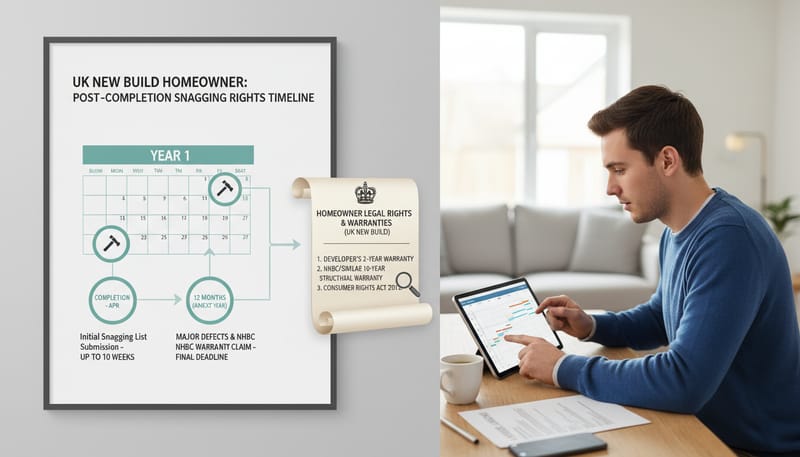
Understanding Your Post-Completion Snagging Rights
Buying a new build home in the UK comes with a layered system of protections designed to ensure your property meets certain standards. These protections include the builder’s contractual obligations, the Consumer Code for Home Builders, your structural warranty (typically NHBC Buildmark, LABC, or Premier Guarantee), and your general legal rights under consumer protection law.
However, each of these protections has different timescales, different scopes, and different procedures for making a claim. Many new build buyers don’t fully understand the deadlines involved, and as a result, they miss windows of opportunity to have defects rectified at the developer’s expense. This guide provides a clear, timeline-based overview of every protection available to you after completion.
Understanding these overlapping timelines is the key to protecting your investment. Let’s break down each period and explain exactly what’s covered, what you need to do, and by when.
The NHBC 2-Year Builder Liability Period
The first two years after legal completion are covered by what the NHBC calls the “builder warranty period” (years 1–2 of Buildmark). During this time, your developer is directly responsible for putting right any defects or damage caused by their failure to build the property to NHBC Standards. This is your most powerful protection period — use it fully.
What is covered during the builder liability period:
- All defects caused by the builder’s workmanship — from cosmetic issues like poor paintwork to functional problems like leaking windows
- Non-compliance with NHBC Standards — anything that does not meet the technical standards set out in the NHBC Standards handbook
- Items not built to the agreed specification — missing features or lower-quality finishes compared to what was agreed at purchase
- Damage caused during construction — scratched glass, damaged flooring, or dented surfaces that were present at handover
Crucially, the 2-year period is measured from the date of legal completion, not the date you moved in or the date the property was built. If you report a defect within this two-year window, the developer is obligated to investigate and, if it qualifies, repair it — even if the actual repair is carried out slightly after the two-year mark. The key is to get the defect formally reported and acknowledged before the deadline.
When to Conduct Your Snagging Inspections
Timing your snagging inspections strategically ensures you catch different types of defects as they emerge. Not all issues are visible on day one — some only appear after the house has been heated, weathered its first rain, or dried out over summer. Here is the optimal inspection schedule:
The month 21–22 inspection is the one most buyers forget or underestimate. Set a calendar reminder now for 21 months after your completion date. This final sweep often reveals settlement cracks that have stabilised, long-term damp issues, and defects with external works that have developed over time. Report everything before the two-year mark, even if you think the developer might dispute it — getting it on record protects your position.
The 8–10 Year Structural Warranty Period
After the 2-year builder liability period ends, your structural warranty kicks in as your primary protection. For NHBC Buildmark, this runs from year 3 to year 10 (providing 8 years of insurance cover). LABC and Premier Guarantee offer similar 10-year policies.
The structural warranty covers a narrower range of issues than the 2-year builder liability period. It is specifically designed to cover physical damage to the home caused by defects in the structure — not cosmetic issues or minor maintenance items.
To make a claim under the structural warranty during years 3–10, you typically need to contact the warranty provider directly (not the developer). The warranty provider will arrange an inspection and, if the claim is valid, will either require the original builder to carry out repairs or appoint their own approved contractors. Claims under the structural warranty have minimum claim values (NHBC’s current minimum is £1,750 including VAT), and there is an excess payable on each claim.
Consumer Code Timescales and Legal Protections
Beyond your warranty, you have additional protections under the Consumer Code for Home Builders and the general law. These provide further avenues for redress if the warranty process fails or if your issue falls outside warranty coverage.
The Limitation Act 1980 is particularly important. For a standard breach of contract claim (the developer built something that doesn’t meet the contract specification), you have six years from the date of completion to start legal proceedings. This runs in parallel with your warranty and can be used for issues that the warranty doesn’t cover or where the warranty provider declines a claim.
For latent defects — problems that could not have been discovered with reasonable inspection at the time — the six-year limitation period runs from the date you discovered (or should reasonably have discovered) the defect, subject to a long-stop of 15 years from the date of the breach (i.e., when the defective work was carried out). This means that if a hidden structural defect is discovered in year 8, you could potentially bring a claim up to year 14 from completion.
Seasonal Checks: What to Look For Throughout the Year
Different seasons reveal different types of defects. Planning your inspections around the seasons ensures you catch weather-related issues that may not be apparent at other times of year.
Condensation is a particularly common winter complaint in new builds. Some condensation is normal in a newly constructed property because the building materials (concrete, plaster, mortar) release moisture as they dry out — a process that can take 12–18 months. However, persistent condensation, black mould growth, or water streaming down windows may indicate inadequate ventilation, faulty trickle vents, or a missing or disconnected extractor fan. These are all legitimate snags if caused by the builder’s installation rather than the occupant’s lifestyle.
What Happens After Your Warranty Expires
Once your 10-year structural warranty expires, you lose the dedicated warranty protection, but you are not entirely without recourse. Understanding your remaining options is important, particularly for latent defects that may only become apparent later.
The Building Safety Act 2022 introduced significant changes for some homeowners. While the extended limitation periods primarily target higher-risk buildings (those over 18 metres or 7 storeys), the Act also extended the Defective Premises Act limitation period to 15 years retrospectively and 30 years prospectively. For standard new build houses and low-rise flats, the practical impact is that you may have longer than previously thought to bring certain claims against developers for serious defects.
After your warranty expires, maintaining thorough records of any issues that developed during the warranty period becomes your key protection. If a structural defect was reported during the warranty period but not fully resolved, you have a stronger position for pursuing the issue through legal channels.
Key Actions to Protect Your Rights
Your rights are only as strong as the evidence that supports them. Taking proactive steps throughout the warranty period ensures you are protected if issues arise later. Here is a summary of the essential actions every new build homeowner should take.
For a complete walkthrough of the snagging process from inspection to resolution, read our comprehensive guide to snagging your new build home. For details on what your warranty covers and how to make a claim, see our NHBC warranties guide. And if you’re still preparing for your handover day, make sure you’re ready to start the snagging process from day one — the clock starts ticking the moment you complete.