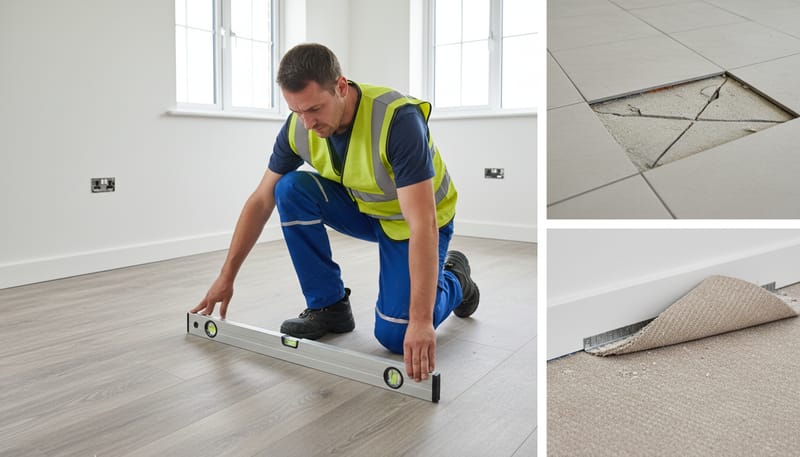
Why Flooring Defects Are So Common in New Builds
Flooring issues consistently rank among the top five most reported snagging problems in UK new build homes. Whether you’ve opted for the developer’s standard flooring package or installed your own, the underlying subfloor and structural components are the builder’s responsibility — and this is where many problems originate.
The root causes are often straightforward: new builds settle during the first 12–24 months, concrete screeds retain moisture for longer than builders allow, and construction timelines often mean floors are laid before the property has properly dried out. Understanding the most common flooring defects will help you identify them during your snagging inspection and ensure your developer puts them right.
This guide walks through every common flooring issue you might encounter, from squeaky boards to cracked tiles, and explains what the builder should fix versus what falls under normal settlement.
Squeaky Floorboards and Creaking Floors
Squeaky floorboards are perhaps the most common flooring complaint in new build homes. The noise typically occurs when timber floorboards or chipboard panels rub against each other or against the joists beneath them. In new builds, the main culprit is moisture — timber is often installed with a higher-than-ideal moisture content, and as the heating system dries the house out, boards shrink and gaps develop.
Key causes of squeaky floors in new builds include:
- Inadequate fixing — boards not screwed or nailed securely to joists
- Timber shrinkage — boards drying and contracting after installation
- Missing adhesive — tongue-and-groove joints should be glued but often aren’t
- Joist movement — structural settling causing slight movement in the floor frame
- Pipes and cables — floorboards resting on or rubbing against services routed through the floor void
While developers sometimes dismiss squeaking as “normal settlement,” persistent or loud squeaks should be logged as snags. Under the NHBC warranty, the builder is obligated to address defects during the first two years. Document the exact location of each squeak and whether it occurs under foot traffic or is constant.
Uneven Floors and Level Differences
An uneven floor is one of the more serious flooring defects and can point to problems with the screed, subfloor, or even structural elements beneath. In a new build context, uneven floors usually result from poorly levelled concrete screed, inadequate drying time, or differential settlement of the building.
The NHBC Standards (Chapter 9.1) specify tolerances for floor levelness. For a screeded floor, the surface regularity should be within 5mm over a 2-metre straightedge. Anything beyond this tolerance is a legitimate snag. You can check this yourself with a long spirit level or a straightedge.
Signs of an uneven floor include furniture that rocks, visible dips or high spots, gaps under skirting boards, and doors that scrape or fail to close properly. If you notice any floor finish (laminate, vinyl, tile) that feels hollow or bouncy underfoot, the subfloor beneath likely has voids or was not levelled correctly before the finish was laid.
Floor level differences between rooms — particularly at doorway thresholds — are also common in new builds, especially where different floor constructions meet (such as a concrete ground floor meeting a timber first floor). Transitions should be smooth and covered with appropriate threshold strips. A step of more than 3mm at a threshold without a proper ramp or strip is a reportable snag.
Laminate Lifting, Buckling, and Peaking
Laminate flooring is the most popular choice in UK new builds, often included as part of the developer’s upgrade package. Unfortunately, it’s also the floor type most prone to visible snagging issues. The three most common laminate problems are lifting (edges curling upward), buckling (boards rising in the middle), and peaking (ridges forming along joints).
The primary cause of laminate problems in new builds is excess moisture. Concrete screeds can take up to one month per 25mm of thickness to dry adequately — a 75mm screed needs roughly three months under ideal conditions. If laminate is laid before the screed has dried to below 75% relative humidity (measured with a hygrometer), moisture will migrate upward through the boards and cause them to swell and distort.
Another frequent cause is insufficient expansion gaps. Laminate is a floating floor and must have a gap of 8–12mm around all edges, including around pipes, door frames, and fixed objects. If the installer pushes the boards tight against walls or trims the expansion gap too narrow, the laminate has nowhere to expand when temperature or humidity changes — resulting in peaking and buckling.
If your developer installed the laminate as part of their package, any defects within the first two years are their responsibility to rectify. If you had the laminate installed independently after completion, the subfloor preparation and moisture levels remain the developer’s responsibility, but the installation quality sits with your own fitter.
Tile Cracking and Grout Issues
Cracked tiles in new builds are nearly always caused by substrate movement rather than defective tiles. When a new build settles, slight movements in the screed or subfloor create stress points that transfer through to rigid floor tiles, causing cracks — typically hairline fractures that follow the line of joints in the screed beneath.
Common tile defects to look for during your snag include:
- Hairline cracks — usually running diagonally across individual tiles
- Hollow tiles — tiles that sound hollow when tapped, indicating incomplete adhesive coverage (also called “drummy” tiles)
- Cracked or missing grout — grout lines crumbling, especially in corners and along walls
- Lippage — uneven tile edges where one tile sits higher than its neighbour (tolerance: 1mm for rectified tiles, 2mm for non-rectified)
- Stained or discoloured grout — poor cleaning during installation
For tiled areas included in the developer’s specification (typically en-suite and bathroom floors), the builder should use flexible adhesive and grout in areas subject to movement. If rigid adhesive was used on a screed that was still drying or settling, the builder is liable for cracked and hollow tiles. Check your specification to confirm which tiled areas are the developer’s responsibility.
Gaps at Skirting Boards and Carpet Fitting Issues
Gaps between the floor covering and skirting boards are one of the most visible flooring snags. In a new build, skirting boards are typically fitted before the floor covering is installed. When the floor covering doesn’t meet the skirting neatly, or when settlement causes the skirting to pull away from the floor, unsightly gaps appear.
For carpeted rooms, common issues include:
- Visible gripper rods — carpet not stretched far enough to cover the gripper strip along walls
- Loose carpet — ripples or wrinkles across the carpet surface indicating poor stretching
- Poorly cut edges — ragged or fraying carpet at doorways and thresholds
- Gaps under skirting — where the carpet tuck doesn’t reach high enough behind the skirting
- Lumps and bumps — debris or uneven subfloor showing through the carpet
For laminate and vinyl, gaps at skirting boards are expected to some degree — floating floors require an expansion gap — but this gap should be covered by the skirting or by scotia/beading. If you can see the expansion gap between the floor and the skirting, the developer needs to install appropriate beading or refit the skirting. This is a common and legitimate snag.
When logging these issues, measure the gap width and note whether it’s consistent or varies along the wall. Gaps wider than 3mm that aren’t concealed by beading should be reported. For carpets, walk every room slowly and note any areas that feel loose, bumpy, or where you can feel the gripper rod through the carpet.
Underfloor Heating and Flooring Compatibility
Underfloor heating (UFH) is increasingly standard in new build homes, particularly on ground floors. While UFH is an excellent feature, it introduces specific flooring challenges that builders don’t always get right. The most common issue is choosing or installing a floor covering that isn’t suitable for use with UFH.
Key UFH and flooring compatibility issues include:
- Excessive underlay tog rating — thick underlay insulates the floor from the heating, making the UFH work harder and potentially overheating. The combined resistance of underlay and flooring should not exceed 1.0 tog.
- Engineered vs solid wood — solid wood is generally unsuitable for UFH as it will warp and crack. Engineered wood is acceptable if it’s rated for UFH use.
- Thermal cracking of tiles — tiles laid directly over UFH without flexible adhesive can crack as the system heats and cools.
- Hot and cold spots — uneven heating across the floor may indicate poorly spaced UFH pipes or air locks in the system rather than a flooring issue.
If your developer installed both the UFH and the flooring, they are responsible for ensuring compatibility. Check your new home manual for the UFH commissioning date — the system should have been run for at least 48 hours before any floor covering was installed to allow the screed to complete its initial drying cycle.
Threshold Strips and Room Transitions
Where different floor finishes meet — typically at doorways between rooms — threshold strips (also called door bars or transition strips) should provide a clean, safe transition. Missing, poorly fitted, or inappropriate threshold strips are common snags that are easy to overlook during a busy handover day.
Issues to check during your snagging inspection:
- Missing threshold strips — where two different floor coverings meet with no transition piece
- Loose or lifting strips — strips that rock or have pulled away from the subfloor
- Wrong type — a flat strip used where a ramp strip is needed (e.g., where tile meets carpet at different heights)
- Colour mismatch — threshold strip colour doesn’t match either adjoining floor
- Sharp edges — metal strips with exposed sharp edges that catch bare feet or socks
- Trip hazard — any step or ridge greater than 3mm between rooms without an appropriate ramp strip
Floor level differences between rooms can also indicate a more serious issue. If there’s a noticeable step between, say, the hallway and the living room, this could mean the screed levels weren’t coordinated properly during construction. Small differences (under 3mm) are generally within tolerance, but anything more should be reported.
How to Report Flooring Snags Effectively
When reporting flooring defects to your developer, clear documentation is essential. The more specific and evidence-based your report, the harder it is for the developer to dismiss your concerns or delay repairs.
For a comprehensive guide to all types of new build defects, see our complete guide to common defects in new build homes. If you’re preparing for your handover, our new build handover guide includes a full walkthrough of what to check on the day, including all flooring areas.
Remember that your builder’s obligation to fix flooring defects lasts for the full two-year NHBC builder liability period. Don’t accept being told to “wait for the house to settle” unless the developer confirms in writing that they will return to fix the issue once settling is complete. Get everything documented, and don’t be afraid to escalate through the snagging process if your concerns are not addressed promptly.