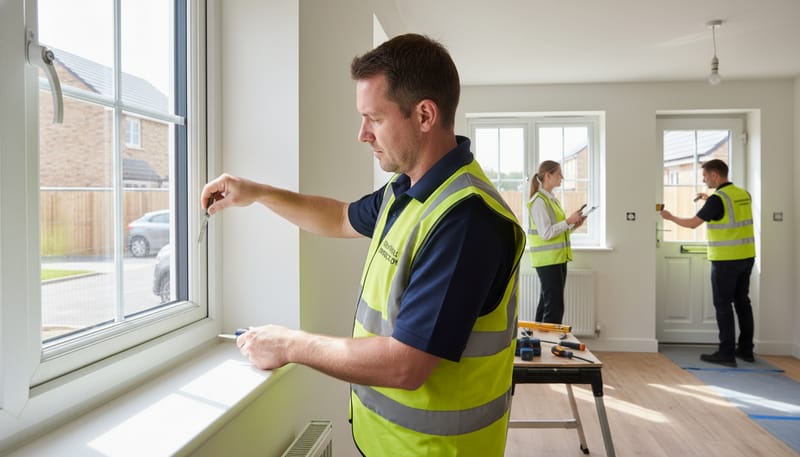
Why Windows and Doors Are Critical Snagging Areas
Windows and doors are some of the hardest-working components in any new build home. They keep out the weather, provide security, contribute to energy efficiency, and play a vital role in fire safety. Yet they consistently rank among the most common areas for snagging defects. According to NHBC data, window and door issues appear on roughly 23% of all new build snagging reports in England and Wales, making them the second most common defect category after internal wall finishes.
The reason is straightforward: windows and doors involve multiple trades working in sequence. The carpenter fits the frames, the bricklayer builds around them, the plasterer finishes internally, the plumber connects trickle vents, and the locksmith fits ironmongery. Any misalignment at one stage compounds through the rest. A frame that’s 3mm out of plumb can result in doors that stick, locks that don’t engage, and seals that fail to compress properly — leading to drafts, water ingress, and even security vulnerabilities.
A thorough snagging inspection of every window and door in your new home should take at least 30 to 45 minutes in a typical three-bedroom house. You need to check each unit individually — what passes on the front door may fail on a bedroom window. This guide walks you through every check, from seals and weather stripping through to fire door compliance, trickle vents, and safety restrictors, giving you the knowledge to ensure your new home is properly finished.
Checking Seals and Weather Stripping
Seals and weather stripping are your first line of defence against drafts, rain penetration, and noise. Every external window and door should have continuous rubber or brush seals around the full perimeter of the opening casement. These seals compress when the window or door is closed, creating an airtight and watertight barrier. Even a small gap or section of missing seal can dramatically reduce the thermal performance of the unit.
Start by visually inspecting every seal with the window or door open. Run your finger along the full length of the seal, feeling for tears, gaps, sections where the seal has pulled away from its groove, or areas where it has been painted over. Pay particular attention to the corners, where seals are most likely to be poorly mitred or left short. On doors, check both the frame seal and any secondary seals on the door leaf itself.
Externally, check the mastic sealant (silicone or polyurethane) between the window or door frame and the surrounding brickwork or render. This seal should be continuous, neatly tooled, and free from cracks or gaps. Poorly applied mastic is one of the most common snagging defects and can allow rainwater to penetrate the cavity wall, potentially causing damp problems within months of moving in. Under Building Regulations Approved Document C, all junctions between different materials must be weathertight.
For composite or timber doors, also check the bottom edge seal. Many new build front doors have adjustable threshold seals that should compress when the door closes. If the door swings freely over the threshold without any resistance from the seal, it needs adjusting. A gap of even 2–3mm at the bottom of an external door can create a noticeable draft and significantly impact your home’s energy performance certificate (EPC) rating.
Double Glazing Unit Integrity and Condensation
The sealed glazing units in your windows are precision-engineered components. Each unit consists of two or three panes of glass separated by a spacer bar, with the cavity between them filled with an insulating gas — usually argon. The unit is then sealed around its perimeter to prevent the gas from escaping and moisture from entering. When these seals fail, the insulating gas leaks out and is replaced by moist air, which condenses on the inner surface of the glass, creating a permanent misty or foggy appearance.
Check every glazing unit by standing at an angle to the glass and looking for any signs of moisture, misting, or discolouration between the panes. This is easiest to spot on a cool morning when temperature differences make condensation more visible. Also look for scratches on the glass, chips along the edges, and any distortion or bowing of the panes. New glazing units should be completely clear with no manufacturing defects.
It’s important to distinguish between the three types of condensation. Condensation on the outside of the outer pane is actually a sign that your glazing is working well — it means the outer pane is cold because very little heat is passing through the unit. Condensation on the room side of the inner pane is usually a ventilation or humidity issue within the home, not a glazing defect. However, condensation or misting between the panes is always a defect and means the sealed unit has failed and must be replaced.
Also inspect the glazing beads — the strips that hold the glass in place within the frame. These should be firmly clipped in with no gaps, and the drainage slots at the bottom of each glazing unit should be clear and unobstructed. Blocked drainage slots can allow water to pool inside the frame, accelerating seal failure. Under the NHBC Standards Chapter 6.7, all glazing must comply with BS 6262 and sealed units must be installed in accordance with the Glass and Glazing Federation guidelines.
Lock, Handle and Hinge Operation
Every window and door in your new build should operate smoothly and securely. This means handles should turn without excessive force, locks should engage and disengage cleanly, and multi-point locking mechanisms on doors should throw all bolts simultaneously when the handle is lifted. Testing this sounds simple but requires systematic attention to every single opening in the property.
Start with the front door. Close it and check that the latch engages into the keep plate without having to push or lift the door. Then lock it using the key and check all locking points — a typical composite front door has three to five locking points. Try to push and pull the door while locked to check for any movement. Repeat this test on the back door, any side doors, and patio or bi-fold doors. For patio doors, test the sliding mechanism for smooth operation along the full track and check that the locking pins engage at both top and bottom.
For windows, open each one fully and check that the hinge mechanism holds the casement securely in the open position without any sagging or dropping. Close the window and operate the espagnolette handle — this is the handle that drives the locking cam mechanisms around the frame. It should turn smoothly through its full range and the cams should visibly engage with the keep plates when locked. If you can see daylight around the edge of a closed and locked window, the cams are not pulling the casement tightly enough against the seals.
Check every hinge for tightness by gripping the open sash and trying to move it vertically. Any play or clicking indicates loose hinge screws. Friction hinges on windows should hold the sash in any position without it creeping closed or swinging open. On doors, check for dropped hinges by examining the gap between the door and frame — it should be even all the way around, typically 2–3mm. An uneven gap, particularly one that narrows at the top on the hinge side, indicates that the hinges need adjusting or that the frame has twisted.
Draft Exclusion Testing
Testing for drafts is one of the most important checks you can carry out on a new build, and it’s surprisingly easy to do yourself. Drafts through windows and doors are not just uncomfortable — they represent a direct failure of the building envelope and can significantly increase your heating bills. Under Building Regulations Approved Document L, new build homes must meet strict air permeability targets, and drafty windows or doors will push your home below these standards.
The simplest draft test uses a candle, incense stick, or even a damp hand. Close all windows and doors, then slowly move your detector around the edges of each window and door. A flickering candle flame, wisping smoke trail, or cool sensation on your hand indicates air infiltration. Pay particular attention to the corners of opening casements, the junction between the frame and the wall, the letterbox on your front door, and any trickle vents that may not be sealing properly when closed.
For a more rigorous test, close all the internal doors in your home and then open one window on the windward side of the property. Walk through the house with your draft detector, checking each window and door. The slight positive pressure created by the open window will push air out through any gaps, making them much easier to detect. If you find a draft, try to identify whether it’s coming through a failed seal, a gap in the mastic, or an alignment problem with the frame. Each requires a different fix from your developer.
Professional snagging inspectors often use thermal imaging cameras for this test, which can reveal cold spots around windows and doors that indicate air infiltration or thermal bridging. If your inspector finds significant drafts, they may recommend that the developer carries out a formal air pressure test to the affected areas. Under the NHBC warranty, the developer is responsible for ensuring the home meets the designed air permeability specification.
Fire Door Compliance
Fire doors are a life-safety feature, and checking them properly is one of the most important aspects of any new build snagging inspection. In houses of three or more storeys, Building Regulations Approved Document B requires fire doors to all habitable rooms that open onto the main staircase. In flats, the entrance door and any door between the flat and communal areas must be a certified fire door, typically rated FD30 (30 minutes fire resistance) or FD60.
Identifying a fire door is the first step. Look for a certification plug or label on the top edge of the door. This small circular or rectangular marker contains the fire rating and the certification body. If it’s missing, the door may not be a genuine fire door, which is a serious compliance issue. Some developers have been known to fit standard doors where fire doors are required, so this check is essential.
Next, check the intumescent strips. These are thin strips installed in the door frame or the edge of the door that expand dramatically when exposed to heat, sealing the gap between door and frame during a fire. They should run continuously around the top and both sides. Smoke seals — usually a brush or rubber strip — should also be present, often combined with the intumescent strip. If either is missing, damaged, or has been painted over so thickly that it cannot function, this is a critical defect.
The gap between the fire door and its frame should not exceed 3mm on any edge when the door is closed. Use a £1 coin (approximately 3mm thick) to check this — if the coin slides through easily anywhere around the door, the gap is too large. The door must also be fitted with a self-closing device that reliably pulls it shut from any open position. Open the door to various angles and release it; it should close firmly into the latch every time, without bouncing back open.
Finally, fire doors must be hung on a minimum of three CE-marked hinges, and any hardware modifications such as letter boxes, spy holes, or additional locks must be fire-rated components installed in accordance with the door manufacturer’s certification. Unauthorized modifications can void the door’s fire rating entirely.
Threshold Seals and Trickle Vents
Threshold seals on external doors are frequently overlooked during snagging inspections, yet they play a crucial role in keeping out rainwater and drafts. Every external door should have a threshold strip or sill that creates a weathertight seal when the door is closed. Check that the threshold is securely fixed, not cracked or damaged, and that there are no gaps between it and the door bottom seal. On level-access thresholds (increasingly common for Part M accessibility compliance), pay extra attention to the drainage channels either side of the threshold, which must be clear and fall away from the door.
Trickle vents are the small ventilation slots built into the top of window frames. Under Building Regulations Approved Document F, all new build homes must have adequate background ventilation, and trickle vents are the standard solution. Check that every window has a trickle vent where required, that the vent slider operates smoothly between open and closed positions, and that no vents have been painted shut. The equivalent ventilation area for each room should be shown on the building control completion certificate.
In bedrooms and living rooms, trickle vents provide essential background ventilation that helps control condensation and maintain indoor air quality without needing to open windows. If vents are missing, blocked, or non-functional, you may experience excessive condensation, particularly during the first heating season when the property is still drying out. This is not just a comfort issue — persistent condensation can lead to mould growth, which is both a health hazard and a defect your developer must address.
Window Restrictors and Safety Checks
Window restrictors are a safety requirement under Building Regulations Approved Document K and BS 8213-1. Any opening window where the bottom edge of the opening is less than 800mm above finished floor level and more than 600mm above external ground level must be fitted with a restrictor that limits the opening to 100mm. This is primarily to protect children from falling, and it applies to all upper-floor windows and many ground-floor windows in homes built on sloping sites.
Check each restrictor by opening the window to its first stop. It should hold firmly at the restricted position and require a deliberate two-stage action (usually pressing a button and lifting) to override it for full opening. Restrictors that fail to engage, that can be overridden too easily, or that are missing entirely are serious safety defects that must be rectified before you move in with a family.
Also check that any windows designated as emergency egress (escape windows) can open to the required clear opening of 0.33 square metres with a minimum dimension of 450mm in any direction. This is specified in Approved Document B and applies to all habitable rooms on upper floors where there is no alternative fire escape route. Your developer should be able to tell you which windows are designated as egress windows, but if they can’t, check the building control approved plans.
Finally, check any patio doors and bi-fold doors for safety glass markings. All glass below 800mm in doors and below 300mm in side panels must be safety glass (toughened or laminated) and should carry a permanent BS EN 12150 or BS EN 14449 marking, usually in the corner of the pane. Missing safety glass is a serious defect under Approved Document K and the Workplace (Health, Safety and Welfare) Regulations. If you can’t find the safety glass marking, your inspector may test with a polarising filter, which reveals the stress patterns unique to toughened glass.
By working through every point in this checklist, you’ll ensure that every window and door in your new build is properly sealed, safely glazed, securely locked, and fully compliant with UK Building Regulations. For a broader overview of all the checks you should carry out, see our complete new build snagging checklist, and if you’re unsure whether to inspect yourself or hire a professional, our snagging guide can help you decide.