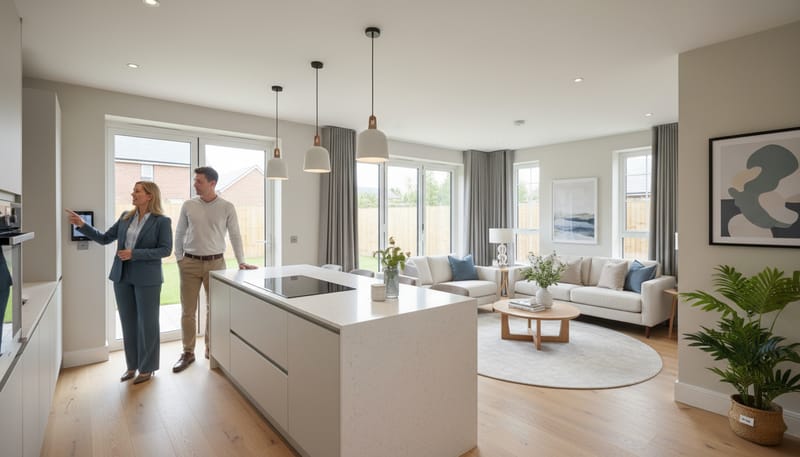
Understanding What Show Homes Are Really For
Show homes are, first and foremost, a sales tool. They represent the absolute best version of a property on the development, carefully curated by professional interior designers with budgets often exceeding £30,000–£80,000 per show home. Understanding this is the foundation of a smarter viewing experience. When you walk through the front door, you are stepping into a meticulously crafted environment engineered to make you fall in love with the lifestyle on offer — and there is nothing wrong with that, as long as you know how to separate the dream from the reality.
Major UK developers including Barratt Homes, Taylor Wimpey, Persimmon, and Bellway invest significantly in their show home presentations. These homes showcase the developer upgrades and optional extras that you can add to your own home, but they also include many items that are not included as standard. The trick is knowing exactly which features come with your plot and which will cost extra.
This guide will walk you through every room, every trick of the trade, and give you a comprehensive checklist of what to check before you put down a reservation fee. Whether you are a first-time buyer or an experienced homeowner, these insights will help you make a far more informed decision.
The Show Home Investment
Developers typically spend between £40,000 and £100,000 dressing a show home, depending on the property size and target market. This includes bespoke furniture, professional lighting design, curated artwork, luxury soft furnishings, and often structural upgrades such as bi-fold doors, upgraded kitchen specifications, and premium flooring throughout. Every element is chosen to make spaces feel larger, brighter, and more aspirational than the standard specification.
It is worth noting that many developments now offer virtual show home tours as well, but nothing replaces an in-person visit where you can gauge room sizes, ceiling heights, and the general feel of a property. When you visit in person, bring a tape measure, a notepad, and a critical eye — you will need all three.
Furniture Sizing Tricks and Staging Secrets
One of the most well-known tactics in show home presentation is the use of undersized furniture. Sofas, beds, dining tables, and wardrobes in show homes are frequently smaller than standard retail sizes. A double bed in a show home might be a small double (4ft) rather than a standard double (4ft 6in), and a “king-size” bed could actually be a standard double. This makes bedrooms appear significantly more spacious than they will feel with your own furniture.
Common Sizing Discrepancies
| Furniture Item | Show Home Size | Standard Retail Size | Difference |
|---|---|---|---|
| Double Bed | 120cm × 190cm (small double) | 135cm × 190cm | 15cm narrower |
| King Bed | 135cm × 190cm (actually a double) | 150cm × 200cm | 15cm narrower, 10cm shorter |
| Sofa (3-seat) | 180cm wide | 200–220cm wide | 20–40cm narrower |
| Dining Table (6-seat) | 140cm × 80cm | 160cm × 90cm | 20cm shorter, 10cm narrower |
| Bedside Table | 35cm wide | 45–55cm wide | 10–20cm narrower |
| Wardrobe | 80cm wide (or none shown) | 120–180cm wide | 40–100cm narrower |
| Coffee Table | 80cm × 50cm | 100cm × 60cm | 20cm shorter, 10cm narrower |
Other Staging Techniques to Watch For
- No doors on bedrooms: Many show homes remove internal doors or leave them permanently open to create a sense of flow and space. In reality, you will have doors and they take up wall space when open.
- Mirrors everywhere: Strategically placed mirrors double the visual size of rooms, hallways, and landings. Count the mirrors — if there are more than two in a single room, they are working hard to create an illusion.
- Slim-profile radiators: Show homes often feature designer radiators that are far slimmer than the standard convector radiators included in the specification. Check what radiators actually come as standard.
- No curtains, only blinds: Blinds sit flush against windows, maximising the perceived room width. Standard curtains and curtain poles project into the room and require wall space either side of the window.
- Reduced storage furniture: Bedrooms may lack wardrobes entirely, or show a single slim unit. In reality, you need substantial storage that will reduce floor space significantly.
- Professional lighting: Show homes use layered lighting design with dimmable spotlights, table lamps, and accent lighting to create warmth and atmosphere. Your home will come with basic ceiling pendants unless you upgrade.
Room-by-Room Inspection Guide
When you visit a show home, resist the urge to simply admire the decor. Instead, approach each room with a systematic checklist mindset. Here is what to focus on in every key area of the home.
Kitchen
The kitchen is where developers invest most heavily in upgrades. The show home kitchen is almost certainly not the standard specification. Look for labels or ask the sales advisor which appliances, worktops, splashbacks, and units are included as standard versus optional extras.
- Worktops: Show homes often feature quartz or granite worktops. Standard specification is usually laminate. Upgrading can cost £2,000–£5,000.
- Appliances: Check the brand and specification. Standard might be a basic integrated oven, hob, and extractor. The show home may feature a wine cooler, American-style fridge-freezer, and a high-end dishwasher.
- Handles and taps: Brushed brass or matt black handles look stunning but may be upgrades costing £300–£800.
- Flooring: Tiled or engineered wood flooring in the show home kitchen is often an upgrade from the standard vinyl or basic laminate.
- Under-cabinet lighting: Almost always an upgrade, typically £400–£800 depending on the kitchen size.
Living Room
Pay attention to the dimensions rather than the furnishings. Measure the room if possible, and consider whether your own sofa, TV unit, and other furniture will fit comfortably. Check ceiling height — standard new builds typically have 2.4m ceilings, though some premium developments offer 2.5m or 2.7m. Also note the position and number of plug sockets, as this determines your furniture layout options.
Bedrooms
This is where undersized furniture is most impactful. Mentally replace the show home bed with your own and think about whether you can fit bedside tables, a wardrobe, and a chest of drawers. Check the space standards for the property type. The master bedroom should comfortably accommodate a king-size bed (150cm × 200cm) with bedside tables and a wardrobe. If it cannot, the room is smaller than you might think.
Bathrooms
Check whether the bathroom suite shown is standard or upgraded. Premium tiling, rainfall showerheads, freestanding baths, and vanity units are common upgrades. Standard specification typically includes a basic white suite with minimal tiling. Also check water pressure if possible — turn on taps and flush toilets to get a sense of the plumbing performance.
Garden and External Areas
Show home gardens are professionally landscaped with mature planting, artificial turf or premium paving, outdoor furniture, and sometimes hot tubs or fire pits. Your garden will typically be handed over as a levelled plot with turf (or sometimes just topsoil), basic fencing, and a patio area. Budget £3,000–£15,000 for landscaping your garden to a reasonable standard, depending on size.
Show Home Features vs Standard Specification
This is arguably the most important section of this guide. Understanding the gap between what you see in the show home and what you actually get as standard is crucial for budgeting accurately. Below is a comprehensive comparison based on typical major UK developer specifications.
| Feature | Show Home (Upgraded) | Standard Specification | Typical Upgrade Cost |
|---|---|---|---|
| Kitchen Worktops | Quartz or granite | Laminate | £2,000–£5,000 |
| Kitchen Appliances | Neff/Bosch integrated package | Basic integrated oven & hob | £1,500–£4,000 |
| Flooring (throughout) | Engineered wood & premium tile | Basic carpet & vinyl | £3,000–£8,000 |
| Bathroom Tiling | Full-height feature walls | Half-height around bath/shower | £500–£1,500 per bathroom |
| Internal Doors | Flush panel or oak veneer | Moulded white panel | £1,000–£2,500 |
| Lighting | Downlights throughout | Pendant ceiling roses | £800–£2,000 |
| Wardrobes | Built-in fitted wardrobes | None included | £1,500–£4,000 |
| Garden Landscaping | Professional design with patio | Turf and basic fencing | £3,000–£15,000 (self-arranged) |
| Garage | Fully fitted with storage | Bare shell with power | £1,000–£3,000 (self-arranged) |
| Smart Home Features | Smart thermostat, doorbell, etc. | Basic thermostat only | £500–£2,000 |
The total cost of replicating the show home finish in your own property can easily reach £15,000–£45,000 depending on the property size and developer. This is a critical figure to factor into your budget alongside the purchase price. Many buyers find it more cost-effective to purchase some upgrades through the developer before completion, as these can sometimes be added to the mortgage, and others to arrange independently after moving in.
Typical Show Home Upgrade Costs by Category
Based on typical UK developer upgrade pricing for a 3–4 bedroom detached home, 2024–2025.
Lighting Tricks and Atmospheric Manipulation
Lighting is one of the most powerful tools in the show home designer’s arsenal. A well-lit room feels larger, warmer, and more inviting. Show homes typically employ a layered lighting strategy with multiple light sources at different heights and intensities, creating depth and ambiance that is impossible to achieve with a single ceiling pendant.
Key Lighting Techniques Used in Show Homes
- Recessed downlights: These are installed throughout the ceiling to provide even, shadow-free illumination. Standard specification usually includes basic pendant roses, not downlights. Upgrading to downlights typically costs £80–£150 per light fitting.
- Under-cabinet kitchen lighting: LED strips beneath wall cabinets create a warm glow across worktops and make the kitchen feel luxurious. This is almost always an optional upgrade.
- Table and floor lamps: Show homes use multiple lamps to create pools of warm light, eliminating harsh overhead lighting. These are staging items, not included with the home.
- Dimmer switches: Many show homes feature dimmer switches that allow precise control of light levels. Standard specification usually includes basic on/off switches only.
- Accent lighting: Picture lights, shelf lighting, and LED strips behind TV units are used to highlight architectural features and create focal points.
- External lighting: Motion-sensor security lights and decorative garden lighting create a welcoming entrance. Standard external lighting is usually limited to a single bulkhead light by the front and back doors.
Visiting at Different Times of Day
One of the most valuable things you can do is visit the show home (and ideally your actual plot) at different times of day. Morning visits reveal how east-facing rooms receive natural light, while afternoon visits show the sun’s path through south and west-facing windows. An evening visit lets you assess street lighting, road noise levels, and the general feel of the development after dark.
If possible, visit on both a weekday and a weekend. Weekday visits give you a sense of commuter traffic, school-run congestion, and daytime noise from any nearby commercial or industrial areas. Weekend visits reveal the social character of the neighbourhood and whether the development feels quiet and family-friendly or busy and vibrant.
When choosing your plot, consider how the sun moves across the development. South-facing rear gardens are highly desirable and often command a premium. North-facing bedrooms can be cooler and darker, which some people prefer for sleeping. Understanding orientation is essential for making the right choice.
Your Essential Show Home Viewing Checklist
Print this checklist or save it to your phone before visiting any show home. Ticking off each item will ensure you do not get swept up in the staging and miss critical details that affect your buying decision and your budget.
| Area | What to Check | Why It Matters | Red Flag If... |
|---|---|---|---|
| Kitchen | Which appliances are standard vs upgraded | Budget for replacements or upgrades | Sales advisor cannot specify standard items |
| Kitchen | Worktop material (laminate vs quartz/granite) | Major visual and cost difference | No specification sheet available |
| Bedrooms | Measure bed sizes with tape measure | Undersized beds make rooms look bigger | Staff discourage measuring |
| Bedrooms | Check if wardrobes are built-in or freestanding | You will need to buy wardrobes separately | No wardrobe shown at all |
| Bathrooms | Tiling extent and suite specification | Tiling upgrades can cost £500–£1,500 | Premium suite with no standard alternative shown |
| Living Areas | Measure room dimensions yourself | Furniture may be undersized | Room feels tight even with show furniture |
| Flooring | What is standard: carpet, vinyl, or tile? | Flooring throughout costs £3,000–£8,000 | Multiple flooring types shown with no pricing |
| Windows | Double or triple glazing? Opening mechanism? | Affects energy efficiency and ventilation | Windows do not open fully or feel flimsy |
| Heating | Type of heating system (gas boiler, heat pump, etc.) | Running costs vary significantly | No clear answer on heating type |
| Garden | What is included: turf, fencing, patio? | Landscaping costs £3,000–£15,000+ | Show garden heavily landscaped with no caveat |
| Garage | Internal dimensions and whether it is standard | Many garages are too small for modern cars | Garage is used as a utility room in show home |
| Storage | Count cupboard and under-stairs storage | New builds often lack adequate storage | Show home uses clever staging to hide lack of storage |
| Sockets | Count electrical sockets in each room | Determines furniture layout flexibility | Fewer than 4 double sockets in living room |
| EPC Rating | Ask for the predicted EPC rating | Affects energy bills and mortgage eligibility | No EPC information available |
Critical Questions to Ask the Sales Advisor
A show home visit is your opportunity to gather detailed information directly from the developer’s team. Do not be shy about asking detailed questions — a good sales advisor will welcome them, and their answers (or lack thereof) will tell you a lot about the developer’s transparency and professionalism.
- Can I see the full specification sheet for my plot? This document lists exactly what is included as standard. Every developer should have this available. If they don’t, that is a concern.
- Which items in this show home are upgrades? Ask them to walk you through the show home pointing out every upgrade. Some developers mark upgrades with small signs, but many do not.
- What is the build stage of my plot? Understanding the build timeline helps you plan your mortgage, sale, and move.
- What warranty provider covers this development? Most new builds come with an NHBC, LABC, or Premier Guarantee warranty. Confirm the details.
- Can I visit my actual plot during construction? Reputable developers typically allow accompanied site visits at key build stages.
- What broadband connectivity is available? Check whether fibre-to-the-premises (FTTP) is available, as this significantly affects property desirability and value.
- Is the property freehold or leasehold? Houses should ideally be freehold. If leasehold, understand the ground rent and service charge implications.
- Are there any Section 106 contributions or CIL charges? These planning obligations can affect local infrastructure delivery timelines.
- What are the expected completion dates for the wider development? Living on an active building site can be disruptive. Understand the phasing plan.
- Can I see a copy of the management company details and estimated service charges? Even freehold houses on managed estates will have service charges for communal area maintenance.
For a comprehensive list of questions beyond the show home visit, see our guide on questions to ask before buying a new build.
Frequently Asked Questions
Are show home furnishings included when you buy a new build?
No. Show home furnishings are staging items owned by the developer or a specialist staging company and are not included in the purchase price. Everything you see — furniture, soft furnishings, artwork, decorative items, and often many of the visible finishes — is there purely for presentation purposes. Your new home will be delivered as an empty shell with the specifications listed in your contract. Some developers occasionally sell the show home itself “fully furnished” at the end of a development’s sales period, typically at a premium, but this is not common for standard plots.
Can you take measurements in a show home?
Yes, and you absolutely should. Bring a tape measure (or use a laser measure app on your phone) and measure room dimensions, doorway widths, and window sizes. Some show homes have dimension labels on the walls, but these are not always present. If a sales advisor asks you not to measure, consider that a significant red flag. Reputable developers are transparent about their property dimensions and will provide floor plans with measurements. Cross-reference these with the nationally described space standards to ensure the home meets your needs.
How many show homes should I visit before buying?
We recommend visiting at least three to five show homes across different developers and developments. This gives you a valuable basis for comparison in terms of build quality, specification levels, pricing, and customer service. Even if you have your heart set on a particular development, visiting competitors helps you negotiate more effectively and ensures you understand the market. Each developer has different standard specifications, and seeing several side by side makes the differences far more obvious.
What should I bring to a show home viewing?
Bring a tape measure, a notebook or phone for notes, a camera (check if photography is allowed first), a list of your current furniture dimensions, and a printed checklist of items to inspect. If you are seriously considering the development, also bring details of your financial situation (mortgage agreement in principle, details of any property to sell) as this allows the sales advisor to give you more specific and useful information. Having your buyer paperwork organised in advance accelerates the process significantly.
Do all new build developers use the same tricks in show homes?
While the specific techniques vary, all major UK developers — including Barratt, Taylor Wimpey, Persimmon, Bellway, Redrow, and others — use professional staging in their show homes. This is standard industry practice, not a deceptive tactic. The key differences lie in the gap between show home presentation and standard specification. Some developers include a more generous standard specification than others, meaning the show home is closer to what you actually receive. Always request the full specification sheet for your specific plot and house type to understand exactly what is included.
Make Your Show Home Visit Count
Show homes are designed to inspire, and they do that brilliantly. But as a buyer, your job is to look beyond the carefully curated staging and assess the property on its genuine merits: room sizes, build quality, specification levels, and overall value for money. By using the checklists and insights in this guide, you will be far better equipped to make an informed decision that you will be happy with for years to come.
Remember that buying a new build home is one of the biggest financial decisions you will make. Take your time, visit multiple developments, ask detailed questions, and never feel pressured into reserving on the spot. The right home at the right price will be worth the wait. If you are ready to explore new build developments across the UK, browse our listings to find your perfect home.
For more guidance on the next steps after your show home visit, explore our guides on understanding new build specifications, customising your home before completion, and the conveyancing process for new builds.