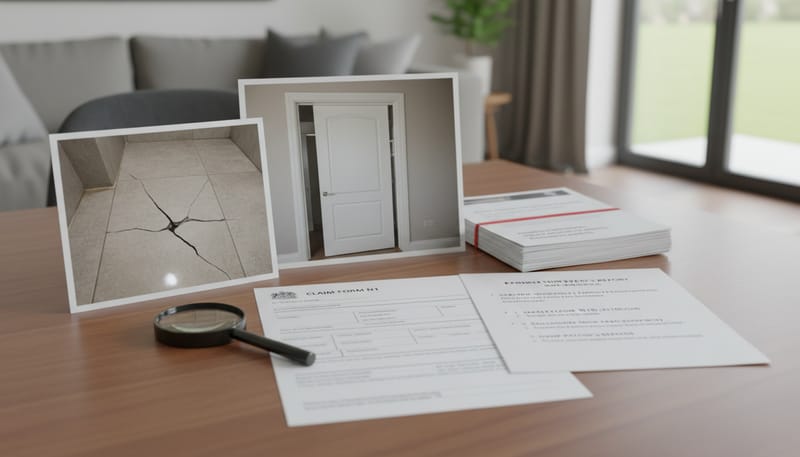
Introduction: Understanding the Legal Side of Snagging
Moving into a new build home should be an exciting experience, but the reality for many buyers is that their new property arrives with a list of issues – from minor cosmetic blemishes to more serious defects that affect the structure or habitability of the home. While the practical process of identifying and reporting these issues (commonly known as “snagging”) is well documented, the legal implications are less widely understood. Knowing where you stand legally can make the difference between a swift resolution and a prolonged, frustrating dispute.
This guide examines the legal framework surrounding snagging and defects on new build properties in England & Wales. It covers the crucial legal distinction between snagging (cosmetic) and defects (structural), your contractual rights, the application of consumer protection legislation, the developer’s obligations during the defect liability period, warranty provider responsibilities, and the legal remedies available to you if issues are not resolved. Whether you have already moved in and are dealing with problems, or you are about to complete on a new build and want to understand your rights, this guide will equip you with the legal knowledge you need.
Please note: This article provides general guidance on the law in England & Wales relating to snagging and defects on new build properties. It is not a substitute for professional legal advice. For specific legal issues relating to your property, always consult a qualified solicitor. The legal framework in Scotland and Northern Ireland may differ in certain respects.
The Legal Distinction Between Snagging and Defects
In everyday language, “snagging” is often used as a catch-all term for any issue found in a new build home. However, in legal terms, there is an important distinction between snagging items (cosmetic or minor issues) and defects (more serious problems that affect the structure, safety, or functionality of the home). This distinction matters because it determines which legal remedies are available and which party is responsible for putting things right.
| Category | Definition | Examples | Typical Responsibility |
|---|---|---|---|
| Snagging (cosmetic) | Minor issues relating to the finish or appearance of the home that do not affect its structural integrity or habitability | Scuffed paintwork, poorly fitted doors, gaps in sealant, uneven tiling, minor plaster cracks, scratched glass | Developer – during and after defect liability period |
| Defects (structural/functional) | Significant issues affecting the structure, weatherproofing, safety, or core functionality of the home | Subsidence, roof leaks, faulty damp-proof course, structural cracking, defective drainage, non-compliant electrics | Developer (defect period) & warranty provider (post defect period) |
| Building regulation non-compliance | The home fails to meet the building regulations in force at the time of construction | Inadequate insulation, fire safety non-compliance, incorrect staircase dimensions, missing ventilation | Developer (legal obligation to comply) & local authority (enforcement) |
Why the Distinction Matters Legally
The legal significance of this distinction relates primarily to the remedies available and the parties responsible:
- Snagging items are primarily a contractual matter between you and the developer. The purchase contract typically includes an obligation for the developer to rectify snagging issues reported within a specified period (the defect liability period). Snagging items are unlikely to be covered by the structural warranty once the defect liability period ends
- Defects may trigger obligations under the purchase contract, the new home warranty (such as NHBC Buildmark), the Consumer Rights Act 2015, and potentially the Defective Premises Act 1972. Serious defects that amount to a breach of Building Regulations can also be pursued through the local authority
- Building regulation non-compliance is a separate legal issue that goes beyond the contractual relationship. If your home does not comply with Building Regulations, the local authority has enforcement powers, and you may have additional claims against the developer and/or the approved inspector
When conducting your snagging inspection, it is important to categorise issues correctly and to document them thoroughly, as this will strengthen your position if legal action becomes necessary. For a practical approach to identifying issues, use our snagging checklist.
Your Legal Rights Under the Purchase Contract
The purchase contract is the primary legal document governing the relationship between you and the developer. It sets out the specification of the home, the developer’s obligations, and the process for dealing with issues that arise after completion. Understanding the relevant contractual provisions is essential to enforcing your rights.
Specification and Tolerances
The contract should include a specification of the home you are buying, either as part of the contract itself or in a schedule attached to it. This specification describes the materials, finishes, fixtures, and overall standard of the home. It is against this specification that snagging issues are assessed – if the home does not meet the contracted specification, the developer is in breach of contract.
However, most new build contracts include tolerance clauses that allow for minor variations from the specification. These tolerances may relate to:
- Dimensions (e.g., room sizes may vary by a specified percentage)
- Materials (the developer may reserve the right to substitute materials of equivalent quality)
- Finishes (minor variations in colour, texture, or appearance)
- Layout (minor adjustments to the floor plan)
Your solicitor should review these tolerance clauses carefully as part of the pre-exchange checklist and advise whether they are reasonable. Overly broad tolerance clauses can significantly limit your ability to challenge issues after completion.
The Defect Liability Period
Most new build contracts include a defect liability period (sometimes called a “defects rectification period”) – typically two years from completion – during which the developer is contractually obliged to rectify defects and snagging items that are reported. This is a key provision because it creates a direct obligation on the developer, separate from any warranty obligations.
During the defect liability period, the developer should:
- Accept and acknowledge reports of defects and snagging items
- Inspect reported issues within a reasonable timeframe
- Carry out rectification works to a reasonable standard
- Complete repairs within a reasonable period
The defect liability period is your primary window for getting issues resolved directly with the developer, and it is important to report all problems – no matter how minor – within this timeframe. For a comprehensive understanding of your obligations and rights during this period, see our dedicated guide to the defect liability period.
Consumer Rights Act 2015: How It Applies to New Builds
Beyond your contractual rights, you also have statutory protections under the Consumer Rights Act 2015 (CRA). The CRA applies to contracts for the supply of goods and services between a trader (the developer) and a consumer (you), and it provides important protections that supplement your contractual rights.
Key Provisions Relevant to New Builds
The CRA requires that goods and services supplied by a trader must be:
- Of satisfactory quality – The home must meet the standard that a reasonable person would consider satisfactory, taking into account the description, the price, and all other relevant circumstances. For a new build, this means the property should be free from material defects, properly finished, and fit for habitation
- Fit for a particular purpose – If you have made the developer aware of a specific requirement (e.g., that you need the property to be suitable for a disabled occupant), the home must be reasonably fit for that purpose
- As described – The home must match the description provided by the developer in marketing materials, the specification, and the contract. If the show home included certain features that were described as standard, the finished home should include them
Remedies Under the CRA
If the home fails to meet the standards set by the CRA, you have the following remedies:
- Right to repair or replacement – The developer must repair or replace defective elements at no cost to you. This is typically the first remedy pursued for snagging and defect issues
- Right to a price reduction – If repair or replacement is not possible, not carried out within a reasonable time, or causes significant inconvenience, you may be entitled to a price reduction
- Right to reject – In extreme cases where the home has a major defect that substantially impairs its value or habitability, you may have the right to reject the property and recover the purchase price. This is a theoretical remedy that is rarely exercised in practice for real property, but it remains part of the legal framework
It is important to note that the CRA provides these rights in addition to your contractual rights – you do not have to choose between them. In practice, the CRA is most useful when the purchase contract is silent on a particular issue, or when the contractual remedies are inadequate.
| Legal Basis | What It Covers | Time Limit | Remedies |
|---|---|---|---|
| Purchase contract | Defects and snagging per contracted specification | Defect liability period (usually 2 years) + 6-year limitation | Repair, damages for breach of contract |
| Consumer Rights Act 2015 | Satisfactory quality, fitness for purpose, as described | 6 years from completion (breach of statutory duty) | Repair, replacement, price reduction, (rejection in extreme cases) |
| Defective Premises Act 1972 | Duty to build dwellings properly and fit for habitation | 15 years from completion (extended by Building Safety Act 2022) | Damages for loss caused by defective work |
| New home warranty (e.g., NHBC) | Structural defects, building standards, specific covered items | 10 years from completion (varies by provider) | Repair or financial settlement per warranty terms |
| Consumer Code (NHQB) | Developer conduct, after-sales service standards | Per code complaint procedure | Apology, remedial work, compensation via Ombudsman |
Warranty Provider Obligations & NHBC Dispute Resolution
Most new build homes come with a structural warranty, the most common being the NHBC Buildmark warranty. Understanding when the warranty applies and how to use it is important, particularly for defects that emerge after the developer’s defect liability period has ended.
How Warranty Coverage Works
The NHBC Buildmark warranty (and equivalent schemes from LABC, Premier Guarantee, and others) typically provides cover in three stages:
- Pre-completion cover – Protects your deposit if the developer goes into administration or becomes insolvent before completion
- Developer’s defect liability period (years 1–2) – During this period, the developer is primarily responsible for rectifying defects. The warranty acts as a backstop if the developer fails to carry out repairs or becomes insolvent
- Structural warranty period (years 3–10) – After the defect liability period, the warranty provider takes over responsibility for structural defects that fall within the warranty’s definition. This typically covers damage caused by defects in the structure, foundations, external render, roof, drainage below ground, and other specified elements. Cosmetic snagging items are not covered during this period
Making a Warranty Claim
If you need to make a claim under your warranty, the process typically involves:
- Reporting the issue to the warranty provider in writing, with photographs and a description of the problem
- The warranty provider will arrange an inspection to assess whether the issue falls within the scope of the warranty
- If the claim is accepted, the warranty provider will either arrange and pay for the repairs, or provide a financial settlement towards the cost of remediation
- If the claim is rejected, you have the right to appeal through the warranty provider’s internal complaints process
NHBC Dispute Resolution
If you disagree with the NHBC’s decision on a claim, you can escalate the matter through their formal dispute resolution process. The NHBC operates an internal review procedure, and if this does not resolve the matter, you can refer the dispute to an independent adjudicator. The adjudicator’s decision is binding on the NHBC but not on you – you retain the right to pursue other legal remedies (such as court action) if you are not satisfied with the outcome.
Additionally, if the developer is registered with the New Homes Quality Board, you can also pursue a complaint through the NHQB’s New Homes Ombudsman Service, which provides a separate avenue for resolving disputes about the developer’s conduct and after-sales service.
Retention Money, Legal Remedies & Court Action
When snagging issues are not resolved through the developer’s after-sales process or the warranty provider, you may need to consider more formal legal remedies. Understanding your options – and the practical considerations of each – will help you decide the best course of action.
Withholding Retention Money
In some new build contracts, particularly those involving bespoke or custom-built homes, a retention may be agreed – a percentage of the purchase price that is held back by the buyer’s solicitor pending satisfactory completion of snagging works. This is more common in self-build and design-and-build contracts than in standard volume housebuilder purchases.
If a retention is included in your contract:
- The retention amount is typically 2.5%–5% of the purchase price
- It is held by the buyer’s solicitor in a designated account
- The developer is entitled to request release of the retention once the snagging works have been satisfactorily completed
- If the developer fails to complete the works, the buyer may be entitled to use the retention funds to have the works carried out by an alternative contractor
For standard volume new build purchases, retention clauses are less common. However, this is a point that your solicitor can negotiate at the contract stage – particularly if you are buying an off-plan property and have concerns about the developer’s track record on snagging. This is another consideration for your pre-exchange legal checklist.
Legal Remedies if the Developer Refuses to Fix Issues
If the developer refuses or unreasonably delays in rectifying snagging issues or defects, you have several legal avenues:
- Formal complaint under the Consumer Code – Follow the NHQB complaint procedure and, if necessary, escalate to the New Homes Ombudsman. This is free and can result in orders for remedial work and compensation
- Warranty claim – If the issue falls within the warranty scope, make a formal claim to the warranty provider. If the developer fails to act during the defect liability period, the warranty provider may intervene
- Letter before action – Instruct a solicitor to send a formal letter before action, setting out the issues, the legal basis for your claim, and a deadline for the developer to respond. This is a required step before court proceedings under the Civil Procedure Rules pre-action protocol
- Alternative dispute resolution (ADR) – Mediation or adjudication may be an option, either through the warranty provider’s scheme or independently. Many courts expect parties to have attempted ADR before issuing proceedings
- Court action – If all other avenues fail, you can issue court proceedings for breach of contract, breach of statutory duty (under the CRA or Defective Premises Act), or negligence. The appropriate court depends on the value of the claim
Small Claims Court
For claims valued at £10,000 or less (in England and Wales), the small claims track of the County Court is often the most practical route. The small claims process is designed to be accessible to litigants in person (i.e., you do not necessarily need a solicitor), costs are limited, and the process is relatively informal compared to other court tracks.
Key features of the small claims process for snagging disputes:
- Court fees are based on the value of the claim (ranging from £35 for claims up to £300 to £455 for claims between £5,001 and £10,000)
- The losing party is generally not liable for the winning party’s legal costs (except court fees and limited witness expenses), making it a lower-risk option
- Cases are typically decided at a short hearing (usually 1–2 hours) before a district judge
- You can represent yourself, though you may wish to seek legal advice on preparing your case
- Expert evidence (such as a surveyor’s report on the defects) is often important and may be the deciding factor
For claims above £10,000, the case will be allocated to the fast track (up to £25,000) or multi-track (above £25,000), where the process is more formal, legal representation is more strongly advised, and costs recovery rules apply. For very significant defects, particularly structural issues, the claim value may justify the fast track or multi-track, but you should seek legal advice on the cost-benefit analysis before proceeding.
Documenting Issues for Legal Purposes
Whether or not you ultimately need to pursue a legal claim, thorough documentation of snagging issues and defects is essential. Good documentation strengthens your negotiating position with the developer and, if it comes to court, provides the evidence you need to prove your case.
How to Document Snagging Issues Effectively
- Photograph everything – Take clear, well-lit photographs of every issue, with close-ups and wider shots showing the context and location. Include a ruler or coin for scale where relevant. Date-stamp your photographs (most smartphone cameras do this automatically)
- Create a written log – Maintain a detailed written record of every issue, including the date it was first noticed, the location in the property, a description of the problem, and any communications with the developer about it
- Retain all correspondence – Save every email, letter, text message, and online portal message relating to snagging reports and the developer’s responses. If you have telephone conversations, follow up with an email summarising what was discussed and agreed
- Use the developer’s formal reporting system – Always report issues through the developer’s official after-sales process (whether this is an online portal, email, or formal letter). This creates an audit trail and ensures the developer cannot claim they were unaware of the issues
- Obtain professional reports – For significant defects, consider instructing an independent professional (such as a chartered surveyor or structural engineer) to inspect and report on the issues. A professional report carries significant weight in legal proceedings and can help establish whether an issue is a cosmetic snag or a structural defect
- Record the impact on you – If the issues have caused you inconvenience, distress, or financial loss (e.g., cost of temporary accommodation, loss of use of a room, heating costs due to insulation defects), document this as well. These losses may be recoverable as damages in a legal claim
What Evidence Courts Look For
If a snagging or defect dispute reaches court, the judge will typically want to see:
- The purchase contract and specification – to establish what was agreed
- Evidence of the defects – photographs, videos, and professional reports
- Evidence that the developer was notified – copies of snagging reports and correspondence
- Evidence of the developer’s response (or lack thereof) – showing whether they attempted to remedy the issue
- Evidence of loss – invoices, receipts, and estimates for remedial works, and evidence of any consequential losses
- Expert evidence – a surveyor’s or engineer’s report on the nature, cause, and cost of remedying the defects
The more comprehensive your documentation, the stronger your legal position. It is much easier to gather evidence at the time an issue is first noticed than to reconstruct the record months or years later. Whether you are conducting your own inspection or using a professional service, our snagging checklist provides a structured approach to documenting issues systematically.
Frequently Asked Questions
What is the legal difference between a snag and a defect?
In legal terms, a snag (or snagging item) is a minor cosmetic issue that does not affect the structural integrity, safety, or functionality of the home – examples include scuffed paintwork, poorly fitted doors, or gaps in sealant. A defect is a more serious issue that affects the structure, weatherproofing, safety, or core functionality – such as roof leaks, subsidence, faulty drainage, or non-compliant electrics. The distinction matters because defects may be covered by the structural warranty (years 3–10), while cosmetic snags are typically only the developer’s responsibility during the first two years. Defects may also trigger additional statutory rights under the Consumer Rights Act 2015 and the Defective Premises Act 1972, which have longer limitation periods.
How long do I have to report snagging issues legally?
Under the purchase contract, you should report snagging issues during the defect liability period (typically two years from completion). However, your legal rights extend beyond this. Under the Limitation Act 1980, you have six years from completion to bring a breach of contract claim, and the Building Safety Act 2022 extended the limitation period under the Defective Premises Act 1972 to 15 years for claims relating to defective work. In practical terms, report issues as soon as you discover them – the sooner you report, the easier it is to resolve and the stronger your legal position.
Can I withhold money from the developer for unresolved snagging?
If your purchase contract includes a retention clause, you may be entitled to withhold a specified percentage of the purchase price until snagging works are satisfactorily completed. If no retention clause exists (which is the case for most standard volume new build contracts), you cannot unilaterally withhold money after completion, as the full purchase price will already have been paid on completion day. However, you can seek compensation through the developer’s complaints process, the New Homes Ombudsman, or court proceedings if the developer fails to rectify issues. In future purchases, consider asking your solicitor to negotiate a retention clause before exchange.
What can I do if the developer refuses to fix snagging issues?
If the developer refuses to rectify legitimate snagging issues or defects, you have several options: (1) Escalate through the developer’s internal complaints procedure; (2) File a complaint with the New Homes Ombudsman Service, which can order remedial work and compensation; (3) Make a warranty claim to the NHBC or other warranty provider; (4) Instruct a solicitor to send a formal letter before action; (5) Pursue mediation or other alternative dispute resolution; (6) Issue court proceedings for breach of contract or breach of statutory duty. The appropriate route depends on the nature and value of the issues – for smaller claims (under £10,000), the small claims court offers an accessible and relatively low-cost option.
Does the NHBC warranty cover snagging?
During the first two years (the Builder Warranty Period), the developer is responsible for snagging and defects, and the NHBC Buildmark warranty acts as a backstop if the developer fails to act. After year two, the NHBC warranty covers structural defects only – meaning damage caused by a defect in specified structural elements (such as foundations, load-bearing walls, the roof structure, and external render). Cosmetic snagging items (such as scratched surfaces, minor plaster cracks, or poorly fitted fixtures) are not covered after the two-year defect liability period. This is why it is so important to report all snagging issues – including apparently minor ones – within the first two years.
Conclusion: Protecting Your Position on Snagging & Defects
Snagging issues and defects are, unfortunately, a common reality of new build homeownership. While many issues are minor and are resolved cooperatively with the developer, knowing your legal rights gives you the tools to deal with situations where the resolution is not straightforward. The legal framework in England & Wales provides multiple layers of protection – from the purchase contract and the defect liability period, through the Consumer Rights Act 2015, to the structural warranty and the independent dispute resolution mechanisms of the NHQB.
The key principles to remember are:
- Document everything – from the moment you first inspect the property, photograph, log, and retain records of every issue and every communication
- Report promptly – use the developer’s formal reporting process and report all issues during the defect liability period
- Understand the distinction between snagging and defects – this affects which remedies are available and which party is responsible
- Know your legal rights – under the contract, the Consumer Rights Act, the Defective Premises Act, and your warranty
- Escalate methodically – follow the formal complaints process, use the Ombudsman Service, and consider court action as a last resort
- Seek professional advice – for significant defects, instruct a chartered surveyor or structural engineer for an independent assessment, and consult a solicitor on your legal options
By combining practical diligence with legal awareness, you can ensure that snagging issues are resolved fairly and that your new build home meets the standard you paid for. For more information on the overall new build buying process and how to protect your interests at every stage, explore our comprehensive range of guides.