The Waiting Game: Setting Realistic Expectations
You’ve completed your snagging inspection, submitted your list of defects to the developer, and now the clock is ticking. One of the most frustrating aspects of buying a new build home in the UK is the uncertainty around how long it will take to get snags fixed. Some buyers report swift, professional responses with all issues resolved within weeks. Others find themselves chasing developers for months, battling through customer care departments that seem designed to delay rather than deliver.
The reality is that fix timescales vary enormously depending on the type of defect, the developer’s aftercare resources, your warranty provider’s requirements, and — frankly — how persistent you are in following up. Understanding what’s reasonable, what your rights are, and how to escalate effectively can make the difference between a swift resolution and a drawn-out ordeal.
In this guide, we’ll break down typical repair timescales by defect category, explain the warranty deadlines that protect you, outline the escalation paths available when things go wrong, and cover the Consumer Code requirements that developers must follow.
Typical Timescales by Defect Type
Not all snagging issues are created equal, and the type of defect has a significant impact on how quickly you can expect a resolution. Developers generally triage incoming snagging lists into categories based on severity, and their aftercare teams prioritise accordingly.
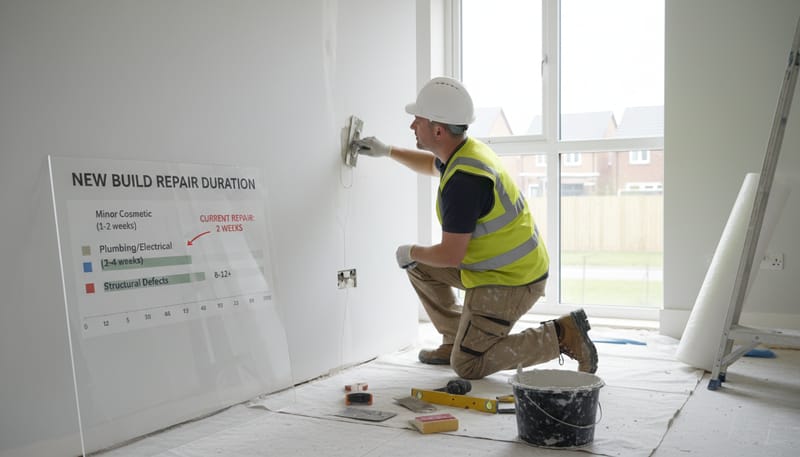
Cosmetic defects — such as paint blemishes, scuffed skirting boards, poorly fitted door handles, scratched worktops, and minor plaster imperfections — are the quickest to fix but often the lowest priority for developers. Most competent aftercare teams will schedule cosmetic repairs within 14 to 28 days of acknowledgement. These fixes are usually completed in a single visit by a general operative or decorator and take a few hours per property.
Functional defects cover issues that affect how your home operates day to day, such as doors that don’t close properly, windows that don’t seal correctly, faulty extractor fans, plumbing leaks, or heating systems that don’t work as intended. These typically require specialist tradespeople and may involve ordering replacement parts. Expect 28 to 56 days for most functional repairs, though complex issues can stretch to 90 days if parts need to be sourced.
Structural or building regulation defects are the most serious category and include issues like cracked lintels, inadequate damp-proof courses, missing fire stopping, non-compliant electrical work, or insufficient drainage. These require urgent attention, and your developer should acknowledge them within 48 hours and begin remediation work within 14 days. In practice, structural repairs can take several months to complete fully, particularly if planning or building control approval is needed for the fix.
Be aware that some developers will attempt to classify functional defects as cosmetic to justify longer response times. If you disagree with a classification, challenge it in writing and reference the relevant building regulation or British Standard. A professional snagging report carries significant weight here because inspectors categorise defects using industry-standard terminology.
NHBC and Warranty Provider Deadlines
Your new build warranty is one of the most powerful tools you have for getting defects fixed, and understanding its structure is essential. The most common warranty provider in the UK is the NHBC (National House Building Council), which covers around 80% of new homes. Other providers include LABC Warranty, Premier Guarantee, ICW, and Checkmate.
All major warranty schemes follow a broadly similar two-stage structure. During the first two years (the “builder liability period” or “defects insurance period”), your developer is directly responsible for fixing any defects that breach the warranty standards. This is your primary window for getting snagging issues resolved, and you should ensure all defects are reported during this period even if they haven’t been fixed yet.
After the two-year builder liability period, your warranty provider takes over for a further eight years (giving you ten years of total cover). However, during years three to ten, only major structural defects and issues affecting the home’s habitability are covered. Cosmetic issues and minor functional defects are excluded after year two, which is why it’s so critical to report everything early.
The NHBC’s Buildmark warranty specifically requires developers to resolve reported defects within a “reasonable time.” While the policy doesn’t define this precisely, NHBC guidance suggests that most repairs should be completed within 30 working days of being reported. If the developer fails to act, you can request a Resolution Service from the NHBC, which investigates the dispute and can order the developer to carry out repairs.
It’s vital to report defects in writing and keep copies of all correspondence. If a defect is reported verbally but not followed up in writing, you may struggle to prove it was raised within the warranty period. Email is ideal because it provides a timestamped record.
Consumer Code and New Homes Ombudsman Requirements
The Consumer Code for Home Builders sets out mandatory standards that all registered developers must follow. It was significantly strengthened in 2022 and now works alongside the New Homes Quality Board’s code of practice. Together, these frameworks give you substantial rights when it comes to after-sales service and defect rectification.
Under the current Consumer Code, developers must provide a written complaints procedure, acknowledge your snagging list within five working days, and provide a realistic timeline for completing repairs. They must also ensure that any repair work is carried out by competent tradespeople and that the quality of the fix meets the same standard as the original specification. You have the right to reject substandard repair work and request it be redone.
The New Homes Ombudsman, established in 2023, provides an independent dispute resolution service for new build homebuyers. If you’ve exhausted your developer’s complaints procedure and remain dissatisfied, you can refer the matter to the Ombudsman. They have the power to order developers to carry out repairs, issue formal apologies, and pay compensation of up to £25,000. Cases are typically resolved within 40 working days of referral.
A crucial point: the Consumer Code requires developers to have an internal complaints procedure with at least two stages. If your initial complaint doesn’t resolve the issue, you should escalate to the next stage (usually a senior manager or director review) before going to the Ombudsman. Skipping this step can mean your Ombudsman referral is sent back.
Escalation Paths When Your Developer Drags Their Feet
If your developer isn’t meeting reasonable repair timescales, you have several escalation options. The key is to follow a structured approach, escalating progressively rather than jumping straight to the nuclear option.
Start by putting your concerns in writing to the site manager or customer care manager, clearly stating which defects remain unresolved and how long they’ve been outstanding. Set a reasonable deadline for response — usually 14 days. If this doesn’t produce results, escalate to the developer’s regional or divisional management. Most major housebuilders have a formal escalation procedure, and reaching the managing director’s office often triggers faster action.
If internal escalation fails, your next steps are to contact your warranty provider for a Resolution or Dispute service, refer the matter to the New Homes Ombudsman, and consider involving your local authority’s Trading Standards team if you believe the developer is breaching consumer protection legislation. For defects that pose a health and safety risk — such as faulty electrics, gas leaks, or structural instability — contact your local Building Control authority immediately, as they have enforcement powers.
Social media can also be a surprisingly effective escalation tool. Many of the major developers have dedicated social media teams that monitor mentions and respond quickly to public complaints. A measured, factual post detailing your experience on platforms like X (formerly Twitter) or Facebook can prompt faster action than weeks of email exchanges.
As a last resort, you have the right to commission independent repairs and pursue the developer for the cost through the small claims court (for claims up to £10,000) or the county court (for larger amounts). However, you should only do this after giving the developer every reasonable opportunity to carry out the work themselves, as courts expect claimants to have acted proportionately.
What Happens If Your Developer Refuses to Act
In extreme cases, developers may simply stop responding or refuse to fix defects they consider “within tolerance.” This is where your warranty and legal rights become essential protection.
If a developer goes into administration or ceases trading, your warranty provider steps in to cover the cost of repairs. This is one of the core benefits of having an NHBC, LABC, or similar warranty — it provides a financial safety net even if the developer no longer exists. The warranty provider will typically appoint an alternative contractor to carry out the necessary work.
For issues that fall outside warranty cover — such as defects reported after the two-year builder liability period that aren’t structural — you may still have rights under the Consumer Rights Act 2015 and the Defective Premises Act 1972. The latter was amended by the Building Safety Act 2022 to extend the limitation period from six to fifteen years for claims related to dwellings, giving you a much longer window to pursue legal action for serious defects.
Some buyers have also had success using Section 38 of the Highways Act to compel developers to complete road adoption works, and Section 104 of the Water Industry Act for drainage adoption. These statutory mechanisms can force developers to finish communal infrastructure works that affect your property.
Tips for Getting Your Snags Fixed Faster
Based on the experiences of thousands of UK new build buyers, there are several proven strategies for accelerating the snagging resolution process. Taking a proactive, organised approach makes a tangible difference to outcomes.
Report early and comprehensively: Don’t trickle-feed defects to your developer. Submit your complete snagging list in one go, clearly numbered and categorised. This allows the aftercare team to plan efficient visits rather than returning repeatedly. A professional snagging report is invaluable here because it’s already formatted for this purpose.
Keep a resolution tracker: Create a simple spreadsheet or document that logs each defect, when it was reported, when it was acknowledged, the promised fix date, and the outcome. Share this tracker with your developer at regular intervals (every two to four weeks) to maintain pressure and demonstrate any patterns of delay.
Be flexible with access: Aftercare teams often juggle multiple properties simultaneously. Being flexible with appointment times — particularly if you can offer weekday access — can move your property up the schedule. If you’re working during the day, consider leaving a key with a trusted neighbour or asking if the developer’s key safe system can be used.
Build relationships: The site manager and aftercare team are the people who will actually fix your defects. While it’s important to be firm about your rights, maintaining a constructive relationship with these individuals can pay dividends. A polite but persistent approach tends to achieve better results than an adversarial one.
Escalate strategically: Don’t threaten the Ombudsman in your first email. Follow the formal complaints procedure step by step, documenting everything as you go. When you do escalate, your paperwork trail will strengthen your case enormously. However, if safety is at risk, don’t hesitate to escalate immediately to your warranty provider and Building Control.
Remember that you’re not alone in this process. Online communities such as the HomeOwners Alliance forum, the New Build Snagging Facebook groups, and sites like Trustpilot can provide valuable advice and emotional support from others who’ve been through similar experiences. They can also help you understand whether your developer’s response times are typical or unusually slow compared to industry norms.