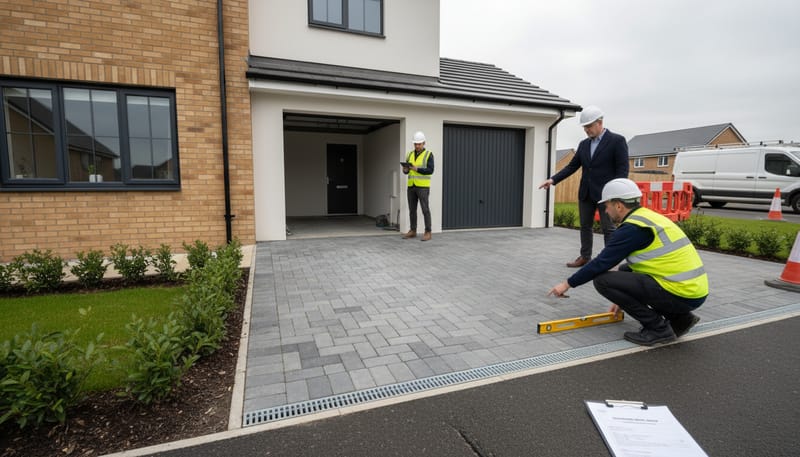
Why Your Driveway and Garage Deserve a Thorough Snagging Inspection
When buyers collect the keys to a new build home, most head straight for the kitchen, bathrooms, and bedrooms. The driveway and garage are almost always an afterthought — inspected with a quick glance on the way out. That is a costly mistake. Driveways and garages are consistently among the most defect-prone areas on any new build estate, and the repairs involved if problems are missed can run into thousands of pounds.
The reason is straightforward: external works are scheduled last. By the time the groundworkers arrive to lay your driveway, the developer is under pressure to hit completion targets. Heavy plant may still be crossing the site, delivery lorries churn up newly laid surfaces, and finishing trades rush to get the job signed off. Meanwhile, your garage — whether integral or detached — is often treated as a storage area during the final fit-out, leaving it scratched, stained, and poorly finished at handover.
A systematic inspection of these areas during your snagging survey ensures that every defect is recorded and becomes the developer’s responsibility to fix under your warranty. This guide covers every check you need to carry out, from surface finish and drainage to garage electrics and boundary issues with neighbours.
Every item in this guide is covered by the NHBC Standards (particularly Chapter 5.2 for hard landscaping and Chapter 9 for garages), the LABC Warranty Technical Manual, and the Consumer Code for Home Builders. If your developer disputes a defect, you have strong regulatory backing.
Driveway Surface Finish: What to Look For
The overall quality of the driveway surface is the first thing to assess. Whether your new build has block paving, tarmac (bituminous macadam), resin-bound aggregate, or poured concrete, the finished surface should be smooth, even, and free from visible defects. The best way to spot problems is to crouch down at the far end of the driveway and look across the surface at a low angle. Any undulations, dips, or humps that are invisible from above become immediately apparent from this vantage point.
Block Paving Checks
Block paving is the most common driveway surface on new build estates across England and Wales. The blocks should be laid in a consistent pattern — typically herringbone for vehicular areas, as this provides the best interlock under wheel loads. Check the following:
- All blocks are the correct way up, with the textured face uppermost.
- Joint widths are consistent at 2–5mm and filled with kiln-dried sand.
- No blocks have cracked, chipped, or already started to sink or rock.
- The colour pattern matches what was specified in your purchase agreement.
- Cuts at edges and around manholes are neat and precise, not rough or oversized.
Walk slowly across the entire surface and feel for any blocks that move underfoot. Even a single rocking block indicates insufficient compaction of the sand bed beneath. Left unaddressed, surrounding blocks will follow, creating a widespread uneven surface within months.
Tarmac Checks
For tarmac driveways, the surface should be uniformly black (when newly laid), smooth, and free from roller marks, scuff marks, and areas of varying texture. Run your hand across it — the finish should feel consistent with no loose aggregate that comes away when rubbed. Look for ridges or humps at joints between different laying sessions, and pay particular attention to the junctions with kerbs, manhole covers, and the garage threshold, where cracking is most common.
Also check for construction damage. It is extremely common for heavy vehicles to drive across newly laid tarmac during the final stages of a development, leaving tyre marks, indentations, and cracked edges. Under the Consumer Code for Home Builders, the developer is responsible for handing over your property — including all external areas — in a clean, undamaged condition.
Gradient and Drainage Falls
Proper drainage is arguably the single most important functional requirement of any driveway. Water must flow away from your property, not towards it. Under Building Regulations Approved Document H and NHBC Standards Chapter 5.2, all hard surfaces adjacent to a dwelling must be designed so that surface water drains away from the building and does not pool or pond.
The minimum acceptable gradient for a driveway is 1:40, which means a fall of 25mm for every metre of length. To test this, pour a bucket of water onto the driveway at several points and observe where it flows. Better still, visit during or immediately after rainfall and inspect the surface while it’s wet. Water should flow steadily towards the road, a drain gulley, or a soakaway — never towards your front door, garage entrance, or the neighbouring property.
Even small depressions that hold 5–10mm of standing water will cause problems in winter. Pooled water freezes, expands, and cracks the surface. Over several freeze-thaw cycles, a minor depression becomes a serious pothole. If your driveway connects to the public highway, there should be a drainage channel or dropped kerb with a gulley to prevent surface water from running onto the road — this is typically a planning condition the developer must satisfy.
For permeable driveways (required under planning rules for front gardens over 5 square metres, to reduce flood risk), test that water genuinely drains through the surface. Pour a bucket of water onto the paving and it should soak through within a few minutes. If water sits on top, the sub-base may lack porosity or the jointing material may be too fine and is blocking the gaps between blocks. Report any of these issues in your snagging list — they are the developer’s responsibility to correct.
Edging, Kerbs and Block Paving Patterns
Edging serves both a structural and aesthetic role. For block-paved driveways, a solid concrete edge restraint is essential — without it, the outer blocks gradually spread outward under vehicle weight, and the entire surface can migrate over time. This hidden haunching (a concrete bed set below the paving level) should be present along every unsupported edge. You may not see it, but you should be able to feel firmness when pressing the outermost blocks.
Check all visible kerbs and edging stones. They should be firmly bedded, level with their neighbours, and free from cracks caused by construction traffic. Mortar joints between kerb stones should be intact with no gaps. Where the driveway meets the public footpath, the dropped kerb must provide a smooth transition with no trip hazards — any step greater than 6mm between adjacent surfaces is a reportable defect.
The block paving pattern should be consistent across the full driveway area. Where cuts are required at edges, around manholes, or at threshold strips, the quality of those cuts is an excellent indicator of overall workmanship. Neat, precise cuts with tight-fitting pieces suggest a skilled installation, while rough, oversized cuts filled with mortar point to rushed work. Also check that any recessed manhole covers sit flush with the surrounding blocks and do not rattle or rock when you step on them.
Tarmac Defects and Construction Damage
Tarmac (asphalt) driveways present their own set of issues at snagging. Because tarmac is laid as a hot material and then compacted with a roller, the quality of the finished surface depends heavily on weather conditions, temperature management, and the skill of the laying team. Common tarmac defects include:
- Roller marks: visible lines left by the compaction roller, indicating uneven pressure or the tarmac cooling too quickly before compaction was complete.
- Loose aggregate: surface stones that pull away when rubbed, suggesting the binder content was too low or the mix temperature was wrong at the time of laying.
- Edge cracking: fissures along the junction between the tarmac and kerbs, manholes, or the garage threshold, caused by inadequate compaction near rigid features.
- Depressions and humps: undulations in the surface caused by uneven sub-base compaction or the tarmac being laid at inconsistent thicknesses.
- Construction vehicle damage: tyre tracks, indentations from heavy plant, and cracked edges where lorries have mounted the kerb after the surface was laid.
Any of these defects should be recorded in your snagging report with photographic evidence. Tarmac repairs are notoriously difficult to blend — patching an area typically leaves a visible colour difference — so it is in everyone’s interest to get the surface right first time. If the developer proposes a “patch and make good” repair, consider whether the result will be aesthetically acceptable to you before agreeing.
Where services (gas, water, electricity, broadband) cross beneath the driveway, the reinstatement over the trench should match the surrounding surface perfectly. Trench lines that settle over the first twelve months are one of the most common driveway complaints on new estates, and they are covered by your NHBC or equivalent warranty for the full defect liability period.
Garage Door Operation and Security
The garage door is one of the largest moving components in your property, and it must work safely and reliably from day one. Whether you have an up-and-over canopy door, a sectional door, or a roller shutter, the same fundamental checks apply. Take your time during the snagging inspection and test every function methodically.
For manually operated up-and-over doors, verify that the springs are properly tensioned. The door should hold its position when opened to roughly halfway — if it drops or flies upward, the spring tension is wrong, and this is a safety issue. The cables connecting the springs to the bottom brackets should show no signs of fraying.
If the garage has an electric operator, test the manual release mechanism. This is the cord or lever that disengages the motor so you can open the door during a power cut. Make sure it works and that you know how to re-engage the motor afterward. Check that the remote control handsets are programmed and that spare batteries are available or that the charging instructions are included in your handover pack.
Security is also a concern. If your garage has a connecting door to the house, the garage door itself is technically an external entry point and should have a lock rated to at least the same standard as your front and rear doors. Many new build garage doors come with a basic lever lock that offers minimal security — consider whether this is acceptable, and raise it with the developer if the specification promised something better.
Garage Floor Finish, Lighting and Electrics
The garage floor should be a smooth, level concrete slab with a light broom finish to provide grip. Check for cracks by walking the entire surface and looking carefully, especially along the edges and around any drainage channels. Hairline shrinkage cracks (less than 0.3mm wide) are generally acceptable in new concrete, but wider cracks or any crack that shows a step between the two sides indicates structural movement and must be reported.
The floor should fall very slightly towards the garage door — a gradient of about 1:80 is typical — so that any water brought in on car tyres or washed in during heavy rain drains outward rather than pooling inside. Check for damp patches or water staining, which could indicate rising damp through the slab or water ingress from under the door seal. If the garage is integral to the house, the floor level must be at least 100mm below the level of any habitable room, creating a step-down that prevents liquid spills from flowing into the home.
Garage lighting should be adequate for safe use of the space. Most new build garages are fitted with at least one ceiling-mounted bulkhead or batten light controlled by a switch near the internal or pedestrian door. Test the switch and confirm the light illuminates the full garage, including the corners. If your garage specification includes an external security light above the door, test that its PIR sensor activates correctly.
If the garage has a power socket, test it with a plug-in socket tester (around £15 from any DIY store) just as you would test every other socket in the house. Garages are classified as special locations under BS 7671 (the IET Wiring Regulations), which means the electrical installation may have specific requirements for IP-rated fittings and RCD protection. The socket should be at a safe height — typically 450mm above floor level — and away from any water sources.
If your garage is integral to the house, the connecting door must be a fire door — typically rated FD30 (30 minutes fire resistance). Check for the certification plug on the top or hanging edge of the door, intumescent strips in the frame rebate, a self-closing mechanism that pulls the door firmly shut, and correct frame gaps (2–4mm at the top and sides, no more than 10mm at the threshold). A failed fire door in an integral garage is a critical safety defect that must be reported immediately.
Oil Stains, Construction Debris and Final Cleanup
It is remarkably common for new build driveways and garages to be handed over with oil stains, paint splashes, mortar droppings, plaster residue, and general construction debris. None of this is acceptable. Under the Consumer Code for Home Builders and the NHBC Standards, the developer must ensure the property is presented in a clean, finished condition at completion.
Oil stains are particularly problematic on tarmac driveways. Diesel and hydraulic fluid from construction plant dissolve the bituminous binder in tarmac, causing the surface to soften and crumble. Minor stains can sometimes be treated with a proprietary degreaser, but significant contamination may require the affected area to be cut out and relaid. On block paving, oil stains penetrate the porous concrete blocks and are almost impossible to remove completely — stained blocks may need to be individually replaced.
Check the garage floor for cement splashes, plaster dust, paint drips, and any leftover building materials. Developers frequently use the garage as an unofficial site compound during the final weeks of construction, and the evidence is usually still visible at handover. The floor should be swept clean, and any fixed stains or marks should be noted on your snagging report. Also check behind the garage door track mechanism and in corners where debris tends to accumulate.
Externally, look for mortar or cement splashes on the driveway surface, kerbs, and boundary walls. Check that all protective coverings have been removed from windows, door panels, and light fittings. Remove any temporary signage, cable ties, or plastic barriers that the developer’s team may have left behind. Your driveway and garage should look finished, not like a construction site in its final stages.
Boundary Issues with Neighbours
Boundary disputes are one of the most common and emotionally charged problems on new build estates, and many of them originate from issues that are visible at snagging but not raised until it is too late. Before you complete, check that fences, walls, and other boundary treatments are in the positions shown on the site plan that your solicitor provided.
Your title deeds will specify who owns and maintains each boundary, typically indicated by a ‘T’ mark on the title plan. However, what is shown on the plan must match what is physically built. Common boundary snagging issues include:
- Fences in the wrong position: even a 100mm discrepancy matters. Check against the title plan and report any misalignment.
- Fence quality: close-board fence posts should be concreted or driven at least 600mm into the ground. Panel fences should have panels securely slotted or clipped with no loose or warped sections.
- Fence height: typically 1.8 metres at the rear and 1.0 metre at the front, as approved in the planning permission. Measure to confirm.
- Shared driveway boundaries: if you share a driveway with a neighbour, check that the division (often a colour change in block paving or a physical line) matches the legal boundary. On some developments, the driveway is split with one half belonging to each plot, while on others it’s a shared surface with a right of way.
- Retaining walls: where your plot is at a different level to the neighbour’s, check that any retaining walls are correctly built, with adequate drainage and no signs of movement or cracking.
Any discrepancies between the as-built boundary and the legal title plan should be raised with the developer before you complete. Once you exchange keys and the property is legally yours, resolving boundary issues becomes dramatically more expensive and time-consuming — often requiring a surveyor, solicitor involvement, and potentially the Land Registry. Getting it right at snagging stage costs the developer almost nothing and saves you potentially thousands of pounds.
Your Driveway and Garage Snagging Action Plan
By working methodically through every item in this guide, you will ensure that your driveway and garage are properly finished, safely constructed, and ready for years of daily use. These external areas may not feel as exciting as the kitchen or master bedroom, but they are just as important — and defects caught now are the developer’s responsibility to fix free of charge under your warranty.
Photograph every defect from both a wide angle and a close-up, include a ruler or coin for scale where relevant, and number each item sequentially in your snagging report. Use clear, factual language: “3mm depression in block paving at centre of driveway, 2.4 metres from garage threshold” is far more effective than “driveway is bumpy.”
Submit your completed snagging report in writing (email is ideal for the dated record) and request acknowledgement within 48 hours. If you need guidance on building a thorough snagging list covering every area of your home, see our comprehensive new build snagging checklist. For information on what your warranty covers and how to escalate unresolved defects, visit our guide to NHBC and builder warranties.
Your driveway and garage are part of the home you are paying for. Hold your developer to the same standard here as you would for any room inside the house.