Why Consider Downsizing to a New Build?
Downsizing — moving from a larger property to a smaller, more manageable one — is a significant life decision that millions of homeowners across the UK consider as their circumstances change. Whether the children have left home, retirement is approaching, or maintaining a large house has become physically or financially burdensome, downsizing to a new build home offers a compelling combination of modern living, lower running costs, and financial freedom that few other options can match.
The UK housing market in 2025 shows a clear trend towards downsizing among the over-55s. Research from the Centre for Ageing Better suggests that around 3.5 million homeowners over 55 are actively considering or would consider downsizing, while data from Knight Frank indicates that downsizers now account for approximately 25% of new build purchases by value. This is not a niche decision — it is a mainstream housing strategy.
New build homes are particularly well-suited for downsizers for several practical reasons. First, they are chain-free purchases, meaning you do not need to wait for someone else’s sale to complete before moving in. Second, modern construction standards deliver significantly lower energy bills and maintenance requirements compared to older properties. Third, new builds are designed with modern accessibility features that support comfortable living at every stage of life.
For many downsizers, the move is not just about reducing space — it is about improving quality of life. A smaller, well-designed new build can offer better use of space, more efficient heating, superior insulation, and access to modern amenities that an ageing larger home simply cannot provide.
Financial Benefits of Downsizing to a New Build
The financial case for downsizing to a new build is often the primary motivator, and the numbers can be genuinely transformative. If you own a large family home outright or have substantial equity, moving to a smaller new build property can release significant capital while simultaneously reducing your monthly outgoings.
Equity Release and Capital Benefits
The most immediate financial benefit of downsizing is equity release. If your current home is worth more than the new build you are purchasing, the difference is yours to keep. For example, selling a 4-bedroom detached home in the South East for £550,000 and purchasing a 2-bedroom new build apartment for £300,000 could release £250,000 in equity — after accounting for moving costs, stamp duty, and legal fees.
This released equity can be used for retirement income, helping family members onto the property ladder, investments, travel, or simply as a financial safety net. For many retirees, this capital release is far more valuable than remaining in a large, expensive-to-maintain property.
Financial Comparison: Large Older Home vs New Build
Below is a detailed comparison of annual running costs between a typical 4-bedroom older home and a 2-bedroom new build, based on average UK figures for 2024/25:
| Cost Category | 4-Bed Older Home (EPC D) | 2-Bed New Build (EPC B) | Annual Saving |
|---|---|---|---|
| Gas and electricity | £2,100 | £780 | £1,320 |
| Council tax | £2,800 (Band F) | £1,600 (Band C) | £1,200 |
| Home insurance | £480 | £220 | £260 |
| Maintenance and repairs | £2,500 | £200 | £2,300 |
| Water rates | £520 | £340 | £180 |
| Garden maintenance | £600 | £100 | £500 |
| Total annual costs | £9,000 | £3,240 | £5,760 |
The potential saving of nearly £5,760 per year is significant, particularly for those on fixed retirement incomes. Over a 20-year retirement period, that amounts to over £115,000 in cumulative savings — money that stays in your pocket rather than going towards maintaining an oversized property.
Stamp Duty Considerations
When downsizing, stamp duty is an important cost to factor in. As of 2025, the stamp duty rates for residential property purchases in England and Northern Ireland are tiered. If your new build purchase is £250,000, the stamp duty would be £2,500. However, if you are over 65 and meet certain criteria, some developers offer assistance with stamp duty costs as part of their incentive packages.
It is also worth noting that if you sell your existing home and buy a less expensive property, you are not purchasing an “additional” property, so the 5% surcharge does not apply. Your solicitor will confirm this during the conveyancing process.
Running Cost Comparison Chart
Based on average UK costs for 2024/25. New build figure assumes a 2-bedroom property with EPC rating B. Older home assumes a 4-bedroom property with EPC rating D.
Modern Accessibility and Design Features
One of the most compelling reasons for downsizers to choose a new build over a second-hand property is the standard of modern design and accessibility features that come as standard with contemporary construction. New build homes are designed to meet current Building Regulations, which include specific provisions for accessibility that older homes simply do not have.
Standard Accessibility Features in New Builds
Under Part M of the Building Regulations (England), all new homes must be built to at least Category M4(1) standard, which means they must be “visitable” by people with disabilities. Many developments, particularly those aimed at the retirement or downsizer market, are built to the higher M4(2) standard (“accessible and adaptable dwellings”), which includes:
- Level or gently sloping approach to the front door with no steps
- Wide doorways (minimum 775mm clear opening width) throughout the ground floor
- A ground-floor WC or accessible bathroom
- Walls reinforced in bathrooms for future grab rail installation
- Level thresholds at all external doors
- Switches and sockets at accessible heights (between 450mm and 1200mm from floor level)
- Space for a future stairlift installation on the staircase
These features are built in from the start — no expensive retrofitting is required. For downsizers who want a home that will support them comfortably for decades, this forward-thinking design is invaluable.
Energy Efficiency and Comfort
New build homes are significantly warmer, quieter, and cheaper to heat than older properties. With EPC ratings of B or above, modern new builds use advanced insulation, double or triple glazing, and efficient heating systems that keep the interior comfortable without high energy bills. For older homeowners who may feel the cold more acutely, the consistent warmth of a well-insulated new build is a genuine quality-of-life improvement.
Many new builds now also include heat pumps and solar panels, further reducing energy costs and the home’s environmental impact. Combined with smart home systems such as app-controlled heating and lighting, the technology in new builds makes daily living more convenient and more efficient.
Low Maintenance Living
Perhaps the biggest practical advantage of downsizing to a new build is the dramatic reduction in maintenance requirements. Older homes require constant attention — from roof repairs and damp treatment to rewiring and replumbing. A new build comes with:
- A 10-year NHBC Buildmark warranty covering structural defects (see our warranty guide)
- Manufacturer warranties on all appliances, boilers, and heating systems
- 2-year developer aftercare covering all snags and defects
- No immediate repair or renovation needs — everything is brand new
- Modern materials designed for longevity and minimal upkeep
Part Exchange and Selling Options
For downsizers, one of the biggest concerns is selling the existing home. Being in a property chain can cause delays, stress, and uncertainty. New build developers offer several solutions specifically designed to make the transition smoother.
Part Exchange Schemes
Part exchange is a scheme offered by most major UK developers where they purchase your existing home directly, removing the need to find a buyer on the open market. The developer values your current home (usually at 90–95% of market value) and deducts that amount from the purchase price of the new build. The key advantages for downsizers include:
- Chain-free sale: No waiting for buyers, no risk of the chain collapsing. This is one of the biggest advantages of buying new build.
- Certainty of sale: Once the part exchange offer is accepted, the sale of your existing home is guaranteed.
- Coordinated completion: The developer can align the sale of your old home with the completion of your new build, avoiding the need for temporary accommodation.
- Reduced stress: No estate agent viewings, no open days, no protracted negotiations.
Part Exchange vs Open Market Sale
| Factor | Part Exchange | Open Market Sale |
|---|---|---|
| Sale price achieved | 90–95% of market value | Potentially 100% of market value |
| Time to sell | 2–4 weeks | 3–6 months (average) |
| Risk of chain collapse | None | Moderate to high |
| Estate agent fees | None | 1–3% of sale price |
| Stress level | Low | High |
| Viewings required | Developer valuation only | Multiple viewings over weeks/months |
| Certainty of completion date | High | Low |
For downsizers, part exchange is often the preferred option despite the slight discount on sale price. The saved estate agent fees (typically 1–2% of the sale price), the elimination of chain-related stress, and the guaranteed timeline make it financially and emotionally advantageous for many.
Most major developers offer part exchange, including Barratt Homes, Taylor Wimpey, Persimmon Homes, Bellway, Redrow, and David Wilson Homes. Eligibility typically requires your existing home to be within a certain value range and to meet certain condition standards. Some developers limit part exchange to properties within 30 miles of the new development.
Emotional Considerations and Decluttering
While the practical and financial benefits of downsizing are clear, the emotional aspects should not be underestimated. Leaving a family home where you may have lived for 20, 30, or even 40 years is a significant life event. The memories attached to a home — children growing up, family gatherings, years of personalisation — make it more than just bricks and mortar.
Managing the Emotional Transition
Successful downsizers often describe the process as bittersweet but liberating. Here are some strategies that can help manage the emotional side of the move:
- Focus on what you gain, not just what you leave: A new build offers warmth, security, lower bills, less maintenance, and more freedom to enjoy life. Frame the move as a positive new chapter.
- Visit the new area before committing: If you are moving to a new location, spend time exploring the neighbourhood, local amenities, and community groups. Feeling connected to the new area makes the transition easier.
- Take photographs of your current home: Before you leave, photograph every room and the garden. These memories are preserved regardless of where you live.
- Involve family in the process: If children or grandchildren have emotional ties to the old home, involve them in the move. Let them visit the new property and understand why the decision makes sense.
- Give yourself time: Do not rush the decision. Visit several show homes, compare developments, and make the choice that feels right for your circumstances.
Decluttering: A Practical Guide
Downsizing inevitably means owning less. A 4-bedroom home accumulates decades of possessions that will not fit into a 2-bedroom new build. Decluttering is both a practical necessity and an emotional process.
We recommend a staged approach over 3–6 months before your move date:
- Room-by-room assessment: Go through each room systematically, sorting items into four categories: keep, donate, sell, and dispose.
- Measure your new home: Use the new build space standards and floor plans to determine exactly what furniture will fit. There is no point keeping a large dining table if the new dining area is designed for a smaller one.
- Sell valuable items early: Antique furniture, art, and quality household items can be sold through auction houses, specialist dealers, or online platforms. Start this process early to avoid last-minute pressure.
- Donate generously: Charity shops, community groups, and organisations such as the British Heart Foundation will collect large furniture items for free. Many downsizers find donating deeply satisfying.
- Digitise paperwork and photographs: Scan important documents and photograph albums that take up physical space. Cloud storage means nothing is lost.
- Keep meaningful items: You do not have to part with everything. Choose the items that matter most and find space for them in your new home. A curated collection of meaningful objects is more enjoyable than rooms full of unused possessions.
Bungalow and Apartment Options for Downsizers
New build developers offer a wide range of property types that are well-suited to downsizers. The two most popular choices are bungalows and apartments, each offering distinct advantages depending on your lifestyle preferences and mobility needs.
New Build Bungalows
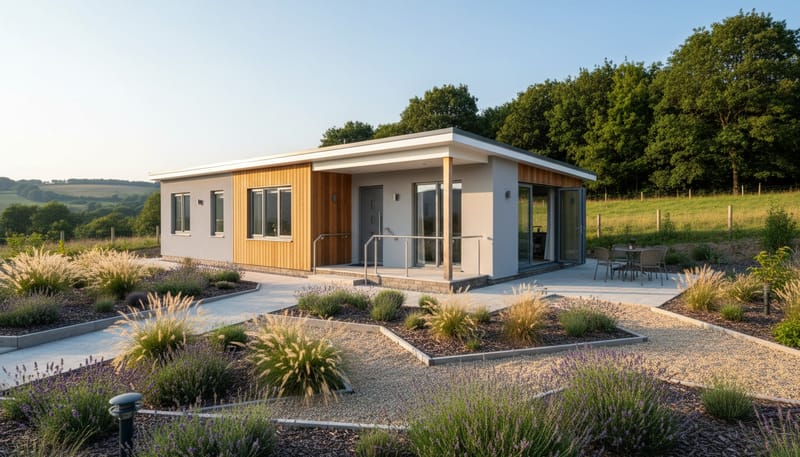
Bungalows remain the most sought-after property type for downsizers, and new build bungalows are increasingly available across the UK. Single-storey living eliminates the need for stairs entirely, making the home accessible for those with mobility challenges or those who want to future-proof their living arrangements.
Key advantages of new build bungalows include:
- No stairs: Entire living space on one level, ideal for those with joint problems, mobility issues, or wheelchair use
- Private garden: Most bungalows include a manageable rear garden, providing outdoor space without the burden of a large plot
- Privacy: No shared walls, entrances, or communal areas (unlike apartments)
- Flexibility: Open-plan layouts in modern bungalows can be adapted to changing needs over time
New build bungalows are offered by many UK developers, including McCarthy Stone (retirement specialists), Barratt Homes, and regional builders who focus on bungalow developments. Prices vary significantly by region, but a 2-bedroom new build bungalow typically ranges from £200,000 in the North of England to £400,000+ in the South East.
New Build Apartments
New build apartments are an excellent option for downsizers who want truly low-maintenance living. With no garden to tend, no exterior maintenance responsibilities, and often a concierge or management service on-site, apartments offer the most hands-off lifestyle available. For a detailed comparison, see our guide on new build apartments vs houses.
Apartment advantages for downsizers:
- Minimal maintenance: Exterior maintenance, communal areas, and building insurance are handled by the management company
- Security: Many new build apartment developments include secure entry systems, CCTV, and on-site management
- Community: Shared spaces and resident communities can combat the loneliness that some downsizers experience
- Location: Apartments are often in town centre or well-connected locations, close to shops, transport, and healthcare
The main consideration for apartments is leasehold ownership and service charges. Annual service charges for a standard new build apartment typically range from £1,200 to £3,000, covering building insurance, communal maintenance, lift maintenance (if applicable), and management fees. These costs must be factored into your financial planning.
Property Type Comparison for Downsizers
| Feature | New Build Bungalow | New Build Apartment | New Build 2-Bed House |
|---|---|---|---|
| Stairs | None | Lift access (usually) | Yes (1 flight) |
| Garden | Private rear garden | Balcony or shared grounds | Private rear garden |
| Maintenance | Low (you manage) | Very low (management company) | Low (you manage) |
| Service charge | None (usually) | £1,200–£3,000 per year | None (usually) |
| Tenure | Freehold | Leasehold | Freehold |
| Resale demand | Very high | High (location dependent) | High |
| Typical price (UK average) | £250,000–£400,000 | £180,000–£350,000 | £220,000–£380,000 |
| Privacy | High | Moderate | High |
Making the Move: Practical Steps
Once you have decided to downsize to a new build, a structured approach will make the process as smooth as possible. Here is a recommended step-by-step plan:
- Assess your finances: Get a clear picture of your current home’s value (request 2–3 estate agent valuations), calculate your expected equity release, and determine your budget for the new build. If you need a mortgage, explore the options — many lenders offer mortgages to over-55s, including competitive new build rates.
- Research developments: Identify new build developments in your preferred area. Visit show homes, review floor plans, and compare specifications. Use our guide to choosing a developer to evaluate different housebuilders.
- Consider part exchange: Ask the developer about part exchange options early in the process. If eligible, this can dramatically simplify your sale.
- Instruct a solicitor: Choose a conveyancer experienced in new build transactions. New build conveyancing has specific requirements around CML disclosures, warranty registrations, and management company obligations.
- Begin decluttering: Start the decluttering process 3–6 months before your expected move date. This gives you time to sell, donate, and dispose of items without pressure.
- Plan your move: Book a removal company experienced in downsizing moves. They can advise on packing, storage, and logistics. Many offer a “downsizing service” that includes help with sorting and disposing of unwanted items.
Timeline for Downsizing to a New Build
A typical downsizing timeline from initial decision to moving in looks like this:
- Month 1–2: Research, visit show homes, shortlist developments
- Month 3: Reserve your plot, begin part exchange or list your current home
- Month 4–6: Solicitor instructed, searches and legal work progresses, decluttering in full swing
- Month 6–8: Exchange contracts, final decluttering, book removals
- Month 8–10: Completion, move in, enjoy your new home
This timeline assumes you are buying a property that is already built or nearing completion. If you are reserving off-plan, add 6–18 months for construction, though this extra time can be useful for gradual decluttering and financial planning.
Frequently Asked Questions
Will I lose money by downsizing?
In most cases, no. If your current home is worth more than the new build you are purchasing, you will release equity. There are costs involved — stamp duty, solicitor fees, removal costs, and potentially estate agent fees — but for most downsizers, the equity released far exceeds these costs. A move from a £500,000 property to a £280,000 new build, for example, could release over £200,000 even after all transaction costs are accounted for.
Can I get a mortgage as an older buyer?
Yes. While there was historically an age limit on mortgages, many UK lenders now offer mortgages to borrowers well into their 70s and even 80s. Some lenders have no maximum age at all, while others require the mortgage term to end before a specified age (e.g., 80 or 85). Retirement interest-only (RIO) mortgages are another option for older borrowers. Consult an independent mortgage advisor who specialises in later-life lending for personalised advice.
What if my current home needs work before I can sell it?
This is where part exchange is particularly valuable. Developers assess properties based on their current condition and offer a price accordingly. While you may get slightly less than if you renovated first, you avoid the cost, time, and stress of carrying out improvements. If selling on the open market, focus on cost-effective improvements that maximise kerb appeal rather than major renovations — a fresh coat of paint, tidy garden, and professional clean can significantly boost your sale price without major investment.
Is it worth downsizing just for lower energy bills?
Lower energy bills alone may not justify the move, but they are a significant component of the overall financial picture. When combined with reduced council tax, lower maintenance costs, reduced insurance premiums, and the capital released from equity, the financial case becomes much stronger. A new build with an EPC rating of B or above will typically save £1,000–£1,500 per year on energy costs alone compared to an older, larger property.
Do developers offer any incentives specifically for downsizers?
Yes. Many developers offer incentive packages that are particularly attractive to downsizers, including part exchange schemes, stamp duty contributions, legal fees paid, and moving cost contributions. Some retirement-focused developers also offer trial stays, furniture packages, and assisted move services. Ask the sales advisor about current incentive packages when you visit the development.
Embracing a New Chapter with Confidence
Downsizing to a new build is one of the smartest housing decisions you can make at the right stage of life. The combination of released equity, lower running costs, modern accessibility features, and a maintenance-free lifestyle creates a genuinely improved quality of life for millions of UK homeowners.
The key is to approach the process with thorough research, realistic expectations, and a clear financial plan. Visit show homes, compare developments, explore part exchange options, and give yourself time to declutter and prepare emotionally for the move.
For more guidance on the new build buying process, explore our comprehensive new build buying guide. If you are considering different property types, our guides on new build property types and apartments vs houses will help you identify the right fit for your lifestyle and budget.