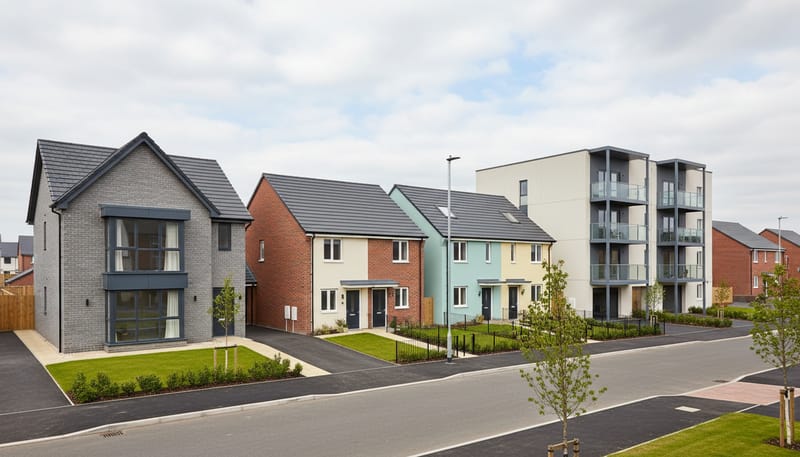
Understanding UK New Build Property Types
The UK new build market offers an impressive variety of property types, each designed to suit different lifestyles, budgets, and household sizes. Whether you are a first-time buyer looking for a starter home, a growing family needing more space, or someone looking to downsize into a low-maintenance property, understanding the characteristics of each property type is essential for making the right choice.
Modern new build developments typically feature a mix of property types, from compact apartments to spacious detached family homes. This diversity ensures that developments cater to a range of buyers and create balanced, vibrant communities. Each property type comes with its own set of advantages, considerations, and typical price points.
In this comprehensive guide, we will explore every major new build property type available in the UK, compare their features side by side, and help you identify which type best matches your needs and budget. We will also cover the legal distinctions between freehold and leasehold ownership that vary by property type, and the impact on your long-term costs.
Houses: Detached, Semi-Detached, and Terraced
Houses remain the most popular new build property type in the UK, and they come in three main configurations: detached, semi-detached, and terraced. Each offers a different balance of space, privacy, and value.
Detached Houses
A detached house stands entirely on its own, with no shared walls with neighbouring properties. This is the most sought-after house type, offering maximum privacy, typically the largest plot sizes, and often the greatest potential for future extension or modification (subject to planning permission). Detached new builds range from compact three-bedroom homes to expansive five or six-bedroom executive properties.
New build detached homes typically range from 90m² to over 200m² of internal floor space. Prices vary enormously by location, from around £250,000 in parts of the North East and Midlands to £600,000+ in the South East and commuter belt areas. Most detached new builds are sold freehold, giving you full ownership of the property and land.
Semi-Detached Houses
Semi-detached houses share one wall with a neighbouring property. They are one of the most common property types in the UK and represent an excellent balance between space and affordability. New build semi-detached homes typically offer three to four bedrooms, a good-sized garden, and off-street parking. They are particularly popular with growing families who need more space than a terraced house but cannot stretch to a detached property.
Floor areas for new build semis typically range from 75m² to 130m². Prices generally sit 15–25% below equivalent detached properties on the same development. Sound insulation between the shared wall is an important consideration — modern building regulations require significantly better acoustic performance than older properties, but it is still worth checking the specification.
Terraced Houses
Terraced houses (also called town houses in some marketing materials, though this can mean something different — see below) share walls with properties on both sides, except for end-terrace plots which share only one wall. New build terraced homes are typically two to three bedrooms and represent some of the most affordable family housing on new developments.
Modern terraced homes are designed with much better sound insulation than their Victorian and Edwardian predecessors. The shared walls reduce heat loss, often resulting in excellent EPC ratings and lower energy bills. Floor areas typically range from 60m² to 100m², with prices starting from as low as £160,000 in some regions.
End-Terrace Properties
End-terrace homes sit at the end of a terraced row, sharing only one party wall. They often benefit from a larger plot, a side-access path, and windows on three sides rather than two, improving natural light and ventilation. End-terrace plots typically command a small premium over mid-terrace equivalents — usually 5–10% more. They are often considered the best value on a development, offering many of the benefits of a semi-detached home at a more accessible price point.
Townhouses: The Modern Urban Home
Townhouses are a distinctive property type that has become increasingly popular on urban and suburban new build developments. A townhouse typically spans three or more storeys, with a narrow footprint but generous overall floor area. The living accommodation is spread vertically rather than horizontally, making townhouses an efficient use of land in higher-value areas.
Typical Townhouse Layout
- Ground floor: Entrance hall, garage or utility/storage room, and sometimes a study or home office. Some designs include a bedroom or shower room on the ground floor for accessibility.
- First floor: Open-plan kitchen, dining, and living area, often with direct access to a rear balcony, terrace, or Juliet balcony. This elevated living space can offer pleasant views and increased privacy.
- Second floor: Two to three bedrooms with a family bathroom and often an en-suite to the master bedroom.
- Third floor (some designs): Additional bedroom or flexible room, potentially with roof terrace access.
Townhouses typically offer 100m² to 150m² of floor space, comparable to a semi-detached or small detached house, but on a much smaller plot footprint. This makes them ideal for urban locations where land values are high. Prices generally sit between semi-detached and detached houses on the same development.
The main consideration with townhouses is the vertical living arrangement. Stairs feature prominently in daily life, which can be a challenge for those with mobility limitations or young children. However, for active couples and families, the separation of living and sleeping floors provides excellent spatial organisation and a genuine sense of having distinct zones within the home.
Apartments and Flats
Apartments (also called flats) represent a significant proportion of new build homes in the UK, particularly in urban areas and city centres. They range from compact studio apartments to spacious three-bedroom penthouses, and everything in between. The apartment versus house decision is one of the most fundamental choices for new build buyers.
Types of New Build Apartments
- Studio apartments: A single open-plan living and sleeping space with a separate bathroom. Typically 30–45m². Ideal for single professionals or investors. Prices from around £120,000 in regional cities.
- One-bedroom apartments: A separate bedroom plus open-plan kitchen/living area. Typically 45–55m². The most common apartment type for first-time buyers. Prices from around £150,000.
- Two-bedroom apartments: Two bedrooms, bathroom, and open-plan living/kitchen. Typically 55–75m². Suitable for couples, small families, or sharers. Prices from around £200,000.
- Three-bedroom apartments: Spacious family-sized apartments, often in premium developments. Typically 75–100m²+. Less common but increasingly popular in urban regeneration schemes.
- Penthouses: Top-floor apartments with premium finishes, often featuring private roof terraces and panoramic views. Prices vary enormously but typically command 20–40% premiums over equivalent lower-floor units.
Key Apartment Considerations
New build apartments are almost always sold on a leasehold basis, meaning you own the right to occupy the property for a set period (typically 125–999 years on new builds) but do not own the building itself. This means paying an annual service charge for building maintenance, communal area upkeep, and building insurance. Service charges vary widely but typically range from £1,200 to £4,000 per year for a standard apartment, with premium developments potentially exceeding this.
Ground rent on new build apartments has been a contentious issue, but recent legislation (the Leasehold Reform (Ground Rent) Act 2022) ensures that ground rent on new leases is set at a peppercorn (effectively zero). This is a significant improvement for buyers of new build leasehold properties.
Bungalows and Maisonettes
New Build Bungalows
Bungalows are single-storey properties with all living accommodation on the ground floor. While relatively rare on modern new build developments, they remain highly sought-after, particularly among older buyers, those with mobility requirements, and anyone who values the convenience and accessibility of single-level living.
New build bungalows typically offer two to three bedrooms, with floor areas ranging from 60m² to 110m². They require larger plot sizes than equivalent multi-storey homes, which is the primary reason developers build fewer of them — the land cost per unit is higher. However, this also means bungalow plots often come with generous gardens and more private outdoor spaces.
Prices for new build bungalows can sometimes surprise buyers. Because of their scarcity and the larger plots they require, bungalows often cost as much as, or more than, a two-storey house with equivalent bedroom numbers on the same development. However, their low-maintenance nature, absence of stairs, and strong resale demand make them an excellent long-term investment.
Maisonettes
A maisonette is a self-contained property within a larger building, typically spanning two floors with its own private entrance (usually from street level). They differ from standard apartments in that they have their own front door rather than accessing their home through a shared communal entrance and corridor.
New build maisonettes are particularly common in urban developments where developers want to provide a house-like feel within a higher-density scheme. They typically offer two to three bedrooms and 60–90m² of floor space. The private entrance gives a greater sense of independence than a standard flat, while the two-storey layout provides natural separation between living and sleeping areas.
Maisonettes may be freehold or leasehold depending on the development structure. If leasehold, they will carry service charge obligations similar to apartments, though these are sometimes lower due to reduced communal facilities. They are an excellent compromise for buyers who want more than a flat but are priced out of houses in their preferred area.
Property Type Comparison
The following comprehensive comparison table summarises the key characteristics of each property type, helping you identify which best matches your requirements and budget. Prices shown are indicative national averages for new builds and vary significantly by region.
| Property Type | Typical Bedrooms | Floor Area (m²) | Price Range | Tenure | Best Suited For |
|---|---|---|---|---|---|
| Detached House | 3–6 | 90–200+ | £250,000–£800,000+ | Freehold | Families, upsizers, those wanting maximum privacy |
| Semi-Detached House | 2–4 | 75–130 | £200,000–£500,000 | Freehold | Growing families, balancing space with budget |
| End-Terrace House | 2–4 | 65–110 | £180,000–£400,000 | Freehold | Families wanting semi-detached benefits at lower cost |
| Mid-Terrace House | 2–3 | 60–100 | £160,000–£350,000 | Freehold | First-time buyers, smaller families, budget-conscious |
| Townhouse | 3–4 | 100–150 | £220,000–£550,000 | Freehold | Urban professionals, families wanting city-centre space |
| Apartment (1-bed) | 1 | 45–55 | £150,000–£350,000 | Leasehold | Singles, couples, first-time buyers, investors |
| Apartment (2-bed) | 2 | 55–75 | £200,000–£450,000 | Leasehold | Couples, small families, downsizers |
| Bungalow | 2–3 | 60–110 | £230,000–£500,000 | Freehold | Retirees, those with mobility needs, low-maintenance seekers |
| Maisonette | 2–3 | 60–90 | £180,000–£400,000 | Freehold/Leasehold | Urban buyers wanting house-like feel at flat prices |
Pros and Cons Summary
| Property Type | Key Advantages | Key Considerations |
|---|---|---|
| Detached House | Maximum privacy, large gardens, extension potential, strong resale value | Highest purchase price, larger maintenance burden, higher heating costs |
| Semi-Detached House | Good space-to-price ratio, decent gardens, freehold, good resale | Shared wall (noise potential), smaller than detached, less extension scope |
| Terraced House | Most affordable house type, excellent energy efficiency, strong communities | Less privacy, limited parking, smaller gardens, restricted extensions |
| Townhouse | Generous floor space on small footprint, urban convenience, freehold | Multiple staircases, vertical living not for everyone, limited garden |
| Apartment | Low maintenance, secure entry, urban locations, lower purchase price | Service charges, leasehold, no garden (usually), less storage |
| Bungalow | Single-level accessibility, large plots, strong demand, quiet locations | Premium pricing, limited new supply, may need adaptation as needs change |
| Maisonette | Own front door, two-storey living, more affordable than houses | May be leasehold, limited outdoor space, variable service charges |
Choosing the Right Property Type for Your Needs
Selecting the right property type requires honest assessment of your current needs, future plans, budget, and lifestyle preferences. Here are the key factors to consider:
Household Size and Future Plans
Consider not just your current household but where you expect to be in five to ten years. A couple planning to start a family may outgrow a two-bedroom apartment within a few years, while empty nesters may find a large detached house increasingly impractical. If you are unsure about your future plans, choosing a property with good resale potential gives you flexibility to move when circumstances change.
Budget Considerations
Your budget determines which property types are realistic in your preferred location. In many parts of Southern England, first-time buyers may only be able to afford an apartment or shared ownership property, while the same budget in Northern England or the Midlands could secure a three-bedroom semi-detached house. Be realistic about your budget and factor in all costs, including stamp duty, legal fees, and moving costs.
Lifestyle and Priorities
Think about what matters most to you in your daily life. If you value a garden for children or entertaining, apartments and maisonettes may not meet your needs. If you prioritise low maintenance and urban convenience, a detached house with a large garden may feel burdensome. If accessibility is important now or may become so in the future, a bungalow or ground-floor apartment offers the best long-term solution.
Consider your commute, local amenities, and how the location of different property types on a development affects your daily routine. Apartments tend to be located closer to development entrances and transport links, while detached houses are often positioned at the quieter edges of a development.
Frequently Asked Questions
What is the most popular new build property type in the UK?
Semi-detached and terraced houses collectively account for the largest share of new build family homes, while apartments dominate in urban areas and city centres. The most popular type varies significantly by region: in London and other major cities, apartments represent the majority of new builds, while in suburban and rural areas, semi-detached and detached houses are more common. National statistics show that approximately 37% of new builds are flats, with the remainder being houses of various types. Your ideal property type depends on your location, budget, and household requirements.
Are new build apartments a good investment?
New build apartments can be an excellent investment, particularly in areas with strong rental demand and good transport links. They typically offer lower entry prices than houses, making them accessible to first-time buyers and investors. However, it is important to factor in ongoing service charges and potential ground rent when calculating your total costs. Apartments in well-managed developments with good facilities tend to hold their value well. For a detailed comparison, see our guide on apartments versus houses.
Why are new build bungalows so rare?
New build bungalows are relatively scarce because they require more land per dwelling than multi-storey homes. A three-bedroom bungalow needs a plot almost twice the size of a three-bedroom two-storey house to provide the same internal floor area. With land being the most expensive component of new home development, builders can achieve better returns by building upwards. However, the strong demand for bungalows means they often achieve premium prices and sell quickly, which is encouraging some developers to include more bungalows in their site plans.
What is the difference between a flat and a maisonette?
The key difference is the entrance and layout. A flat (apartment) is a single-level dwelling accessed through a shared communal entrance, corridor, or lobby. A maisonette is a multi-level dwelling (typically two storeys) with its own private front door, usually at ground level. Maisonettes offer a more house-like living experience with separate floor levels for living and sleeping, while still being part of a larger building. Both may be leasehold, but maisonettes sometimes come with freehold or share of freehold arrangements.
Can I extend a new build property?
In principle, yes, but there are important caveats. Most new build homes come with restrictive covenants that prevent external modifications during the NHBC warranty period (typically the first ten years). Any extension requires planning permission (or must qualify under permitted development rights) and must not breach any covenants in your title deeds. Detached houses generally offer the most scope for extension, while terraced homes, apartments, and maisonettes are more restricted. Before purchasing, check the site plans and title restrictions with your conveyancer if future extension is important to you.
Finding Your Ideal New Build Property Type
The UK new build market offers a property type for virtually every buyer, from compact city apartments to spacious rural detached homes. The key to making the right choice is understanding the characteristics, costs, and compromises of each type, and matching these honestly against your needs, budget, and lifestyle preferences.
Take time to visit show homes across different property types, even those you might not have initially considered. You may find that a well-designed townhouse offers more space than you expected, or that a ground-floor apartment with a private garden provides the perfect low-maintenance lifestyle. Keeping an open mind about property types significantly expands your options and may lead you to a home you had not previously considered.
For further guidance on your new build purchase, explore our guides on choosing the right plot, understanding space standards, and the complete buying process.