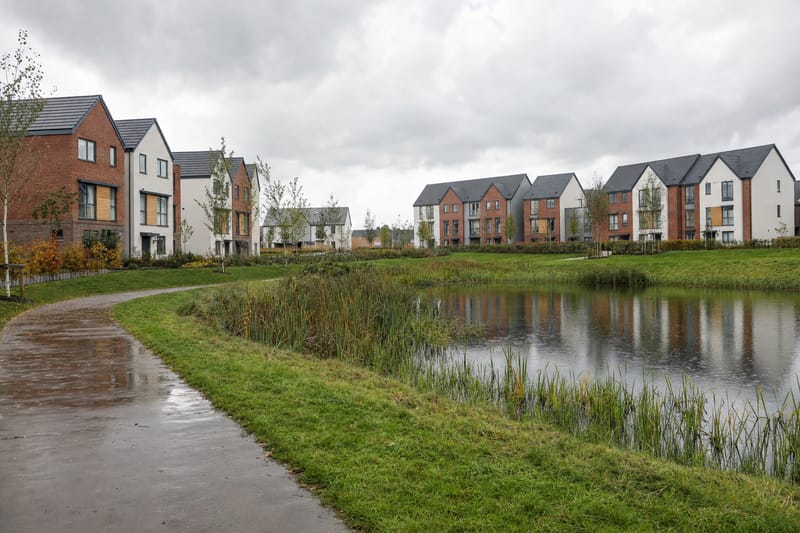
Flood risk is one of the least discussed factors in new build marketing — and one of the most consequential. Developers build show homes, landscaped roads and glossy brochures around a site, but they are rarely obliged to volunteer that a plot sits in a floodplain, backs onto a culverted stream, or relies on a sustainable drainage system (SUDS) that has never been tested in a real storm. Because new build land is often secured cheaply precisely because it was previously considered unsuitable or marginal for development, a meaningful proportion of new build schemes across England, Wales, Scotland and Northern Ireland are approved on land that carries some degree of flood risk from rivers, surface water, or the sea.
This does not mean you should automatically rule out a development near water. Modern planning policy requires flood risk to be assessed and mitigated before permission is granted, and thousands of new build homes on flood-affected land are built safely, insured normally, and never flood. But "planning permission was granted" is not the same as "there is no risk", and it is entirely your job — not the developer's, not the estate agent's — to check the flood history and drainage strategy of a plot before you reserve.
This guide walks through exactly how to check official flood maps for a specific plot, what questions to ask about a development's SUDS strategy, how flood risk affects mortgage lending and insurance premiums, and what red flags should make you pause before paying a reservation fee. It is written for anyone buying a new build home in the UK, whether you are a first-time buyer, downsizer, or investor.
The single most useful thing you can do before reserving any plot is look up the exact postcode or address on the relevant national flood map — not the town name, not the postcode district, but the specific plot. Flood risk can vary sharply between one side of a development and the other.
How to Check the Official Flood Maps Before You Reserve
Every UK nation publishes free, public flood risk mapping, and checking it takes a few minutes. This should be one of the first things you do once you have a plot number or address — ideally before you pay any reservation fee.
- England: the Environment Agency's "check your long-term flood risk" service (gov.uk) lets you search by postcode or address and returns separate risk ratings for rivers and the sea, surface water, and reservoirs, plus a long-term flood risk category (very low, low, medium, high).
- Wales: Natural Resources Wales publishes an equivalent flood risk map covering rivers, the sea and surface water.
- Scotland: the Scottish Environment Protection Agency (SEPA) runs Scotland's Flood Maps, showing river, coastal and surface water risk.
- Northern Ireland: the Rivers Agency (part of DAERA) maintains flood maps for Northern Ireland, accessible via the NI Direct or DAERA websites.
When you search, note that these maps typically show risk in two ways: a flood zone classification (based on the underlying natural floodplain, before any defences or drainage are considered) and a surface water risk layer (based on how heavy rainfall would flow across the actual ground surface, accounting for drains, slopes and hard standing). A plot can score "low" on one layer and "medium" or "high" on the other — both matter, and both should be checked separately.
What the flood zones actually mean
| Flood Zone (England, EA classification) | Annual probability of river/sea flooding | What it means for a new build |
|---|---|---|
| Zone 1 – Low probability | Less than 1 in 1,000 (0.1%) | Suitable for all types of development with no special flood conditions typically required. |
| Zone 2 – Medium probability | Between 1 in 100 and 1 in 1,000 (river) or 1 in 200 and 1 in 1,000 (sea) | Development generally allowed but a site-specific flood risk assessment is usually required at planning stage. |
| Zone 3a – High probability | 1 in 100 or greater (river) / 1 in 200 or greater (sea) | Residential development is more tightly controlled; the sequential and exception tests may apply (see below). |
| Zone 3b – Functional floodplain | Land expected to flood regularly and used to store floodwater | Residential new build is very rarely permitted here. |
This classification only reflects the "undefended" natural risk — it does not automatically factor in flood defences, raised ground levels, or the site's own drainage scheme, all of which a developer may have built specifically to bring a Zone 2 or 3 site up to an acceptable standard. That is why the flood zone rating alone is only the starting point of your research, not the end of it.
Why New Build Developments End Up on Flood-Affected Land
It is worth understanding the planning mechanics, because they explain why a perfectly legal, fully consented development can still carry meaningful flood risk.
The sequential test
Under the National Planning Policy Framework (NPPF) in England (and broadly similar frameworks in the devolved nations), local authorities are supposed to apply a "sequential test" when allocating land for housing: sites in Flood Zone 1 should be used first, then Zone 2, and Zone 3 only where there is no reasonably available alternative. In areas with limited land supply — river valley towns, coastal fringes, parts of Greater London along the Thames, cities built around historic waterways — there may genuinely be very little Zone 1 land left, so councils allocate Zone 2 or 3a sites subject to mitigation.
The exception test
Where a site fails the sequential test but is still considered necessary for housing supply, an "exception test" can apply: the development must demonstrate wider sustainability benefits and show that it will be safe for its lifetime without increasing flood risk elsewhere, usually through raised finished floor levels, flood-resilient construction, and a robust drainage strategy.
Why this matters commercially
Land in Zone 2 or 3 is typically cheaper for developers to acquire, and previously undeveloped brownfield sites near rivers, old mills, wharves, and reclaimed industrial land are common targets for regeneration-led new build schemes precisely because of this discount. None of this is illegal or improper — it is standard, policy-compliant development. But it means "new" does not equal "risk-free", and a scheme's planning history is genuinely informative.
If you cannot find the FRA online, ask the site sales team or write to the local planning authority's planning department quoting the application reference number (usually visible on the site's planning notice board or the council's planning portal search).
Understanding SUDS: The Development's Drainage Strategy
Sustainable drainage systems (SUDS) are now a standard requirement on most new build sites of any size, and they are directly relevant to flood risk — particularly surface water flooding, which is now understood to affect more UK properties than river or coastal flooding combined. SUDS mimic natural drainage rather than sending all rainwater straight into pipes and watercourses, slowing the flow and reducing the chance of local flash flooding during heavy rain.
Common SUDS features on new build sites
- Attenuation ponds or basins — landscaped dips or ponds (sometimes doubling as amenity space) that hold excess rainwater temporarily and release it slowly.
- Swales — shallow, vegetated channels running alongside roads or paths that carry and filter surface water.
- Permeable paving — driveways and parking areas that let water soak through rather than run off.
- Underground attenuation tanks or crates — storage built beneath roads or green space, invisible once the site is finished.
- Green roofs — less common on standard housing but increasingly used on apartment blocks to slow roof run-off.
Questions to ask about the SUDS scheme
- Who owns and maintains the SUDS infrastructure once the development is complete — the local authority, a water company, or a private management company funded through the estate service charge?
- Is there a formal SUDS maintenance plan and who is responsible if it fails?
- Was the SUDS scheme designed and approved by the Lead Local Flood Authority (LLFA), and did it receive sign-off, not just conditional approval?
- Is your specific plot uphill or downhill of the attenuation pond, swale or basin? Downhill plots closest to a drainage feature can face different practical risk to plots further away, even within the same development.
- What happens to the SUDS system in extreme rainfall beyond its design capacity — is there a documented overflow route, and where does it go?
If the SUDS scheme is maintained by a private management company under the estate charge, ask what happens if maintenance lapses due to non-payment or the company's insolvency — this has real implications for both flood performance and your annual service charge bill. See our guide on understanding estate charges on new build developments for more on how these arrangements typically work.
A well-designed and properly maintained SUDS scheme is a genuine flood risk mitigation, not just a planning tick-box. A poorly maintained one — silted swales, blocked permeable paving, an under-sized attenuation pond — can quietly stop performing exactly when it is needed most, often years after the developer has sold the last plot and left the site.
Reading the Site-Specific Flood Risk Assessment (FRA)
For any development in Flood Zone 2 or 3, or where surface water risk is flagged, planning policy typically requires a site-specific Flood Risk Assessment prepared by a qualified consultant and submitted alongside the planning application. This document is far more detailed than the national flood maps and is worth requesting directly, either from the council's planning portal or from the developer's technical team.
What a good FRA should tell you
- The modelled flood depth and extent for a 1-in-100-year river event and a 1-in-1,000-year event including an allowance for climate change over the development's lifetime (usually assessed to 2115 or later for residential schemes).
- The proposed finished floor levels (FFL) for each plot or block, and how much freeboard (safety margin) has been built in above the modelled flood level.
- The safe access and egress route in a flood event — i.e., is there always a dry route out of the site, and where does it lead?
- Any flood defence infrastructure the scheme relies on (e.g., a raised flood wall, a bund, an upgraded culvert) and who owns and maintains it long-term.
- Whether the development includes any flood warning or resilience measures, such as flood-resistant construction details, non-return valves on drains, or raised electrical sockets in ground-floor rooms.
Independent verification
You do not have to take the developer's FRA at face value. A RICS-qualified surveyor conducting your pre-purchase survey (see our related guide on what to check before you reserve a new build) can be asked specifically to comment on flood risk indicators during the physical inspection, and some specialist flood risk consultants offer a standalone desktop flood risk report for a modest fee, cross-referencing the EA/NRW/SEPA maps, historic flood outlines, and local drainage records for a specific address.
For higher-value purchases, or where you have any doubt, this independent check is inexpensive relative to the size of the transaction and can flag issues the sales brochure will never mention, such as a nearby watercourse's history of overtopping, or a local authority's own surface water management plan flagging the wider area as a known problem spot.
Questions to Ask the Developer's Sales Team
Sales negotiators are not usually flood risk experts, and their answers should be treated as a starting point rather than a guarantee — but a good sales team will be able to point you to the technical documents or the site's engineering consultant if pressed. Go in with specific, direct questions rather than a general "is this area at risk of flooding?", which is easy to deflect with a vague reassurance.
- What flood zone does the Environment Agency (or NRW/SEPA/DAERA equivalent) place this site in, and was a sequential or exception test required for planning permission?
- Can I see the site-specific Flood Risk Assessment submitted with the planning application?
- What is the finished floor level of my specific plot, and how does that compare to the modelled flood level in the FRA?
- What SUDS features serve this development, who owns them, and who is responsible for maintaining them once the development is complete and handed over?
- Has this site, or the land immediately around it, flooded historically — before development began?
- Is the development, or any part of it, dependent on a flood defence structure (wall, bund, pumping station) for its flood risk rating, and is that structure adopted and maintained by a public body or a private company?
- Will the property be eligible for standard buildings and contents insurance, or has the developer had any indication from insurers about this site?
- Is there a residents' or estate management company responsible for ongoing drainage maintenance, and what does that cost via the service charge?
Get answers to flood risk questions in writing, ideally via email, even if you also ask verbally on a site visit. If a sales team gives you a categorical assurance ("this site never floods"), ask them to confirm it in writing referencing the FRA — a genuine, well-managed low-risk site will have no difficulty doing this.
Red flags during a site visit
- Visible standing water, waterlogged ground, or a persistently boggy landscaped area on or near the site, even weeks after rain.
- A nearby stream, ditch or culvert that looks recently re-engineered, piped, or diverted.
- Show homes or completed plots with noticeably raised thresholds, ramps, or steps up to the front door that seem disproportionate to the natural slope of the land — this can indicate the finished floor level has been deliberately raised for flood mitigation.
- A landscaped "pond" or dip feature the sales team describes vaguely as "just for drainage" without further detail.
- Reluctance or delay in providing the FRA or planning documents when asked directly.
Flood Insurance for New Build Homes: What Actually Happens
Insurance is often where flood risk becomes financially real, sometimes years after you move in. It is worth understanding how the market treats new builds specifically.
Flood Re and its limits
Flood Re is the UK government and insurance industry reinsurance scheme designed to keep flood cover affordable for homes at elevated flood risk. It has genuinely helped many existing homeowners in flood-prone areas obtain affordable buildings insurance. However, Flood Re has an important exclusion that catches many new build buyers by surprise: homes built after 1 January 2009 are not eligible for Flood Re support. The rationale is that post-2009 planning policy is supposed to prevent inappropriate development in high flood risk areas, so new homes are expected to be insurable on the open market without the scheme's support.
What this means in practice
Most new build homes, even those in Flood Zone 2 or 3 with a robust FRA and good mitigation, are insurable through standard insurers — but premiums and excesses can be noticeably higher than an equivalent Zone 1 property, and some insurers may apply a higher flood excess (sometimes several thousand pounds) rather than declining cover outright. A minority of insurers may decline cover for the highest-risk plots altogether, particularly if the site relies heavily on man-made defences or drainage rather than natural elevation.
Steps to take before and after buying
- Get an indicative buildings insurance quote for the specific address before you exchange contracts, not after completion — a specialist broker experienced in flood risk properties (the British Insurance Brokers' Association, BIBA, maintains a "Find a Broker" tool with a flood-specialist filter) can be more useful here than a comparison website.
- Ask whether the quote assumes any particular resilience measures (flood barriers, non-return valves, raised sockets) and keep evidence that these are actually installed.
- Review your policy annually rather than auto-renewing, since flood risk premiums can move significantly between insurers as flood mapping and claims data are updated.
- Keep any FRA, SUDS handover documentation and NHBC/LABC/Premier warranty paperwork on file — insurers sometimes ask for evidence of flood mitigation measures when assessing or renewing cover.
For a wider view of new build running costs including insurance, see our year one budget guide to new build running costs and our guide on how to calculate the true monthly costs of a new build.
How Flood Risk Affects Your Mortgage Application
Lenders care about flood risk primarily because it affects the property's insurability and long-term saleability, both of which underpin the security of their loan. This shows up at two points in the process.
The mortgage valuation
The RICS valuation carried out for your lender (distinct from a full structural survey) includes a standard flood risk check against the same national flood maps discussed earlier. If the property scores as medium or high risk, the valuer may:
- Note the risk in the valuation report without it affecting the figure, particularly if mitigation (raised FFL, SUDS, defences) is clearly evidenced;
- Request confirmation that standard buildings insurance is obtainable before the lender will proceed;
- In rarer cases, apply a more cautious valuation or require additional conditions if the flood risk is judged to affect marketability.
Lender risk appetite varies
Not all lenders treat flood risk identically. Some high-street lenders have specific internal flood risk policies and may decline to lend, or lend only with additional conditions, on properties in the highest risk categories, particularly where insurance cannot be confirmed. This is one of several reasons a mortgage broker experienced with new build lending — not just any broker — can be genuinely useful; they will often know in advance which lenders take a more pragmatic view of a specific development or postcode.
If you are relying on a mortgage, get your insurance quote sorted in principle before your mortgage offer is due to expire. A flood-related insurance problem discovered late in the process is one of the more common causes of last-minute mortgage delays on affected new build plots.
New build warranty providers and flood risk
Structural warranty providers such as NHBC, LABC and Premier Guarantee assess ground conditions and drainage as part of their technical standards during construction, and a site with unresolved flood or drainage issues can face delays to warranty sign-off. This is a useful proxy: a development that has struggled to progress through warranty inspections, or that has seen phases delayed, is worth asking about directly. For more on how these warranties work generally, see our guide on new build warranty costs and what they cover.
Resale Value and Long-Term Considerations
Flood risk is not only a today problem. Climate projections used in current planning and insurance modelling generally assume increasing rainfall intensity and rising sea levels over coming decades, and both the Environment Agency and the insurance industry have signalled that flood risk assessments and premiums are likely to become more, not less, conservative over time as data improves and climate trends become clearer.
What this can mean for a flood-risk-adjacent new build
- Insurance costs may drift upward over the life of your ownership as insurers refine their models, even if your specific property never actually floods.
- Buyer awareness is increasing. Flood risk checking tools are now free, quick and well publicised; future buyers in ten or twenty years are likely to check the same maps you are checking now, and a documented flood history or elevated risk rating can affect buyer appetite and, in turn, achievable resale price.
- Mortgage lending appetite could tighten further if flood events in a local area increase in frequency, which can reduce your pool of potential buyers when you come to sell, particularly cash-strapped first-time buyers reliant on mainstream lending.
- Estate charges may rise if SUDS infrastructure requires more active maintenance, repair or eventual replacement than originally budgeted, particularly on schemes where the drainage scheme is more elaborate (attenuation tanks, pumping stations) rather than simple gravity-fed swales.
Balancing the decision
A helpful way to frame it: ask what specifically makes this plot lower-priced or more available than a Zone 1 equivalent nearby, and decide whether the discount (if any) genuinely compensates for the additional insurance cost, potential estate charge exposure, and narrower future buyer pool. Sometimes it clearly does — a well-designed riverside regeneration scheme with robust flood engineering and strong local amenity can be an excellent long-term home. Sometimes the numbers do not stack up once realistic long-term insurance and maintenance costs are included. Our guide on the new build location checklist covers other location factors worth weighing alongside flood risk.
Flood Risk Checklist: Summary Table
Use this as a working checklist alongside the full research described above. Tick each item off before you pay a reservation fee, not after.
| Check | Where to find it | What you're looking for |
|---|---|---|
| Flood zone rating for the exact plot | Environment Agency / NRW / SEPA / DAERA online flood map | Zone 1 ideally; if Zone 2/3, look for the mitigation evidence below |
| Surface water risk rating | Same national flood map, separate surface water layer | Low or very low; medium/high warrants further questions |
| Site-specific Flood Risk Assessment (FRA) | Council planning portal or developer's technical team | Modelled flood levels, finished floor levels, freeboard, safe access route |
| SUDS scheme details | FRA, developer sales team, planning conditions | Type of SUDS, ownership, maintenance responsibility and funding |
| Historic flooding of the site or immediate area | Local news archives, council flood records, long-term residents nearby | Any recorded flood events before or during construction |
| Buildings insurance quote for the specific address | Specialist flood-aware broker (e.g., via BIBA) | Confirmation of availability, and realistic premium/excess |
| Warranty provider and build progress | Developer, NHBC/LABC/Premier Guarantee | No unusual delays linked to ground or drainage conditions |
| Mortgage lender's flood policy | Your mortgage broker | Confirmation the lender is comfortable lending on this specific plot |
It is worth keeping copies of everything you gather — the flood map screenshot with date, the FRA, your insurance quote, and any written confirmations from the sales team — in one folder alongside your other purchase paperwork. If a dispute or an insurance question arises years later, having contemporaneous evidence of what you were told and what the official risk rating was at the time of purchase can be genuinely useful. Our new build buyer's paperwork checklist is a good template for organising this alongside your other documents.
If You've Already Reserved: What to Do Next
If you have already paid a reservation fee and are now reading this with a specific plot in mind, do not panic — but do move quickly through a condensed version of the checks above while your reservation period is still active, since most reservation agreements give you a limited window (commonly 28 days, though it varies) before you are expected to exchange contracts.
- Check the flood map immediately using the exact address or plot postcode, not just the development's general location.
- Ask your solicitor or conveyancer to specifically request and review the FRA and any flood-related planning conditions as part of their standard searches — a standard local authority search often flags flood zone status, but ask explicitly rather than assuming it is covered.
- Get an insurance quote for the specific plot before your survey deadline, so you have time to raise any issue with your solicitor, mortgage broker, or the developer if cover is expensive or hard to obtain.
- Ask your surveyor to comment specifically on flood risk indicators during the physical inspection if you are having a full survey done (which is worth doing even on a new build — see our related guidance on what to check before you reserve a new build).
- If something concerning turns up — a materially higher-than-expected flood zone rating, an FRA that raises questions the developer cannot answer, or an insurance quote that comes back very high or is declined — raise it with your solicitor promptly. Reservation agreements typically allow you to withdraw within the reservation period, usually with your reservation fee refunded if you have not proceeded to exchange, though you should check the specific terms of your agreement.
Discovering a genuine flood risk concern before exchange of contracts is a manageable situation with several options available to you. Discovering it after completion is a far harder position, so use every day of your reservation period productively rather than assuming the standard conveyancing process will catch everything automatically.
If you are still comparing developments or plots at this stage, it is also worth revisiting your wider research process — our guide on how to research a new build development before buying covers the non-flood-related checks worth running in parallel.
Frequently Asked Questions
Does new build automatically mean low flood risk?
No. New build status tells you the property was constructed under current building regulations and planning policy, which includes flood risk assessment requirements — but it does not mean the land itself is free of flood risk. Some new build sites are specifically permitted on Flood Zone 2 or 3 land subject to mitigation such as raised finished floor levels and SUDS drainage. Always check the specific plot's flood zone rating rather than assuming "new" equals "safe".
Can I get a mortgage on a new build in a flood risk area?
Often yes, provided standard buildings insurance is available for the property and the lender's valuation does not raise unresolved concerns. Lender appetite varies, and a mortgage broker experienced with new build lending can help identify which lenders take a more favourable view of a specific development. Confirming an insurance quote early in the process reduces the risk of a late-stage mortgage delay.
Is flood insurance more expensive for new builds in flood zones?
It can be, though the picture varies by insurer, plot-specific mitigation, and the type of flood risk (river, sea or surface water). Note that Flood Re, the scheme designed to keep flood insurance affordable in high-risk areas, does not cover homes built after 1 January 2009, so new builds must be insurable on the standard open market rather than relying on this safety net.
What is a SUDS scheme and why does it matter to me as a buyer?
SUDS (sustainable drainage systems) are features such as attenuation ponds, swales, permeable paving and underground storage tanks designed to slow and manage rainwater on a development, reducing surface water flood risk. As a buyer, you should find out who owns and maintains the SUDS infrastructure long-term, since poor maintenance can both reduce flood protection and affect your estate service charge.
How do I find the Flood Risk Assessment for a specific development?
Search the local council's online planning portal using the development's planning application reference (often shown on site notice boards or available from the sales team), and look for the Flood Risk Assessment document submitted alongside the original planning application. Alternatively, ask the developer's technical or sales team directly, in writing.
Does flood risk affect the resale value of a new build?
It can, particularly over the longer term as flood risk data, insurance premiums and buyer awareness evolve. A well-mitigated development with robust SUDS and clear evidence of low practical risk may see little impact, while a site with an unclear or poorly documented flood history may face a narrower pool of future buyers or mortgage lenders. It is one factor among several — alongside price, location and specification — worth weighing rather than an automatic dealbreaker.
What if the flood map shows my plot as medium or high risk but the developer says it's fine?
Ask for the site-specific Flood Risk Assessment and finished floor level data in writing, and consider commissioning an independent flood risk report or asking your surveyor to comment specifically on flood indicators. Get an insurance quote for the exact address before committing further. A genuinely well-mitigated site should have no difficulty providing this evidence.
Are flood risk checks part of standard conveyancing searches?
Many standard local authority searches include some flood zone information, but coverage and depth vary. It is worth asking your solicitor explicitly to review flood zone status, any flood-related planning conditions, and drainage/SUDS arrangements as part of your purchase, rather than assuming this is automatically covered in full.
Next Steps
Flood risk research is most useful when it runs alongside your wider due diligence, not as an afterthought. Before you reserve, or while your reservation period is still active, use these tools to build a complete picture of the development and the property itself:
- Browse /developments to compare new build schemes by location, builder and specification, and check whether a development you're considering has alternative plots further from any watercourse or drainage feature.
- Use /map to view a development's exact position relative to rivers, coastline and surrounding terrain before you commit to a specific plot.
- Research the builder's track record via /builders, including how they've handled drainage, warranty and snagging issues on previous schemes.
- Search live listings on /properties and cross-reference specific addresses against the national flood maps discussed in this guide.
- Use /compare to weigh flood-risk-adjacent developments against lower-risk alternatives on price, specification and running costs side by side.
- Explore our wider /tools section for calculators and checklists covering mortgages, running costs, and other pre-purchase research.
Flood risk is one check among many, but it is one of the few that can materially affect your ability to get a mortgage, your ongoing insurance costs, and your resale prospects years down the line — all for the cost of a few minutes on a free government map and some direct questions to the sales team. Do it early, get answers in writing, and factor what you find into your decision alongside everything else that matters to you about the home and the location.