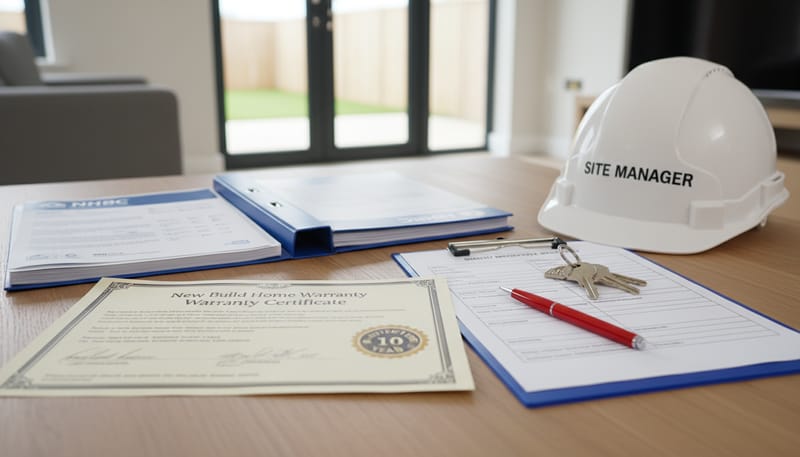
New Build Warranty Costs and What They Cover
By New-Builds Team
When you purchase a new build home in the UK, one of the most valuable protections included in your purchase is a structural warranty that typically lasts for ten years. Unlike buying an older property where you inherit whatever existing issues may be lurking behind the walls, a new build warranty gives you confidence that your home has been inspected during construction and that you have recourse if significant defects emerge. For most buyers, this warranty is provided by the National House Building Council (NHBC) through their Buildmark scheme, which covers approximately 80 percent of all new homes built in the UK. However, several alternative warranty providers also operate in the market, each with their own terms, coverage levels, and claiming processes. Understanding exactly what your warranty covers, what it does not cover, and how to make a claim if needed is essential knowledge for every new build homeowner, yet it is a topic that many buyers spend surprisingly little time researching before or after their purchase.
The cost of your new build warranty is not paid by you directly as a separate line item on your purchase. Instead, it is paid for by the developer as part of the construction process and is included in the price you pay for the home. For NHBC Buildmark, the developer typically pays between £1,500 and £3,500 depending on the property size and value, with larger and more expensive homes attracting higher fees. This cost is effectively built into the purchase price, which means you are indirectly funding it, but you never see it as a separate charge on your completion statement. What matters to you as the buyer is understanding the protection this warranty provides, because it could save you thousands or even tens of thousands of pounds if something goes wrong with your home. In this guide, we will break down every aspect of new build warranty coverage, from the comprehensive protection in the first two years through to the structural cover that extends to year ten, and we will explain what happens if you need to make a claim. We will also look at additional warranty options, how warranties work with shared ownership properties, and the eye-watering costs you could face if you had to pay for major repairs without warranty protection.
How New Build Warranties Are Structured
New build warranties in the UK are structured in distinct phases, each providing different levels of protection. Understanding these phases is crucial because the type of defect covered and who you should contact about problems changes as you move through the warranty period. The most common structure, used by NHBC Buildmark, divides the ten-year warranty into three key periods.
During the first two years, your builder is required to put right any defects that breach the NHBC's technical requirements. This is the broadest period of protection and covers everything from minor snagging issues like cracked plaster and stiff door handles to more serious construction defects such as leaking roofs, faulty plumbing, and inadequate insulation. If your builder fails to address legitimate defects during this period, NHBC can step in through their Resolution Service to mediate between you and the builder, and in extreme cases, they can arrange for the work to be done by another contractor at the builder's expense.
From year three onwards, the responsibility shifts from the builder to NHBC directly. The insurance period covers physical damage to your home caused by defects in specified parts of the structure. This includes the foundations, load-bearing walls, external render and cladding, roof structure and weatherproofing, floor structures, staircases and internal load-bearing walls, retaining walls necessary for structural stability, and underground drainage serving the building. The key distinction is that this period covers structural defects only; cosmetic issues, wear and tear, and problems caused by lack of maintenance are not covered.
What Your Warranty Costs (Paid by the Developer)
Although you do not pay for the warranty directly, understanding the costs involved helps you appreciate the value of the protection you receive. The developer pays NHBC (or the alternative provider) a registration fee for each plot, which covers the cost of inspections during construction and the insurance premium for the ten-year warranty period.
Detailed Coverage: Years 1 and 2
The first two years of your warranty are by far the most comprehensive and the most commonly used period. During this time, your builder has a contractual obligation to fix any defects that do not meet the NHBC Standards that were applicable when your home was registered. These standards are detailed technical requirements covering every aspect of construction, from foundations and drainage to plastering and decorating.
In practice, the types of defects commonly reported during the first two years include shrinkage cracks in plaster and plasterboard joints (which are normal to some extent as a new build dries out), doors and windows that stick or do not seal properly, minor plumbing leaks, condensation issues related to new build moisture, gaps appearing between skirting boards and walls, uneven or cracked floor tiles, drainage problems in gardens, and faults with heating controls or thermostats. More serious defects such as roof leaks, damp penetration through walls, and problems with staircases or balustrades are less common but do occur and are fully covered.
It is important to report defects to your builder as soon as you notice them, and ideally within the first few months of moving in. While you have two full years to report defects under the builder's warranty period, leaving problems unreported can make them harder to resolve later. The builder may argue that the defect was caused by your actions or lack of maintenance rather than being a construction defect. Keeping a detailed record of every defect, including photographs, dates, and copies of all correspondence with the builder, is essential for supporting any claim.
If your builder is unresponsive or refuses to fix legitimate defects during the first two years, you can escalate the matter to NHBC's Resolution Service. This is a free service that investigates disputes between homeowners and builders. An NHBC inspector will visit your home, assess the reported defects against the technical standards, and issue a resolution report. If the defects are found to breach the standards, the builder is required to carry out the repairs. If they still refuse, NHBC can arrange for the work to be done by an alternative contractor and recover the costs from the builder.
Detailed Coverage: Years 3 to 10
From the start of year three, the builder's direct responsibility ends and NHBC's insurance policy takes over. This is where many homeowners are surprised to discover that the coverage is significantly narrower than during the first two years. The insurance period covers physical damage to your home caused by a defect in specified structural elements. The keyword here is structural, as the policy is specifically designed to protect against major construction defaults that affect the integrity or habitability of the building.
The structural elements covered during years 3 to 10 include foundations, load-bearing walls (both internal and external), wet-applied external render and external wall cladding, load-bearing parts of the roof, ceiling and floor structures, chimneys and flues, staircases forming part of the structure, retaining walls necessary for the structural stability of the house, and below-ground drainage installed by the builder. Each claim is subject to a minimum claim value, which for NHBC Buildmark is currently £1,750. This means that if the cost of repairing a structural defect is below this threshold, you will need to pay for it yourself.
What Is NOT Covered by Your Warranty
Understanding what your warranty does not cover is just as important as knowing what it does. Many homeowners have had unpleasant surprises when they discovered that problems they assumed were covered fell outside the warranty terms. The following items are typically excluded from new build warranties across all providers.
Normal shrinkage and settlement is the most common source of confusion. All new build homes experience some degree of drying out during the first one to two years, and this can cause minor cracks in plaster, gaps between skirting boards and walls, and slight movement in joinery. While excessive shrinkage may indicate a defect, normal levels are considered an inherent characteristic of new construction and are not covered. Similarly, condensation caused by lifestyle factors such as drying clothes indoors, insufficient ventilation, or keeping heating too low is not a warranty issue, even though the resulting mould and damp damage can be significant.
Other common exclusions include damage caused by alterations or additions you make to the property, wear and tear on fixtures and fittings, garden landscaping and fencing, driveways and paths (unless they are structurally necessary), communal areas in apartment buildings (which are typically covered by a separate communal warranty), white goods and appliances, and any damage caused by failure to maintain the property. External drainage that was installed by utility companies rather than the builder is also excluded, as are problems with services such as gas, electricity, and water that are the responsibility of the utility provider.
Alternative Warranty Providers
While NHBC Buildmark is the most common warranty scheme, several alternative providers offer comparable protection. If your new build does not come with NHBC cover, it is not necessarily a cause for concern, but you should understand the differences between providers to ensure you have adequate protection. The main alternatives include LABC Warranty (backed by Local Authority Building Control), Premier Guarantee (now part of MD Insurance Services), Checkmate (by Global Home Warranties), and ICW (International Construction Warranties).
Each provider has its own technical standards, inspection regime, and claims process. The fundamental structure is similar across all providers, with a builder's liability period in the first two years and an insurance-backed structural warranty for years 3 to 10. However, there are differences in the minimum claim values, the specific structural elements covered, and the process for escalating disputes. Most mortgage lenders accept warranties from any of the major providers, but some may have preferences or additional requirements. Your conveyancing solicitor should check that the warranty provided with your new build is acceptable to your mortgage lender as part of the purchase process.
The Claims Process: Step by Step
Knowing how to make a warranty claim efficiently can save you significant time, stress, and money. The process differs depending on whether you are in the builder's warranty period (years 1-2) or the insurance period (years 3-10), so we will cover both scenarios.
During years 1 and 2, your first point of contact should always be your builder's customer service or aftercare team. Most major housebuilders have dedicated aftercare departments with online portals where you can log defects, upload photographs, and track the progress of repairs. When reporting a defect, be as specific as possible. Include the exact location of the problem, when you first noticed it, photographs showing the defect clearly, and any measurements that might be relevant (such as the width of a crack or the extent of a damp patch).
If the builder does not respond within a reasonable timeframe (NHBC suggests allowing 56 days for non-emergency repairs), or if you disagree with their assessment that a reported issue is not a defect, you can contact NHBC's Resolution Service. You will need to provide your Buildmark policy number, details of the defects reported, copies of correspondence with the builder, and photographs. NHBC will then arrange for an independent inspector to visit your home and assess the issues.
For claims during years 3 to 10, you contact NHBC directly rather than the builder. You can make a claim online through the NHBC portal or by telephone. NHBC will assess whether the reported problem meets the criteria for a structural defect under the insurance policy. If it does, they will arrange for repairs to be carried out and cover the cost, subject to the minimum claim value of £1,750. If the claim is below this threshold, you will need to fund the repair yourself. Claims during this period typically take longer to resolve than builder's warranty claims because they require a more detailed assessment of whether the defect qualifies as structural damage under the policy terms.
Typical Repair Costs Without Warranty Protection
To truly appreciate the value of your new build warranty, it helps to understand what you would be paying if you had to fund major repairs yourself. Structural defects in homes can be extraordinarily expensive to fix, and without warranty protection, these costs come entirely out of your own pocket. The following examples illustrate the scale of potential costs for common structural problems.
Foundation problems are the most expensive structural defects to repair. If a new build home develops subsidence due to inadequate foundations, the cost of underpinning can range from £15,000 for a small section of a terraced house to well over £50,000 for a large detached property. The disruption involved is significant too, with the work typically taking several months and often requiring the family to move out temporarily. Without warranty protection, the homeowner would bear the full cost, which could potentially exceed the remaining equity in the property.
Roof defects are another area where costs can escalate rapidly. A complete roof replacement on a typical three-bedroom semi-detached house costs between £8,000 and £15,000 for the basic structure, but this can rise to £25,000 to £35,000 when you include scaffolding, replacing battens and felt, new tiles, and reinstating any internal damage caused by water ingress. Even a more localised repair such as replacing a section of defective flashing or relaying ridge tiles can cost £2,000 to £5,000 depending on the extent of the work and the access requirements.
Additional Warranty and Protection Options
Beyond the standard new build warranty, several additional protection options are worth considering. These can fill gaps in your coverage or extend protection beyond the standard ten-year period.
Boiler and heating system warranties are particularly important. While your builder's warranty covers the heating system during years 1 and 2, most boiler manufacturers offer their own separate warranty of between 5 and 12 years. Registering your boiler warranty directly with the manufacturer (which may require an annual service by a Gas Safe registered engineer) can give you coverage well into the period when the standard warranty no longer covers non-structural systems. The cost of an annual boiler service is typically £80 to £120, which is modest compared to the £2,000 to £4,000 cost of replacing a boiler.
Home emergency cover is another option worth considering, particularly once your builder's warranty period ends after year two. Policies typically cover emergency callouts for boiler breakdowns, plumbing emergencies, electrical failures, and locksmith services. Annual premiums range from £50 to £200 depending on the level of cover, and many providers offer unlimited callouts during the policy year. While this is not a warranty replacement, it provides peace of mind for the types of everyday emergencies that fall outside your structural warranty.
For those planning significant home improvements during the warranty period, it is essential to check whether the proposed works could affect your warranty. Major alterations such as loft conversions, extensions, and structural modifications should be discussed with your warranty provider before work begins. Some alterations may void specific elements of your warranty if not carried out to the provider's satisfaction, and in some cases, the warranty provider may need to inspect the work before it is closed up.
Warranty Considerations When Selling Your Home
If you decide to sell your new build home before the ten-year warranty period expires, the remaining warranty transfers automatically to the new owner. This is a significant selling point that can add value to your property, particularly in the early years when substantial coverage remains. Buyers and their solicitors will want to see the warranty documentation as part of the conveyancing process, so keep your Buildmark certificate or equivalent warranty document in a safe place along with your other property paperwork.
The existence of a transferable warranty with several years of remaining cover can justify a higher asking price compared to similar older properties without this protection. For your financial planning, this means your new build home may retain its value better than an older property in the first decade of ownership, providing a more solid foundation for your long-term wealth-building strategy.
The New Homes Ombudsman and Consumer Code
Since 2022, all major housebuilders in England are required to be members of the New Homes Quality Board and adhere to the New Homes Quality Code. This code sets out standards for how developers should treat buyers throughout the purchase process and beyond, and it is backed by the New Homes Ombudsman Service, which provides a free, independent dispute resolution service. If you have exhausted the builder's own complaints process and remain unsatisfied with the outcome, you can escalate your complaint to the Ombudsman, who has the power to order the builder to carry out repairs, pay compensation, or issue a formal apology.
The Ombudsman sits alongside rather than replacing your NHBC or alternative warranty protection. While the warranty covers physical defects in the property itself, the Ombudsman addresses broader issues such as misleading sales practices, poor communication, failures in the aftercare process, and unreasonable delays in completing snagging works. Having both protections available gives new build buyers a comprehensive safety net that is significantly stronger than anything available to buyers of second-hand properties.
It is worth noting that the Ombudsman's powers include ordering financial compensation of up to £25,000, which can make a real difference if you have been significantly inconvenienced by your developer's actions or failures. Common scenarios where the Ombudsman has intervened include developers refusing to fix defects they are clearly responsible for, unreasonable delays in completing repairs, failure to provide accurate information about service charges or management arrangements, and poor handling of complaints by aftercare teams.
Warranty Coverage for Apartments and Communal Areas
If you have purchased a new build apartment, your warranty arrangements are slightly more complex than for a house. Your individual flat will have its own Buildmark or equivalent policy covering the internal structure and any defects specific to your unit. However, the communal areas of the building, including hallways, stairwells, lifts, the roof above the top floor, external walls, and shared drainage systems, are covered by a separate communal warranty that is usually held by the management company or freeholder rather than individual flat owners.
This communal warranty is important because defects in communal areas can affect your home even though they are not within your individual unit. For example, if the building's external cladding develops defects (an issue that has received significant attention following the Grenfell tragedy), the cost of remediation could be enormous. Without communal warranty protection, these costs would be passed on to flat owners through service charge demands, potentially amounting to tens of thousands of pounds per flat. Your solicitor should verify the existence and adequacy of communal warranty cover as part of the conveyancing process when you purchase an apartment.
The communal warranty also covers shared facilities that your service charges help maintain, including communal heating systems, door entry systems, car park barriers, and landscaped communal gardens. If these develop faults due to construction defects within the warranty period, the warranty should cover the repair costs rather than these being charged to residents through increased service charges. However, it is important to understand that the management company, not individual flat owners, is responsible for making communal warranty claims. If you believe there is a communal defect that needs attention, raise it with your management company or residents association and follow up to ensure they are pursuing the claim.
Common Warranty Myths Debunked
Several persistent myths about new build warranties cause confusion and can lead homeowners to either miss out on legitimate claims or waste time pursuing issues that were never covered. The most common myth is that the warranty covers everything for ten years. As we have explained, the comprehensive cover only lasts for the first two years, and from year three onwards, only structural defects are covered. A dripping tap, a broken window handle, or a boiler breakdown in year four is your responsibility, not the warranty provider's.
Another common misconception is that you cannot carry out any home improvements without voiding your warranty. In reality, most routine improvements such as redecorating, replacing flooring, fitting new kitchen units, or adding a garden shed will have no effect on your warranty whatsoever. The risk only arises when you carry out structural work that affects the elements covered by the warranty, such as removing a load-bearing wall, extending the property, or altering the drainage system. Even then, the warranty is not automatically voided; rather, the specific elements you have altered may no longer be covered if you have not followed the warranty provider's guidance.
A third myth is that you must use the builder's own tradespeople for any repairs during the warranty period. While it is generally advisable to give the builder the opportunity to fix defects themselves during years 1 and 2 (both because it is their obligation and because using third-party contractors could complicate any future claim), you are not compelled to do so. If the builder is unresponsive or you have lost confidence in their ability to carry out repairs to an acceptable standard, you can instruct your own contractors. Just be aware that if you do this, you will need to fund the work yourself and then seek reimbursement from the builder or warranty provider, which can be more difficult than having the builder do the work directly.
Maximising Your Warranty Protection
To get the most value from your new build warranty, follow these practical steps from the day you move in. First, commission a professional snagging survey as soon as possible after completion. A qualified snagging inspector will identify defects that you might miss, providing a comprehensive report that forms the basis of your initial claim to the builder. Professional snagging surveys typically cost between £300 and £500 but can identify dozens of defects that the builder is obligated to fix for free.
Second, maintain a home maintenance log from the start. This serves two purposes: it demonstrates that you have been maintaining the property properly (which protects your warranty position), and it helps you identify problems early before they become more serious and potentially more expensive to fix. A simple spreadsheet recording dates of maintenance activities, any issues noticed, and actions taken is sufficient.
Third, do not let defects slide because they seem minor. A small crack that appears harmless today could be an early sign of structural movement that, if caught early, can be monitored and addressed before it becomes a major problem. Report everything to your builder during the first two years, even if you are not sure whether it constitutes a defect. It is better to report something that turns out to be normal than to miss reporting something that worsens over time and becomes harder to claim for later.
Finally, keep copies of all correspondence with your builder and warranty provider. This includes emails, letters, photographs, and records of telephone conversations. If a dispute arises, having a clear paper trail of what was reported, when it was reported, and what response you received can make the difference between a successful claim and a rejected one. Many homeowners find it useful to create a dedicated email folder and physical file for all warranty-related documentation.